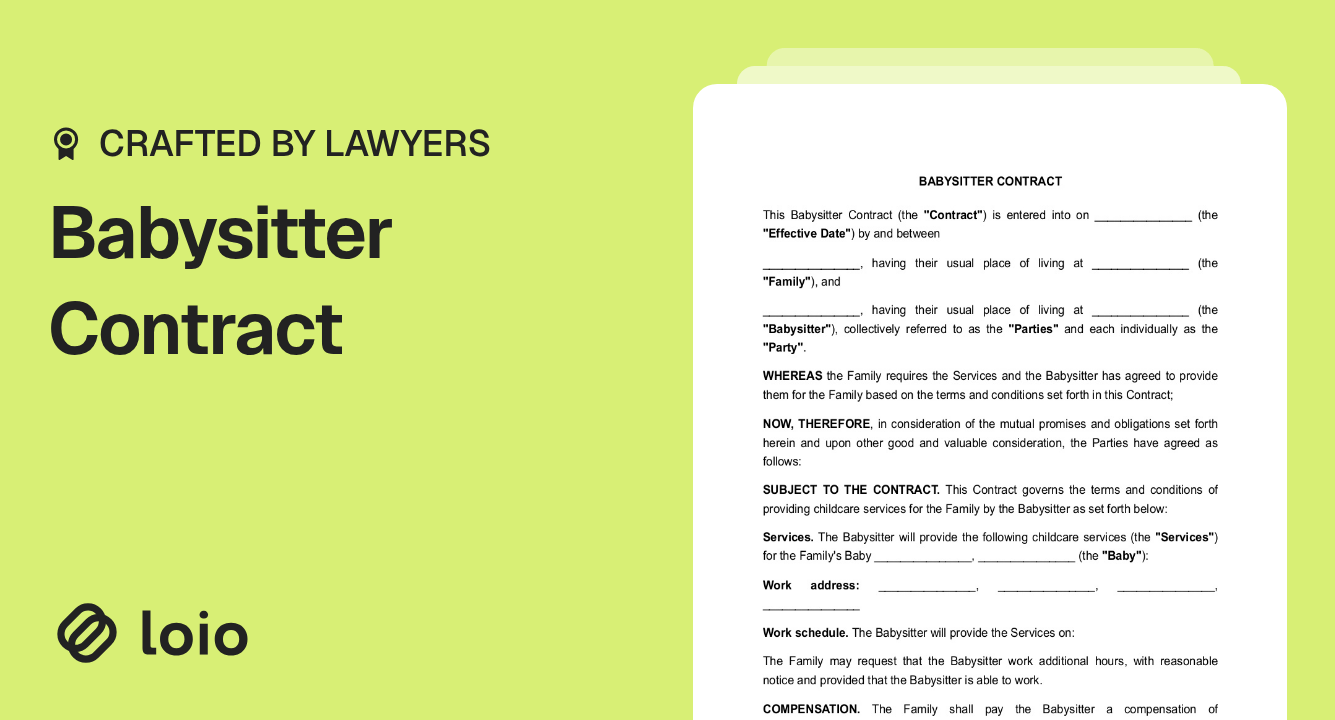
Free template
Free Babysitter Contract Template

What Is a Babysitter Contract?
Copy section linkA babysitter contract is a written employment agreement between a parent or guardian and a babysitter that defines the terms of the child care arrangement. It records what the babysitter is expected to do, the hours of care, the payment rate and schedule, household rules, and procedures to follow while the parent is away.
The agreement should put the child’s safety and well-being first. Parents should provide information about known allergies, medications or health needs, emergency contacts, approved activities, meals, bedtime routines, transportation rules, and any limits on screen time. The babysitter agreement can also address privacy, confidentiality, cancellation or termination, and responsibility for specific expenses.
Using a standardized babysitter contract template helps both sides record the same expectations in writing. However, calling a document a service or independent contractor agreement does not determine the sitter’s legal classification. Under IRS guidance, a babysitter who works in a family’s home and whose duties and manner of work are controlled by the family may be a household employee, even if the work is part-time.
When To Use a Babysitter Contract
Copy section linkHiring a babysitter is a common necessity for most families, whether it's a one-off occasion or a recurring need. In such instances, having a babysitter contract in place acts as a guide to outline responsibilities, set expectations, and prevent potential misunderstandings. Here are a few situations when you would need a baby sitter contract:
Regular babysitting: If you need a babysitter regularly, it's vital to specify days, times, and expectations in a written agreement to ensure both parties are on the same page.
One-off occasions: Even if you're hiring a babysitter just for an evening, a clear contract can lay out what duties the babysitter will perform and what compensation they will receive.
Overnight babysitting: When leaving your child under the babysitter's care overnight, a detailed contract helps outline protocols for the babysitter to follow during nighttime or in case of emergencies.
Babysitting by family: Even when entrusting your child to a relative, it helps to set clear expectations through a babysitter contract. This ensures responsibility is well-defined and maintains the familial relationship by avoiding misunderstandings.
For babysitting exchange: In communities where parents take turns babysitting each others' children, a contract can lay out what each parent is responsible for during their turn.
In essence, any situation that involves hiring or assigning a babysitter calls for a well-drafted babysitter agreement form. This agreement underpins a professional relationship, safeguards the child's welfare, and promotes a harmonious working rapport between the babysitter and the parents.
Parties of the Babysitter Contract
Copy section link- Babysitter — This term refers to an individual, generally a part-time worker, who cares for children when their parents or guardians are unavailable.
- Parent or Guardian — These individuals commission babysitters' services to look after their children. Payment to the babysitter is also their responsibility, as per the agreement stated in the contract.
A babysitter can offer specialized services such as feeding, bathing, playing with children, putting them to sleep, etc., according to the terms specified in the babysitter contract, often documented in a sample babysitting contract.
A parent or guardian must provide essential information such as children's dietary preferences, bedtime routines, emergency contacts, and any special requirements needed to do the babysitting job effectively.
Key Terms
Copy section link- Services: Tasks to be performed by the babysitter.
- Remuneration: The pay or compensation for the babysitter's services.
- Termination clause: Specifies the conditions under which the babysitting form can be discontinued.
- Indemnity clause: Protection for the babysitter against certain events or damages while babysitting.
- Confidentiality: The babysitter's template should clearly emphasize any restrictions on sharing personal or sensitive information about the child or the family.
How To Write a Babysitter Contract
Copy section linkCreating a babysitter contract, like the printable babysitter contract PDF we provide, requires a careful approach. This is because the babysitter is entrusted with a child's safety and welfare. So, how to craft such a document:
Firstly, clearly identify all parties involved — the babysitter and the parents or guardians. Include full names and contact details. Mention the formal agreement to start the babysitting services, stating clearly the beginning and end dates.
When outlining the details of services to be provided by the babysitter in your babysitter contract template, be sure to include the duties, expectations, and any special requests. This should incorporate information on meals, bedtime, and any planned activities. Also, remember to detail vital health information about the child in the contract template.
In your babysitting contract example, clarify how much the babysitter will be paid, how, and when. If there are any conditions for payment for extra hours, specify them in the contract.
Finally, incorporate an acknowledgment of the duties and obligations of the babysitter and parents or guardians in the baby sitting contract.
Crafting such a contract need not be an arduous task — by using a comprehensive, customizable babysitting contract template, you can conveniently lay out commitments and ensure peace of mind for all parties involved. Choose simplicity, clarity, and assurance by today crafting your babysitter contract with our user-friendly template.
Is a babysitter an employee or an independent contractor?
A babysitter who works in the family’s home is often treated as a household employee when the parent controls both what work is performed and how it is performed. The IRS specifically lists babysitters and nannies among household workers. A caregiver who operates an independent business and controls how the services are provided may be treated differently. The wording of the babysitter contract alone does not determine worker status.
Federal wage law also distinguishes a casual babysitter from regular domestic employment. Under 29 C.F.R. § 552.4, casual babysitting is irregular or intermittent work performed by someone whose vocation is not babysitting. Babysitters who do not meet that definition may be covered by the ordinary federal rules applicable to domestic service employees.
Do parents have to report taxes for a casual babysitter?
Possibly. The FLSA exemption for casual babysitting concerns federal minimum-wage and overtime requirements; it does not automatically remove household-employment tax obligations.
For 2026, a household employer generally must withhold and pay Social Security and Medicare taxes after paying $3,000 or more in cash wages to one household employee during the year. FUTA may apply if the employer pays household employees a combined $1,000 or more in cash wages in any calendar quarter of 2025 or 2026. Different rules apply to certain family members and employees under age 18. In particular, wages paid to an employee under 18 generally are not counted for Social Security and Medicare purposes unless household work is that employee’s principal occupation; household work is not considered a student’s principal occupation. State tax requirements may also apply.
Parents should check the current IRS Publication 926, Household Employer’s Tax Guide, and applicable state rules before deciding how babysitting wages should be reported.
Should a babysitter know CPR and first aid?
It is a strong safety precaution. The American Academy of Pediatrics recommends that parents make sure a babysitter has first-aid training and knows CPR. A babysitter agreement form can make CPR or first-aid training an explicit requirement, particularly where the sitter will care for infants, young children, or a child with medical needs.
Parents should also provide emergency phone numbers, the home address, healthcare contact information, and details about allergies or other special needs. The AAP specifically recommends giving the sitter this type of information before care begins.
How old does a babysitter have to be?
Copy section linkThere is no single federal minimum age that applies to all casual babysitting arrangements. The U.S. Department of Labor explains that children under 14 may perform casual babysitting because this type of work is outside the usual federal child-labor restrictions. However, state laws may impose additional requirements.
As a safety recommendation rather than a nationwide legal minimum, the American Academy of Pediatrics advises parents to choose a babysitter who is at least 13 years old and mature enough to respond to common emergencies.
Should screen-time and house rules be included in a babysitter contract?
Yes. The babysitter agreement should state any household rules the parent expects the sitter to follow. These may include permitted screen time, approved websites or apps, bedtime, meals and snacks, visitors, outdoor activities, transportation, homework, discipline, use of household equipment, and areas of the home that are off limits.
Specific instructions are especially useful for recurring babysitting because they give the sitter a consistent routine to follow and reduce misunderstandings about what is permitted during each babysitting period.
Sources
Related Documents
Also Read