Free template
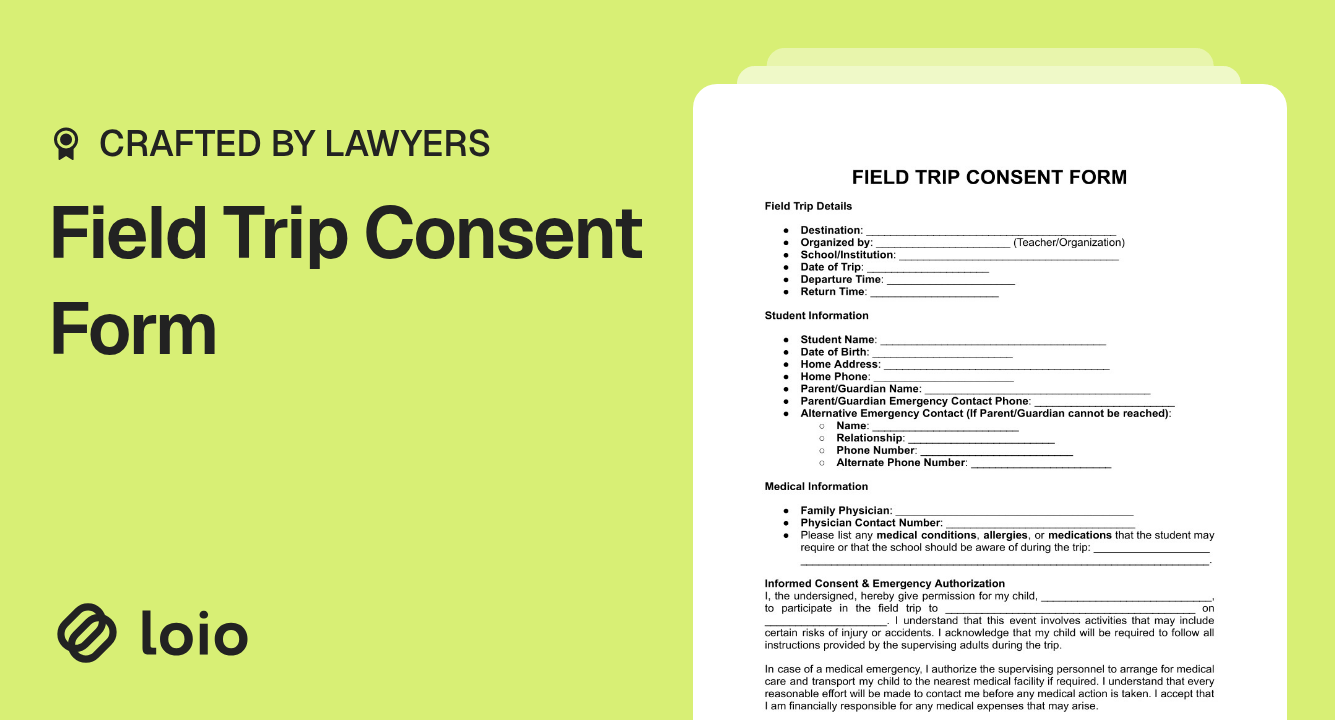
Free Field Trip Consent Form Template
What Is a Field Trip Consent Form?
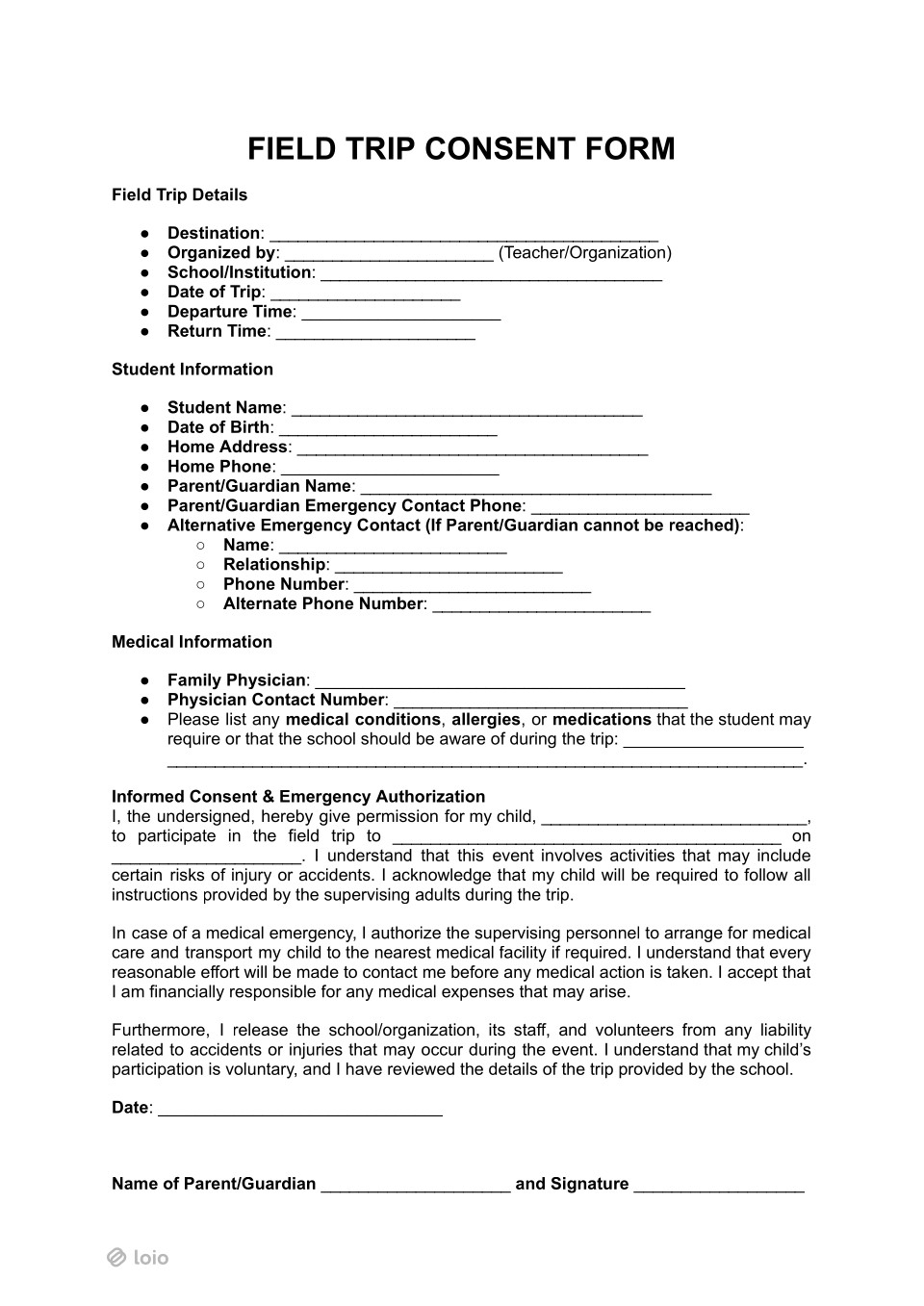
Copy section linkA field trip consent form is a document schools use to get written permission from a parent or legal guardian before a student takes part in an activity outside the classroom. It records the trip details, any risks involved, and the medical and emergency information a school may need if something happens while the student is off-campus.
A field trip permission slip is required for essentially any school-sponsored activity that takes students off school grounds — a museum visit, a nature walk, a sports competition, or a multi-day trip. Schools use this field trip form template to keep the process consistent across classes and grade levels, so every parent is asked for the same information in the same format.
Signing a field trip permission form doesn't just confirm that a parent knows about the trip — it also creates a record that the school informed the parent of the activity's nature and any risks involved, and that the parent authorized their child's participation with that information in hand.
When to Use a Field Trip Consent Form?
Copy section linkUse a field trip consent form when:
A class is taking a single-day trip to a museum, park, farm, or other local destination. A permission slip for field trip activities like this is typically distributed at least a week in advance.
Students are traveling for an academic competition, sports event, or performance.
A trip involves an activity with some physical risk, such as hiking, swimming, or visiting an amusement park.
The school needs updated medical information and emergency contacts before taking students off school grounds.
A multi-day or overnight trip requires more detailed logistics and consent than a routine day trip.
The school wants documented permission to photograph students during the activity for educational or promotional use.
When not to use a field trip consent form
Use a child travel consent form instead if a parent is authorizing a child to travel without them present, such as with a relative or another family, rather than with the school.
Use a medical consent form for a minor instead if your only goal is authorizing medical treatment for a child in a parent's absence, separate from a specific school activity.
Use a photo release form instead if photo consent is the sole purpose and no other trip authorization is needed.
Parties to the Field Trip Consent Form
Copy section linkSchool/teacher: The educational institution or staff member organizing the trip. Responsible for providing accurate trip details and collecting signed consent before the activity.
Parent / legal guardian: The adult with legal authority to consent on the student's behalf. Responsible for reviewing the trip details and providing accurate medical and emergency contact information.
Student: The minor is participating in the trip. In most cases, the student doesn't sign the form, but older students may be asked to acknowledge behavior expectations depending on school policy.
Chaperone (conditional): An adult volunteer or staff member supervising students during the trip. Not typically a signing party to the form, but often referenced in it regarding supervision ratios or responsibilities.
What Are the Key Components of a Field Trip Consent Form?
Copy section linkWhether your school calls it a field trip permission slip template, a permission form for field trip activities, or a field trip parent permission form, the core fields stay the same:
Trip details: The destination, date, and timeframe of the activity, so parents know exactly what they're consenting to.
Activity description: A summary of what students will do during the trip, giving parents a clear picture of the experience.
Risk acknowledgment: A statement disclosing any inherent risks involved in the activity — physical activity, transportation, or the destination itself — so parents can make an informed decision.
Medical information: A space for parents to list allergies, medications, or health conditions the school or chaperones should know about in an emergency.
Emergency contacts: At least one, often two, phone numbers for reaching a parent or another designated adult quickly if needed.
Consent statement: The core authorization language confirming the parent has reviewed the trip details and permits for their child to participate.
Photo release (conditional): A separate consent allowing the school to photograph or record the student during the trip for educational or promotional purposes.
Signature and date: The parent or guardian's signature, which makes the consent official and gives the school a dated record of authorization.
What Are the Key Terms on a Field Trip Consent Form?
Copy section linkInformed consent: Permission given after being provided enough information about an activity's nature and risks to make a genuine, voluntary decision.
Legal guardian: An adult granted legal authority to make decisions for a minor, who may or may not be a biological parent, such as in cases of guardianship or foster care.
In loco parentis: A legal doctrine meaning "in place of a parent," under which a school temporarily takes on certain parental responsibilities for a student's care and safety during school-sponsored activities.
Medical authorization: Permission allowing school staff or chaperones to seek or provide emergency medical care for a student if a parent cannot be reached in time.
Photo release: Consent allowing a school to use a student's photo or video likeness, typically for educational materials, newsletters, or promotional content.
Emergency contact: A person designated to be reached if a parent or guardian is unavailable during a school activity.
How Do You Fill Out a Field Trip Consent Form?
Copy section linkWhether you're filling out one of many permission slips for field trips this school year or a single-parent permission slip for field trip day, follow these steps in order:
- Enter the student's full name, grade, and teacher or class name.
- Enter the trip destination, date, and departure and return times.
- Describe the planned activities students will take part in during the trip.
- Disclose any relevant risks associated with the activity or destination.
- List any medical conditions, allergies, or medications the school should be aware of.
- Enter at least one emergency contact name and phone number, and a second if required.
- Review the consent statement confirming understanding of the trip details and risks.
- Indicate consent for photography or video, if the school requests this separately.
- Sign and date the form. You can sign electronically using eSign or by hand.
- Return the completed form to the school by the requested deadline.
Who Can Authorize a Field Trip Consent Form?
Copy section linkAuthority to sign a permission slip for field trip template belongs to the student's parent or legal guardian — not the teacher or school administrator organizing the trip. Teachers and staff are responsible for collecting and reviewing completed forms, but they cannot grant permission on a parent's behalf.
In some cases, legal guardianship extends beyond a biological parent — a foster parent, grandparent, or other relative with documented legal responsibility for the child may also have this authority. Schools should keep a record of who has legal authority to consent, particularly in situations involving custody arrangements or guardianship changes.
Can only one divorced parent sign a field trip consent form?
Usually, yes, if that parent has legal custody or shared decision-making authority. If custody is contested or one parent has sole legal custody, schools should follow whatever custody documentation is on file. When in doubt, schools can request a copy of the custody order to confirm who has authority to consent.
What happens if a field trip detail changes after the form is signed?
Minor changes, like a slight schedule shift, typically don't require new consent. Significant changes — a different destination, a new activity with added risk, or a change in supervision — should generally prompt the school to notify parents and, in some cases, to collect updated consent.
Do students over 18 still need a consent form signed by a parent?
No. Once a student turns 18, they are legally an adult and can consent for themselves, even if they're still attending high school. Schools should have students sign their own consent forms rather than require a parental signature.
Does an international field trip need additional consent?
Yes, typically. International trips usually require more detailed consent covering passport and visa requirements, travel insurance, emergency procedures abroad, and, in some cases, notarized consent if only one parent is traveling with the student. Schools organizing international trips should build in significant advance notice, given the added logistics.
Is a field trip consent form legally required?
Requirements vary by state and school district, but most schools require a permission slip for a field trip as a matter of policy, even where it's not strictly mandated by state law. Written consent protects both the school and the family by creating a clear record of what was disclosed and authorized.
Can a parent revoke consent after signing?
Yes, generally, as long as it's done before the trip. A parent can withdraw permission by notifying the school in writing, and the student will not be permitted to attend the trip if consent is withdrawn.
What if a parent doesn't return the consent form on time?
Students typically cannot participate in the trip without a signed consent form on file. Schools usually arrange supervised alternative activities for students without returned forms, since a school cannot take a student off campus without documented parental authorization.
Requirements for this document vary by state. Review your state's laws and procedures — or consult a licensed attorney — before using this template to ensure it's valid and enforceable where you live.
Sources
Related Documents
Also Read