Plus template
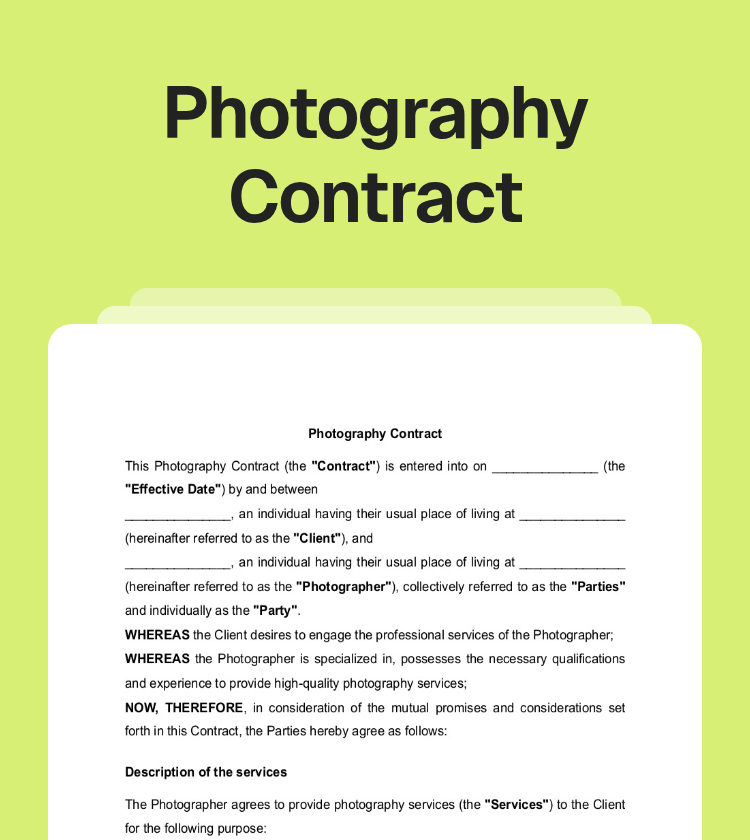
Photography Contract Template

What Is a Photography Contract?
Copy section linkA photography contract is a written agreement between a photographer and a client that sets the terms of a photo shoot before it happens. It covers what services will be delivered, when and where the session will take place, how much it costs, and who owns the resulting images.
A photography contract template provides both parties with a reliable structure to work from, whether the project is a wedding, a portrait session, a commercial shoot, or freelance photo editing work. Basic photography contracts follow the same core structure regardless of the type of shoot, even though the specific terms: hours, deliverables, usage rights, change based on the work involved.
Without a signed contract for photography services, disagreements about payment, rescheduling, or image rights have no clear reference point for resolution. A written agreement gives both the photographer and the client something concrete to point back to if expectations diverge from what was delivered.
When Should I Use a Photography Contract?
Copy section linkUse a photography contract any time you are paid to take photographs, regardless of whether photography is your full-time profession or a side project. Common situations include:
Wedding photography, where deliverables, timelines, and second-shooter arrangements need to be locked in well before the event.
Portrait sessions — family, senior, newborn, or pet photography — where the client expects a defined number of edited images by a set date.
Event photography for birthdays, parties, or corporate events, where hours of coverage and overtime rules matter.
Commercial shoots for products, real estate, or food, where usage rights and licensing terms are often more complex than personal photography.
Freelance photo editing or retouching services, where the deliverable is the edited file rather than the shoot itself.
Content creation for social media or marketing campaigns, where the client may want ongoing or recurring sessions.
Headshots, engagement shoots, or travel photography assignments.
When not to use a photography contract:
Use a photo licensing agreement instead if you are only licensing existing images for use, rather than performing a new photo shoot.
Use a photo release form instead if your only goal is getting a subject's consent to be photographed and have their likeness used, without the broader scope of a service agreement.
Use a videography contract instead if the project is primarily video rather than still photography.
Who Are the Parties to a Photography Contract?
Copy section linkPhotographer (service provider): The individual or business providing the photography services. This party is responsible for delivering the agreed-upon shoot, edits, and final images.
Client: The individual or business hiring the photographer and paying for the services. The client may or may not be the subject of the photos.
Subject/model (conditional): If the person being photographed is not the client, for example, a company hiring a photographer to shoot a model, or a parent hiring a photographer for a child's portrait, the subject's consent may need to be addressed separately through a photo release.
Second photographer or assistant (conditional): Some shoots, especially weddings, involve a second shooter or assistant. The contract should state whether this person is included and who is responsible for their conduct and deliverables.
What Are the Key Components of a Photography Contract?
Copy section link- Photographer and client information: Full legal names, addresses, and contact details for both parties, so there is no ambiguity about who is bound by the agreement.
- Scope of services: A description of the type of shoot, the number of hours covered, and what is included, for example, a single session versus a full day of wedding coverage.
- Date, time, and location: The specific date and time of the shoot and the address where it will take place, including any backup location for weather-dependent outdoor shoots.
- Pricing and payment terms: The total cost, deposit amount, payment schedule, accepted payment methods, and any additional fees, such as travel costs or rush editing.
- Deliverables and turnaround time: The number of final images the client will receive, the format in which they will be delivered, and the expected delivery date.
- Editing details: What level of editing is included: basic color correction, full retouching, or specific style edits, and whether additional rounds of revisions cost extra.
- Cancellation and rescheduling policy: What happens if either party needs to cancel or reschedule, whether the deposit is refundable, and any fees that apply to last-minute changes.
- Copyright and image usage rights: A statement of who owns the copyright to the images and what rights, if any, are being licensed to the client. This is one of the most disputed areas of photography contracts and should be unambiguous.
- Model release/consent (conditional): If the photographer wants to use images from the shoot in a portfolio, on social media, or in marketing materials, this clause secures the client's or subject's permission to do so.
- Liability and force majeure: Language limiting the photographer's liability for circumstances beyond their control, such as equipment failure or extreme weather, and outlining what happens if the photographer cannot perform due to an emergency.
- Governing law: The state whose law applies if a dispute arises over the contract.
- Signature block: Signature lines for both the photographer and the client, with printed names and dates.
What Are the Key Clauses in a Photography Contract?
Copy section linkA Photography Contract should explain what the photographer will deliver, how the client will pay, who will own the photographs, and what happens if the session is changed or cannot proceed. The clauses below follow the order used in this template.
Editing and Delivery Clause
What it does: This clause states how many edited photographs the photographer will provide, how the client selects images for editing, what standard editing includes, and when and where the finished photographs will be available.
Sample language:
The Photographer will provide [number] edited and retouched photographs from the Photography Session. The Client may select [number] photographs for editing and retouching. Editing may include color correction, exposure adjustment, minor blemish removal, and overall enhancement. The photographs will be available through [delivery method] within [delivery period] after the Photography Session and may be reviewed, downloaded, and shared through [platform]. The Photographer may decline requests involving unrealistic alterations, misrepresentation, copyright violations, defamation, or harmful edits.
When to include or customize: Keep this clause in most photography contracts. Complete the number of photographs, selection process, delivery period, and delivery platform before signing.
Equipment Clause
What it does: This clause makes the photographer responsible for providing and operating the necessary equipment. It also makes the client responsible for damage, loss, theft, or misuse caused by the client or someone associated with the client.
The clause also addresses optional makeup, hairstyling, or grooming services arranged by the client.
Sample language:
The Photographer shall provide and operate the necessary photography equipment for the Photography Session. If the Equipment is damaged, lost, stolen, or misused because of the Client or a person associated with the Client, the Client shall compensate the Photographer for its repair, replacement, or restoration.
The Client may engage a makeup artist, hair stylist, or grooming specialist of their choice. The Client shall arrange these services before the Photography Session and cover the related expenses, which are not included in the payments under this Contract.
When to include or customize: Keep this clause when the photographer brings professional equipment to the session. The styling language may be removed when makeup, hair, or grooming arrangements are irrelevant to the project.
Payment Conditions Clause
What it does: This clause establishes the fixed photography fee, payment deadline and method, and hourly rate for services performed beyond the scheduled session. Our default template offers the following terms: cash-only, prepaid-in-full. These can be changed to suit your situation.
Sample language:
The Client shall pay the Photographer a fixed fee of [amount]. The payment shall be made in full before the commencement of the Services. Overtime services shall be paid at a rate of [amount] per hour. The Client shall pay the Photographer in cash.
When to include or customize: Keep this clause whenever the photographer is paid for the services. Replace “cash” if the parties agree to use a different payment method.
Copyright and Usage Clause
What it does: Under this template, the clause provides that the client will hold the copyright to all photographs taken during the session. It also requires the photographer to sign documents confirming the client’s exclusive ownership when requested.
Sample language:
The Client shall retain the copyright to all photographs taken during the Photography Session. Upon the Client’s request, the Photographer will execute all documents necessary to confirm the Client’s exclusive ownership of the photographs.
When to include or customize: Copyright terms should always be addressed. The parties should revise this clause when the photographer will retain ownership and grant the client only specified usage rights.
Model Release Clause
What it does: This clause gives the photographer permission to use the photographs for a purpose specified by the parties without paying additional compensation to the client.
Sample language:
The Client grants the Photographer the irrevocable right to use the photographs for [purpose] without compensation to the Client.
When to include or customize: Complete this clause when the photographer may use the photographs in a portfolio, website, social media account, advertisement, or other publication. Remove it when the photographs must remain private.
State publicity and privacy laws vary, so the consent language may need to be adjusted depending on where the parties or use of the photographs are located. For example, California regulates certain commercial uses of a person’s photograph or likeness without prior consent, while New York requires written consent for use in advertising or trade, including parental or guardian consent for minors.
The clause covers permission granted by the Client. Separate consent may be needed from other identifiable people appearing in the photographs.
Cancellation and Rescheduling Clause
What it does: This clause establishes notice periods for rescheduling or cancellation, explains what happens when either party cancels, and allocates location-related costs caused by the change.
Sample language:
The Client may request rescheduling no later than [number] days before the scheduled time, subject to the Photographer’s availability. The Client may cancel the Photography Session by providing at least [number] days’ prior notice. If adequate notice is not provided, the Client shall pay a cancellation fee of [amount].
If the Photographer cancels the Photography Session, the Photographer shall notify the Client at least [number] days in advance and reschedule the session for a mutually agreed time. The Party responsible for the cancellation or rescheduling shall reimburse the other Party for related location costs and fees already incurred.
When to include or customize: Keep this clause for sessions scheduled for a particular date and time. Complete all notice periods and the cancellation amount before signing.
Limitation of Liability Clause
What it does: This clause mainly addresses indemnification and responsibility for damage. It makes the photographer responsible for certain claims resulting from gross negligence or willful misconduct and makes the client responsible for damage caused by the client or associated persons.
Sample language:
The Photographer shall indemnify and hold harmless the Client from claims, damages, losses, liabilities, costs, and reasonable attorneys’ fees arising from the Photographer’s performance under this Contract, but only in cases of gross negligence or willful misconduct by the Photographer.
The Client shall be liable for damage to the Photographer or the location caused by the negligence or willful misconduct of the Client or persons associated with the Client. Damages shall be limited to actual and proven damages incurred by the Photographer.
When to include or customize: Keep this clause when the session involves professional equipment, rented premises, guests, employees, or other people connected with the client.
Force Majeure Clause
What it does: This clause excuses a party from liability for delay or failure to perform caused by circumstances beyond that party’s reasonable control. It also requires notice, mitigation, and an effort to resume performance.
Sample language:
Neither Party shall be liable for failure or delay in performing its obligations if caused by force majeure events, including acts of God, war, terrorism, strikes, lockouts, labor disputes, pandemics, epidemics, governmental regulations, or similar circumstances beyond the affected Party’s reasonable control.
The affected Party shall promptly notify the other Party in writing, provide reasonable proof of the cause, take reasonable steps to mitigate its effects, and resume performance as soon as possible. If the circumstances continue for more than [number] days, either Party may terminate this Contract by written notice, and neither Party shall be liable for damages arising from the termination.
When to include or customize: Keep this clause for outdoor sessions, events, destination photography, or other projects that may be affected by weather, travel restrictions, emergencies, or venue closures.
What Are the Key Terms in a Photography Contract?
Copy section linkWork for hire: A legal arrangement in which the person or company paying for a creative work is treated as the copyright owner, rather than the person who created it. Most photography is not automatically work for hire unless the contract specifically says so.
Copyright: The legal right to control how a creative work, including a photograph, is copied, distributed, displayed, or used. Under U.S. law, copyright in a photograph belongs to the photographer the moment the image is created, unless the contract transfers it.
License: Permission to use a copyrighted image for specific purposes, without transferring ownership of the copyright itself. Most photography contracts grant the client a license rather than full ownership.
Assignment (of copyright): The transfer of copyright ownership from the photographer to another party. Unlike a license, an assignment gives the recipient full control over the image, including the right to license it to others.
Deposit: An upfront payment, often non-refundable, that secures the photographer's availability for the agreed date and is applied toward the total cost of the shoot.
Kill fee: A fee paid to the photographer if the client cancels the shoot after work has already begun or the date has been reserved, compensating the photographer for lost availability.
Exclusivity clause: A provision preventing the client from hiring another photographer for the same event or project, or preventing the photographer from working with a competing client during a specified period.
Model release: A signed consent form from a photo subject allowing the photographer (or client) to use their image for specific purposes, such as marketing or portfolio display.
How to Fill Out a Photography Contract Template?
Copy section link- Enter the photographer's full name, business name (if applicable), and contact information.
- Enter the client's full name and contact information.
- Describe the photography services being provided, including the type of shoot and number of hours covered.
- Enter the date, start time, and location of the shoot, including a backup location if applicable.
- State the total price, deposit amount, payment due dates, and accepted payment methods.
- List any additional fees that may apply, such as travel costs, overtime, or rush editing.
- Specify the number of final images the client will receive and the expected delivery date.
- Describe the editing services included and the process for requesting additional edits.
- Add the cancellation and rescheduling policy, including whether the deposit is refundable.
- State who owns the copyright to the images and what usage rights, if any, are being granted to the client.
- Add a model release clause if the photographer wants permission to use the images for portfolio or marketing purposes.
- Include a liability and force majeure clause covering circumstances beyond the photographer's control.
- Enter the state whose law will govern the contract.
- Sign the contract by hand or with eSign, and date it — both the photographer and the client should sign.
This template is intended for general use across all 50 U.S. states+DC. Local procedures — such as notarization, witnessing, or filing requirements — may still apply, so check your state's specific rules before signing.
Sources
Related documents
Also read