Free template
Free Photo Release Form Template

What Is a Photo Release Form?
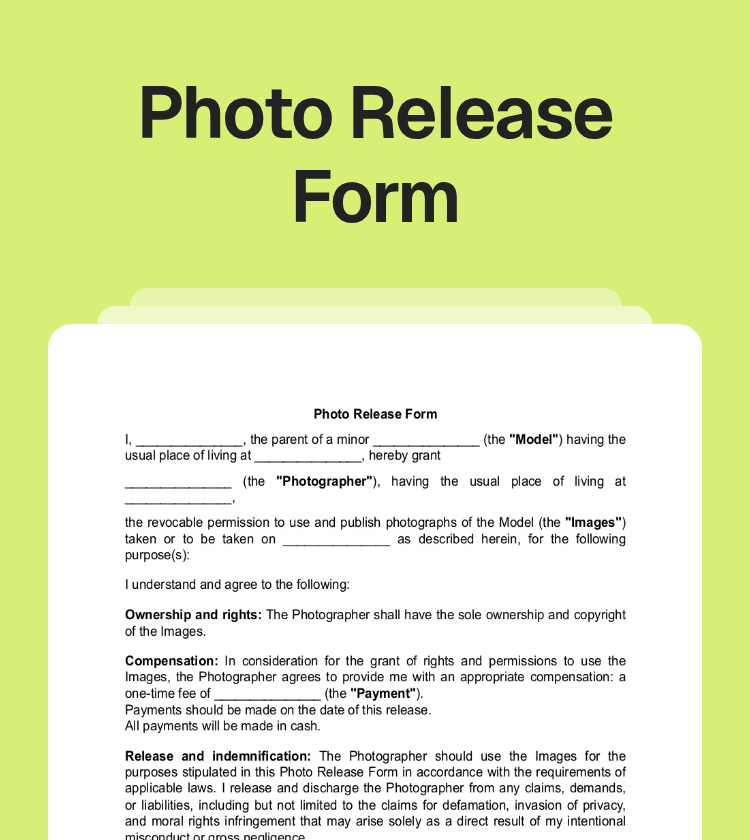
Copy section linkA photo release form is a legal document that gives permission to use a person’s image in photographs, videos, websites, social media posts, advertisements, publications, and other types of media. By signing the form, the person shown in the image agrees to its use under the terms stated in the document.
Photographers, businesses, schools, nonprofits, media companies, event organizers, and content creators often use photo release forms. The agreement can explain who may use the image, where it may appear, whether the use is commercial or editorial, and whether the person photographed will receive payment.
A photo release form does not usually transfer copyright ownership. The photographer generally keeps the copyright, while the release grants permission to use the person’s likeness. To transfer ownership of the image itself, the parties may need a separate copyright assignment or license agreement.
A photo release form is mainly about permission to use a person’s likeness. A copyright agreement is about the ownership or licensing of the photo as a creative work.
When to Use a Photo Release Form
Copy section linkA photo release form may be needed in situations such as:
A business wants to use a person’s image in advertising or promotional materials;
A photographer plans to publish client photos in a portfolio, website, or social media account;
A school, camp, or nonprofit wants to use photos of participants in newsletters or online posts;
A brand uses a customer, employee, or influencer photo in a campaign;
A company photographs employees for a website, brochure, ID badge, or internal directory;
An event organizer wants permission to use attendee photos after an event;
A journalist, publisher, or media company wants written consent for certain image uses;
A project involves minors, and a parent or legal guardian must give permission.
When not to use a photo release form:
If you need to transfer ownership of a photo, use a copyright assignment or image license instead;
If you need to protect confidential project details, use a non-disclosure agreement;
If the document is about accident risks or activity participation, use a release of liability form;
If the photo is taken in a public place for news reporting or editorial use, a release may not always be required, but privacy and publicity rights may still matter;
If the image includes trademarks, private property, artwork, or confidential information, additional permissions may be needed.
Parties of the Photo Release Form
Copy section linkReleasor: The person whose image, likeness, or appearance appears in the photo and who gives permission for its use.
Releasee: The person, photographer, business, publisher, organization, or agency that receives permission to use the photo.
Photographer: The person who takes the photo and may own the copyright unless the rights are assigned or the photo is created as work made for hire.
Parent or legal guardian: The adult who signs on behalf of a minor.
Authorized representative: A company officer, manager, agent, or other person who signs for a business or organization.
What to Include to the Photo Release Form
Copy section linkDocument title and date: Identifies the agreement as a photo release and shows when consent is given.
Release information: Lists the full legal name and contact details of the person whose image may be used.
Releasee information: Identifies the person or organization receiving permission to use the photo.
Description of the photo or project: Explains which images, event, session, campaign, or production the release covers.
Scope of permitted use: States where and how the photo may be used, such as websites, ads, social media, print materials, or publications.
Commercial or editorial purpose: Clarifies whether the photo may be used for advertising, promotion, journalism, education, internal use, or another purpose.
Copyright and ownership terms: Explain whether the photographer keeps copyright or whether any rights are transferred separately.
Compensation clause: States whether the releasor will receive payment, credit, free copies, or no compensation.
Editing and modification permission: Allows or limits cropping, retouching, color correction, design edits, or other changes to the photo.
Duration of consent: Explains whether the release lasts permanently, for a fixed period, or until revoked under the agreement.
Revocation terms: State whether consent can be withdrawn and how revocation must be made.
Minor consent clause: Requires a parent or legal guardian's signature if the person in the photo is under 18.
Confidentiality clause: Protects sensitive information when the photo project involves private events, unreleased products, client work, or internal materials.
Release of claims: States that the releasor gives up certain claims related to the approved use of the photo.
Key Terms of the Photo Release Form Template
Copy section linkLikeness: A person’s recognizable image, appearance, face, body, voice, or other identifying feature.
Copyright: The legal protection for creative works, including many photographs.
Right of publicity: A person’s right to control commercial use of their name, image, likeness, or identity.
Editorial use: Use connected to news, commentary, education, or public-interest publishing rather than direct advertising.
Commercial use: Use that promotes a product, service, brand, company, or campaign.
Revocation: The act of withdrawing consent, if the agreement allows it.
How to Fill Out a Photo Release Form
Copy section linkEnter the effective date and party information. Add the date the release begins, along with the full legal names and contact details of the releasor and releasee.
Describe the photo or project. Identify the photo session, event, campaign, production, or specific images covered by the release.
Define the permitted uses. Explain whether the image may appear on websites, social media, advertisements, brochures, press materials, portfolios, publications, or other channels, and state whether the use is commercial or editorial.
Add copyright and editing terms. Clarify who owns the copyright and whether the image may be cropped, retouched, edited, combined with other materials, or used in design layouts.
State the compensation and duration. Specify whether the releasor will receive payment, credit, copies, or no compensation, and explain how long the permission will remain valid.
Include revocation, minor consent, and optional clauses. Explain whether permission may be withdrawn, add a parent or guardian’s consent for a minor, and include confidentiality or governing law terms if needed.
Review, sign, and keep copies. Check all details before the parties sign and date the form, complete the notary section if required or preferred, and provide each party with a signed copy.
State Law
Copy section linkState law typically adheres to federal law in relation to photo releases.
People have a reasonable expectation of and a right to their privacy. Therefore, any images of a subject, whether they are an adult or a minor cannot be used without their permission.
The exception to this with limitations is that, if the photograph is taken in a public place or space such as a beach or dog-walking park then the photos can be used without a release form. In most states, the law still stands that if the photo is defamatory then permission has to be sought from the subject of the photo.
Sources
Related documents
Also read