Handyman Contract Template

4.8 (90 reviews)
All states | 16 types
Updated May 2, 2024
~ 7 pages
PDF
4.3K downloads
A Handyman Service Contract is a legal document between a handyman and a client defining tasks, fees, and completion timelines. It is used to ensure clarity, protect both parties, and establish quality expectations.
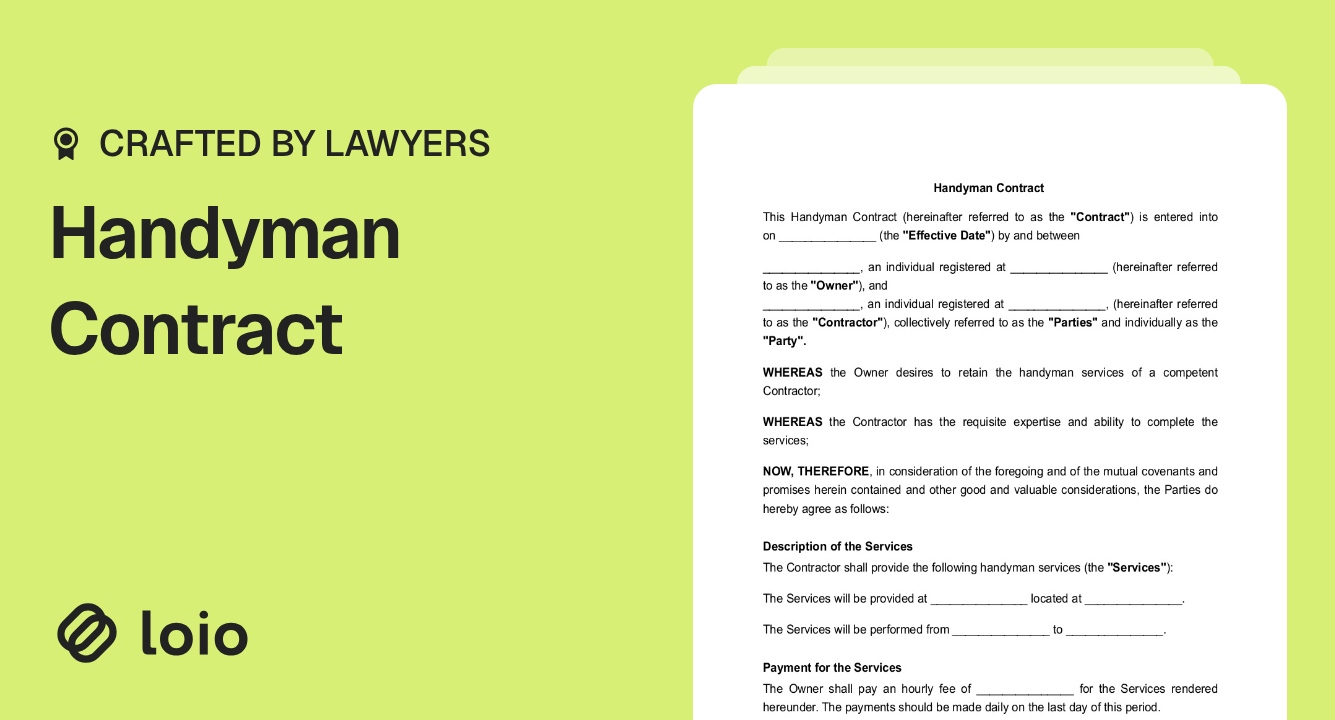
Handyman Contract 

This Handyman Contract (hereinafter referred to as the "Contract") is entered into on   (the "Effective Date") by and between

 , an individual registered at   (hereinafter referred to as the "Owner"), and

 , an individual registered at  , (hereinafter referred to as the "Contractor"), collectively referred to as the "Parties" and individually as the "Party". 

WHEREAS the Owner desires to retain the handyman services of a competent Contractor;

WHEREAS the Contractor has the requisite expertise and ability to complete the services;

NOW, THEREFORE, in consideration of the foregoing and of the mutual covenants and promises herein contained and other good and valuable considerations, the Parties do hereby agree as follows:

Description of the Services 

The Contractor shall provide the following handyman services (the "Services"):

The Services will be provided at   located at  .

The Services will be performed from   to  .

Payment for the Services 

The Owner shall pay an hourly fee of   for the Services rendered hereunder. The payments should be made daily on the last day of this period

The Contractor will submit an invoice daily.

The Contractor will submit a report on working hours spent within a specific time frame. The report shall be delivered to the Owner's email address, which is specified in the Contract.

The Owner shall pay the Contractor by wire transfer. The payment should be made by wire transfer to the Contractor's bank account indicated in this Contract.

The Parties shall sign the certificate of acceptance to confirm the completion of the Services. The certificate of acceptance should be signed weekly.

Retainer

The Owner shall pay a retainer of   to the Contractor as a deposit on future Services (the "Retainer"). The Retainer is refundable.

The refundable Retainer should be returned to the Owner within   days after the termination of this Contract.

Services quality guarantees

The Contractor guarantees the quality of all Services provided under the Contract. The Owner shall accept the Services. If the Owner is not satisfied with the results of the Services, they should make a written claim within   days after completion of the Services. The Contractor should make the necessary corrections free of charge within a reasonable period. All claims made after this period are considered out-of-scope Service requests and should be agreed upon and paid extra according to the Contract. If the Contractor fails to make the required corrections within the granted reasonable period, the Owner has the right either to accept the Services as nonconforming, in which case the fees shall be reduced equitably, or to terminate this Contract unilaterally.

Term and termination 

This Contract shall remain in full force and effect until   (the "End Date")

Either Party has the right to terminate this Contract unilaterally, with or without cause, within   days by providing written notice to the other Party. 

If the Owner terminates the Contract, they shall be obliged to pay the Contractor all non-disputed amounts for the part of the Services rendered as of the termination date on a pro-rata basis. 

Materials and suppliers

The Owner shall provide the Contractor with all equipment, tools, and materials necessary to perform the Services. Upon the termination of this Contract, the Contractor should return all property, including but not limited to cleaning supplies, equipment, uniforms, and any other items provided by the Owner.

In case of failure, the Owner has the right to delay final payments, deduct the costs of non-returned property from the last payment, and/or demand compensation for the losses.

Relationship of the Parties

The Parties to this Contract are independent contractors. Nothing in this Contract, during its performance, shall be interpreted to create an employment, agency, joint venture, or partnership relationship between the Owner and the Contractor.

Compliance with applicable regulations

The Contractor shall obtain all permits, licenses, and inspections necessary for the proper execution and completion of the Services.

The Contractor shall comply with and give notices required by all laws, ordinances, rules, regulations, and orders of public authorities applicable to the performance of Services.

The Contractor shall provide the required Services personally and shall not assign or subcontract the carrying out of the Services without the Owner's prior written approval.

Insurance

The Contractor shall maintain the insurance in full force and effect to protect the Parties from claims set forth below that may result from the Contractor's activities under the Contract and for which the Contractor may be legally liable, namely, claims involving contractual liability insurance applicable to the Contractor's obligations under the Contract.

Injuries (obligation of insurance coverage)

The Contractor shall maintain in full force and effect the insurance to protect the Parties from:

  • Claims under employees' compensation, disability benefits, damages resulting from bodily injury, occupational sickness or disease, or the death of the Contractor's employees;

  • Claims for bodily injury or property damage arising during the rendered Services.

Indemnification

Each Party agrees to indemnify and hold harmless the other Party, their employees, and representatives against any damage, liability, loss, legal fees, and costs incurred that may relate to this Contract. This clause shall not be interpreted to provide indemnification for any Party if a competent court of law, rendering a final judgment, finds that the bad faith, gross negligence, or willful misconduct of the Party caused the damage, liability, or loss.

Force majeure

"Force majeure" means an earthquake, flood, storm, other acts of God, war, emergency, accident, industrial strike, acts of Government, or other impediment that the affected Party proves was beyond the Party's control and that it could not reasonably be expected to have taken into account at the time of the conclusion of this Contract or to have avoided or overcome it or its consequences.

The Party affected by force majeure shall not be deemed to be in breach of this Contract or otherwise be liable to the other because of any delay in performance, or non-performance, of any of the obligations under this Contract if the delay or non-performance is caused by events of force majeure of which one Party has notified the other Party. The time for the performance of that obligation shall be extended accordingly. In the case of force majeure, the affected Party shall immediately notify the other Party about the nature and extent of the circumstances and their effect on the Party's ability to perform.

If the force majeure circumstances last more than   days, either Party may terminate this Contract by giving written notice to the other Party. In this case, neither Party shall be liable to the other Party for any damages arising from the termination of this Contract.

Confidentiality

The Contractor shall not disclose, use, or disseminate any confidential information received from the Owner to any person, corporation, association, or other entity for any purpose not expressly permitted or required under this Contract and without obtaining the Owner's prior written consent on a case-by-case basis.

"Confidential information" is any information that is disclosed by the Owner to the Contractor in connection with the Contract which is conveyed in written, graphic, machine-readable, or other tangible form and marked "confidential," "proprietary," or in some other way to indicate its confidential nature. Without limitation, this confidential information shall include information related to the financial obligations of the Parties, design solutions, and the Owner's property (keys, codes, access, etc).

This confidentiality clause shall remain in effect after the termination of this Contract.

Governing law and dispute resolution

This Contract will be governed by and construed under the laws of the State of  , except for its conflict of laws principles.

The Parties agree on the exclusive jurisdiction of the court located in the State of  .

Miscellaneous

Severability. If and to the extent that any provision of this Contract is held illegal, invalid, or unenforceable in whole or in part under applicable law, such provision or that portion thereof shall be ineffective as to the jurisdiction in which it is illegal, invalid, or unenforceable to the extent of its illegality, invalidity, or unenforceability. The illegality, invalidity, or unenforceability of such a provision in that jurisdiction shall not affect the legality, validity, or enforceability of this Contract in any other jurisdiction.

Entire agreement. This Contract is the complete agreement between the Parties with respect to the subject matter hereof, superseding any prior agreements and communications, both written and oral, regarding such subject matter.

Amendments. This Contract may only be modified, or any rights under it waived, by a written document executed by both Parties.

Binding effect. This Contract shall be binding for the Parties and their respective permitted successors and assigns.

IN WITNESS WHEREOF, the Parties have signed this Contract as of the Effective Date.

Details and signatures of the Parties

The Owner

Full name:  

Address:  

Signature: ____________

Email:  

Phone number:  

Banking details:  


The Contractor

Full name:  

Address:  

Signature: ____________

Email:  

Phone number:  

Banking details:  

Written by Megan Thompson - Reviewed by Jonathan McGill

Template Description

Copy section link
Paper titled "Handyman Contract", handymen, tools

A handyman contract sample helps outline the terms of the working agreement in writing. This protects both the handyman and their client by setting clear expectations upfront. When creating your handyman contract template, start with the basics.

Using a simple handyman contract helps ensure professional, high-quality service. It gives clients confidence. With a handyman contract, clear communication, and well-set expectations, you’ll build excellent working relationships and a loyal customer base.

What Is a Handyman Contract?

Copy section link

A handyman contract is an agreement between a client and handyman outlining the work a handyperson will do, how much they’ll get paid, and other essential details.

A good handyman contract agreement should specify:

  • The parties involved (the client and the handyperson);

  • The start and end dates;

  • What tasks the handyman will perform (install new cabinets, paint the living room, etc.);

  • Any materials or equipment the client will provide;

  • The total cost for labor and an estimate of materials;

  • A payment schedule (e.g., 50% upfront, 50% upon completion).

Using a free printable handyman contract is in both parties' best interests. For clients, it ensures the work they want gets done at the agreed-upon price. For the handyman, it guarantees they’ll be paid fairly for their services. With a solid contract, clients can sit back and let the handyperson do their thing.

Parties of the Handyman Contract

  • The homeowner agrees to hire the services of a handyman for specific repair and maintenance in the handyman contract. The homeowner will provide the handyman access to the property and compensate them for their work. The homeowner should also allow the handyman to bring all the materials needed.

  • The handyman maintenance contract defines the handyman as the service provider. Using proper tools and materials, the handyman should complete the job as specified in the handyman contract.
    The handyman must agree to perform all tasks using the correct tools and materials. The handyman will be expected to follow all building codes and standards. The handyman will keep their worksite tidy and  remove all debris once the job has been completed successfully.

Key Terms

  • Compensation: The homeowner pays the handyman for services rendered.

  • Scope of work: The specific tasks the handyman will perform.

  • Materials: Any supplies needed.

  • Start and end dates: The timeframe for the work.

  • Insurance: The handyman's liability insurance coverage.

What Does a Handyman Do?

Copy section link

A handyman needs to be a master of all trades. It is essential to have a handyman contract in place before work commences. A handyman contract template will make taking on new jobs much easier. The handyman service agreement will set out the duties, typically including:

  1. Basic plumbing.

  2. Minor electrical work.

  3. Painting interior or exterior surfaces of a house.

  4. Basic carpentry.

  5. Appliance repair and maintenance.

  6. Yard and lawn maintenance.

  7. General cleaning.

To handle such a variety of jobs, handymen need to be resourceful, adaptable and have a working knowledge of multiple trades. A handyman contract will not only protect the handyman but also the work they are doing.

Why Is a Handyman Contract Important?

Copy section link

As a handyperson, having a solid contract for each job is essential to protect both parties to the agreement. Here are some reasons a handyman contract should be used:

  • It outlines the scope of work in detail so there are no surprises or confusion.

  • It serves as legal protection should any disputes arise.

  • The payment for any work will be legally protected.

  • It establishes a professional relationship built on trust and accountability.

A handyman contract template ensures legal protection for both the handyman and the client.

How Are Handyman Contracts Structured?

Copy section link
  1. Handyman & Client Contact Information
    The handyman contract will contain detailed contact information for all parties.

  2. Scope of the Project
    The handyman contract template should clearly outline the tasks the handyperson will perform. Be as detailed as possible in listing services like painting, carpentry, plumbing repairs, yard work, etc.

  3. Start and End Dates of Employment
    Establish target start and end dates for the overall project, as well as any milestones in the handyman service agreement.

  4. Payment and Schedules
    A handyman contract template will specify the timelines for payment. How the payment will be made should be specified in the handyman contract.

  5. Liability & Insurance
    A liability waiver releases responsibility for any injuries on the job. Require proof of the handyman’s insurance in case of property damage or other issues.

  6. Signatures & Acceptance

    The handyman contract template will include a section where all parties will sign the agreement. By using this structure to draft a handyman contract, all parties know what is expected from them. The contract can also be reviewed by a lawyer to ensure compliance.

How To Create a Handyman Contract

Copy section link

A free handyman contract can be created by the parties to avoid any complications. Here are some tips that should be incorporated into the handyman contract template:

Coordinate With the Counterpart

Go over the project scope, timeline, payment schedule, and any other concerns.

Negotiate Essential Terms of the Contract

The handyman contract agreement should stipulate all payment schedules and times. Also, mention all the completion times and dates for any work the handyman will complete.

State Clearly the Division of Finances

The handyman contract should stipulate whether the handyperson will be entitled to travel time fees and who will be responsible for purchasing all the materials needed. Payment methods, warranties, and guarantees should also be included. Make specific mention of each disbursement that has occurred.

Handyman Agreement vs. Service Agreement

Copy section link

A handyman service agreement will provide terms and conditions on the general tasks or jobs that a handyman can deliver. This may include general maintenance or general repair work and can include tasks that may be supplemental to the main job. A service agreement will specify a certain job or task and be limited to that job only setting out the specifics of only one type of job.

For one-off jobs it will be better suited to use a handyman contract template as the contract will come to an end once the job has been completed. For larger jobs that may require an ongoing relationship a service agreement will be better suited. The service agreement will provide more detail on the work, including:

  • Scope of work: Exactly what will be done, step-by-step;

  • Timeline: Deadlines and milestones for the work;

  • Payment terms: How much will be paid and when. For big jobs, a deposit may be payable upfront, then the balance upon completion;

  • Warranties: Guarantees on labor and materials in case anything needs fixing;

  • Liability: Who is responsible for any damages or injuries? The handyman should have proper insurance.

Using a detailed service agreement helps ensure all parties are on the same page. A service agreement is well worth the investment for any major home project.

What Is a Handyman Contract Used for?

Copy section link

A handyman contract agreement establishes the agreement between the homeowner and the handyman. A handyman contract template defines what is expected from each party.

Common Use Cases

A handyman contract agreement is typically used for small home repair or maintenance jobs. Some common examples include:

  • Minor plumbing repairs;

  • Basic electrical work;

  • Painting interior rooms or exterior trim;

  • Yardwork and landscaping;

  • Weatherizing homes by caulking windows or adding insulation.

Insight

A handyperson can also be responsible for certain bigger repair and maintenance tasks, like

  • Installing new flooring;

  • Remove old wiring, install new wiring and outlets, and connect them to the electrical panel;

  • Constructing a new deck or repairing an existing one.

When Not To Use a Handyman Contract

For larger remodeling projects or anything structural, hiring a licensed and insured contractor is best. A handyman contract is not suitable for:

  • Adding or removing walls;

  • Rewiring an entire house;

  • Installing a new roof;

  • Building an extension;

  • Pouring concrete like a new driveway or foundation.

While handypersons can be an excellent resource for minor fixes around the house, their work is not regulated or insured like a professional contractor’s. For major work, it’s safer and often required by law to use a licensed tradesperson. A handyman contract should only be used for basic maintenance and repairs.