Free template
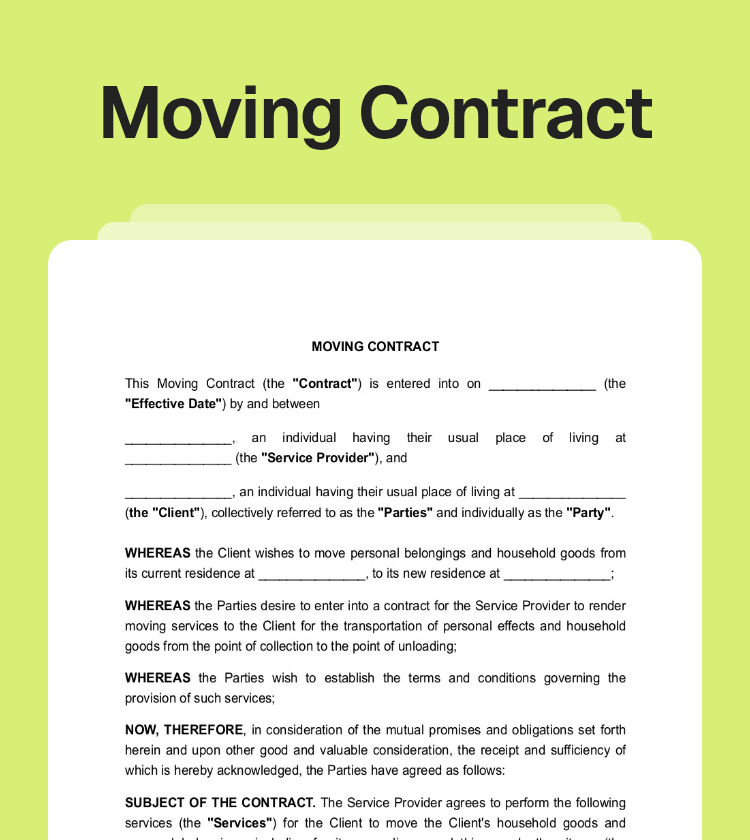
Free Moving Contract Template

A moving contract template is generally useful to save time and energy. You can easily adapt this professional template to create a moving contract to accurately fit your current needs. With this customizable moving contract template, you can be assured of clarity and accuracy and a contract that will protect your rights before, during, and after the moving process.
What Is a Moving Contract?
Copy section linkA moving contract is an agreement between two parties when one requires a service to move properties or goods from one place to another usually for a fee. A moving contract implies that a contractual relationship exists between the moving company and the client. With a written contract, there is a documented understanding between the parties of the responsibilities that they both bear and the services that will be provided.
To illustrate, a customer intends to relocate from his current residence to a new apartment, and he requires assistance to move his belongings to the new place. He contacts a moving company, and the company representative takes a comprehensive inventory of all of the belongings that need to be moved. The representative then gives a quote (projected price) for the service. If the customer is comfortable with the price, then a moving contract will be created, stating the terms and scope of the service. After the agreement is signed by both parties, it becomes binding.
Parties of a Moving Contract
Copy section linkThere are two parties involved in a moving contract. They are the:
- Moving company: This could be a professional company or an individual responsible for moving services that include packing, loading, transporting, off-loading, etc.
- Client: In a moving contract, this individual or entity requires moving services for household goods, office equipment, or any other possessions to a designated area within a specified time.
Key Terms
Copy section linkThere are several key terms that define the rights and obligations of parties to a moving contract. These include:
- Date of the move: This is the date agreed by the parties for moving the client’s belongings.
- Scope of services: This specifies the exact moving services that will be rendered under the agreement.
- Pricing and payment: This section describes the overall expected cost for the services, including the rate, whether a flat fee or hourly rate, and estimated time required.
- Insurance and liability: This section outlines liability and insurance coverage in the event that the client’s property is damaged or lost.
- Cancellation and termination: This clause details the grounds or basis upon which either party can cancel or terminate the signed moving contract.
What Is Included in a Moving Contract?
Copy section linkA comprehensive moving contract should include the following sections:
1. State and Date
The moving contract should specifically include the jurisdiction that governs the agreement because state laws regulating these contracts can vary. Also, it should state the date on which the moving contract was signed as well as the date the service will be performed.
2. Party Identification
Proper identification of the parties is crucial to every contract. Therefore, the moving contract must clearly list both parties to the transaction — the moving company and the client. Include names, addresses, and other contact details to easily identify the parties and enable communication.
3. Description of Moving Services
This part of the moving contract will describe the exact service(s) that will be provided by the moving company for the client. Often listed in detail are what belongings or items to be moved. Also listed is the mutually agreed moving date and time. The more details that can be clearly listed can help to avoid misunderstandings.
4. Legal Provisions
This section deals with responsibilities and rights in case there is damage or loss to the goods being moved or any issue or misunderstanding that may arise as a result. Some legal provisions usually include insurance provision, a liability clause, dispute resolution, indemnification, force majeure, and more.
5. Signature Block
The signature section of the moving contract demonstrates that both parties agree to the terms and conditions documented and acknowledge that they are legally bound by those terms. Always ensure that the contract is signed and dated by both parties.
How To Write a Moving Contract
Copy section linkThe following are simple steps to take when writing a moving contract:
Fill in all necessary information. When writing a moving contract or using a sample moving contract, be sure to add all the necessary information, including names, addresses, services, payments, etc.
Coordinate with the counterpart. Once you have drafted the moving contract, either as the moving company or the client, Have the other party review the document. This way, any concerns about the moving company contract can be addressed and necessary revisions implemented before signing.
Negotiate essential terms of the contract. Before the moving contract can be finalized, it is important to ensure that both parties find the terms acceptable. If not, they must negotiate until an agreement can be reached.
Why Do You Need a Moving Contract?
Copy section linkA moving contract serves as an essential document for both the moving company and the client. Below are some of the reasons why you may need a contract for a moving company.
Common Use Cases
- Legal protection: With a moving contract duly signed by both parties, each party is assured of legal protection if the rights, obligations, and liabilities of the parties are well defined.
- Clarity and expectations: With key terms clearly outlined, the parties have a clear and working understanding of what to expect. This prevents misunderstandings and ensures that the moving process will go smoothly.
- Proof of agreement: Having a written contract gives solid proof of the agreement in case a dispute arises and you need a legal basis to protect your interests.
With a moving contract, clients and companies alike can enjoy the following benefits:
-
Peace of mind;
-
Defined scope of responsibilities;
-
Prevented misunderstandings; and
-
A legal basis to enforce any right if the contract is breached.
When Not To Use the Moving Contract
There are some moving situations that may not require a moving contract as it is simply not necessary. These include small local moves where the belongings to be moved can be moved without involving a moving company. Also, informal arrangements between friends or family do not generally require a moving contract since verbal agreements are often made to exchange moving for something else like pizza or there is no expectation of compensation or trade.
What Happens If Something Gets Damaged?
Copy section linkProperty damage can become a point of disagreement during a move. Responsibility may depend on both the moving contract and applicable law. The agreement can allocate responsibilities and establish legally permitted liability limits, but it cannot override statutory duties or liability that cannot legally be waived.
Interstate household-goods movers subject to federal regulation must follow specific valuation and claims rules. For smaller or intrastate moves, the contract should clearly address:
- The standard of care the mover must follow;
- Pre-existing damage that is not the mover's responsibility;
- Legally permitted liability limits for lost or damaged property;
- Responsibility for packing and how owner-packed items may affect damage claims.
Clear terms help both parties understand what happens if something goes wrong. For example, if furniture is damaged during unloading, the agreement can help establish the parties' responsibilities and available remedies, subject to applicable law.
Important: This moving contract template does not replace documents required for a regulated interstate household-goods move. Interstate movers must also provide applicable estimates, an order for service, a bill of lading, valuation disclosures, and other federally required documents. Intrastate moves may be subject to separate state forms and disclosure requirements.
Does an interstate moving company need a USDOT number?
Yes. Interstate household-goods movers must register with the Federal Motor Carrier Safety Administration (FMCSA) and have a USDOT number. Customers should verify the mover's federal registration and operating status before signing an agreement. These movers are also subject to federal requirements under 49 CFR Part 375.
Is moving valuation coverage the same as insurance?
No. Interstate movers must offer Full Value Protection and Released Value Protection. Released Value generally limits liability to $0.60 per pound per article. These are liability levels, not insurance policies. The bill of lading and related shipping documents should identify the valuation option selected.
What is the difference between a binding and non-binding moving estimate?
A binding estimate generally sets the amount due for the listed services, while a non-binding estimate is approximate. At delivery, a mover may generally collect up to 110% of a non-binding estimate. Charges for tariff-defined impracticable operations may also apply but cannot exceed 15% of all other charges due at delivery.
Who pays storage-in-transit fees during a move?
Customers may pay storage-in-transit charges when they cannot accept delivery during the agreed period. However, if a mover attempts delivery more than 24 hours early without the customer's agreement and stores the shipment, the mover is responsible for the resulting storage, handling, and redelivery costs.
How long does a customer have to file a damage claim against an interstate mover?
Customers generally have nine months after delivery to file a written loss or damage claim. If the entire shipment is not delivered, the period runs from the date the shipment should have been delivered. Customers should document damage and submit claims promptly.
Are the same moving rules used for interstate and intrastate moves?
No. Federal rules govern interstate household-goods moves, while intrastate moves are generally regulated under state law. State agencies may impose their own licensing, rates, documents, and consumer protections. For example, the Illinois Commerce Commission regulates household-goods movers operating within Illinois.
Sources
Related Documents
Also Read