Free template
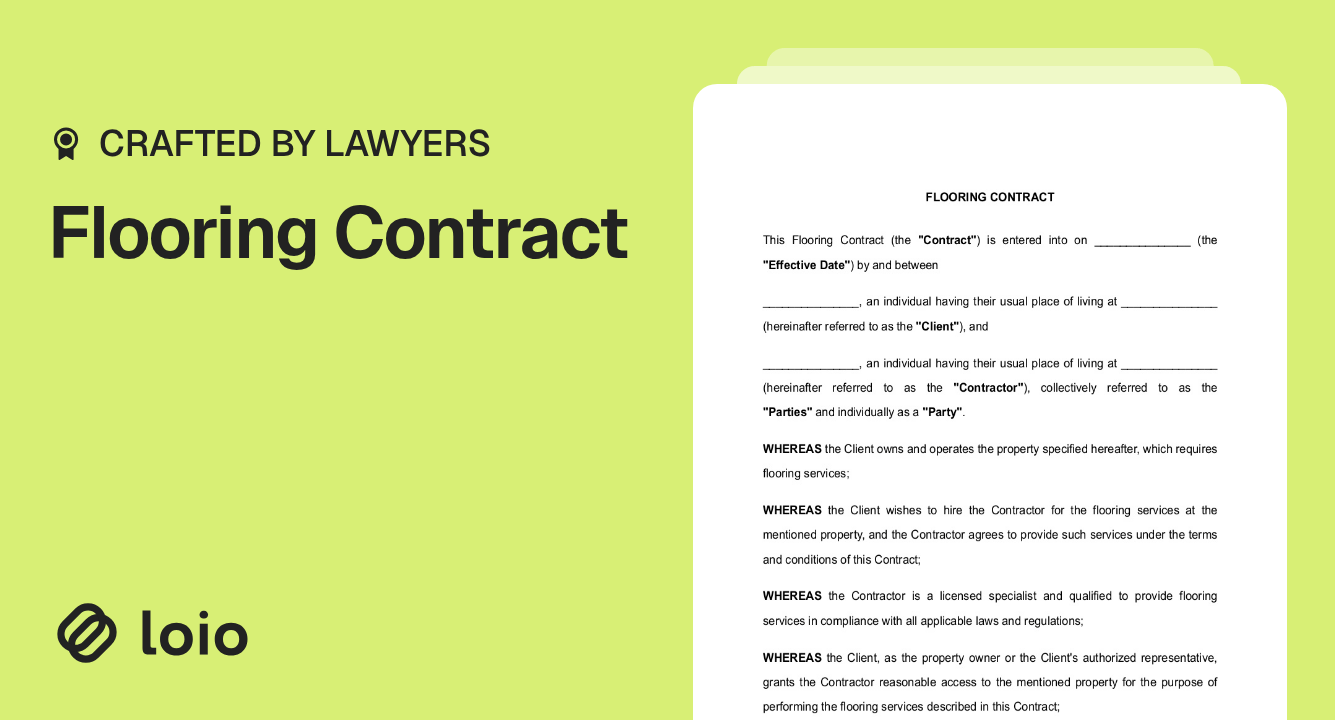
Free Flooring Contract Template

What Is a Flooring Contract?
Copy section linkA flooring contract is a written agreement between a flooring professional and a property owner, general contractor, or business. This document sets the terms for flooring work, such as hardwood installation, tile work, carpet replacement, laminate installation, or concrete floor finishing.
A correctly filled-out flooring installation contract template protects both parties. For contractors, it confirms the scope of work, material specifications, payment schedule, liability limits, and gives legal recourse if a client refuses to pay. For clients, it guarantees that the work will meet agreed standards and includes warranty protection.
Flooring projects vary in complexity. A simple carpet installation differs from a large-scale hardwood project that requires subfloor preparation, moisture testing, and coordination with plumbing adjustments. A proper flooring contract template addresses these variables and sets clear expectations before work begins.
When to Use a Flooring Contract
Use a flooring contract template when you:
Install new flooring in a residential or commercial property.
Replace or remove old flooring, tear out existing materials, and prepare the subfloor for new installation.
Provide flooring repair services: fix damaged sections, replace worn areas, or refinish existing floors.
When not to use a flooring contract:
If you work as an employee for a flooring company (your employer’s contract covers the terms of your work).
If you only provide an estimate or consultation with no commitment to perform the job (use a consulting services agreement instead).
If you work as a subcontractor on a construction or renovation project (use a subcontractor agreement instead).
What Are the Parties to the Flooring Contract?
Contractor (Service Provider): The licensed professional or company that performs the flooring work. They are responsible for labor, materials (if specified), proper installation, and warranty coverage.
Client (Property Owner): The party that hires you to perform flooring services. The client pays for work completed and provides access to the property.
What to Include in the Flooring Contract
Copy section linkParties' information: Full legal names, business names, addresses, and contact details of both the contractor and client, which ensures clear identification and legal accountability.
Description of services: A detailed list of flooring tasks (installation, removal, subfloor preparation, finishing), flooring type, and square footage, which prevents disputes over what the contract covers.
Payment terms: The total cost, deposit amount, progress payments, final payment due date, and accepted methods, which establishes cash flow expectations and reduces non-payment risk.
Taxes: Clarification of who pays sales tax on materials and whether labor is taxable in your state, which prevents unexpected costs for either party.
Materials: A list of flooring products, underlayment, adhesives, and transition strips, including brands, grades, and who provides them, which ensures quality standards and cost clarity.
Completion date: The expected finish date for the project.
Term of contract and default: The contract duration and what happens if either party fails to meet their obligations.
Relationship of the parties: A statement that confirms you operate as an independent contractor, not an employee.
Warranty: The guarantee period for labor and materials, including conditions and exclusions.
Indemnification: Allocation of responsibility for claims or damages that arise from the work or breach of contract.
Insurance: Confirmation that you carry liability insurance, which protects both parties from claims related to injury or property damage.
Force majeure: A clause that addresses unexpected events (natural disasters, supply shortages, government orders) that may delay or prevent completion without penalty.
Confidentiality: Protection of proprietary information, pricing structures, or client details shared during the project.
Governing law: The state whose laws apply to the contract, which determines where disputes are resolved.
Parties' signatures to confirm mutual agreement and make the document enforceable.
Date when both parties sign the contract.
What Are the Key Terms in a Flooring Contract?
Copy section linkAcceptance act: A signed document from the client that confirms the flooring work is complete, meets the agreed quality standards, and is approved for final payment.
Contract amount: The total price for labor and materials as stated in the agreement, which may be fixed or adjusted through change orders.
Commencement date: The official start date of the flooring project as agreed by both parties.
Non-exclusivity: A clause that confirms the contractor is free to work for other clients during the contract period and is not limited to one customer.
Cure period: The amount of time one party has to fix a problem or breach of contract before the other party can take legal action or terminate the agreement.
How to Fill Out a Flooring Installation Contract Template
Copy section link- Enter the date of the agreement.
- Enter your full legal name or business name, address, contact details, and contractor license number (if required in your state).
- Enter the client's full name, address, and contact information.
- State the property address and specific rooms or areas where flooring work will take place.
- Describe the services you will perform, including flooring type (hardwood, laminate, tile, vinyl, carpet), square footage, and any removal of existing flooring.
- List all materials you will use, specify brands, grades, and colors, and confirm who purchases and pays for them.
- Clarify preparation work such as subfloor repair, leveling, or moisture testing, and state who is responsible for each task.
- Enter the project start date and expected completion date.
- State the total project cost, deposit amount, progress payments, final payment due date, and accepted payment methods.
- Specify warranty terms for labor and materials, including the guarantee period and any conditions that void the warranty.
- Add termination conditions that explain how either party may cancel the agreement and what payment is due for work already completed.
- Have both parties sign the agreement and enter the date next to each signature.
What are safe subfloor moisture readings?
The acceptable reading depends on what's being installed and the manufacturer's specific requirement. There’s no fixed number for all subfloors.
What is a transition warranty in a flooring contract?
A transition warranty concerns the transition elements connecting different floor surfaces,such as threshold strips, T-moldings, seams, and reducers. It guarantees these pieces will not crack, lift, or separate within a set time.
Does the flooring contractor have responsibility for underlayment?
It is the contractor who usually selects and installs the underlayment before installing the flooring. However, it can vary depending on the project scope, flooring system, and the wish of the client. Your contract should state who provides the material and who pays for it. For instance, if the client supplies their own underlayment, the warranty may not cover the problems that may occur.
What permits does a flooring contractor need?
Most standard flooring jobs do not require a special permit. However, the contractor may need one if the work involves asbestos-containing materials, structural changes, or electrical work. Verify your local building code before starting work.
What allergen and VOC concerns should a flooring contractor address?
VOCs are chemicals in some adhesives and finishes that affect air quality. For flooring services, low-VOC or zero-VOC products are recommended. Besides, the space should be ventilated during and after installation.
- Modest, simple projects –– Straightforward projects concerning standard materials may not require elaborate contracts. Even an email exchange defining the scope of work may be sufficient.
- Informal relationships –– If you have a long-standing relationship based on mutual trust with a client, you may not need a contract.
- Verbal agreements –– A verbal agreement may suffice for simple projects. However, it is essential to have a record of the terms of engagement.
Requirements for this document vary by state. Review your state's laws and procedures — or consult a licensed attorney — before using this template to ensure it's valid and enforceable where you live.
Sources
Related documents
Also read