Pro template
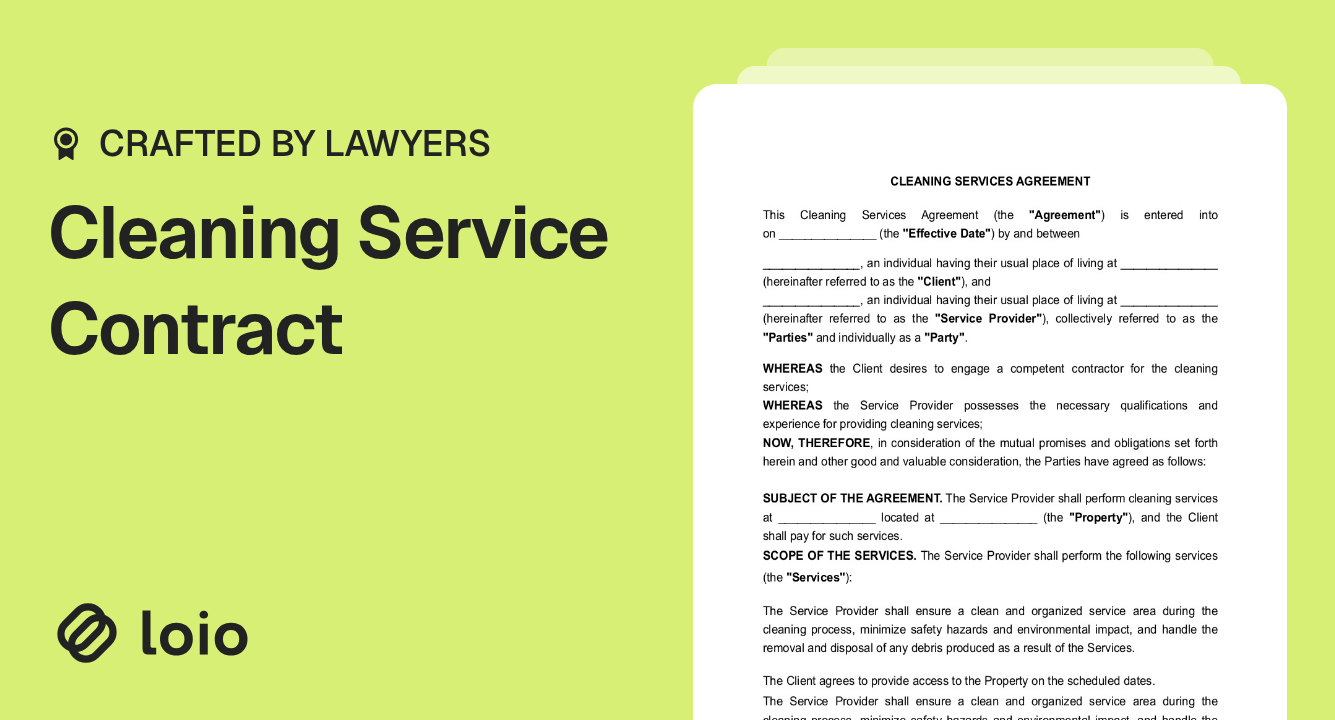
Cleaning Contract Template

A cleaning contract sets clear expectations between a client and a service provider before the work begins. It can define what areas will be cleaned, when the service will take place, who supplies the equipment, how much the client will pay, and what happens if either party cancels or ends the arrangement.
Use this cleaning contract template to document the terms of one-time or recurring cleaning services. The agreement also covers payment, subcontractors, confidentiality, liability, service quality, and termination. Review each provision carefully and adjust the terms to match the actual working relationship and applicable state law.
With Loio, you can customize the agreement for your arrangement and prepare a printable version when you are ready to sign.
What Is a Cleaning Contract?
Copy section linkA cleaning contract is an agreement between a client and a service provider that describes the cleaning work to be performed and each party's responsibilities. It commonly identifies the property, scope of services, schedule, payment terms, equipment responsibilities, cancellation rules, and procedures for ending the agreement.
A written cleaning service agreement can be used for a single cleaning appointment or an ongoing arrangement. For example, the parties might agree to a one-time deep cleaning before a move or to services every week for a defined contract period.
A cleaning contract is different from a cleaning proposal. A proposal generally presents the services and price offered to a potential customer, while a contract records the terms the parties have agreed to follow.
When should you use a cleaning contract?
You can use a written contract whenever the details of a cleaning arrangement should be clear to both sides. It can be particularly useful when:
Cleaning will take place on a recurring schedule.
The client expects particular rooms, surfaces, or tasks to be covered.
The service provider will receive access to a home or other private property.
The parties need to decide who provides cleaning products and equipment.
Cancellation or rescheduling fees may apply.
The service provider may use subcontractors.
The parties want a process for reporting and correcting unsatisfactory work.
Even for a one-time job, putting the scope, price, schedule, and access arrangements in writing can reduce uncertainty about what each party agreed to do.
When might this template not fit your arrangement?
First, consider whether the cleaner is genuinely operating as an independent service provider. Calling someone an independent contractor in a contract does not make that classification legally controlling.
For federal tax purposes, the IRS looks at the actual relationship, including behavioral control, financial control, and the type of relationship between the parties. The IRS specifically explains that a written contract describing someone as an independent contractor is not sufficient by itself to establish that status.
This issue can be especially important when an individual is hired to clean a private home. The IRS lists housecleaning workers and housekeepers among people who may perform household work. If the homeowner has the right to control both what work is done and how it is performed, the cleaner may be a household employee. By contrast, a cleaner who controls how the work is performed, normally provides their own tools, and offers services to the public through an independent business may be self-employed.
State law can also use a different classification test. For example, California generally treats a person providing services for payment as an employee unless the hiring entity can satisfy all three parts of the ABC test in Labor Code § 2775, subject to applicable exceptions.
The version of this template shown here also identifies the Client and Service Provider as individuals. If an LLC, corporation, or another business entity will be a party, make sure the agreement identifies that entity correctly and that the person signing has authority to sign on its behalf.
What to Know Before Using a Cleaning Contract
Copy section linkThe best cleaning service contract template is one that reflects what will actually happen during the job. Before signing, work through the practical details below rather than relying on general terms such as “cleaning services.”
Define exactly what “cleaning” includes
Describe the work with enough detail that both sides understand what is included in the agreed price. Depending on the job, the scope could identify:
- Rooms or areas to be cleaned;
- Vacuuming, sweeping, mopping, or dusting;
- Bathroom and kitchen cleaning;
- Window or appliance cleaning;
- Trash and debris removal;
- Deep-cleaning tasks;
- Tasks that are specifically excluded.
Be precise when using terms such as sanitize or disinfect. The Environmental Protection Agency distinguishes them from ordinary cleaning. Cleaning removes dirt and organic matter using soap or detergents; sanitizing uses chemicals to kill bacteria on surfaces; disinfecting uses chemicals to kill viruses and bacteria. EPA-registered sanitizers and disinfectants should be used according to their label directions.
Decide who provides equipment and cleaning supplies
The parties should agree in advance who will provide vacuums, mops, cleaning products, protective equipment, and other materials.
This template places that responsibility on the Client and makes the Service Provider responsible for the safety and storage of the equipment and materials while using them. If the cleaner normally brings their own products and equipment, the agreement should reflect the actual arrangement instead.
Who provides tools and supplies can also be relevant to worker classification, but it does not decide the issue by itself. The IRS considers it alongside the other circumstances showing financial and behavioral control.
Set the schedule, access rules, and cancellation terms
Specify when cleaning will take place and how the Service Provider will enter the property. If the arrangement is recurring, define the frequency instead of relying on an informal understanding.
The template also lets the parties choose how much advance notice is required to cancel or reschedule an appointment and provides for a cancellation fee when the Client does not give the required notice.
Cancellation fees should not automatically be treated as enforceable in every state. For example, California Civil Code § 1671 applies special rules to liquidated-damages provisions in contracts for services purchased primarily for personal, family, or household purposes. For these consumer contracts, such a provision is generally void unless the statutory exception for damages that would be impracticable or extremely difficult to determine applies.
Agree on payment, extra work, and applicable taxes
Set the compensation before work starts. This template provides fields for:
- A fixed amount for the agreed services;
- The payment due date;
- An hourly rate for services performed beyond the schedule;
- A cancellation fee;
- Interest on overdue payments.
The current agreement also states that payments will be made in cash. If the parties intend to use another method, such as check, card, or electronic payment, edit the contract to match that arrangement.
Avoid assuming that cleaning services receive the same sales-tax treatment everywhere. State rules differ. For example, the Texas Comptroller treats building cleaning and janitorial services as taxable real-property services. Texas separately provides that qualifying traditional household services, such as housekeeping, are not taxable when the provider is an employee of the household rather than a subcontractor working through a third-party maid service.
Make sure the contractor classification matches the real relationship
The independent-parties clause in a contract for cleaning services documents what the parties intend, but authorities can still examine how the relationship operates in practice.
For federal tax purposes, the IRS considers behavioral control, financial control, and the parties' relationship. There is no single factor that automatically determines the result.
Federal wage-and-hour law uses a separate framework. As of September 2026, the U.S. Department of Labor has proposed replacing its 2024 independent-contractor rule with a streamlined economic-reality analysis. The February 2026 proposal identifies control over the work and opportunity for profit or loss as two core factors, with additional factors such as skill, permanence, and integration of the work. This remains a proposed rule, so it should not be treated as a finalized new classification standard.
Address subcontractors, property access, and confidentiality
Cleaning frequently requires access to areas the Service Provider could not otherwise enter. Decide how access will work and whether keys, entry codes, alarm information, or other sensitive information will be shared.
Under this template, the Client must provide access to the Property on scheduled dates. The Service Provider may subcontract all or part of the Services only with the Client's prior written approval and remains responsible for overall safety, quality, and completion.
The agreement also contains a confidentiality provision that continues after termination or expiration. Read it carefully if the cleaner may encounter sensitive business information, personal records, access codes, or other private information while working on the property.
Understand liability, warranties, and the cure period
Review how responsibility for loss or damage is allocated before signing. The template includes an indemnity provision covering certain claims and losses connected with the Service Provider's performance or breach and separately addresses damage to the Service Provider caused by the Client's negligence or willful misconduct.
The agreement also requires the Service Provider to provide quality and timely services. If the Client identifies a quality defect, the Client must notify the Service Provider, who then has a specified Cure Period to correct it without additional charge. Unless the Client waives the requirement, failure to correct the defect within that period results in termination under the template.
Because liability, indemnity, and damage provisions can be affected by state law and the circumstances of the transaction, do not assume that every allocation of liability will be enforceable exactly as written in every jurisdiction.
Check licensing and chemical-safety requirements when relevant
EPA does not generally license companies simply because they provide cleaning services, but it notes that state requirements for training, certification, and licensing vary. Check state and local rules applicable to the services being offered.
Businesses with employees should also consider workplace chemical-safety obligations. OSHA's Hazard Communication Standard requires employers to communicate hazards associated with hazardous workplace chemicals. OSHA's guidance for cleaning workers addresses labels, Safety Data Sheets, training, safe handling, storage, spill procedures, and appropriate protective equipment when hazardous cleaning chemicals are used.
How to Write a Cleaning Contract
Copy section linkUse the following steps to complete your free cleaning contract template and make sure its provisions reflect the actual service arrangement.
1. Identify the Client and Service Provider
Enter the Effective Date and the full legal names and addresses of the Client and Service Provider.
Make sure the names are consistent throughout the agreement. If a business entity will sign rather than an individual, identify the correct legal entity and signing representative.
2. Identify the property and cleaning services
Enter the location where the Services will be performed and describe the cleaning tasks.
Avoid relying on broad terms such as “standard cleaning” if the parties could interpret them differently. List important rooms, surfaces, tasks, or exclusions directly in the scope.
3. Set the cleaning schedule
Specify the dates, frequency, or other schedule for the Services.
Then decide how much advance notice either party must give to cancel or reschedule an appointment. The template permits the Schedule to be updated later by mutual written agreement.
4. Assign responsibility for equipment and supplies
Check whether the Client or Service Provider will provide the tools, equipment, and cleaning materials.
The current template makes the Client responsible for supplying them. If that does not reflect the arrangement, revise the provision before signing rather than leaving contradictory terms in the contract.
5. Decide whether subcontractors are allowed
Under this agreement, the Service Provider can subcontract the work only after receiving the Client's prior written approval.
Consider whether that arrangement works for the parties, especially when the Client is providing access to a private home or restricted areas of a business.
6. Enter the payment terms
Complete the fixed Compensation and Due Date. If extra services may be requested beyond the agreed Schedule, enter the hourly rate that will apply.
Also review the fields for the cancellation fee and late-payment interest. Do not select a fee or interest rate simply because there is a blank in the template; check whether the amount is permitted under applicable law.
Finally, make sure the stated payment method matches the parties' actual arrangement.
7. Confirm the parties' working relationship
Read the relationship clause carefully. It states that the parties are independent and that the agreement does not create an employment relationship, partnership, joint venture, or agency.
This language records the parties' intended relationship, but it does not override worker-classification law. The actual circumstances of the work remain important under federal and state rules.
8. Set the contract term and termination rules
Enter the date when the agreement will end and the amount of prior written notice required for termination without cause.
The template also allows immediate termination in specified insolvency or bankruptcy circumstances and requires the Client to pay for Services satisfactorily completed through the termination date.
9. Review confidentiality, liability, and warranty terms
Read these provisions rather than skipping them simply because most do not contain blank fields.
Pay particular attention to what information must remain confidential, how liability is allocated, and what remedy applies if the Service Provider's work is defective.
Then complete the number of days in the Cure Period so that both parties know how long the Service Provider has to correct a reported quality problem.
10. Add notice and governing-law information
Enter the email addresses that the parties will use for contractual notices.
The agreement also asks for the state whose law will govern the contract and the state whose courts will resolve disputes. Choose these fields deliberately rather than assuming they must always correspond to one party's home state.
11. Review and sign the agreement
Before signing, check the entire printable cleaning contract template for incomplete blanks or inconsistent terms. In particular, confirm:
- The parties' names and addresses;
- Property and scope of Services;
- Schedule and access arrangements;
- Equipment responsibilities;
- Compensation and Due Date;
- Cancellation and late-payment terms;
- Termination notice period;
- Cure Period;
- Notice information;
- Governing law.
Both the Client and Service Provider should then sign the completed agreement and retain a copy.
A clear cleaning contract cannot eliminate every disagreement, but it gives both sides a written reference for the scope, schedule, payment, access, and other important parts of the arrangement. The terms should reflect what the parties actually intend to do rather than simply remaining in the cleaning contract template because they were included by default.
Related Documents
Also Read