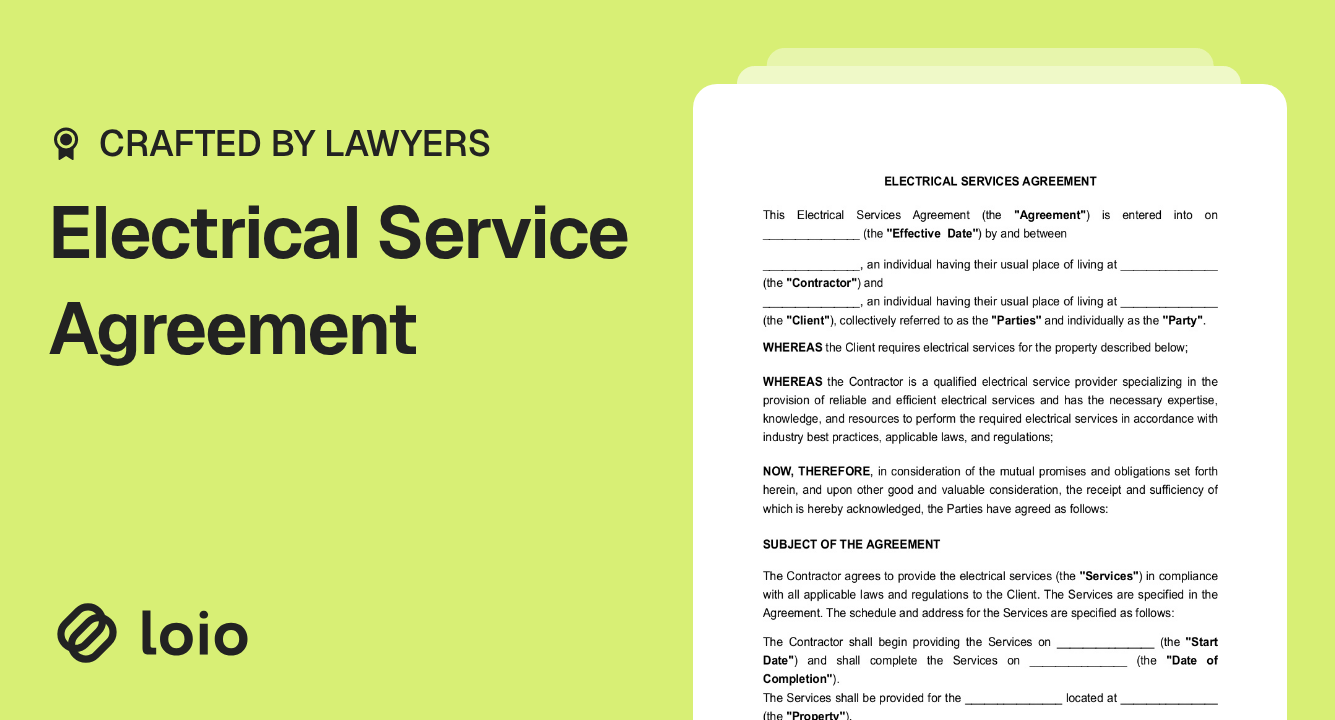
Free template
Free Electrical Contract Template

What Is an Electrical Service Agreement?
Copy section linkAn electrical contract is a written agreement between an electrician and a property owner, general contractor, or business. This document sets the terms for electrical work, including wiring, panel upgrades, lighting installations, outlet repairs, and full system overhauls.
For electricians, an electrical service agreement confirms the scope of work, payment schedule, and liability limits. For clients, it documents the contractor's obligation to complete the work according to agreed quality standards.
Electrical work carries significant safety and legal risks. For instance, low-quality wiring can cause fires, serious property damage, and even endanger people's lives. A proper electrical contract requires the service provider to comply with the requirements of the locally adopted version of the National Electrical Code (NEC) and provides a warranty for their labor and materials.
Require compliance with whatever electrical code the local jurisdiction has adopted, noting that many are based on some edition of the NEC but with local amendments.
When to Use an Electrical Service Agreement
Copy section linkThe agreement is helpful for contractors who provide the following electical services:
Install circuits, panels, outlets, and lighting as part of new construction.
Increase capacity, replace outdated equipment, or bring the electrical system up to code.
Remove old wiring and install new circuits throughout the building.
Are hired by general contractors to handle the electrical portion of a larger job as a subcontractor.
When not to use the electrical service agreement:
If you work as an employee for an electrical company (you sign an employment agreement instead).
If you only provide an estimate or consultation with no agreement to do the job (sign a consulting services agreement instead).
If electrical appliances are sold or purchased (a purchase agreement should be used instead).
What Are the Parties to the Electrical Service Agreement?
Service provider or contractor: An individual or electrical company responsible for providing the electrical services described in the agreement, which may include repair, installation, or maintenance of a client’s electrical system.
Client: A property owner or a business requesting the services of the electrician.
What to Include in the Electrical Service Agreement?
Copy section linkScope of work: A list of services to be provided,materials, and tools the contractor needs and the timelines for delivery.
Terms of payment: The amount the service provider will be paid upon work completion, the payment schedule, and penalties for late payment.
Duration of the agreement: The electrical service agreement can be for one year or as needed. If the service is on a need basis, the agreement may stay in force until the service described is fully delivered or until the parties terminate the agreement in writing.
Liability, indemnification, and insurance: Each party is liable for specific actions under the electrical service contract. In the indemnification clause, for example, the contractor may agree to hold the client harmless for any injuries that may occur while working and take responsibility for any property damage. This section may also define the type of insurance the service provider must carry, the scope of the coverage, and a requirement to provide proof of insurance.
Confidentiality: The agreement may require that both parties treat the terms of their engagement as confidential.
Dispute resolution: The mechanism available for the parties to resolve disagreements.
Governing law: The jurisdiction which law that will be used to interpret or enforce the agreement.
What Are the Key Terms of the Electrical Services Agreement?
Copy section linkOvertime rate: The higher hourly rate a contractor charges for work performed outside normal business hours, on weekends, or on holidays.
Travel and lodging: Reimbursable expenses for transportation, fuel, hotels, and meals when a job site is far from a contractor's regular service area.
Acceptance certificate: A signed document from the client that confirms the work is complete, meets the agreed standards, and passes inspection.
Certificate of insurance: The contract may require a document from the contractor's insurance company proving it carries liability coverage.
Warranty period: The set amount of time after project completion during which the contractor agrees to repair defects in their work at no extra cost to the client.
Cure period: The amount of time one party has to fix a problem or breach of contract before the other party can take legal action or terminate the agreement.
Force majeure: Unexpected events outside the worker's control, such as natural disasters or severe weather, that may delay or prevent the contractor from completing the work on time.
How to Fill Out an Electrical Service Agreement Template
Copy section link- Enter the date of the agreement.
- Add the service provider’s full legal name or business name, address, contact details, and contractor license number.
- Enter the client's full name, address, and contact information.
- State the property address where the electrical work will take place.
- Describe the services you will perform, including specific tasks such as panel upgrades, wiring, outlet installation, or GFCI/AFCI devices.
- List the materials you will use, specify brands and quantities, and confirm who provides them.
- Enter the project start date and expected completion date.
- State the total project cost, deposit amount, payment schedule, and accepted payment methods.
- Clarify permit and inspection responsibilities, including who obtains permits, pays fees, and schedules inspections.
- Confirm your insurance coverage, including liability insurance and workers' compensation.
- Specify warranty terms for labor and materials, including the guarantee period and any exclusions.
- Have both parties electronically sign the agreement and enter the date next to each signature.
Can I legally write my own electrical contract?
Yes, you can draft your own contract from scratch or use a template. However, the document must comply with state laws and include all the essential clauses, such as a list of services, price, payment terms, warranty, and signatures from both parties.
Can I legally do my own electrical work?
If you live in a single-family residence, you can do minor electrical repairs without a license and special permits. For larger projects, like adding circuits, running new wire, or upgrading a panel, you must get a permit and invite an inspection to check if it is safe. However, some states, like Hawaii and Massachusetts, forbid unlicensed homeowners from doing most DIY electrical work.
Do I need a permit for electrical work?
If you want to provide electrical services as a professional, you need a permit. It allows a local inspector to check that your work meets safety and quality requirements. Your contract should state who gets the permit and who pays for it — usually, that is your responsibility as the contractor
What is the difference between a journeyman and a master electrician?
Copy section linkA journeyman electrician has finished an apprenticeship and passed a licensing exam. A master electrician has more experience, passed a harder exam, and can pull permits, run a business, and supervise other electricians.
Should an electrician provide a warranty on labor or parts?
Most electricians offer a warranty on their workmanship, typically one year. Manufacturer warranties cover materials and equipment. If something installed fails because of the master’s mistake, they should fix it at no charge. Parts and equipment usually have separate manufacturer warranties.
What are the NEC requirements for GFCI and AFCI?
GFCI (Ground Fault Circuit Interrupter) cuts power when it detects a ground fault, and AFCI (Arc Fault Circuit Interrupter) – when it detects dangerous arcs that can start fires. The NEC requires GFCI outlets in wet areas: bathrooms, kitchens, garages, basements, and outdoor spaces, and AFCI protection in bedrooms, living rooms, and most other living spaces.
Requirements for this document vary by state. Review your state's laws and procedures — or consult a licensed attorney — before using this template to ensure it's valid and enforceable where you live.
Sources
Related documents
Also read