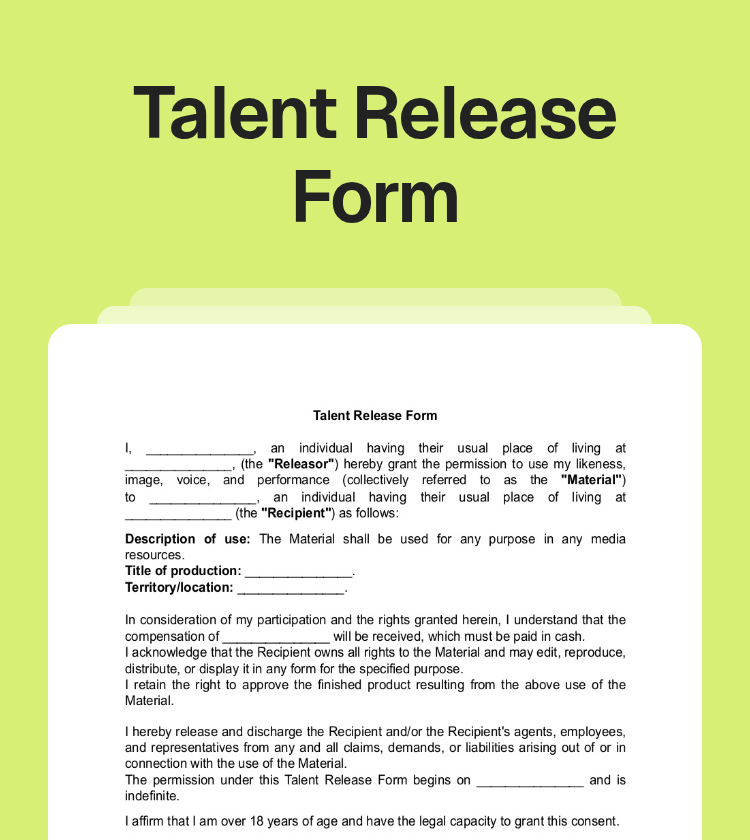
Free template
Free Talent Release Form Template

Template Description
Copy section link
When making a film to distribute to the public, you can use a talent release form template to create a contract with the featured individuals. The agreement establishes a contractual relationship between the filmmaker and the talent and gives the filmmaker the legal right to distribute a motion picture with the actor’s name or appearance.
What Are Talent Release Forms?
Copy section linkA talent release form for actors contract template, or talent contract template, is used to create a legally binding agreement between a video or photography content creator and the talent used in that content. The contract permits a producer to use the talent’s image, likeness, voice, name, performance, or any other specified feature for the show, content, commercial, or picture. The talent agreement meaning refers to a professional or non-professional individual hired to appear in a film, including:
- Background actors;
- Voiceover artists;
- Main characters;
- Child actors;
- Models.
Further, the term “image” refers to the physical appearance of the talent captured in the performance. The word “likeness,” on the other hand, refers to the intangible features of the actor, such as voice, performance, and personality.
The production release forms offer the following protections:
Guarantees that the talent is not putting the producer in conflict with another project they are working on;
Gives the exclusive right to distribute and commercialize the content produced;
Gives the right to use the actor’s performance without violating the actor’s rights;
Protects from lawsuits for using the talent’s voice, image, and likeness in marketing materials;
Safeguards artists’ interest by guaranteeing compensation for their talent;
Gives the artist some degree of control over how the producers will use the material through the permissible use clause; and
Helps the artist avoid disputes with the producers.
Parties of the Talent Release Form
Copy section linkThere are two parties to a talent release form.
- The Artist (also called the “Talent”) — The artist permits the person or company (a producer, filmmaker, photographer, etc.) to use his or her image or likeness for a specific purpose in exchange for defined compensation.
- The person or company who will be using the artist’s work — This party agrees to pay the artist a specific compensation in exchange for using the artist’s talent for a defined purpose.
Key Terms
- Talent — the artist (actor, model, singer, etc.).
- Name — when used in the talent release agreement, generally refers to the right to use the talent’s name in promoting the project.
- Voice — if the talent will make any sound in the project, include a clause specifically giving the right to use the talent’s voice.
- Image and Likeness — if the talent or any picture, painting, or likeness of the person will be seen in the project, include a clause that gives the right to use the talent’s image and likeness.
- Performance — if the talent takes any action or makes any movement, it may be considered a “performance.” Include a clause giving the right to use the talent’s performance in the project.
Details of the talent release form may vary depending on the industry and intended use of the content. For instance, in the recording industry, a talent release form gives the producer the right to make a recording of the talent and intellectual property rights to such recording. It may contain additional terms, such as a waiver of future compensation, permission for the talent’s image to be digitally altered, or permission to use the actor’s biographical information in connection with promotions, etc.
What To Include in a Talent Release Form Template
Copy section linkComprehensive film talent release forms outline the talent’s consent to participate in the production of film or other content for commercial gain. The talent’s commercial interest in the output ends when they receive payment for their work. Film release forms templates help the producers create legal contracts with the talent they use, and they give control over the work to use in present or future opportunities.
The following information should be included in the template:
- Names of the parties — Add the names and contact information of the parties to the contract. The parties are usually the talent and the production company or individual content creator. Besides capturing the actor’s name, the agreement should also allow the use of that name in association with the project.
The talent may be open to the use of their names in the opening and closing credits, but explicit permission is needed to use them in promotional materials. The talent may require additional financial incentives for the extra leverage on their names, and their interests must be well covered in the contract. - Performance — Performance refers to anything the audience will see, hear, or experience due to the unique ways the actor has portrayed the role. Provide specific details for the expected talent’s performance in the contract.
- Voice, image, and likeness — In addition to the talent’s performance in the production, the producer will need permission to use the talent’s voice, image, and likeness in press kits, bonus features, promotional stills, or official posters of the production.
- Compensation — Include a statement that the talent’s performance will not be used unless he or she receives payment for the work. A separate agreement can outline the terms of engagement, including payment.
- Permissions — If the work is an audio-visual production, ensure that the agreement permits the content creator to use the actor’s image and likeness and voice.
- Ownership of the intellectual property — Establish the owner of the intellectual property that will be produced. The business entity that is a party to the contract will generally own the rights to the film or production that makes the subject of the agreement.
- Permissible use — Describe how the film or other content will be used in the present or near future. For example, if you intend to use the project output online first, but it may later be featured on national television, reflect these possibilities in the agreement. Keeping the clause broad can allow the content creator to draw additional value from the work.
- Release of liability — The talent must acknowledge that they have released the content creator or the company and its successors from any liability arising from the use or sale of the production or project that includes the talent’s name, image, or likeness.
The form should reflect more than just the actor’s involvement in the principal work. It should also include the use of his or her features in other incidental efforts, such as marketing, that contribute to the success of the main project.
In the film industry, a talent release form should be signed before the start of production. If you plan to sell the recording or the rights to it, any media company interested in making a purchase will require talent releases. In a video production, talent releases should be obtained from primary actors and from extras.
How To Write a Talent Release Agreement
Copy section linkWhen you have determined that you need a talent release agreement, download a simple professionally created template as a PDF to use as is or fill in the blanks to customize it to your specific needs. Using a general talent release agreement form, follow the below steps to create your agreement.
1. Contact the Talent
If you know that you want to work with a particular talent, you will need to make contact with that person or his or her agent to extend the offer.
2. Negotiate the Terms
Propose the terms for working with the talent and negotiate any necessary issues. After these have been decided, send the talent a copy of the talent release agreement form for him or her to consider.
3. Create the Talent Release Agreement
Using the talent release agreement form with the negotiated terms, create the agreement and print the document for signing.
4. Sign and Date the Talent Release Agreement
Be sure that both parties sign and date the agreement prior to beginning work with the talent for the project that is subject to the agreement.
When To Use a Talent Release Form
Copy section link
Use a standard talent release form any time you use the name, image, or likeness of a person or pet and plan to distribute your work in any way. If you are the talent, you will need to negotiate fair terms for the purchase of your talent. Every person has a right to privacy, which includes the right to:
Not have private affairs made public without a legitimate public concern;
Protection from the unlawful appropriation of the person’s personality; and
Protection from unnecessary publicity.
Therefore, content creators risk a civil rights lawsuit by filming or recording a person without his or her consent. A talent release form for video provides sufficient legal cover if your project also involves taking photographs of people. However, you will need a separate release document if you are featuring someone’s property or a pet in your project.
Common Use Cases
There are several scenarios when a person would need to use a talent release form. Some of the most common use cases include:
- A photographer creating a portfolio of work and using a model;
- A videographer creating a video to distribute;
- A recording of an artist’s voice (edit this Loio template to make a complete voice over contract template);
- Creating an advertisement that uses a voice-over;
- Creating an animated video that uses a talent’s voice;
- Using the image or likeness of anyone and planning to distribute it;
- Using a video, photograph, or recording of a pet.
When Not To Use the Talent Release Form
If you are photographing or videoing a crowd of people from a distance, and the people cannot easily be identified, you will not need to use a talent release form agreement. Additionally, if you are only using the photographs or video for your personal use and will not distribute your work, then you do not need to use a talent release form.
If you have any doubt whether you need a talent release form, you may want to contact a local attorney experienced in entertainment law to be sure you are protected. If you intend to distribute a video or photograph that includes easily identifiable people, download a printable talent release form to use.
State Law
Copy section linkThe laws governing talent release forms generally fall under the category of entertainment law or media law. This area overlaps considerably with intellectual property, copyright, trademark, and patent laws, as well as advertising and marketing law. These laws are governed by federal statutes, and state laws are based upon and defer to those federal laws.
Related documents
Also read