Free template
Free Media Release Form Template

What Is a Media Release Form?
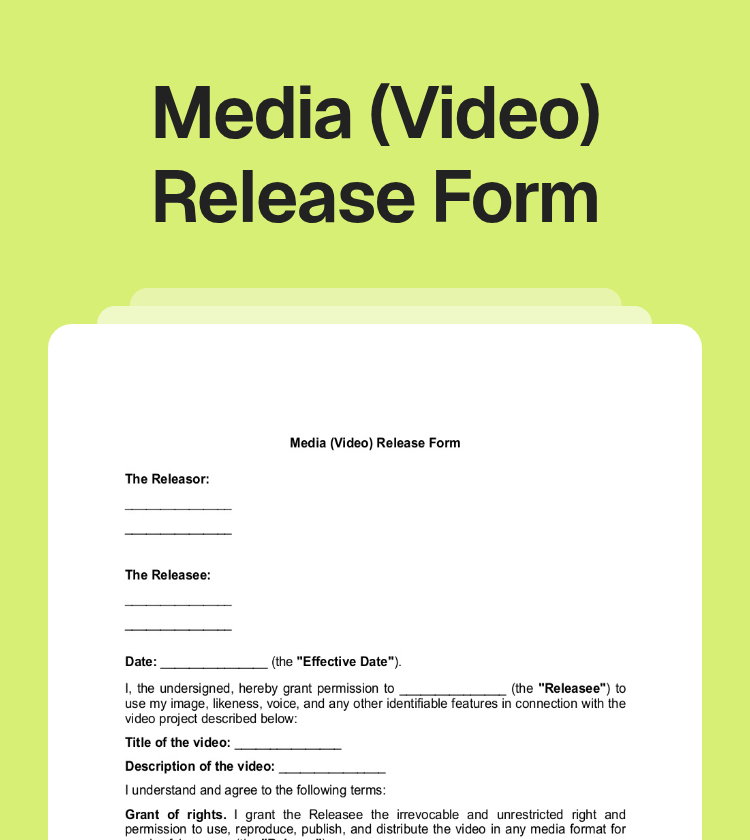
Copy section linkA media release form is a document in which a person grants another party permission to use their name, image, video, or voice recording for a specified purpose. It's the legal foundation that lets a business, filmmaker, or content creator use someone's likeness without risking a claim for unauthorized use.
A media release form template covers more than just photos — it applies to video footage, audio recordings, and even written testimonials that identify a specific person. Some people search for this document as a video release form, a filming release form, or a media consent form, depending on the type of content being collected. The underlying purpose is the same across each version.
When someone's likeness is used without a signed release, especially for commercial or promotional purposes, the person or business using it may be subject to a right-of-publicity or privacy claim. This is true even if the subject originally agreed to be filmed or photographed informally.
When to Use a Media Release Form
Copy section linkUse a content release form, sometimes drafted as a general media release form, when:
You're filming or photographing someone for a commercial, advertisement, or promotional campaign.
You're producing a documentary, interview, or testimonial featuring identifiable individuals.
A business wants to use employee photos or videos in marketing materials.
You're recording content for social media that features people who aren't the account owner.
A film or TV production needs to clear the use of someone's image or voice before release.
An event organizer wants to photograph or record attendees for promotional use afterward.
When not to use a media release form:
Use a photo release form instead if you're only collecting still images and don't need to cover video or audio.
Use a talent release form instead if you're working with a professional actor or performer under a broader talent agreement.
Don't get preoccupied with a media release form if you're filming in a clearly public place with no reasonable expectation of privacy and no commercial use planned. That said, getting a release is still good practice if you might use the footage commercially later.
Who Are the Parties to a Media Release Form?
Copy section linkReleasor: The person who owns the rights to their own image, voice, or likeness and is granting permission for it to be used. If the subject is a minor, a parent or legal guardian signs on their behalf.
Releasee: The individual, business, or organization that intends to use the media and is responsible for confirming they've obtained proper consent before publishing or distributing it.
Parent / legal guardian (conditional): Required to sign in place of the releasor whenever the subject is a minor, since minors generally cannot grant legally binding consent themselves.
Key Components of a Media Release Form?
Copy section linkWhether you're using a standard video release form or a general media release template, the core fields are the same:
- Parties' information: Full legal names and contact details for the releasor and releasee, so it's clear who granted permission and who received it.
- Description of the media: A specific account of what's being released — photos, video footage, audio, or a combination — described in enough detail to avoid ambiguity later.
- Purpose of use: A statement of how the media will be used, such as advertising, editorial content, social media, or a documentary.
- Scope of rights granted: The extent of the permission — whether it's exclusive or non-exclusive, limited to specific platforms, or unrestricted, and whether it applies worldwide or in specific territories.
- Term: How long the releasee's rights to use the media last — some releases grant perpetual use, while others are limited to a set period or campaign.
- Compensation: Any payment the releasor receives in exchange for granting the release, or a statement that no compensation is provided.
- Signature and date: The releasor's signature (or a parent/guardian's, for a minor), confirming that consent was given knowingly and voluntarily.
Key Terms in a Media Release Form
Copy section link- Releasor: The person granting permission for their image, voice, or likeness to be used.
- Releasee: The person or organization receiving permission to use the media.
- Right of publicity: A person's legal right to control the commercial use of their name, image, or likeness — protected under state law, and increasingly relevant with AI-generated content.
- Perpetual license: A grant of usage rights with no expiration date, meaning the releasee can continue using the media indefinitely unless the release states otherwise.
- Exclusive rights: Permission that prevents the releasor from granting the same usage rights to anyone else, typically in exchange for greater compensation.
- Revocation: The withdrawal of consent after a release has been signed — generally difficult or impossible once media has already been used, unless the release specifically allows it.
How to Fill Out a Media Release Form?
Copy section link- Enter the releasor's full legal name and contact information.
- Enter the releasee's full legal name or business name and contact information.
- Describe the media being released — photos, video, audio, or a combination — with enough detail to identify it clearly.
- State the purpose for which the media will be used, such as advertising, editorial content, or social media.
- Describe the extent of the rights given, including any limitations, the platforms or areas covered, and if the usage is exclusive.
- State the term of the release — whether it's perpetual or limited to a specific period.
- State whether compensation is being provided, and if so, the amount.
- If the releasor is a minor, include a parent or guardian signature line in place of the minor's own signature.
- Sign and date the release. You can sign electronically using eSign or by hand.
- Before using the media in public, save a signed copy for your records.
Do you need a media release form?
Generally, yes, if you plan to use someone's identifiable image, video, or voice for commercial or promotional purposes. Without a media release consent form, you risk a right-of-publicity or privacy claim, even if the person originally agreed informally to be filmed or photographed. A signed release removes that ambiguity and gives you documented proof of consent.
What is a media release used for?
A media release form protects both sides of the relationship. It gives the releasee clear legal permission to use the media as intended. It also gives the releasor a documented record of exactly what they agreed to – including how and for how long the media would be used.
Can a minor sign a media release form?
No. A minor cannot legally grant binding consent on their own. A parent or legal guardian must sign the release on the minor's behalf, confirming they understand and agree to how their child's image, video, or voice will be used. Commercial use involves using someone's likeness to sell or promote a product or service, which generally requires stronger consent and often compensation. Editorial use — such as in news reporting or documentary journalism — has more legal flexibility under free speech and newsworthiness protections. A release is still good practice whenever possible.
What's the difference between commercial and editorial use?
Commercial use involves using someone's likeness to sell or promote a product or service, which generally requires stronger consent and often compensation. Editorial use — such as in news reporting or documentary journalism — has more legal flexibility under free speech and newsworthiness protections. A release is still good practice whenever possible.
Is a perpetual license standard in media release forms?
Are media release forms required to have a perpetual license? It's not ubiquitous, but it's common. While some releases restrict usage to a particular campaign, platform, or time frame, others provide the releasee unlimited rights to utilize the media. The term should be stated explicitly, since a releasor who assumes usage is limited may be surprised to find the release grants perpetual rights.
Can you revoke a signed media release form?
Generally, no, once the releasee has relied on it and used the media. Some releases include specific revocation or opt-out terms, but absent that language, a signed release is treated as a binding grant of rights for its stated term. This is why reviewing the term and scope carefully before signing matters.
Does the right of publicity vary by state?
Yes. Some states, like California, have detailed statutory right-of-publicity protections covering a person's name, voice, signature, photograph, or likeness, with specific damages available for unauthorized commercial use. Other states rely more on common law privacy protections, which can differ meaningfully in scope. If your content will be used in a specific state, it's worth confirming that state's particular rules.
Does a media release form cover FTC disclosure requirements?
No, they address different things. A media release form covers consent to use someone's likeness. If the person featured is also endorsing a product — for example, in a paid testimonial or sponsored content — the FTC separately requires clear disclosure of that paid relationship. You may need both a signed media release and a compliant endorsement disclosure for the same piece of content.
Is a media release form legally binding?
Yes. A signed media release form is a legally binding contract enforceable under state law, provided it includes the basic elements of a valid agreement: an offer, acceptance, and consideration. That consideration can include compensation, or simply the value of appearing in the media.
Statutory references
Related documents
Also read