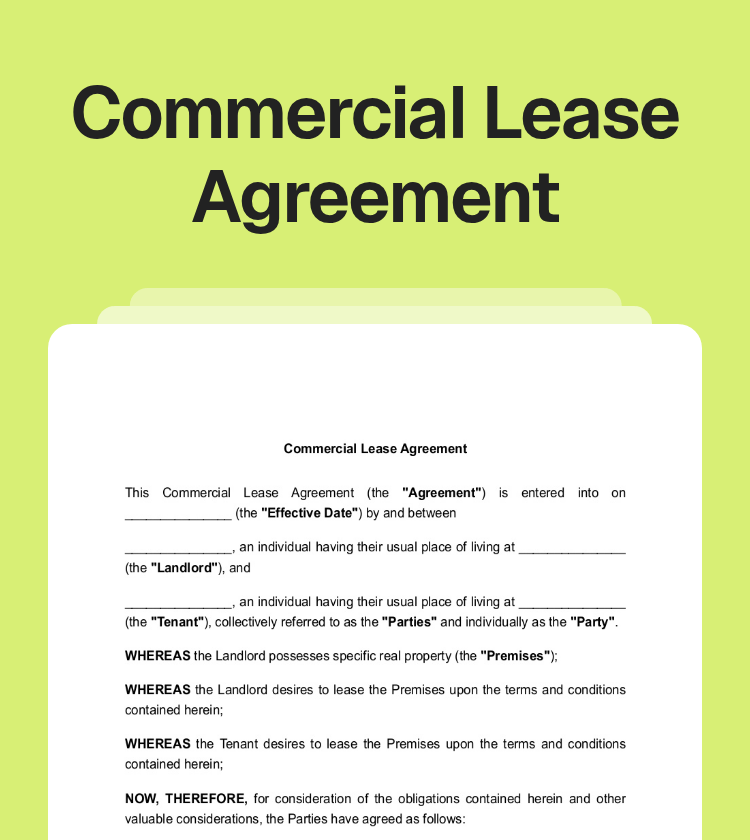
Commercial Lease Agreement Template

4.7 (52 reviews)
All states
Updated Jul 28, 2025
~ 9 pages
PDF
4.2K downloads
Commercial Lease Agreement

This Commercial Lease Agreement (the "Agreement") is entered into on   (the "Effective Date") by and between

 , an individual having their usual place of living at   (the "Landlord"), and

 , an individual having their usual place of living at   (the "Tenant"), collectively referred to as the "Parties" and individually as the "Party".

WHEREAS the Landlord possesses specific real property (the "Premises");

WHEREAS the Landlord desires to lease the Premises upon the terms and conditions contained herein;

WHEREAS the Tenant desires to lease the Premises upon the terms and conditions contained herein;

NOW, THEREFORE, for consideration of the obligations contained herein and other valuable considerations, the Parties have agreed as follows:

Premises  

The Premises mean the following space:  .

The Premises are located at the following address:  .

The Premises are used by the Tenant for the following commercial purpose:  .

Lease conditions

Lease term. The Tenant shall be allowed to occupy the Premises starting on   (the "Commencement Date") and ending on   (the "End Date").

Lease fee. The Tenant shall pay a fixed rent (the "Lease Fee") of  . Payments will be due on the   (the "Due Date").  

Payment procedure

All payments will be made on or before the Due Date in cash.

Late payment

If the payment of the Lease Fee is delayed for more than   business days, the Tenant shall pay the Landlord a late fee equal to  % of the overdue payment. The late fee will be charged until the Lease Fee is paid in full.

Security deposit

The Tenant shall pay   as security for the successful performance of this Agreement (the "Security Deposit"). The Security Deposit should be paid on the Effective Date and may not be used to pay the last month's lease unless written permission is granted by the Landlord.

Utility payments

The Tenant shall pay for all utilities and services, including but not limited to utility bills for natural gas, water, electricity, sewage, air conditioning,  . These payments are not included in the Lease Fee and should be paid directly to the responsible companies.

Possession

The Landlord shall deliver the Premises to the Tenant in "as-is" condition. The Tenant acknowledges, represents, and warrants that the Premises have been inspected and that the Tenant is fully satisfied with their current condition.

If the Landlord fails to deliver possession of the Premises to Tenant on the Commencement Date, this Agreement will continue in effect, but the Lease fee will be prorated according to when possession is given to Tenant. If the delay is more than   days from the Commencement Date, the Tenant has the right to terminate this Agreement and all payments made before should be returned to the Tenant.

At the end of the lease, the Tenant shall remove their personal property and return the Premises vacant and in good condition, except for normal wear and tear.

If the Tenant fails to remove their personal property in accordance with the terms above, the Tenant shall pay the Landlord a late fee of   per day. The late fee will be charged until the Tenant vacates the Premises.

Exclusivity

The Tenant shall have an exclusive right to use the Premises for commercial purpose. The Landlord is obliged not to lease any other space related to the Premises to any other third parties whose commercial activity competes with the Tenant's commercial purpose specified in this Agreement.

Parking and Furnishing

The Parties agree that the Landlord delivers in possession of the Tenant   parking spaces near the Premises for the Tenant's needs (the "Spaces"). The Tenant shall not have the right to use more than the number of the Spaces as set forth herein. The Tenant shall pay   for one Space. The Payment for the Spaces should be made along with the Lease Fee. 

The Tenant has no right to assign or sublease any Spaces without the Landlord's prior written consent.

The Premises are delivered with the fixtures, appliances, and pieces of furniture (the "Furnishing") listed in Annex A that makes an integral part of this Agreement.  

The Tenant has no right to use the furniture beyond the agreed-upon business purpose. The Tenant is liable for damages to the furniture and shall either repair the damaged item or compensate for the purchase of a similar one.

Insurance

During the term of the Agreement, the Tenant shall obtain and maintain in full force and effect the following insurance coverage:

  • Insurance covering the Tenant's equipment and personal property, as well as fixtures and improvements made by the Tenant or at the Tenant's costs, against all physical loss or damage, including but not limited to fire, explosion, smoke, hail, windstorm, earthquake, flood, and malicious mischief.
  • Liability insurance with a limit of   per event and   aggregate.

The Tenant shall furnish the Landlord with either a certificate showing compliance with these insurance requirements or certified copies of all insurance policies within   business days of the Landlord's written request. The Landlord should be provided with a  -day notice of any potential material change or cancellation that may occur in an insurance policy.

Maintenance

The Parties shall promptly perform all necessary maintenance and repair, subject to the conditions specified in this Agreement and in compliance with applicable law.

The Landlord guarantees that the Premises comply with applicable building, sanitary, and fire requirements.

The Landlord must maintain, repair, and change exterior and interior structural components of the Premises, perform major repairs, and change all major building systems, such as heating, ventilation, air conditioning, electricity, water, and gas unless the repairs are caused by the gross negligence or willful misconduct of the Tenant.

The Tenant is obliged to maintain the Premises in a clean, safe, sanitary, and tenantable condition and perform the routine replacement and repair necessary to keep exterior and interior non-structural components of the Premises and all major building systems in good repair and proper working condition, except normal wear and tear.

Termination upon sale of the Premises

The Landlord has the right to sell the Premises at any time. Notwithstanding any other provision of this Agreement, the Landlord has the right to terminate this Agreement upon   days written notice to the Tenant that the Premises have been sold.

Destruction of the Premises 

In case the Premises are destroyed by a third party's action, an act of God, or other casualty, the Agreement shall be deemed terminated, and the rights and obligations of the Parties hereunder shall cease, except such rights and liabilities as may have accrued to the time of such destruction. The Tenant will be entitled to a refund of deposits, if any, and lease fees on a pro-rata basis.

Defaults

In case the Tenant fails to perform their obligations under the Agreement or violates the provisions of this Agreement (the "Default"), the Landlord has the right to provide the Tenant with a  -day written notice (the "Default Notice") with a demand to cure the Default within a limited number of days. If the Tenant fails to meet the Landlord's requirements stated in the Default Notice within a specified term, the Landlord shall be entitled to take all and any actions to protect their interests. Specifically, the Landlord has the right to take protective and preventive measures, including but not limited to declaring all installments of the Lease Fee immediately due and payable, re-entering and taking possession of the Premises, or terminating the Agreement unilaterally without prior notice.

Termination

This Agreement may be terminated by mutual written consent of the Parties. 
The Landlord may terminate this Agreement unilaterally upon providing  -day prior written notice to the Tenant.
The Tenant may terminate this Agreement unilaterally upon providing  -day prior written notice notice to the Landlord.

Confidentiality

Neither Party shall disclose any terms or conditions of this Agreement or give a copy of this Agreement to any third party, except (a) if required by law or in any judicial proceeding, provided that the releasing Party has given the other Party reasonable notice of that requirement; (b) to the Party's attorneys, accountants, brokers, and other consultants or advisers, provided they agree to be bound by this paragraph.

Notices

All notices sent under or related to this Agreement will be deemed sufficiently given if delivered either via email or by certified mail with the return receipt requested to the following addresses:

If to the Landlord:

 .

If to the Tenant:

 .

Governing law and dispute resolution

This Agreement will be governed by and construed in accordance with the laws of the State of  , except for its conflicts of laws principles.

The Parties agree on exclusive jurisdiction in the court of the State of  .

Miscellaneous

Severability. If and to the extent any provision of this Agreement is held illegal, invalid, or unenforceable in whole or in part under applicable law, such provision or such portion thereof will be ineffective as to the jurisdiction in which it is illegal, invalid, or unenforceable to the extent of its illegality, invalidity, or unenforceability. The illegality, invalidity, or unenforceability of such a provision in that jurisdiction will not affect the legality, validity, or enforceability of such a provision or any other provision of this Agreement in any other jurisdiction.

Entire agreement. This Agreement is the complete and exclusive understanding between the Parties with respect to the subject matter hereof, superseding any prior agreements and communications, both written and oral, regarding such subject matter.

Amendments. This Agreement may only be modified, or any rights under it waived, by a written document executed by both Parties.

Binding effect. This Agreement shall be binding and inure to the benefit of the Parties and their respective permitted successors and assigns.

Annexes. Annex A: The list of furniture.

IN WITNESS WHEREOF, the Parties have signed this Agreement.

Details and signatures of the Parties

The Landlord

Signature: ____________

Full name:  

Address:  

Email:  

Phone number:  

Bank name:  

Account number:  


The Tenant

Signature: __________

Full name:  

Address:  

Email:  

Phone number:  

Bank name:  

Account number:  

ANNEX A

to the Commercial Lease Agreement dated  

We, the undersigned, have agreed that the Landlord shall deliver the Premises with the following Furnishing:  .

The Landlord 

Signature: ____________

Full name:  


The Tenant

Signature: ____________

Full name:  

Written by Megan Thompson - Reviewed by Jonathan McGill

Commercial Lease Agreement Sample

Copy section link

A commercial lease agreement is a fundamental document establishing a business's physical presence and operational stability. Unlike straightforward residential leases, commercial leases are often complex, involving legal and financial considerations with fewer protections for commercial tenants.

Selecting the right type of commercial property is critical. Lease provisions define monthly rent, occupancy, maintenance responsibilities, permitted uses of the property, renewal options, and termination. A comprehensive understanding and meticulous review are essential before signing a lease, as these agreements profoundly influence a business's long-term viability and success. 

What Is a Commercial Lease Agreement?

Copy section link

A Commercial Lease Agreement is a legally binding contract allowing a business to occupy a landlord's real property for a set period, in exchange for rent. 

Compared to residential leases, commercial leases usually offer more flexibility in terms, but come with fewer legal protections for tenants. This is based on the assumption that businesses have more negotiation power and are better equipped to review the terms carefully. Since there’s no standard format, commercial leases can be customized to meet the specific needs of both the landlord and the tenant.

What properties are considered commercial

Commercial property refers to real property used for business activities rather than residential living. The defining characteristic of a type of commercial property is its intended use: generating income or facilitating business operations. 

Common types of commercial properties include:

  • Office space or areas within buildings designed for professional services, administrative tasks, and corporate operations.

  • Retail space used for selling goods or services directly to consumers, such as shops, stores, shopping centers, and restaurants. This often includes retail space within larger commercial building complexes.

  • Industrial real estate properties are used for manufacturing, production, storage, distribution, and logistics. This covers warehouse space, factories, and distribution centers.

  • Land or undeveloped parcels of real property intended for future commercial development, or specific uses like parking lots.

  • Special-purpose properties designed for a specific use, such as hotels, medical facilities, educational institutions, or entertainment venues.

Essentially, any property for business purposes that is leased or owned to conduct commercial activities falls under the umbrella of commercial property. The type of business determines the kind of space needed, and the lease agreement is customized to match those needs.

Key Parties Involved in a Commercial Lease

Copy section link

Several key parties shape a commercial lease.

  • The Landlord (Lessor), the property owner, provides the space and receives rent, potentially managing operating costs.

  • The Tenant (Lessee) is the business that rents the property, pays rent, and follows the terms set out in the lease agreement. To protect themselves from personal liability, businesses should use their legal entity name in the lease and clearly mention any “doing business as” (DBA) names.

  • A Guarantor is a critical third party who covers the lessee's obligations if they default, limiting the lessor's risk. Landlords often require personal guarantees from tenant principals, exposing them to substantial personal financial risk, making negotiation of liability or "Good Guy Guarantees" crucial.

  • An Assignor transfers lease rights to an Assignee for the remaining term of the lease. The assignor usually remains liable unless explicitly released by the landlord, and landlord consent is typically required.

  • A Sublease involves the original tenant (Sublessor) leasing part or all of their space to a Sublessee (Subtenant). The sublessor remains primarily liable to the landlord for all obligations. Landlord consent is almost always necessary. Subleasing offers flexibility, acting as a risk management tool to avoid penalties if a business needs to lease early.

  • In retail commercial real estate, an Anchor Tenant is a large, well-known tenant in a shopping center or commercial building. Their presence is significant as they draw substantial customer traffic, which in turn benefits smaller, co-located businesses.

What Are the Types of Commercial Lease Structures?

Copy section link

Commercial lease agreements vary in how operating costs are shared, which is crucial for financial planning. Let’s have a look at the different types of commercial leases.

A Gross Lease (Full Service Lease) involves a fixed rent, where the landlord or tenant covers most property expenses (e.g., property taxes, maintenance, building insurance, utilities, and property upkeep), simplifying tenant budgeting. Here, the tenant pays a fixed rent.

Net Leases shift more financial responsibility to the tenant, who pays base rent plus some or all property expenses. This lease type has several variations:

  1. A Single Net Lease (N) requires the tenant to pay base rent plus property taxes.

  2. A Double Net Lease (NN) requires the tenant to pay base rent, property taxes, and property insurance.

  3. A Triple Net Lease (NNN Lease) requires the tenant to cover base rent plus the "three nets": property taxes, property insurance, and all maintenance responsibilities (common area maintenance, utilities). Landlords favor NNN for stable cash flow, common in single-tenant and industrial real estate for long terms.

The Modified Gross Lease is a hybrid where the landlord and the tenant negotiate expense splits (e.g., landlord covers property insurance/some common area maintenance, tenant covers utilities/some maintenance responsibilities). It offers fixed rates despite fluctuating costs. This modified gross lease provides a balance.

A Percentage Lease, common in retail space, includes base rent plus a percentage of monthly rent based on sales. This percentage lease benefits both parties if the business thrives.

Essential Terms and Clauses in a Commercial Lease

Copy section link

A commercial lease agreement contains numerous clauses that detail the rights and obligations of both landlords and tenants. 

  • Rent and Payment Terms detail financial obligations: base rent, additional rent/pass-through costs (e.g., common area maintenance, property taxes, utilities), and rent increases (often annual). Tenants should negotiate caps on increases. The payment schedule and late payment consequences must be clear. Tenants must analyze the "all-in" cost, not just base rent, due to fluctuating operating costs and increases.
  • The Term Section defines lease duration. While many commercial leases prefer long-term lease agreements, new businesses may benefit from negotiating short-term leases with clear renewal options or lease extensions to renew the lease.
  • The Use of Premises clause defines permitted activities, crucial for preventing disputes and ensuring alignment with zoning and the property's Certificate of Occupancy (CO). This clause is influenced by external regulations, requiring tenant due diligence on local ordinances to ensure the lease allows them to use the property for their intended business.
  • The Maintenance Section specifies maintenance responsibilities for maintaining the property, repairs, and routine upkeep, including who pays and how issues are resolved. Lack of clarity here causes disputes over who is responsible.
  • The Improvements and Alterations Section governs tenant customization, outlining conditions (e.g., landlord approval), payment, ownership upon termination, and restoration requirements for improvements to the property.
  • The Insurance Section lists the insurance requirements for both the tenant and the landlord. This often includes liability and property damage insurance. Landlords may also require basic business insurance and add indemnification clauses. Tenants might consider getting rental interruption insurance for extra protection in case of unexpected disruptions.
  • The Assigning and Subletting clause addresses a tenant's right to transfer or sublease space. Assignment transfers all responsibilities, while subletting keeps the original tenant primarily liable. Both require the landlord's or the tenant's approval. 
  • The Default and Remedies clause outlines what happens if the lease terms are broken. This section should describe how and when notice must be given, how long the tenant has to fix the issue, and how the lease can be terminated. If there's an early termination clause, the tenant may be allowed to end the lease early with proper notice and a fee. Without it, breaking the lease can lead to big penalties.
  • A Dispute Resolution clause, often requiring mediation or arbitration, helps avoid costly litigation and preserve business relationships.
  • The Security Deposit Section explains how much the tenant must pay upfront. Commercial landlords have more flexibility than residential ones. Tenants may be able to negotiate a lower deposit by offering something like a letter of credit from their bank.

When you want to lay out the main commercial terms and key points both parties agree on before drafting the official lease, use a Heads of Terms document (also known as a Letter of Intent). While it’s not legally binding, it serves as a helpful outline of the proposed agreement. This step helps ensure both sides are aligned early on, saving time and reducing legal costs during the formal lease negotiation.

What You Need to Consider Before Signing a Commercial Lease

Copy section link

The complexities of a commercial lease agreement sample require careful consideration and strategic planning before any signatures are affixed. Several critical factors demand thorough attention.

Pro Tip:

Because commercial lease agreements are complex, highly negotiable, and offer fewer legal protections, it's important to get advice from an attorney or legal professional.

A lawyer can carefully review the agreement, spot potential risks, negotiate better terms, and explain any confusing clauses. By doing so, this legal support becomes more than just an added expense — it turns into a smart investment that helps prevent costly problems down the line and ensures the lease truly supports your business’s long-term goals.

In addition to getting legal advice, doing thorough due diligence on both the property and the lease terms is essential. This involves inspecting the physical condition of the building, including the roof, structure, mechanical systems, code compliance, and any required ADA upgrades or site-specific issues. It’s also important to make sure the lease clearly describes what’s included, such as common areas, restrooms, or parking spaces.

As previously discussed, personal guarantees can expose tenant principals to significant personal liability. It is crucial to negotiate the scope of this personal liability to protect individual assets. In some markets, "Good Guy Guarantees" are standard; these clauses offer landlords a quicker way to regain possession if a tenant defaults, while simultaneously providing limited liability to the tenant's principals.

For tenants who plan to renovate or customize the leased space, the lease agreement must clearly define build-out allowances, deadlines, and approval processes. Engaging a general contractor early in the process can be beneficial for assessing building conditions and planning necessary upgrades.