Updated July 20, 2026
12 min read
How to Sublease Your Office Space: 5 Steps to Protect Your Business

How to Sublease Your Office Space: 5 Steps to Protect Your Business
- What Does Subleasing Mean?
- Requirement #1. Obtain Landlord Approval
- Requirement #2. How Does a Sublease Work: Understanding Your Liability
- Requirement #3. Define the Space & Terms
- Requirement #4. Create a Written Commercial Sublease Agreement
- Requirement #5. Protect Your Commercial Sublease with Security & Screening
- How to Sublease Your Office Space: Readiness Checklist
- Wrapping it up
Content
You've got extra office space. Maybe your team went remote, or you're downsizing after a difficult year, or you just overestimated how much square footage you'd actually need. Whatever the reason, you're looking at thousands of dollars per month that could go toward your business instead of rent.
Subleasing seems like the obvious solution. And it can be, but plenty of business owners get blindsided by legal problems, lost deposits, and angry landlords because they cut corners on the process.
The way out is to sublease commercial space the right way, and you can offset your rent significantly. The good news is that it's not complicated. This guide walks you through how to sublease your office space legally and without headaches.
What Does Subleasing Mean?
Here's the core mechanism: you have a commercial lease with your landlord for 3,000 square feet at $4,000 per month. Your business currently requires 1,500 square feet. You then lease the remaining 1,500 square feet to another business — they pay you rent directly, while you continue making full rent payments to your landlord for the entire 3,000-square-foot space.
This arrangement is a sublease.
The essential point that shapes everything else: your original lease with your landlord remains unchanged and active. You don't exit your obligation; you layer an additional tenant relationship on top of it. You're still the party responsible to the landlord.
How does a sublease work, to put it simply? The relationship structure looks like this:
Your Landlord (owns the building) ← You're responsible to them
↓
You (the original tenant) ← Subtenant pays you
↓
Subtenant (occupies the space)
Your landlord has no direct relationship with the subtenant. If problems arise with rent payment or property damage, the landlord addresses concerns with you, not the subtenant. The key point is that the original lease never disappears.

Subleasing vs. other options
Before committing to a sublease, understand how it compares to alternatives:

Unsure whether a sublease is the best approach for your real estate strategy? Review our Buying vs. Leasing Commercial Property guide for a comprehensive comparison of your options. This will help you determine whether a sublease serves your business goals or whether purchasing or a different lease structure makes more sense.
The Pros and Cons of subleasing
✅ Cost reduction. Offset 20-40% of your rent with a subtenant's payments.
✅ Financial flexibility. Generate income from unused space without breaking your lease.
✅ Lease flexibility. Adjust space without lease termination penalties (which can be 3-6 months' rent).
✅ Market hedging. If your business shrinks, you've reduced real estate liability.
✅ Quick scaling. Faster than finding a smaller space and re-negotiating leases.
❌ You stay liable. If the subtenant damages the space or doesn't pay for it, you owe the landlord.
❌ Landlord approval required. Many landlords refuse or impose conditions (higher deposits, rent sharing).
❌ Admin burden. You manage a tenant relationship (collections, maintenance issues, disputes).
❌ Lease restrictions. Some leases prohibit subleasing entirely.
❌ Screening responsibility. Bad tenant choice means ongoing liability and costs.
❌ Early exit costs. If the subtenant leaves early, you lose income and must find a replacement.
Requirement #1. Obtain Landlord Approval
Getting landlord approval is the first and most critical step. Without it, everything else is irrelevant because you're in breach of your lease.
Does your landlord have to approve your sublease?
Almost certainly, yes. Your commercial lease contains language addressing subletting. Even if you don't recall seeing it, review your lease now. The standard language reads something like "Tenant shall not sublease or assign space without Landlord's prior written consent."
If your lease doesn't explicitly mention subleasing, your landlord retains the right to reject any sublease, and discovering this late creates substantial complications.
Why do landlords require approval? They want visibility into who occupies their building. They want assurance that the new tenant won't violate building regulations or compromise the property's condition. They're protecting their asset. This is reasonable.
The operational principle is: your original lease requires landlord consent to sublease. This relationship governs your subsequent actions.
Step 1. Review your original lease
Before approaching your landlord, review your lease for these critical provisions:
Does it forbid subletting entirely? Some leases do. If yours does, you might be able to negotiate around it, but it's an uphill battle.
What's the approval process? Does the landlord have 10 days to respond? 30 days? Do they get to meet the tenant? What documentation do they need?
Is there rent sharing? A lot of commercial leases say the landlord gets 50% of any rent above what you're paying. So if you pay $4,000 and sublease for $5,000, the landlord gets $500 of that extra $1,000.
Notice requirements? Most landlords want 30–60 days' notice before someone moves in.
Insurance? They might require the subtenant to carry $1M–$2M in general liability.
What businesses can operate there? If your lease says "professional services only," you can't sublease to a food service company, no matter what they want to pay.
Understanding these details shapes everything downstream: the rent you can charge, the types of tenants you can accept, and your approval timeline.
Step 2. Prepare written approval request
When you approach your landlord, do it formally. Send an email or letter (not a phone call, not a chat) that includes:
What space you're subletting and who it is (company name, business type)
The proposed rent and lease term
Basic info about the subtenant (how long they've been in business, what they do, how many people)
Supporting documents, if you have them (business license, basic financials)
You're not asking permission like you need a parent's note. You're professionally informing your landlord of a business decision and asking them to approve it.
Step 3. Be prepared to negotiate
Landlords often impose conditions:
Increased security deposit. The landlord may require the subtenant to post a higher deposit.
Landlord rent sharing. Landlord gets 50% of "excess rent" (sublease rent above your original rent).
Shorter sublease term. The landlord may limit it to 12 months instead of 24.
Higher insurance requirements. E.g., $2M liability instead of $1M
Negotiate this before you commit to a subtenant. Once you know the landlord's conditions, you can price your sublease accordingly.
Step 4. Obtain written approval
The critical point is that you must have a written approval from the landlord before the subtenant moves in.
What the approval letter should include:
Landlord's consent to the sublease
Any conditions (rent sharing, insurance, term limits)
Approval of the specific subtenant (name, business)
Signature and date.
This creates a record protecting you if disputes arise later.
Rather than printing, scanning, and emailing back and forth, use our electronic signature feature to get signatures immediately. Both you and the landlord can sign the document in minutes, creating a legally binding, time-stamped record.
Document This Properly.
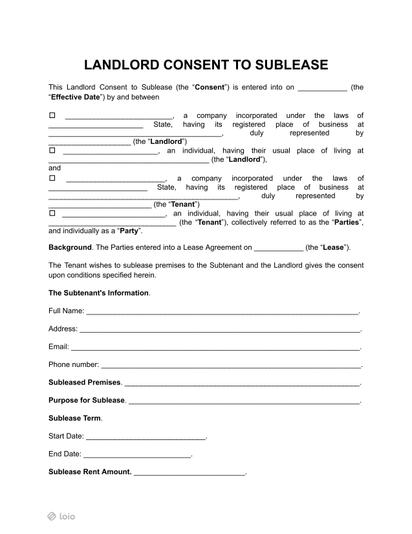
One quick tip: after your landlord approves, use our Landlord Consent to Sublease Template to create a formal approval letter that both of you sign. It turns an email exchange into an official document. It takes 10 minutes and gives you real protection.
Common mistakes
Subleasing without asking first: This is a breach of the lease and can trigger eviction.
Getting only verbal approval: "The landlord said it was okay" isn't enough. Always get written confirmation.
Not reviewing your lease before requesting: You might ask for something the lease prohibits.
Underestimating approval time: Landlord approval can take 2-6 weeks. Plan accordingly.
If the landlord refuses approval, you have limited options: negotiate an amendment, get a one-time waiver, or break the lease. For detailed break procedures and penalty costs, see our Commercial Lease Termination guide.
Requirement #2. How Does a Sublease Work: Understanding Your Liability
This is the element that surprises most business owners. Your liability doesn't transfer to the subtenant; it stays with you.
Why does the original tenant remain legally responsible after subleasing?
Yes, you do. Even after subleasing, you (the original tenant) remain legally responsible to the landlord for:
Rent payments. If the subtenant defaults, you owe the landlord.
Property damage. If the subtenant damages the building, the landlord can pursue you.
Lease compliance. If the subtenant violates building rules, you're responsible.
This legal concept is called "privity of contract", because you signed the original lease, you remain the landlord's direct accountability.
You sublease your office for $5,000/month (your rent is $4,000, so you profit $1,000). In month 3, the subtenant stops paying and leaves. Your landlord demands the unpaid $15,000 from you. You're on the hook: your subtenant is gone, but your obligation remains.
Common mistakes that cost money
Not collecting a deposit. "They seem trustworthy" is not a business strategy. Collect it from every subtenant.
Skipping the personal guarantee. If the business entity goes under, the owner still owes you.
Not requiring insurance. One lawsuit and you could be personally liable for damages.
Having unclear payment terms. You think rent is due on the 1st. They think they have until the 15th. Now you've got a mess.
Not documenting the property condition. When they move out, it's your word against theirs about what damage they caused.
Requirement #3. Define the Space & Terms
Vagueness about the definition creates disputes. You need to be specific: exact square footage, exact rooms, exact services included.
What exactly are they renting?
This sounds obvious, but it's where things go sideways constantly. "Half the office" is not a lease. "The back area" is not a lease. You need specific, documented clarity.
- 1
Physical space: Exactly which offices, desks, or areas are included? How many square feet? What furniture comes with it (desk, chairs, shelving units, etc)? What about storage: closets, filing cabinets? Parking?
- 2
Utilities and services: Who pays for electricity? Heating and air conditioning? Water? Internet? You'd be surprised how often this becomes a dispute. If you're including it in the rent, say so explicitly. If they're paying separately, define that.
- 3
Common areas: Can they use the hallway? What about the bathroom? Is there a break room? Can they use the conference room, and if so, how often? Is it included or extra? Who cleans what?
- 4
Specific amenities: Reception area access? Can they answer phones using your system? Use the printer? What about WiFi?
These details seem minor until they become points of conflict. The subtenant works late on a Tuesday evening and discovers the building is locked after 5 p.m. — you never specified access hours. They expect a kitchen cleaning service; you didn't include it. They're billed for the internet they thought you were covering.

Common mistakes that lead to conflict
Vague space descriptions. "Approximately 1,500 square feet in the back area" creates ambiguity. Specify exact dimensions, exact rooms, and exact square footage.
Undefined utilities. Who pays for which utilities? Even if the subtenant assumes responsibility, document it in the lease.
Shared space conflicts. If they share your bathroom, what's expected? Do they have specific hours, or is it on a first-come, first-served basis? Who cleans? How frequently?
Unrecorded existing damage. You show the space and notice a wall dent and carpet stain. If you don't photograph and document these, the wrong person can be accused of causing them, and you'll have difficulty disproving it.
Requirement #4. Create a Written Commercial Sublease Agreement
This is where informal arrangements become legal documents. A written sublease agreement is the foundation of your protection.
Why written agreement matters
Imagine this scenario: You've been subleasing for three months. The tenant stops paying rent. You want to initiate eviction. However, you lack a formal written agreement — just email exchanges about basic terms and a check they gave for the deposit.
You begin eviction proceedings. The judge asks for the lease. You show emails and texts describing terms. You lack a signed document specifying when rent is due, late payment consequences, default procedures, or eviction timelines.
You'll lose time and money litigating this, or you'll negotiate a settlement less favorable than it should be. Don't become this scenario. Secure a formal agreement.
Aligning with your original lease
It’s crucial: your sublease office space agreement needs to include everything your landlord requires of you. If your original lease says "professional services only," you can't let a subtenant run a manufacturing operation, even if they want to pay more. If the lease requires certain insurance, pass that requirement down. If there's a specific lease end date, your sublease has to end before or on that date, not after.
This is how you stay in compliance with your landlord. You're essentially making your subtenant agree to the same restrictions your landlord imposed on you. Your sublease agreement defines the space, term, and included amenities for the subtenant.
Essential terms
Here’s what your sublease should clearly cover, and why it matters:
Parties & Dates - Establishes who signs and when the lease begins/ends.
Exact Space & Items - Prevents disputes about what's included and what costs extra.
Payment Terms - Creates objective standards for when rent is due and the consequences if late.
Security Deposit - Protects you against unpaid rent and damage; document what it covers.
Default & Consequences - Establishes when you can enforce action or evict.
Damage Liability - Defines what damage the subtenant is responsible for paying.
Insurance Requirements - Protects you from personal liability if the subtenant causes injury or damage.
Property Access - Ensures you can monitor the space and respond to emergencies.
Move-Out Condition - Prevents disputes about deposit deductions when they leave
Early Termination - Addresses what happens if they want to leave before the lease ends.
Before you finalize the sublease agreement, you want to make sure every clause is clear and protective. Use our AI contract review tool to analyze your agreement, identify potential gaps, and get a summary of key risks and protections. It takes minutes and gives you confidence that you haven't missed anything important.
Common mistakes
Using a residential lease template. Commercial and residential are completely different. Don't do this.
Forgetting to include your landlord's restrictions. If your landlord required certain things of you, pass them to your subtenant as well.
No early termination clause. What if they want to leave after six months? You need buyout terms defined before this happens.
Vague default language. "They need to pay on time" is not enough. Specify dates, penalties, and consequences.
No signatures. An unsigned agreement isn't worth the digital paper it's printed on
Get a Professional Template
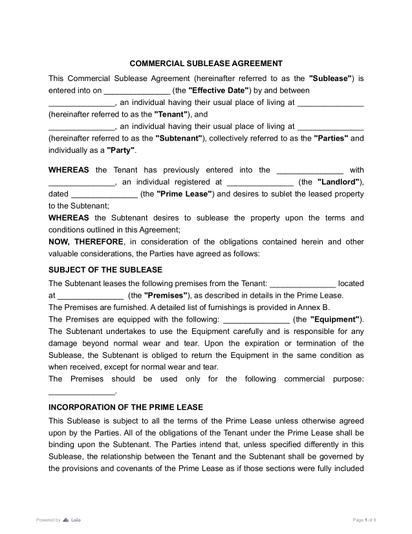
You understand what goes into a sublease agreement now. Don't build one from scratch. Download our Commercial Sublease Agreement Template: it's got all the required fields built in, explanatory notes so you understand each part, and you can customize it for your space in 15 minutes.
Download the template, customize the terms, and then use our PDF editing tool to add your company logo, adjust formatting, or make final edits before sending to the subtenant. It keeps everything in one professional document.
Requirement #5. Protect Your Commercial Sublease with Security & Screening
Who you select as your subtenant determines whether this arrangement succeeds or becomes a liability. Proper screening upfront saves months of headaches.
Determining appropriate security deposit
Standard practice is 1–2 months of sublease rent. For a $5,000 monthly sublease, this translates to $5,000–$10,000.
Request the higher amount if:
Credit history shows weakness
Their business type carries elevated damage risk (manufacturing, food service, high-traffic operations)
The lease commitment is short-term (12 months or less)
They're a newly established business
Lower deposit is appropriate if:
They've been in business 5+ years
They're professional services or consulting (lower risk)
They're committing to 24+ months
They came through a trusted referral.
Hold deposits in a separate account. Don't use these funds. Many states have specific rules about this; you might need to pay interest, keep a ledger, etc. Follow your state's rules, or you could lose the right to keep it.
5-Step commercial tenant screening
This 5-step screening process will help you evaluate potential subtenants more carefully and reduce the risk of payment issues, property damage, or lease disputes later on.
- The Intro Call
Get the basics: business type, age, and timeline. Red flags include vague descriptions ("consulting") or a lack of a budget. Look for established businesses (2+ years) that are transparent about their needs. - Financial Health
Review three months of bank statements and two years of tax returns. Aim for a credit score of 650+. A simple rule: if you wouldn't lend them your own money, don't lease them your space. - Legitimacy Check
Verify their business license and state registration. Does their website look professional? Ensure they have the specific permits needed for their industry (e.g., contracting or therapy). - Reference Calls
Talk to previous landlords. Ask point-blank if they paid on time and if they’d rent to them again. Most landlords are candid when speaking with a peer. - The Walkthrough
Meet them in person, show them the area. Observe how they treat the space and if they ask insightful questions. You’re looking for a partner you can work with for the next couple of years.
Tenants’ business characteristics reflect potential tenants’ quality. Studies prove that tenants’ quality affects the rental income of real estate.
Document property condition (Move-in protocol)
Before the subtenant arrives:
Take extensive photos/video. Document every room, condition of carpet, walls, furniture, and equipment. Date and timestamp all photos.
Create a detailed move-in checklist. Note any existing damage (carpet wear, wall scuffs, equipment condition).
Walk through with subtenant. Acknowledge existing damage so that no one claims they caused it.
Get signed move-in form. Both parties sign and date, confirming the property condition at move-in.
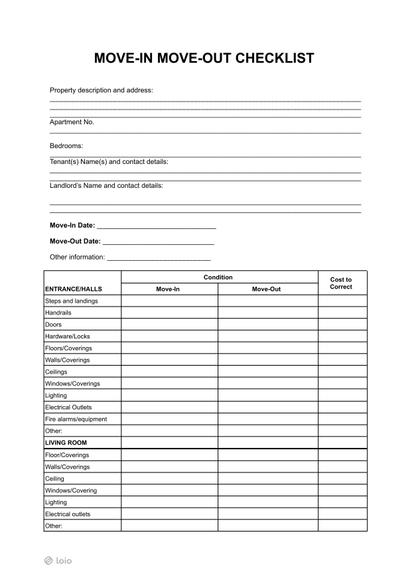
Before your subtenant moves in, document the property condition thoroughly. Our Move-In/Move-Out Checklist Template provides a detailed form to note existing damage, the condition of all areas, and creates a baseline for when they leave.
Common Screening Mistakes
Skipping deposit. "They seem trustworthy" isn't legal protection.
Not checking references. A previous landlord saying "late payments" should disqualify them.
Accepting personal checks as deposits. Only certified funds, wire transfer, or bank check.
Mixing deposit with operating funds. Keep it separate (state law requirement).
Skipping financial verification. A 5-minute credit check prevents months of non-payment.
The same screening process applies to vetting your landlord; our guide on How to Rent Space for Business covers a detailed evaluation of the landlord or property owner.
According to U.S. payment‑data research by the Consumer Financial Protection Bureau, tenant payment delinquencies and defaults can leave landlords with thousands of dollars in unpaid rent and write‑offs, underscoring why screening matters. Problem tenants and lease defaults result in multiple cost layers: unpaid rent, property damage repairs, and significant legal expenses for eviction proceedings.
How to Sublease Your Office Space: Readiness Checklist
Before you start marketing your space or thinking about how to start a subletting business, make sure you’re properly prepared.
Lease & Landlord Approval
☐ Read your original lease thoroughly
☐ Identified landlord's approval process
☐ Confirmed subleasing is allowed
☐ Got written landlord approval
☐ Understood all conditions (rent sharing, insurance, etc.)
☐ Documented the approval
Space Definition & Terms
☐ Measured exact square footage
☐ Listed specific rooms and areas included
☐ Documented utilities/services included
☐ Specified common area access and rules
☐ Took photos and floor plans
Financial Planning
☐ Calculated your cost per square foot
☐ Researched market rates in your area
☐ Decided on your sublease price
☐ Calculated security deposit (1–2x monthly rent)
☐ Set up a separate account for deposit
Legal & Protective Documents
☐ Got Commercial Sublease Agreement Template
☐ Customized all terms for your space
☐ Included all required clauses
☐ Added specific default and eviction language
☐ Had it reviewed by a lawyer (optional but recommended)
Tenant Screening Process
☐ Created screening checklist
☐ Set up credit check service
☐ Prepared reference questions
☐ Determined required insurance ($1M+ general liability)
☐ Planned your interview questions
Marketing & Outreach
☐ Decided where to advertise
☐ Wrote a clear space description with all details
☐ Took professional photos
☐ Created a floor plan diagram
☐ Set timeline expectations
Related guide: How to Rent Space for Business – a similar screening process applies to vetting landlords if you want to rent.
Wrapping it up
Subleasing your commercial office space is a smart way to reduce costs and maintain lease flexibility, but only if you do it legally and protect yourself financially.
The 5 legal requirements are your roadmap:
Get a written approval from the landlord.
Understand your liability: you stay responsible to the landlord.
Define space clearly; it prevents boundary disputes.
Create a written sublease agreement; it’s your legal protection.
Protect with deposits and screening to reduce financial risk.
Follow these steps, use a proper sublease agreement, screen tenants thoroughly, and document everything. You'll avoid costly mistakes and build a smooth subletting relationship.
More guides
September 1
7 min read
How to Provide Proof of Employment: Documents and Steps

July 26
10 min read
Commercial Real Estate Leasing Process: 2026 Guide

July 24
4 min read
What Is a Fixed-Term Lease, and How Is It Different From an Automatic Renewal Lease?

July 20
4 min read
Addendum vs. Amendment: Change Your Purchase Agreement Properly

September 4
8 min read
Buying vs. Leasing Commercial Property in 2026: Which Is Better for Your Business?

September 9
8 min read
Triple Net Lease vs Gross Lease: Costs, Risks, and Who Pays What

One home for your
agreements
Edit PDFs seamlessly
Tweak agreements before signing or sending for signatures. Update details, add or remove clauses, adjust formatting, and redline changes instantly.
eSign legally and securely
Sign documents and collect legally binding signatures. Invite up to ten people to sign in any order, track the progress, and send reminders.
Request legally binding signatures
Invite up to ten people to sign your document in any order. Get a finalized, audit-ready copy without chasing signatures.
Skip the drafting.
Choose from 2,500+ templates
Browse templatesChoose a template
Fill in details
Sign and download