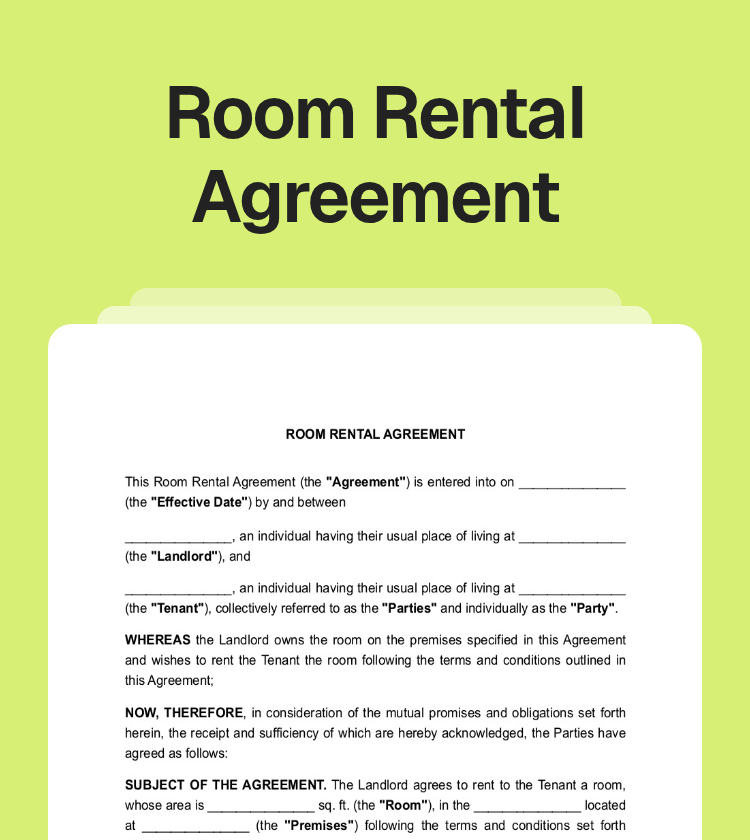
Free template
Free Room Rental Agreement Template

What Is a Room Rental Agreement Template?
Copy section linkA room rental agreement template helps a landlord, homeowner, or primary tenant document the terms for renting a room on a property. The renter usually gets private use of one bedroom and shared access to spaces such as the kitchen, bathroom, laundry area, hallway, or living room.
Room lease agreements are used in a wide range of living situations: student housing, short-term stays, sublets, and multi-tenant households where each occupant holds a separate agreement. Because multiple people share the same physical space, having a written contract is especially important. It removes ambiguity about who pays what, who cleans what, and what happens if someone breaks the rules.
A signed room rental lease agreement usually gives the renter a defined right to occupy the room for the agreed period. This right is often described as a leasehold interest or leasehold estate. The agreement also sets payment due dates, security deposit terms, maintenance duties, and the process for handling disputes. If a disagreement arises, the signed agreement can serve as important evidence of the terms both parties accepted.
Some landlords and primary tenants refer to this document as a room rental agreement form, a room rental agreement PDF, or a contract for renting a room, then customize it for each new occupant. Whatever format you use, the agreement must be complete, clearly written, and signed by all parties before the tenant moves in.
When to Use a Room Rental Agreement Template
Copy section linkUse a room rental agreement when:
A homeowner rents out one bedroom while continuing to live in the home.
A landlord rents separate rooms to different tenants in the same property.
A primary tenant rents a room to another person with the landlord’s written permission.
A student or young professional rents a private room in a shared apartment.
A renter will share utilities, kitchen access, bathroom use, cleaning duties, or parking.
The parties need written rules for guests, quiet hours, pets, smoking, storage, and remote work needs.
A fixed-term or month-to-month lease agreement for renting a room needs clear move-in and move-out terms.
When not to use a room rental agreement:
Use a lease agreement if the tenant is renting the entire home or apartment.
Use a roommate agreement if all occupants are already tenants under the same lease and mainly need shared-living rules.
Use a sublease agreement if an existing tenant rents part or all of the leased property to another person while the original lease stays active.
Use a lease addendum if the parties only need to change or add one term to an existing lease.
Who Are the Parties to a Room Rental Agreement?
Copy section linkLandlord: The property owner or authorized manager who rents the room and controls the rental property.
Primary tenant: The tenant named on the main lease who rents a room to another person, usually only if the lease and landlord allow it.
Room renter or tenant: The person who pays rent for the private room and follows the agreement, house rules, and applicable lease terms.
Roommates or other occupants: People who live in the home and may share common areas, utilities, cleaning duties, or quiet-hour rules.
Property manager: A person or company that may handle rent collection, repairs, access notices, or tenant communication.
Guarantor: A person who agrees to cover rent or certain unpaid amounts if the renter does not pay.
Witness or notary: Usually not required for a simple room rental agreement, but may be used if the parties want extra proof of signing or a state-specific rule requires it.
What Are the Key Components of a Room Rental Agreement?
Copy section linkParty information: Names, addresses, phone numbers, and emails identify who is bound by the agreement.
Property and room description: The agreement should list the property address and describe the exact room being rented.
Shared areas: Kitchen, bathroom, laundry, yard, garage, parking, and storage access should be listed clearly.
Lease term: The agreement should state whether the room rental is fixed-term, month-to-month, or another rental period.
Rent amount and due date: Rent terms should include the rent amount, due date, payment method, grace period, and any late fee, if applicable.
Security deposit: The agreement should state the deposit amount, permitted deductions, return process, and timeline in accordance with state law.
Utilities and services: Electricity, water, gas, internet, trash, and shared subscriptions should be assigned clearly.
House rules: Rules for guests, pets, smoking, quiet hours, cleaning, food storage, and shared items help prevent daily disputes.
Maintenance and repairs: The document should explain who reports damage, who pays for tenant-caused damage, and how repairs are handled.
Privacy and entry: The agreement should describe when the landlord, primary tenant, or property manager may enter the room, subject to state law.
Default and eviction terms: The agreement should explain what happens if rent is unpaid, house rules are broken, or the lease is breached.
Renewal and termination: Notice periods, move-out requirements, and renewal options should be stated clearly.
Signatures: Each required party should sign and date the agreement to provide written proof of consent.
What Are the Key Terms in a Room Rental Agreement?
Copy section linkRoom rental agreement: A contract that allows a renter to occupy one room in a shared residential property.
Rental agreement: A written agreement that sets the terms for using residential property in exchange for rent.
Landlord: The property owner or authorized person who gives another person the right to rent the room.
Primary tenant: A tenant under the main lease who may rent out a room if the lease and landlord allow it.
Leasehold estate: The renter’s legal right to occupy the room for the agreed rental period.
Security deposit: Money collected before or at move-in to cover unpaid rent, damage beyond normal wear and tear, or other allowed charges.
Common areas: Shared spaces such as the kitchen, bathroom, living room, hallway, laundry area, yard, or parking space.
Utilities: Services such as electricity, gas, water, trash, internet, cable, or other shared household services.
Default: A failure to follow the agreement, such as unpaid rent, unauthorized pets, property damage, or repeated rule violations.
Eviction: A legal process a landlord may use to remove a tenant after a serious breach, subject to state and local law.
How to Fill Out a Room Rental Agreement Template
Copy section linkEnter the landlord’s or primary tenant’s full legal name and contact information.
Enter the renter’s full legal name and contact information.
Add the full property address.
Describe the exact room being rented.
List the shared spaces the renter may use.
Choose the rental term, such as fixed-term or month-to-month.
Add the rent amount, due date, payment method, and late fee if applicable.
Enter the security deposit amount and return terms.
Explain which utilities are included and which costs are shared.
Add rules for guests, pets, quiet hours, smoking, parking, storage, and cleaning.
Add rules for guests, pets, quiet hours, smoking, parking, storage, and cleaning.
State who handles maintenance, repairs, and damage caused by the renter or guests.
Add privacy and entry rules for the rented room.
Add default, early termination, renewal, and move-out terms.
Check state and local laws before signing, especially for deposits, disclosures, entry, subleasing, and eviction.
Sign and date the agreement (by hand or with an electronic signature). Give each party a copy.
Requirements for this document vary by state. Review your state's laws and procedures — or consult a licensed attorney — before using this template to ensure it's valid and enforceable where you live.
Sources
Related documents
Also read