Garage Lease Agreement Template

4.8 (68 reviews)
All states | 17 types
Updated Jan 8, 2024
~ 6 pages
PDF
3K downloads
A Garage Lease Agreement is a rental contract between a property owner and a tenant granting rights to use a garage or parking space. It is used to define rental terms, duration, and responsibilities for maintenance and payment.
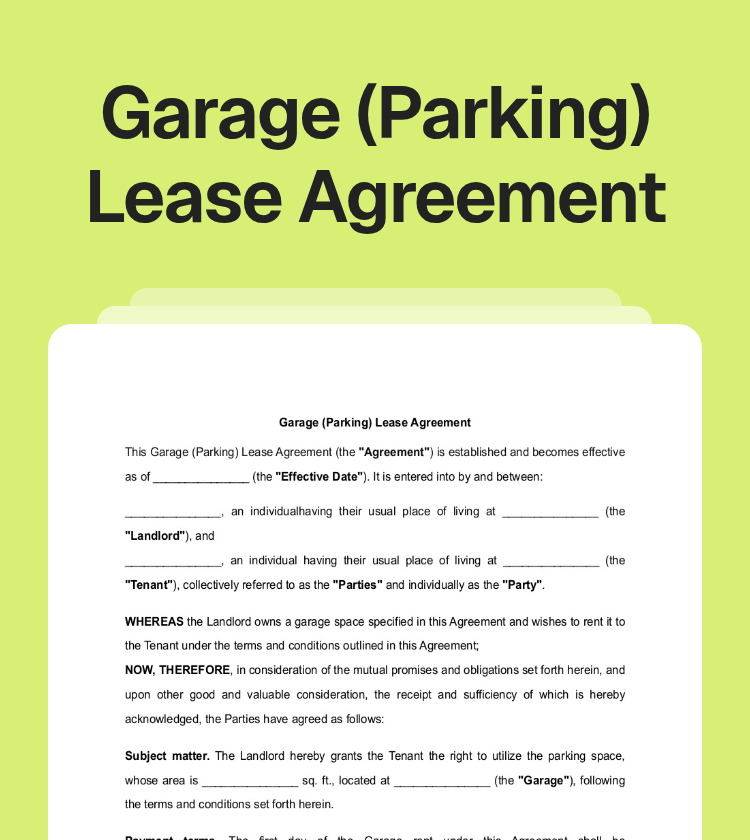
Garage (Parking) Lease Agreement

This Garage (Parking) Lease Agreement (the "Agreement") is established and becomes effective as of   (the "Effective Date"). It is entered into by and between:

 , an individualhaving their usual place of living at   (the "Landlord"), and

 , an individual having their usual place of living at   (the "Tenant"), collectively referred to as the "Parties" and individually as the "Party"


WHEREAS the Landlord owns a garage space specified in this Agreement and wishes to rent it to the Tenant under the terms and conditions outlined in this Agreement;

NOW, THEREFORE, in consideration of the mutual promises and obligations set forth herein, and upon other good and valuable consideration, the receipt and sufficiency of which is hereby acknowledged, the Parties have agreed as follows:


Subject matter. The Landlord hereby grants the Tenant the right to utilize the parking space, whose area is   sq. ft., located at   (the "Garage"), following the terms and conditions set forth herein.


Payment terms. The first day of the Garage rent under this Agreement shall be   (the "Start Date"), and the last day of the rent under this Agreement should be   (the "End Date").

The rent fee is   fixed sum (the "Rent Fee") due on   (the "Due Date").

All payments shall be made by cash.


Term. The rent term is a period from the Start Date to the End Date (the "Term"). This Agreement shall commence on the Effective Date and, subject to the provisions of this Agreement, shall remain in effect until the End Date unless terminated earlier by either Party upon providing   days prior written notice to the other Party. Unless agreed otherwise, nothing shall limit the Parties to prolong the Agreement, subject to the Parties' mutual agreement on a month-to-month basis.

Late payment. If any payment due under this Agreement is delayed by more than   days, the Tenant shall be responsible for paying a late fee of   per day.


Insufficient funds. The Tenant agrees to cover a charge of   for each check issued to the Landlord that is returned due to insufficient funds.


Security deposit. The Tenant is required to provide the Landlord with a security deposit of  , which shall be held in trust. This security deposit serves as protection for the Tenant's compliance with the terms and conditions of this Agreement and any damages caused by the Tenant, the Tenant's family, agents, or visitors to the Garage throughout the Term. The Landlord reserves the right to utilize a portion or the entirety of the security deposit to cover the costs of repairing any damage inflicted on the Garage by the Tenant, the Tenant's family, agents, or visitors. It is important to note that the Landlord is not solely limited to the security deposit amount, and the Tenant remains liable for any outstanding balance beyond the security deposit.

The Tenant is prohibited from applying any portion of the security deposit to offset the rent for the final month or any other rent payment during the lease term. In the event of a breach of any terms or conditions outlined in this Agreement by the Tenant, the Tenant shall forfeit the security deposit to the extent permitted by applicable law.


Defaults. If the Tenant fails to perform or fulfill any obligation outlined in this Agreement, it shall be considered a default. Unless prohibited by applicable statute, ordinance, or law, the Tenant shall have a grace period of   days from the date of receiving notice of default from the Landlord to rectify the issue. If the Tenant does not remedy the default within this specified period, the Landlord has the right to take one of the following actions:

  • Cure the default personally, with the associated costs added to the Tenant's financial responsibilities under this Agreement;
  • Declare the Tenant in default of the Agreement.

In the event of a default, and as permitted by law, the Landlord also reserves the right to re-enter the Garage and regain possession. Additionally, the Landlord may hold the Tenant responsible for any difference between the rent that would have been payable under this Agreement for the remaining term if the Agreement had continued and any rent received from any subsequent tenant in the event of re-letting the Garage. If the Landlord is unable to re-let the Garage for the remaining term of this Agreement after the Tenant's default, the Landlord has the right to hold the Tenant liable for the unpaid balance of the rent under this Agreement as if it had continued in force.

Non-compliance by the Tenant, the Tenant's guests, or invitees with any provision of this Agreement shall be considered grounds for the termination of the tenancy, subject to the appropriate notice and legal procedures as required by law.


Possession and surrender of the Garage. The Tenant shall have the right to take possession of the Garage on the Start Date. Upon the termination of the Agreement, the Tenant shall peacefully return the Garage to the Landlord or the Landlord's agent in the same condition as it was at the start of the Agreement, considering any reasonable wear and tear.


Use of the Garage. The Tenant is permitted to use the Garage exclusively for the following purpose:  .


Assignment and sublease. The Tenant may not assign or sublease any portion of their interest in this Agreement without obtaining the Landlord's prior written consent.


Alterations and improvements. The Tenant shall refrain from making any improvements or alterations to the Garage without obtaining prior written consent from the Landlord. If any alterations, improvements, or modifications are made to the Garage, except for fixtures and personal property that can be removed without causing damage to the Garage, such alterations or improvements shall become the property of the Landlord. These alterations or modifications shall remain in place upon the expiration of the Agreement unless otherwise stipulated in a written agreement.


Maintenance and repair. The Tenant shall be responsible for maintaining the Garage in a good, clean, and sanitary condition throughout the duration of this Agreement and any subsequent renewals.


Security and responsibility for loss. The Tenant acknowledges that the Landlord does not furnish any security alarm system or other security measures for the Garage. The Tenant's vehicle and personal belongings occupying the parking space shall be entirely at the Tenant's risk. The Tenant releases the Landlord from liability for loss, damage, claims, or injuries arising from unforeseen events or incidents.


Insurance and registration. The Tenant must maintain current and lawful insurance coverage for their vehicle(s). Only vehicles that adhere to all relevant laws and regulations shall be permitted to occupy the parking space.


Force majeure. Neither Party shall be liable for any failure to perform or delay in performing the obligations under this Agreement if such failure or delay is caused by events of force majeure, including but not limited to acts of God, war, terrorism, strikes, lockouts, labor disputes, pandemics, epidemics, governmental regulations, or any other similar causes beyond the reasonable control of the affected Party.

In the case of force majeure, the affected Party shall immediately notify the other Party in writing and provide reasonable proof of the cause of the delay or inability to perform the obligations. The Party affected by force majeure shall endeavor to mitigate the consequences of such circumstances and resume the performance of obligations as soon as possible after the circumstances cease to exist.

If the force majeure circumstances last more than   days, either Party may terminate this Agreement by giving written notice to the other Party. In this case, neither Party shall be liable to the other Party for any damages arising from the termination of this Agreement.

Binding effect. The covenants and conditions outlined in this Agreement shall apply to and bind the Parties involved and their heirs, legal representatives, successors, and authorized assignees.


Governing law. This Agreement shall be governed by and interpreted following the laws of the State of  , and any disputes resulting from or related to this Agreement shall be exclusively resolved by the courts of the State of  .


Entire agreement. This Agreement constitutes the complete understanding between the Parties and overrides any previous representation of any nature that precedes the date of this Agreement. No other commitments, conditions, understandings, or agreements, whether oral or written, on the subject matter of this Agreement exist. Any modifications to this Agreement must be made in writing and require the signatures of both the Landlord and the Tenant.


Notice. Any notice or communication required or permitted under this Agreement shall be sufficiently given if delivered personally or by certified mail, return receipt requested, to the address outlined in the opening paragraph or to such other address as one Party may have furnished to the other in writing, or to emails set forth below:

If to the Landlord:  ;

If to the Tenant:  .

Cumulative rights. The rights of the Landlord and the Tenant under this Agreement are cumulative and shall not be interpreted as mutually exclusive unless otherwise mandated by law.


Waiver. The failure of either Party to enforce any provisions of this Agreement shall not be considered a waiver or restriction of that Party's subsequent right to enforce and require strict compliance with every provision of this Agreement. The acceptance of rent by the Landlord shall not constitute a waiver of the Landlord's right to enforce any provisions of this Agreement.

IN WITNESS WHEREOF, the Parties have caused this Agreement to be executed on the Effective Date in  ,   County, State of  .

THE LANDLORD

THE TENANT

 ,

 , USA


____________________________________

(Place for signature)


 ,

 , USA


______________________________________

(Place for signature)


Written by Megan Thompson - Reviewed by Jonathan McGill

Template Description

Copy section link
Paper titled "Garage (Parking) Lease Agreement"; two men talking and standing by parking spots

A garage lease agreement is a legal document that outlines the terms and conditions of renting a parking spot or garage for a vehicle. Like a typical residential or commercial lease, a parking lease agreement delineates the responsibilities of the lessor and lessee, effectively safeguarding both parties' interests.

In many urban areas, parking spaces are a limited and valuable commodity. This allows property owners with extra space to lease it out, thereby generating additional income. However, as with any business transaction, it's crucial to have a clearly formulated and law-abiding contract in the form of a garage lease agreement. This ensures the terms of the agreement are upheld and any potential disputes or misunderstandings are minimized.

When to Use a Garage (Parking) Lease Agreement

Copy section link

A parking space lease agreement is most commonly used when a property owner has additional parking spaces they wish to rent out. This could be a standalone parking lot, parking spaces within a multi-story parking garage, or even a single garage for lease on a residential property.

Another instance is when businesses need additional parking for their employees. Instead of purchasing property, they may opt for a parking lot lease agreement with nearby property owners. Sometimes, residential tenants may need additional parking space and may engage in a parking space rental agreement with their landlord or the owners of the neighboring property. 

Irrespective of the context, formalizing the agreement through a garage lease prevents disputes and is beneficial to all parties involved since it protects their rights and ensures clarity of terms.

Parties of a Garage (Parking) Lease Agreement

Copy section link
  • Lessor –– This is the individual or entity who owns and is leasing out the garage or parking space. They provide the necessary rights to the lessee, enabling them to use the garage or parking space for a specified term as stated in the parking space lease agreement. Upon complete fulfillment of the lease term, the lessor has total rights to regain the use of their property. This retraction of leased rights signifies the end of the lease term, and the lessor regains full and uninhibited possession and control of the property.

  • Lessee –– This would be the individual or entity agreeing to lease the garage or parking space from the lessor. The lessee agrees to abide by all terms set out in the garage rental agreement. This includes but isn't limited to terms regarding payment, duration, and rules of conduct while using the garage or parking space.
Insight

Upon completion of the lease term, the lessee is obligated to hand back the use and possession of the parking space to the lessor. They also provide acknowledgment, often in the form of a document or receipt, that signifies the termination of the parking rental agreement and the successful completion of the lease terms.

  • Lease Term: This refers to the duration of the parking lease terms.
  • Rent: The amount paid by the lessee to the lessor in exchange for using the parking space or garage.
  • Security Deposit: A certain amount of money given to protect the lessor against damages or contract breaches.
  • Default: A violation of any terms of the agreement by either party, providing grounds for the agreement to be terminated.

How to Write a Garage (Parking) Lease Agreement

Copy section link

Creating a parking spot lease agreement is a necessary process for anyone needing to rent out their parking space or garage. This document is essential in legalizing the arrangement and ensuring the protections and rights of both the lessor and the lessee. Here's a walk-through on how to craft a robust parking agreement:

Lessor
  1. Provide detailed identification of the parties involved. It includes your full name and current contact information.
  2. Clearly describe the parking space or garage to be leased. Include its precise location, dimensions, and any other distinguishing features.
  3. Outline the specifics of the lease terms, like duration and renewal options.
  4. Detail the cost of the lease, the preferred payment method, and any potential late fees or penalties for agreement violations.
Lessee
  1. Furnish your valid identification details, including your full legal name and contact information.
  2. Provide details of the vehicle that will be parked in the space, including its make, model, and license plate number.
  3. Acknowledge understanding of the lease duration, the terms and conditions, and the agreed-upon rental cost.
  4. Agree to the protocol for any damages to the parking space, security measures, or any other liabilities.

Regardless of your role in the process, it's crucial for all parties to review the garage lease agreement with some legal counsel. This ensures that individual interests are well-protected and that there's a consensus on vital components of the agreement, such as liability for damages and lease termination terms. Developing a well-structured lease agreement ensures smoother transactions and minimizes potential conflicts or misunderstandings.

In conclusion, whether you're a lessor or a lessee in need of extra spaces, it remains essential to have formal parking agreements that can safeguard your interests and provide a clear understanding of the leasing terms. Consider utilizing a customizable parking space rental agreement PDF template available at Loio to ensure you cover all necessary points and terms.