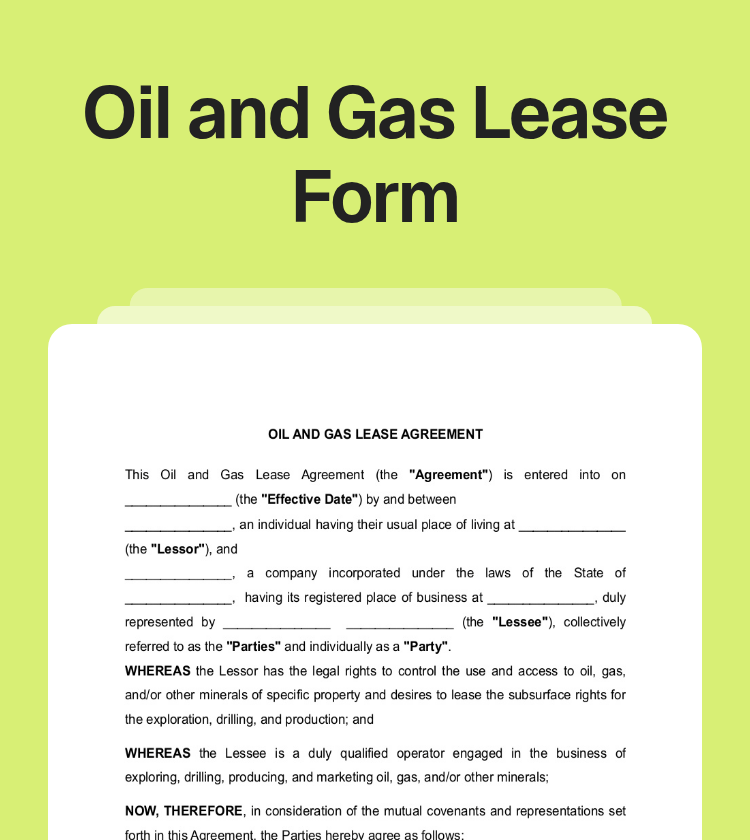
Free template
Free Oil and Gas Lease Example

What Is an Oil and Gas Lease Form?
Copy section linkAn oil and gas lease land contract is a legal form in which landowners (“lessors”) provide energy companies (“lessees”) with the right to explore, extract, produce, and distribute oil and gas resources from the private property. This legal document protects the landowner’s rights, confirms the lease legality for state governments, and outlines the terms and conditions of oil and gas extraction for the established royalty price.
In the United States, individuals or legal entities may hold surface rights and mineral rights, which is known as a fee simple estate. This involves total private ownership in which an owner holds the land’s surface, its subsurface (including minerals and other resources), and the air above a particular piece of land. Thus, owners can sell or lease their mineral rights (the rights to extract minerals) and retain their surface rights.
Parties of the Oil and Gas Lease Form
There may be multiple mineral rights owners, and all owners must agree to the terms of the release of oil and gas lease form. The parties to an oil and gas lease are:
- The Lessee — the company purchasing the right to explore, drill, remove, produce, and distribute the oil and gas from the leased property.
- The Lessor(s) — the owner or owners of the oil and gas rights. There may be several individuals or entities who own an interest in the oil and gas rights of a property, and all are necessary parties to the agreement.
Property owners (including the federal government) can own the surface rights to a piece of property without owning the mineral rights. In some states, the mineral rights to a piece of property may belong to someone other than the surface owner. This is known as split-estate ownership.
Key Terms
- Lease — a legal agreement between the owner of the oil and gas rights and the company that will explore and drill for oil and gas.
- Bonus consideration — money paid by the lessee to the lessor for the extraction of minerals, which is usually paid per acre of land leased.
- Mineral owner — the owner of the rights to a land’s minerals, which may be different from or in addition to the landowner.
- Offset well — a well set near another land tract where there is already a producing well.
- Paid-up lease — a lease that has been paid in advance through the duration of the primary term.
- Royalty — the value paid to the lessor that is based on a percentage of gross proceeds from the oil and gas production.
- Habendum clause — a clause in an oil and gas lease, also called a “term clause,” that defines the term of the lessee’s interest.
- Abstract company — a business that prepares abstracts of titles.
- Net revenue interest — a part of the production money that is paid after the operating and development expenses are subtracted.
What Should Be Included?
Copy section linkWhile the terms of oil and gas leases will vary, there are some standard provisions that should always be included. The following terms should be set forth and defined according to the parties’ agreement:
The parties — The names and identifying information of the lessor(s) and lessee(s) must be included.
The date — The effective date of the lease will usually be set forth at the beginning of the contract.
Property description — The address and legal description of the property subject to the lease agreement must be included.
The lease term — Define how long the lease will be in effect.
Royalties — State the percentage of the proceeds of the oil and gas production that the owner will receive.
Leasing clause — This clause defines the rights of the oil and gas company to explore, drill, produce, develop, and distribute oil and gas from the leased property.
How To Write an Oil and Gas Lease Form Template
Copy section linkWhether you are the landowner or the oil and gas company, you may need to know how to create a fair and comprehensive oil and gas lease agreement. The following steps will help you when using the oil and gas lease form template.
1. Contact the Other Party
If you are the oil and gas company representative, you will need to research the land records to determine who owns the property you are interested in. Once you locate the landowner, you will need to contact the owner or owners to see if they are interested in leasing their land for oil and gas exploration.
If you are a landowner, you may want to contact oil and gas companies that are leasing property in your area to determine whether the company is interested in leasing your land for oil and gas exploration. You may be able to negotiate a profitable agreement.
2. Negotiate the Terms of the Agreement
The parties should discuss the terms and conditions of the agreement. The oil and gas lease form template will guide you through the essential terms. If either party is unsure of the meaning of any terms or whether certain terms are in their best interest to include, that party may want advice from a local attorney who is experienced with oil and gas leases.
3. Customize the Oil and Gas Lease Form
Once you have negotiated the terms of your agreement, you should customize the oil and gas lease form to reflect those terms. You may download a sample template as a PDF file. Ensure that the parties’ names and identifying information are correct and that all conditions are clearly set forth.
4. Execute the Oil and Gas Lease Agreement With a Notary
All contracts need to be signed and dated by the parties. Additionally, when a contract affects real estate, most states require it to be notarized or witnessed or both. Be sure to follow your state’s laws when executing the oil and gas lease agreement. Even when not required, it can be in the parties’ best interest for them to sign and date the agreement in the presence of a notary and witnesses.
When Should an Oil and Gas Lease Land Contract Be Used?
Copy section linkEnergy companies use geological maps to search for the perfect land to start drilling for oil or gas and/or producing various hydrocarbon products. If you have a vast property, land businessmen may reach out to you and offer to cooperate.
Providing acres of land for mineral exploration and development can become a perfect business opportunity for landowners if both sides negotiate correctly with a carefully composed landman oil and gas lease form template. This kind of legal document has been well-known for over a hundred years and gathers all the essential points for a reliable business partnership.
Common Use Cases
Oil and gas lease agreements are used when a landowner agrees to allow an oil and gas company operator to produce and sell oil and gas located below the surface of the land.
The most common scenario occurs when a land agent who works for an oil and gas company makes contact with a landowner to negotiate an agreement. Sometimes, a landowner may approach the oil and gas company to see if the company is interested in exploring for minerals on the landowner’s property. In both situations, the parties will need to enter into an oil and gas lease agreement.
When Not To Use the Oil and Gas Lease Form
Do not use an oil and gas lease form unless you have negotiated carefully and fully understand the terms of the agreement. If you have questions or concerns, a local attorney may be able to help you with the oil and gas lease form.
Remember that the land agent works for the oil and gas company, so you should not rely on them to protect your interests as a landowner. However, once you are confident that you have negotiated general terms that protect your interests, reduce the agreement to writing and execute a legally binding oil and gas lease contract for the sale of those rights.
State Law
Copy section linkEach state has its own laws governing oil and gas activities. The following table contains each state’s relevant oil and gas statutes if you would like to learn more about the regulations in your own state.
Ala. Code 1975 § 9, chapter 17, article 2, division-1 et seq.
AK Stat § 38.05.180 et seq.
AZ Stat § 27-254 et seq.
AR Stat § 15-6-73-2 et seq.
Cal. Civ. Code, Division 2, Part 2, Title 5, Chapter 3, Article 1, Section 883.140
CO Rev. Statute § 38-42-101-106 et seq.
Regs., Conn. State Agencies § 22a-472-1
Del. Stat § 7-6101-6143 et seq.
Florida Statutes, title XVIII, chapter 253, § 253.512
GA Code §12-4-2 et seq.
HI Revised Statutes, Title 12, § 182-7 et seq.
ID Code § 47-704 et seq.
225 ILCS § 725 et seq.
Indiana Code § 32-23-8-1 et seq.
Iowa Code § XI-458A et seq.
Kansas RS chapter 55, article 2 et seq.
KRS Chapter 353
LA RS Title 31, Chapter 7, et seq.
Maine Revised Statutes, Title 12, Part 2, Chapter 201 -A, Subchapter 3, 12 § 549-B
Md. Environmental Code Ann. §14-511 et seq.
Mass. Code, Part II, Title I, Chapter 184a, Section 5
MI Code Chapter 554 Section 554.281
MN Stat. § 272.04 et seq.
MS Code Title 89, Chapter 5, Article 1, § 89-5-23
RSMo. Title XVi Chapter § 259 et seq.
MT Code Ann. Title 77 Chapter 3 part 4 et seq.
NE RS Chapter 57 § 57-201 et seq.
NRS Chapter 522 § 522.050 et seq.
NH RS Title X, § 146-A:2 et seq.
New Jersey Revised Statutes, Title 46, Section 46:3:27
N.M. Sta. Chapter 70, article 1, Section 70-1-1
NY Laws, ENV – Environmental Conservation, Article 23, Title 11, § 23-1101, et seq.
NC Stat. Chapter 47E, § 47E-4.1
ND Cen. Code Title 38 Chapter 38-11
Revised Code Title 15 Chapter 1509.01 et seq.
OK Stat § 52-1 et seq.
ORS § 520.005 et seq.
PA RS Title 58
RI Stat. Title 37, chapter 37-7, section 37-7-9
SC Code § 48-43-10 et seq.
SD Code § 7-31-38 et seq.
TN Code § 60-1-101 et seq.
Tex. Nat. Res. Code Title 3, Subtitle B, Chapter 85, Subchapter A, § 85.001
Utah Code Ann. §§ 40-6-1-19 et seq.
29 V.S.A. § 541 et seq.
VA Code Title 45.2 chapter 16 et seq.
WA Code § 78.52.001 et seq.
WV Stat. § 22-6A-2 et seq.
WI Rev. Stat. § 295.33 et seq.
WY Stat. § 30-5-101 et seq.
Please be aware that development of oil and gas on private land is primarily governed by state and local authorities.
For instance, in Texas, the Railroad Commission is the state authority responsible for the regulation of oil and gas development, including qualification and registration of operators. In Oklahoma, the oil and gas regulator is the Corporation Commission, and the Louisiana Department of Natural Resources fulfills the same role in Louisiana. Such state regulatory agencies are usually responsible for issuing drilling permits, registering oil and gas operators, etc. Therefore, it is recommended to review local legislation requirements before entering into oil and gas lease agreements.
Related Documents