Free template
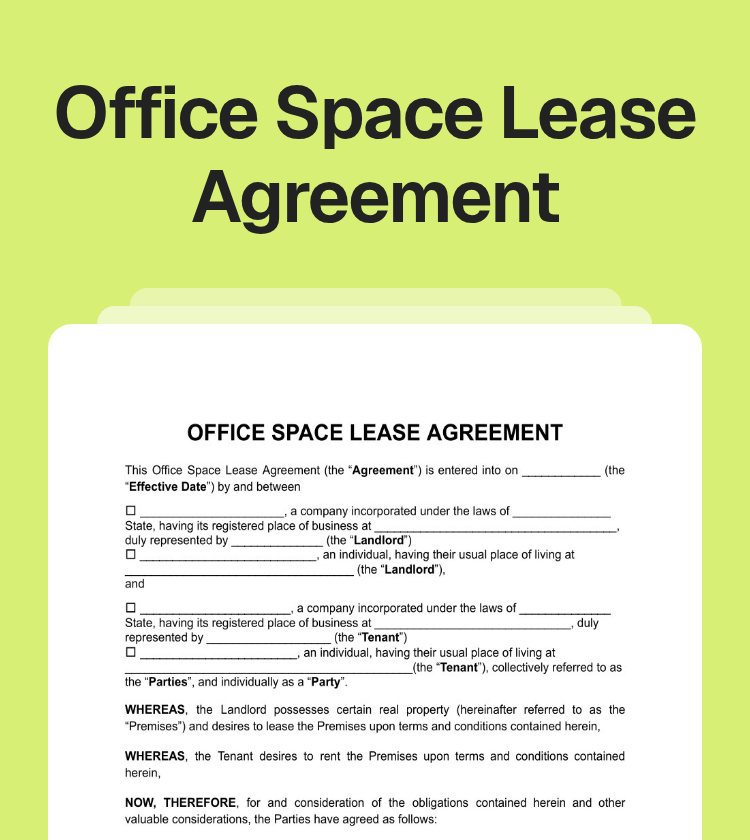
Free Office Lease Agreement Template

What Is an Office Space Lease Agreement?
Copy section linkAn office space lease agreement is a legally binding contract between a tenant and a landlord that outlines the main conditions, costs, and terms of the lease. Terms like “lease,” “rental agreement,” and “contract” are often used interchangeably to refer to the same document.
Unlike a residential lease, a commercial lease has a few add-ons that aren’t typically there if you just lease a space for living. A commercial lease document would cover items such as the base monthly rent, security deposit, lease term, and permitted business uses. Plus, a written contract establishes who is responsible for what (including utilities or repairs). An office lease agreement template helps both sides set their agreement in writing and decide how their responsibilities will be shared.
When to Use an Office Space Lease Agreement
Copy section linkA business needs to rent a dedicated office space for administrative, professional, or client-facing work
A landlord is leasing out office units within a commercial building or business park
A startup or small business is moving out of a co-working space into its own office
A company needs to formalize terms for shared amenities, such as parking, reception, or conference rooms
A tenant is renting office space on a long-term basis (typically one year or more)
A business is expanding and needs additional office space in a new location
When Not to Use an Office Lease Agreement
Copy section linkUse a commercial lease agreement if the space will be used for retail, warehouse, or industrial purposes rather than office work
Use a sublease agreement if a current tenant wants to lease out part or all of their existing office space to another party
Use a coworking or desk-space agreement if the arrangement involves shared, flexible workspace rather than a dedicated private office
Use a short-term rental agreement if the space is needed for a few days or weeks rather than an ongoing lease term
What Are the Parties to an Office Space Lease Agreement?
- Tenant — This is the individual or business entity that is renting the office space in question. They are responsible for making timely rent payments as agreed upon in the office lease agreement. During the term of the lease, the tenant has the right to use and occupy the premises for their business operations, subject to the terms of the lease. Upon completion of the lease term, the tenant either vacates the office space or negotiates a lease renewal with the landlord.
- Landlord — This is the person or firm that owns the office space and is leasing it out to the tenant. As part of the office rental agreement, the landlord holds the responsibility to provide a space that accommodates the tenant's needs, maintains the structural condition of the office space, and ensures peaceful enjoyment of the premises.
The landlord also has the right to receive rent and, at the end of the lease term, regain possession of the office space unless a lease renewal is agreed upon. All these roles and responsibilities are explicitly outlined in the office space lease to avoid any confusion or future disputes.
What to Include to an Office Lease Agreement?
Copy section link- Parties and effective date. Here, an office lease agreement begins by identifying the tenant and the landlord, along with the official date the contract becomes active.
- Premises description and purpose. This section defines the specific office space and address being rented, and explains the purpose.
- Lease term. It explains the tenancy duration, clarifying whether it is a fixed-period or month-to-month lease.
- Lease fees and payments procedure. An office space lease sets out all the specifics for rent amount, due date, and rules for changing any terms.
- Late payment. This point outlines the grace period and financial penalties if rent is not paid on time.
- Security deposit. It describes the upfront security amount required to cover potential defaults or damages during the lease term.
- Possession. This term confirms that the tenant accepts the space in “as is” condition and is satisfied.
- Parking. This aspect of an office rent agreement clarifies whether parking is provided and, if so, details it.
- Utilities. This discusses the responsibilities of the landlord and tenant for essential services such as water, electricity, trash, and internet.
- Access to common areas. It defines a tenant’s right to use shared facilities that don’t include the office space itself.
- Subletting. If a tenant wants to re-lease a space to another party, this section outlines if it’s even allowed.
- Termination upon sale of the premises. It grants the landlord the right to sell the property and end the lease early if they provide written notice.
- Destruction of the premises. This section explains how the agreement ends if the space is destroyed by casualty or force majeure.
- Termination. It reminds that a lease agreement for office space can be ended early and how.
- Notices. This one sets specifics for communication, with addresses for reaching out/sending messages.
- Governing law and dispute resolution. It’s vital to identify which state laws and courts hold power over the contract — that’s what this section does.
- Signatures. Both parties verify that they agree to the terms of the contract.
Key Terms to an Office Lease Agreement
Copy section link- Premises: This is the description of the space to be leased, providing details about its location and any pertinent features.
- Term of lease: This outlines the lease's length, stating its commencement and expiration dates. It can also include provisions for lease extension or early termination.
- Rent: This section provides details on the amount of rent when it is due, and the accepted modes of payment. Any provisions for security deposits should also be mentioned.
- Repairs and maintenance: It's important to stipulate who is responsible for repairs and general upkeep of the premises.
- Default and remedies: This addresses what happens if either party does not uphold their obligations under the agreement. Remedies could include termination of the agreement or legal action.
How to Write an Office Space Lease Agreement
Copy section linkWriting an office space rental agreement can seem daunting, but with proper knowledge of the crucial steps that need to be included, it becomes a straightforward task.
Let’s look at the key steps of the creation of the simple office rent agreement:
Specify the parties involved:
Clearly define who the landlord and the tenant are. This could be individuals or business entities.Describe the premises:
Include a detailed description of the office space being leased, including its location and any specific features or furnishings included in the lease agreement for office space.Outline lease term:
State clearly the duration of the lease, including the commencement and termination dates. Detail any provisions for lease renewal or premature termination.Detail the rent:
Indicate the rent amount, the due dates, and your preferred form of payment. If there is a security deposit, include information about it.State who is responsible for maintenance and repairs:
Clearly lay out who will be responsible for maintaining the property, including minor repairs and general upkeep.Cite potential default and remedies:
Outline what the consequences are if either party defaults on their obligations under the agreement. This could range from monetary penalties to termination of the agreement.
Drafting an office rental agreement benefits both tenants and landlords because it essentially works as protection. A structured office lease agreement template ensures that all of the critical terms are accounted for. Take your time establishing and finalizing a contract — this will help you prevent future disputes and support a transparent professional relationship.
Do You Need to Notarize an Office Space Lease Agreement?
Copy section linkUsually, a short-term office space rental agreement doesn’t require notarization to be legally valid. But requirements vary significantly by state. In some jurisdictions, leases that exceed a specific duration (often 1-3 years) must be signed in the presence of a notary public and recorded in local land records to be enforceable against third parties. For example, Ohio Revised Code sets this exact limitation for three years. Each state has its own rules, so make sure to check it against your local requirements before finalizing your office lease template.
What is the difference between a net lease and a gross lease?
They differ in the payment approach. A gross office lease means a tenant pays a fixed rent, and the landlord covers operating costs such as property taxes, insurance, and utilities. Under a net lease, the tenant pays rent plus a proportionate share of the building-related expenses.
Should an office lease agreement include a personal guarantee?
A personal guarantee makes a person (most often the business owner) liable for rent and legal obligations if the corporate entity defaults on the lease. New businesses will often find a landlord expecting that, which is logical given the potential risks.
Can a tenant sublet office space under this agreement?
This depends entirely on what is mentioned in the agreement. Sometimes it’s totally possible; in other situations, a landlord forbids it. Draft the appropriate options into your office space lease agreement template to be prepared for both scenarios.
What is a build-out allowance?
A build-out allowance is useful if a tenant needs to make improvements to the property. It is a fund provided by a landlord to cover the costs of renovating and adapting the space to meet tenants’ needs.
What happens if an office is destroyed by a natural disaster?
Since a natural disaster is beyond either party’s control, the agreement usually terminates automatically, relieving both parties of their obligations and granting the tenant a refund of prepaid rent and security deposits.
What are the 4 types of commercial leases?
The 4 types of commercial leases are net lease, gross lease, modified gross lease, and percentage lease. They differ in how operating expenses are split between the tenant and the landlord.
What is the 90% rule in leasing?
The 90% rule is a common test in leasing that is used to decide whether a lease is a capital or operating lease. If the payments you make over the life of the lease (calculated at present value) equal 90% or more of what the property is worth, the lease is considered a finance lease. This means that the tenant has to report the lease on their balance sheet.
Requirements for this document vary by state. Review your state's laws and procedures — or consult a licensed attorney — before using this template to ensure it's valid and enforceable where you live.
Sources
Copy section linkRelated documents
Also read