Month-to-Month Rental Agreement Template

4.8 (12 reviews)
All states | 17 types
Updated Feb 13, 2024
~ 7 pages
PDF
2.8K downloads
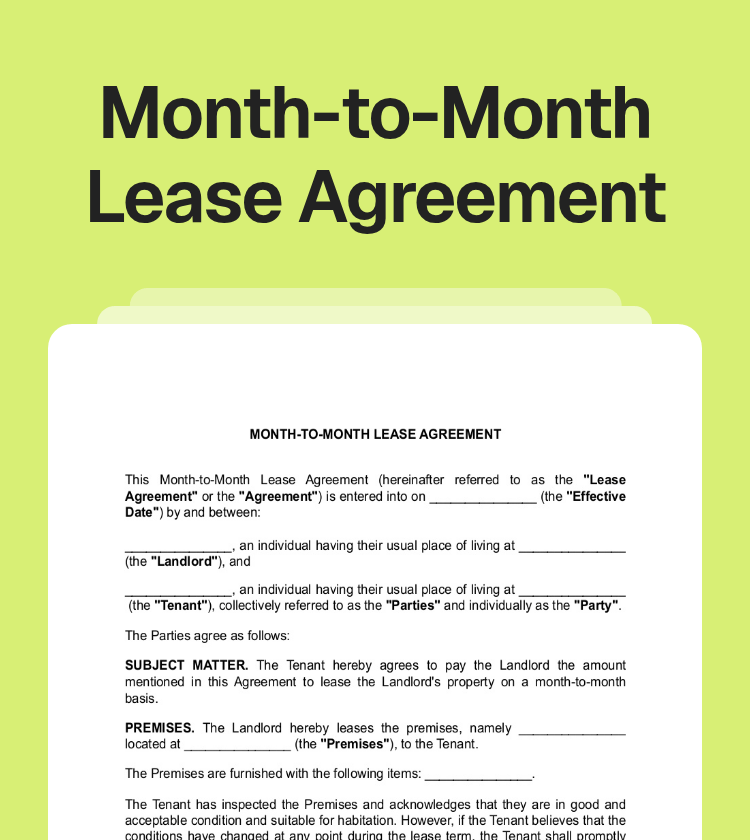
A Month-to-Month Lease Agreement is a rental contract between a landlord and a tenant allowing occupancy without a fixed end date. It is used for flexible renting arrangements that can be renewed or terminated with proper notice.
MONTH-TO-MONTH LEASE AGREEMENT

This Month-to-Month Lease Agreement (hereinafter referred to as the "Lease Agreement" or the "Agreement") is entered into on   (the "Effective Date") by and between:

 , an individual having their usual place of living at   (the "Landlord"), and

 , an individual having their usual place of living at    (the "Tenant"), collectively referred to as the "Parties" and individually as the "Party".

The Parties agree as follows:

SUBJECT MATTER. The Tenant hereby agrees to pay the Landlord the amount mentioned in this Agreement to lease the Landlord's property on a month-to-month basis.

PREMISES. The Landlord hereby leases the premises, namely   located at   (the "Premises"), to the Tenant.

The Premises are furnished with the following items:  .

The Tenant has inspected the Premises and acknowledges that they are in good and acceptable condition and suitable for habitation. However, if the Tenant believes that the conditions have changed at any point during the lease term, the Tenant shall promptly provide reasonable notice to the Landlord.

PURPOSE. The Tenant may use the Premises as a residential dwelling only.

LEASE TERM. This Agreement shall be considered a month-to-month lease. The Tenant shall be allowed to occupy the Premises on a monthly basis starting on   and ending upon notice of   days from either Party to the other Party (the "Lease Term").

The Tenant shall have the right to terminate this Agreement at any time by providing at least   days' written notice to the Landlord along with an early termination fee of  .

LEASE PAYMENTS. The Tenant agrees to pay the Landlord   per month for use of the Premises, payable in advance on the   day of the calendar month. If the Lease Term does not start on the   day of the month or end on the last day of the month, the lease payments for the initial and final months shall be adjusted on a pro-rata basis.

The Tenant is required to make an advance payment of   for the term starting on   and ending on  . This advance payment shall be due upon the execution of this Agreement.

All payments will be made by ACH.

LATE FEE AND NON-SUFFICIENT FUNDS. If the Tenant fails to make the lease payment for a period exceeding   days, the Landlord will be entitled to take necessary actions, including but not limited to charging a late fee of   per day until the entire lease payment is received and/or interpreting it as a material breach of the Agreement and initiating the eviction proceedings.

The Tenant agrees to pay a charge of   for each check given by the Tenant to the Landlord that is subsequently returned due to insufficient funds in the Tenant's account.

SECURITY DEPOSIT. Upon signing this Agreement, the Tenant shall pay   as a security deposit to cover any potential damages or liabilities arising during the Lease Term.

If the Tenant returns the Premises in a condition consistent with its state at the start of the lease, accounting for reasonable wear and tear, the security deposit will be refunded. 

In the event of deductions from the security deposit, the Landlord must furnish the Tenant with a detailed statement of deductions. The return of the security deposit, or the portion that is owed after accounting for any lawful deductions, shall be effected within   days of the Tenant's return of the keys or in any other time frame as may be required by law.

DAMAGE TO PREMISES. If the Premises or part of the Premises are damaged or destroyed by fire or another casualty not due to the Tenant’s negligence, the lease will be abated when the Premises are uninhabitable. 

If the Landlord decides not to repair or rebuild the Premises, this Agreement shall terminate, and the rent shall be prorated up to the time of the damage. Any unearned lease payments paid in advance shall be refunded to the Tenant.

UTILITIES AND SERVICES. The Landlord shall provide the following utilities and services to the Tenant:


The Tenant shall be responsible for any other utilities or services not mentioned in this paragraph.

OCCUPANTS. The Tenant agrees that no more than   persons may reside on the Premises without obtaining prior written consent from the Landlord. Only the following persons will be permitted to occupy the Premises:


The Tenant must receive written consent from the Landlord before allowing additional individuals to reside on the Premises. If someone stays on the Premises for more than three consecutive days or more than ten days in a month, they will be considered a resident of the Premises.

PETS. The Tenant is allowed to keep pets on the Premises. 

The Landlord agrees that the Tenant is entitled to have   pet(s) on the Premises. The following types of pets are allowed:  .

PARKING. The Landlord shall provide   parking space(s) to the Tenant

The Landlord shall provide parking space(s) to the Tenant for a monthly fee of   to be paid in addition to the lease payments. The parking space(s) are the following:  .

SMOKING POLICY. Smoking on the Premises is permitted only in the following areas:  .

NOISE. The Tenant agrees to abide by all local, county, and state noise ordinances. The Tenant must refrain from causing or allowing nuisances or engaging in or permitting any unlawful activities on the Premises.

DANGEROUS MATERIALS. The Tenant is prohibited from storing or possessing any dangerous, flammable, or explosive materials that might unreasonably increase the risk of fire or explosion on or around the Premises or that might be considered hazardous by an insurance provider.

MAINTENANCE AND REPAIRS. The Tenant is required to maintain the Premises in good, clean, and sanitary condition at the Tenant's own cost throughout the duration of this Agreement and any renewal thereof. The Tenant shall be responsible for making all repairs to the Premises and equipment therein that may have been damaged resulting from the misuse, waste, or neglect by the Tenant, the Tenant's family, or guests. 

The Tenant must immediately report any damage or defects to the Premises or any destruction of the appliances or equipment to the Landlord. Upon receipt of such notification, the Landlord is committed to making every effort to repair or replace any such damaged or defective areas, appliances, or equipment promptly and efficiently, thereby maintaining the habitability and functionality of the Premises.

ALTERATIONS AND IMPROVEMENTS. The Tenant shall not undertake any improvements, modifications, or alterations to the Premises without the Landlord's prior written consent.

Unless otherwise agreed in writing, any improvements or changes made to or built on or around the Premises, except for fixtures and personal property that can be removed without damage to the Premises, shall be deemed the property of the Landlord.

RULES AND REGULATIONS. The Tenant agrees to comply with all rules and regulations set forth in this paragraph:


The Landlord shall provide the Tenant notice of any violations of these rules. Violating these regulations is grounds for the Landlord’s termination of this Agreement.

POSSESSION AND SURRENDER OF THE PREMISES. The Tenant shall be granted the right to take possession of the Premises from the first day of the Lease Term. Upon the expiration or earlier termination of this Agreement, the Tenant must peacefully surrender the Premises to the Landlord in good condition, as they were at the commencement of the Agreement, with reasonable wear and tear excepted.

ASSIGNMENT AND SUBLEASE. The Tenant is prohibited from assigning any interest in the Premises or entering into a sublease arrangement without obtaining the Landlord's written consent. The Landlord agrees not to withhold such consent unreasonably, ensuring fairness and consideration for the Tenant's circumstances.

Any assignment or sublease without the Landlord’s written consent may, at the Landlord's discretion, result in the termination of this Agreement.

RIGHT OF ENTRY

  • Inspection and maintenance. The Landlord shall have the right to access the Premises during standard working hours by providing the Tenant with at least   notice. This access is granted for the purposes of inspecting the Premises, performing necessary repairs, modifications, or improvements, providing agreed-upon services, or for other reasonable needs related to the upkeep and maintenance of the Premises. 

  • Showing the Premises. The Landlord is entitled to show the Premises to potential buyers, lenders, or future tenants with reasonable advance notice. 

  • Locks and security. The Tenant is prohibited from adding, changing, or re-keying any locks on the Premises without obtaining the Landlord's written consent beforehand. The Landlord must always possess a set of keys or other means of unlocking and accessing all security devices installed on the Premises.

ABANDONMENT. If the Tenant abandons the Premises during the term of this Agreement, the Landlord has the right to enter the Premises by any legal means without incurring liability for the Tenant. Additionally, the Landlord may terminate the Agreement. Abandonment is defined as the Tenant's absence from the Premises for at least   consecutive days without notice to the Landlord.

If the Tenant plans to be absent from the Premises for a period longer than the specified abandonment duration, the Tenant must provide written notification to the Landlord. During the Tenant's absence, the Landlord may enter the Premises as reasonably necessary to maintain the property, carry out inspections for damages, and perform needed repairs.

INSURANCE. The Landlord will not be responsible for the loss, damage, or destruction of the Tenant's property resulting from theft, fire, riots, strikes, acts of God, or otherwise.

The Landlord does not provide insurance coverage for the Tenant's personal property within the Premises. The Landlord encourages the Tenant to obtain renter's insurance or similar coverage to protect against loss. 

INDEMNIFICATION. The Tenant agrees, to the fullest extent permissible under applicable law, to indemnify and hold the Landlord and the Landlord's property harmless from any liability for losses, claims, damages, and expenses, including but not limited to injury to or death of any person (including the Tenant) and damage to any property. 

This indemnification encompasses incidents arising either directly or indirectly from the Tenant's use and occupation of the Premises or the acts or omissions of any person, including the Tenant, about the Premises with the Tenant's express or implied consent, except for the Landlord's act or negligence.

NOTICE. Any notice required or permitted under this Agreement must be conveyed through a written and acknowledged document that must be directly delivered to the intended recipient. Either Party may change the address occasionally by providing notice to the other Party.

SEVERABILITY. If any provision of this Agreement is deemed invalid or unenforceable, in whole or in part, that part shall be severed from the remainder of the Agreement, and all other provisions should continue in full force and effect as valid and enforceable.

WAIVER. The failure by either Party to exercise any right, power, or privilege under the terms of this Agreement will not be construed as a waiver of any subsequent or future exercise of that right, power, or privilege or the exercise of any other right, power, or privilege.

GOVERNING LAW. The Parties agree that this Agreement shall be governed by the state and/or country in which the Premises are located.

DISPUTES. If a dispute arises during or after the term of this Agreement between the Landlord and the Tenant, both Parties agree to engage in negotiations in "good faith" before pursuing any litigation.

ENTIRE AGREEMENT. The Parties acknowledge and agree that this Agreement represents the entire understanding between the Parties. If the Parties desire to change, add, or otherwise modify any terms, they shall do so in writing to be signed by both Parties.

IN WITNESS THEREOF, the Parties have caused this Agreement to be executed on the day and year first above written.

THE LANDLORD

THE TENANT


 , USA

Phone number:  

Email:  


_________________________

(Place for signature)


 , USA

Phone number:  

Email:  


_________________________

(Place for signature)


Written by Karyna Pukaniuk - Reviewed by Jonathan McGill

Template Description

Copy section link
Paper titled "Month-to-Month Lease Agreement"; a couple is staying by the house

A month-to-month lease agreement is an important document that delineates the rights, duties, and responsibilities between a property owner or landlord and their tenant. Unlike long-term lease agreements, a monthly lease agreement gives both parties the flexibility to modify or terminate their terms with proper notice, typically 30 days.

The power of a month to month rental agreement form lies in its capacity to protect interests and establish clear guidelines for property use, payment requirements, and other aspects related to rental properties. Having such a document in place can provide a solid foundation for a transparent landlord-tenant relationship.

When to Use a Month-to-Month Lease Agreement

Copy section link

A rental agreement month to month is particularly beneficial when you aim for flexibility. It is often used when a fixed-term lease ends but the tenants wish to stay on, albeit without committing to a long-term contract. This arrangement is also favorable for landlords who wish to accommodate tenant turnover, adjust rental rates, or manage properties that see regular vacancy, like vacation rentals.

Insight

In such a way, the month to month lease agreement template can be a valuable tool for property owners and tenants who need a straightforward, adaptable rental contract without extensive time commitments. 

  • Tenant –– This party, also known as a lessee, is the individual or entity who rents the property from the landlord for a specified duration under the terms and conditions of the month-to-month lease agreement. The tenant is obliged to pay the agreed-upon rent monthly and must adhere to all other conditions set forth in the agreement. The tenant also possesses the right to peaceably enjoy the premises without undue interference from the landlord.

  • Landlord –– This individual or entity, sometimes referred to as the lessor, owns the property or has the authority to lease it out to the tenant. Under a month-to-month rental agreement, the landlord agrees to provide the property to the tenant for use under specific terms. The landlord's obligations often include maintaining the property to ensure it is habitable and safe. Upon receiving rent, the landlord enables the tenant to occupy the property under the guidelines of the agreement.
  • Month-to-Month Term: This indicates that no end date is specified for the agreement, which means either party can terminate it with proper notice.
  • Rent: The amount the tenant will pay monthly, the due date, and acceptable payment methods.
  • Security Deposit: The tenant's deposit held by the landlord for the term of the rental to cover potential damage or unpaid rent.
  • Notice Period: The required time, often 30 days, that either party must give before changing or terminating the agreement.
  • Property Use and Maintenance: Guidelines regarding the use of the property, tenant and landlord maintenance duties, and procedures for requested repairs.

How to Write a Month-to-Month Lease Agreement

Copy section link

A simple month to month rental agreement is a significant contractual document that outlines the conditions and provisions between a landlord and a tenant in a rental arrangement that renews monthly. Many online resources provide month to month lease templates, or you can seek assistance from legal practitioners to draft your own.

Here is a step-by-step guide on how to construct a simple month-to-month rental agreement PDF, whether you are a tenant or the property owner:

Tenant
  1. Provide your legal name and contact information.
  2. State the amount of monthly rent, the due date, and your preferred method of payment.
  3. Explain the property specification, including its legal description and address.
  4. Gather all necessary lease details, such as the term of lease commencement and potential termination.
Landlord
  1. Specify the name of the rental property, including any important identifiers, like lot numbers or unit numbers.
  2. Acknowledge the applicable state or local laws guiding the monthly rental agreement.
  3. Verify that the tenant agrees to fulfill all commitments associated with the agreement.
  4. Describe any terms regarding property use, maintenance, and what happens in the scenario of a breach of the month to month agreement.
  5. Decide how the agreement will be formalized and who will oversee this process. Usually, both parties will sign and date the document and keep the copies. 

All stakeholders should review the month to month rental lease form and reach an agreement on crucial aspects of the document. This collective due diligence promotes transparency and fairness and ensures all parties are fully aware of their contractual rights, responsibilities, and implications.

Well-drafted month to month rental agreement forms can protect the rights of both involved parties. It can help clarify the rental relationship and avoid potential disputes that might occur in the absence of a written agreement. The usage of a month to month rental agreement template ensures a comprehensive agreement is quickly and conveniently put together.

It's important to remember, though, that every rental situation is unique, and your month to month rental contract should reflect that. Take the time to craft your agreement in a way that suits your specific needs and makes you feel secure and valued.