Free template

Free Personal Training Contract Template

4.8 (93 reviews)
All states | 18 types
Updated Sep 1, 2026
~ 7 pages
PDF
5.9K downloads
A Personal Training Independent Contractor Agreement is a fitness contract between a trainer and a client outlining training sessions, payments, and liability terms. It is used to ensure professionalism, clarify expectations, and protect both parties from misunderstandings.
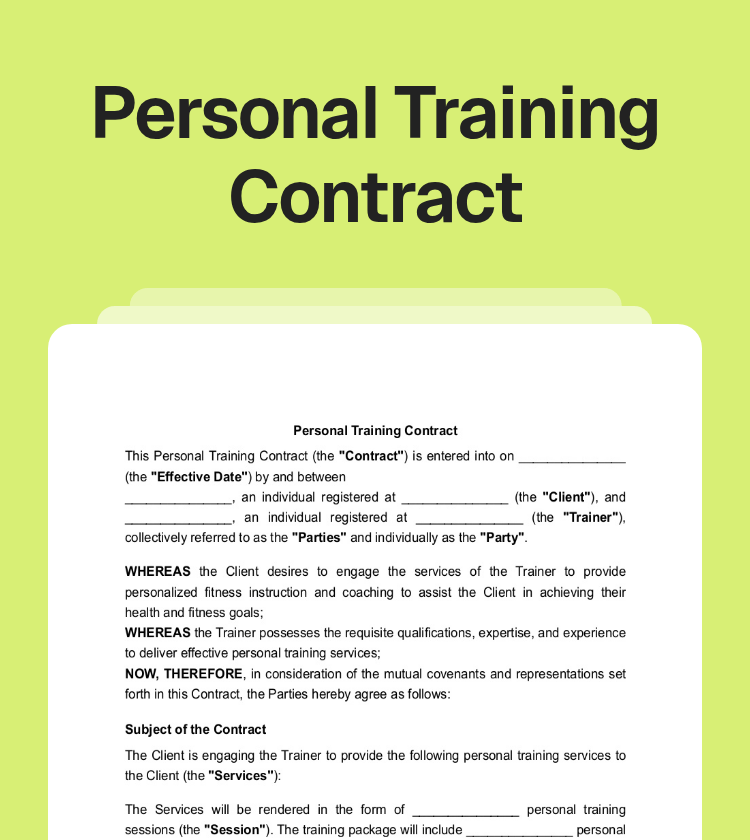
Personal Training Contract Page 1
Preview
Written by Megan Thompson, LLB - Reviewed by Kate Adkham, LLB

What Is a Personal Training Contract?

Copy section link

A personal training contract is a legal document that formalizes the relationship between a fitness professional and their client. This agreement covers essential details such as the type of training (aerobic exercise, strength training, flexibility work), session frequency, payment terms, and each party's responsibilities.

A personal trainer contract template gives the trainer protection against legal liability. Clients may sustain injuries during exercise, and a properly drafted document with a liability waiver helps reduce the risk of lawsuits. The contract also sets expectations for payment, cancellation, and rescheduling so that the trainer does not lose their time and money is the client does not attend the session. 

When to Use a Personal Training Contract

Copy section link

Use a personal training contract template when you:

  • Provide personal training services as an independent contractor and want to formalize your client relationships.

  • Offer virtual or online personal training services.

  • Provide specialized training, such as sport-specific coaching, rehabilitation support, or senior fitness.

When not to use a personal training template:

What Are the Parties to the Personal Training Contract?

Copy section link

Trainer: The individual or company providing personal training services.

Client: The individual or entity who receives the services.

What to Include in a Personal Training Contract?

Copy section link

Parties' information: Full names, addresses, and contact details of the trainer and client.

Services: A description of the training type (strength, cardio, flexibility, sport-specific) and any additional support like nutrition guidance.

Session schedule: Days, times, duration, and frequency of training sessions.

Contract term: The start date, end date, or total number of sessions included in the agreement.

Fees and payment terms: Rate per session or package price, payment due dates, and accepted payment methods.

Cancellation and rescheduling policy: Required notice period for cancellations and any fees for late cancellations or no-shows.

Health disclosure: A requirement for the client to disclose medical conditions, injuries, or limitations — and, where appropriate, to obtain physician approval before exercise.

Liability waiver and indemnity: A clause where the client acknowledges the inherent risks of exercise and releases the trainer from liability for injuries not caused by negligence.

Force majeure: A provision that addresses unforeseen events (such as natural disasters or public health emergencies) that may prevent either party from fulfilling obligations.

Termination clause: Conditions under which either party may end the agreement, required notice period, and refund policy for unused sessions.

Confidentiality: Protection of the client's personal and health information.

Signatures and date: Spaces for both parties to sign and confirm they accept all the terms.

What Are the Key Terms of a Personal Training Contract

Copy section link

Force majeure: Outlines what the parties want to happen when an unforeseeable event, such as a natural disaster, makes it impossible for them to fulfill their responsibilities and obligations under the personal trainer contract.

Governing law: The term is used to define the law that will be used to interpret and enforce the contract. In case of disputes, the governing law also determines the jurisdiction or state where the matter will be heard and resolved.

Liability waiver: A term used in a clause that works to hold the personal trainer blameless for any injury or harm sustained by the client under circumstances beyond the trainer's control.

Session package: A bundle of training sessions sold at a set price, often with a discount compared to single-session rates.

How to Fill Out a Personal Training Contract Template

Copy section link
  1. Enter the date of the agreement.
  2. Add the trainer and the client's full names and contact details.
  3. Describe the services the trainer will provide.
  4. Enter the training schedule.
  5. Specify the contract term: the start date, end date, or total number of sessions included in the agreement.
  6. Define the payment structure and schedule.
  7. Include the cancellation and rescheduling policy
  8. Clarify each party's responsibility for injury, health risks, and property damage.
  9. Define how either party may end the agreement, required notice period, and refund policy for unused sessions.
  10. Confirm that the client has provided accurate information about medical conditions, injuries, or limitations.
  11. Have both parties electronically sign the contract to confirm they accept the terms.

Is a liability waiver in a personal training contract enforceable?

In most states, yes — if it is clearly written, specific about the risks, and signed voluntarily. However, a waiver cannot protect a trainer from liability for gross negligence or intentional misconduct. 

Do clients need medical clearance before they start training?

It depends on the client's age, health status, and the intensity of the program. Many trainers ask clients over a certain age or with known health conditions to obtain physician approval. 

What should a cancellation policy include?

A cancellation policy should state how much notice the client must give (e.g., 24 or 48 hours), what fees apply for late cancellations or no-shows, and how rescheduled sessions are handled. This protects the trainer's time and income.

Is there a difference between in-gym and mobile training contracts?

Yes. In-gym contracts may reference the facility's rules and liability coverage. Mobile training contracts must address location logistics, travel fees, equipment responsibility, and liability at private residences or outdoor spaces.

Can a minor sign a personal training contract?

If the client is under 18, a parent or legal guardian can sign the contract on their behalf. The guardian assumes responsibility for the minor's participation and acknowledges the associated risks.

Disclaimer

Requirements for this document vary by state. Review your state's laws and procedures — or consult a licensed attorney — before using this template to ensure it's valid and enforceable where you live.

Sources

Also read

Personal Training Contract Preview