Updated July 22, 2026
4 min read
Income Statement vs Profit and Loss Statement: Is There a Difference?
Income Statement vs Profit and Loss Statement: Is There a Difference?
Content
Small businesses comprise 99.9% of all businesses in the U.S. Most of these have paid employees and export their products or services. Handling their paperwork remains a crucial priority: for each $1 spent, small businesses generate around $265 in revenue. However, keeping track of all the paperwork takes time and effort, and it’s easy to let something seemingly simple fall through the cracks. To maintain that precise control, you have to understand the specific reporting tools at your disposal. And that’s when the topic of the income statement vs. the profit and loss statement emerges. Is an income statement the same as a profit and loss statement? This guide explains both terms and outlines how to use the critical financial documents to grow your business.
Income statement vs. P&L
It’s easy to mix things up when you’re starting as a small business owner, and different terms aren’t helping. Let’s check the definition first.
Is the income statement the same as a profit and loss statement?
Fundamentally, there is no structural difference between the two documents. An income statement is also called a profit and loss statement, depending on some additional factors, but they can be used pretty interchangeably.
Essentially, a profit and loss statement is a document prepared for a business’s stakeholders that provides information on its income, expenses, and net profit. It is one of the best indicators of your company’s financial health.
The P&L meaning for your business
Understanding and regularly preparing a P&L statement offers several benefits. If you use it properly, an income statement:
Identifies financial loss. It categorizes your costs, allowing you to instantly see whether specific expenses are increasing faster than your earnings.
Measures operational efficiency. It proves whether your core business model is actually working.
Provides data for future projections and budgets. A P&L informs you about what will likely happen to your business over the next year if you stay on the same path. In turn, it shows what you can do to fix an issue by shedding light on it.
Maintains accountability. Your stakeholders demand clarity and honesty. An income statement proves that you’re trustworthy and suitable for long-term cooperation.
What is the difference between an income statement and a profit and loss statement?
While it’s technically the same document, you might notice that some people treat these two differently.
The profit and loss statement. This term is primarily conversational and managerial. It is widely used in day-to-day operations by small business owners and managers.
The income statement. This is the formal, legal designation for the exact same document. It is the terminology you’ll see in official corporate reporting.
An income statement is the more formal term often used in Generally Accepted Accounting Principles (GAAP)-based financial reporting. GAAP is a standardized framework of accounting rules and procedures established by the Financial Accounting Standards Board (FASB). When your investors or regulatory bodies review your business operations, they expect a structured document that follows GAAP conventions and is explicitly labeled as an “Income statement.”

The Anatomy of an Income Statement
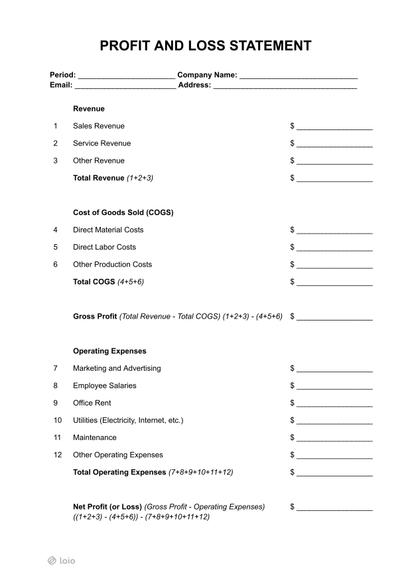
An income statement has a relatively standardized structure, though nuances vary, so feel free to edit your PDF income statement to fit your company’s results.
Revenue
Every structured P&L or Income statement starts with revenue. This represents the total dollar amount your business has generated. It covers:
Sales revenue
Service revenue
Other revenue
Cost of goods sold
COGS accounts for the direct expenses that you have spent while making your products or delivering your core services. It includes:
Direct material costs
Direct labor costs
Other production costs
Gross profit is calculated when you subtract the total of your COGS from your total revenue. It shows how efficient your business is.
Operating expenses
The previous section was about spending money on making your products/services. This one shows how much you spend to keep your business alive. It consists of:
Marketing
Employee salaries
Office rent
Utilities
Maintenance
Other
Subtract your operating expenses from your gross profit — this will give you the knowledge about your operating income. This is your business’s revenue minus the money spent on running it.
Net profit or loss
This is, essentially, what every investor will be looking into. It shows whether your company is earning a profit or operating at a loss.

What Are the 4 Types of Financial Statements?
Business owners will have to deal with four main types of financial statements throughout their careers. Use this financial documents checklist to inform your business decisions.
Balance sheet
A balance sheet is a document that shows your company’s financial position at a particular point in time (usually the final day of the fiscal quarter or year). It’s usually divided into three categories:
Assets. What a business owns.
Liabilities. What a business owes to third parties.
Ownership equity. The owners’ net worth.
The balance sheet shows the assets on one side and liabilities and equity on the other. These two sides should balance each other.

Income statement
This is the document we have focused on throughout this guide. Rather than showing a static moment of your business, it functions like a continuous depiction of your financial activity over a designated period.
Many companies notice that although their income statement shows a healthy profit, they don’t see it in their checking account. It happens because a profit and loss statement uses accrual accounting, which records revenue when a sale is earned. This doesn’t always mean they have this money on their hands. This is when the next financial statement is useful.
Cash flow statement
A cash flow statement is a financial document that tracks the physical movement of liquid cash into and out of your operations across:
Operating Activities. Day-to-day business actions.
Investing activities. Purchasing equipment or physical assets.
Financing activities. Loans or equity movements.
Importantly, the cash flow statement uses your net income (from your income statement) as its starting point and adjusts for non-cash items, such as depreciation.
Statement of shareholders’ equity
This document shows changes in the ownership value of your business over the financial year.
This document covers:
Capital stock or common stock. The total amount of money investors directly pay to the company in exchange for shares of ownership.
Retained earnings. The cumulative profit a business keeps and reinvests into its operations instead of paying it out to shareholders.
Dividends. The corporate assets, usually cash, distributed directly to stockholders as a reward for their investment.
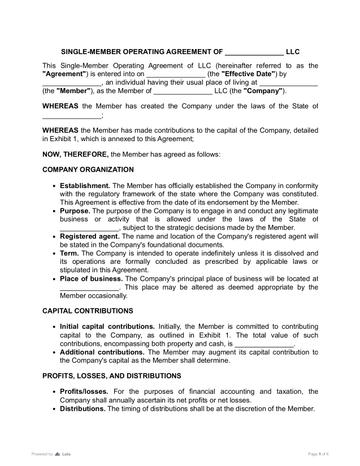
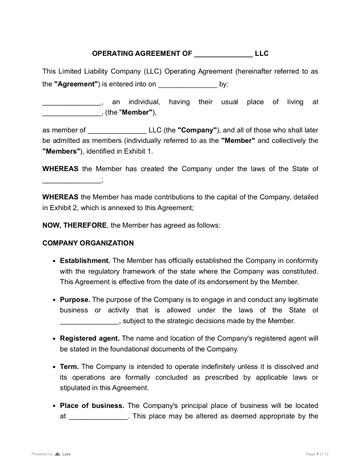
The concept of owner’s equity applies to all parts of a business structure, whether it’s a sole proprietorship or a partnership. It also applies to corporations, as every person who owns stock is an owner. If you’re a business owner of an LLC, your ownership of the business is recorded in a single-member LLC operating agreement. A similar LLC operating agreement exists if you have partners; once signed or eSigned, this document records not only ownership and management but also how profits are distributed.

- Single-Member LLC Operating Agreement
 3949 downloads
 - LLC Operating Agreement
 4037 downloads
A P&L Statement vs Income Statement and Taxes
Your financial documents provide the foundation for your tax obligations. From the standpoint of the IRS, a business’s income statement serves as the evidentiary baseline for evaluating corporate tax liabilities.
Your total earnings, production costs, and overhead expenses directly determine how much you will owe the IRS. When it is time to file, your financial statement numbers plug right into specific tax forms:
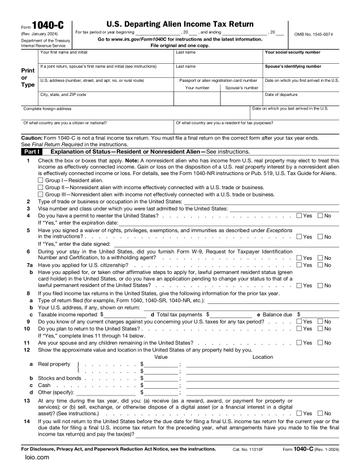
Federal income tax. If you own a sole proprietorship or a single-member LLC, your business profits are taxed at your personal income rate. To report this to the IRS, you will need to copy your financial statement numbers onto a 1040 Schedule C form. If your business is a C-Corporation, things work differently. Your business pays its own flat 21% corporate tax rate on its bottom-line net income.
Self-employment tax. Running a freelance business or side hustle means you have to cover your own Social Security and Medicare taxes. The IRS calculates this 15.3% tax using your net business earnings. If your statement shows you made $400 or more in clear profit over the year, you are legally required to file a Schedule SE along with your standard tax returns.
State and local taxes. Most states charge a local business or franchise tax. Many local tax boards can use your federal net income as a baseline.
Use a 2026 tax checklist for a deeper dive into your federal tax obligations.
- Form 1040-C
 5051 downloads
 - Form 1099-MISC
 5500 downloads
Use Your Profit & Loss Statement Strategically
An income statement or P&L is not just a passive ledger used to satisfy administrative obligations. You can use it to guide your decisions and long-term strategy.
Secure your capital
Institutional lenders require historical, GAAP-compliant income statements to check if they should give you money. They use your P&L to calculate your Debt Service Coverage Ratio (DSCR), which will evaluate if your business can realistically repay the loan. Keep your income statement clean to provide the data your lenders will want to see.
Strengthen your contracts
A strong P&L outlines your real-world cost structures, which gives you the leverage you need during corporate negotiations. For example, if your statement identifies a specific administrative overhead expense that is steadily rising (e.g., logistics), you can rely on this data to restructure your corporate agreements. Use an AI contract reviewer if you sense that your contracts need further change but can’t spot the red flags.
Execute safe funding through personal channels
Most small business owners know that they can (and usually will) put their own money into their company. But even if you are moving your own money into your company, you must treat the transaction with strict corporate formality to protect your personal assets.
Evaluate your P&L statement to establish a realistic repayment schedule based on your historical net income. This ensures you do not inadvertently deplete the company’s operating cash flow.
Take Control of Your Financial Decisions
Your income statement is a tool. When you look at it and treat those numbers as data, your decisions become far more objective. By taking this proactive stance, you shift from simply reacting to your bank balance to actively steering your company’s growth. Don’t let your bookkeeping sit in a drawer. Accurate financial statements give you the leverage to negotiate better vendor contracts, secure business funding, and protect your personal assets.
More guides
September 1
7 min read
How to Provide Proof of Employment: Documents and Steps

July 25
11 min read
Charitable Donations Tax Deduction: Eligibility, Limits, and Records
July 26
12 min read
How to Read a Profit and Loss Statement

September 1
6 min read
Different Types of 1099: Who and When Files Them
August 5
7 min read
How to Accept ACH Payments from Clients
July 20
4 min read
Addendum vs. Amendment: Change Your Purchase Agreement Properly
One home for your
agreements
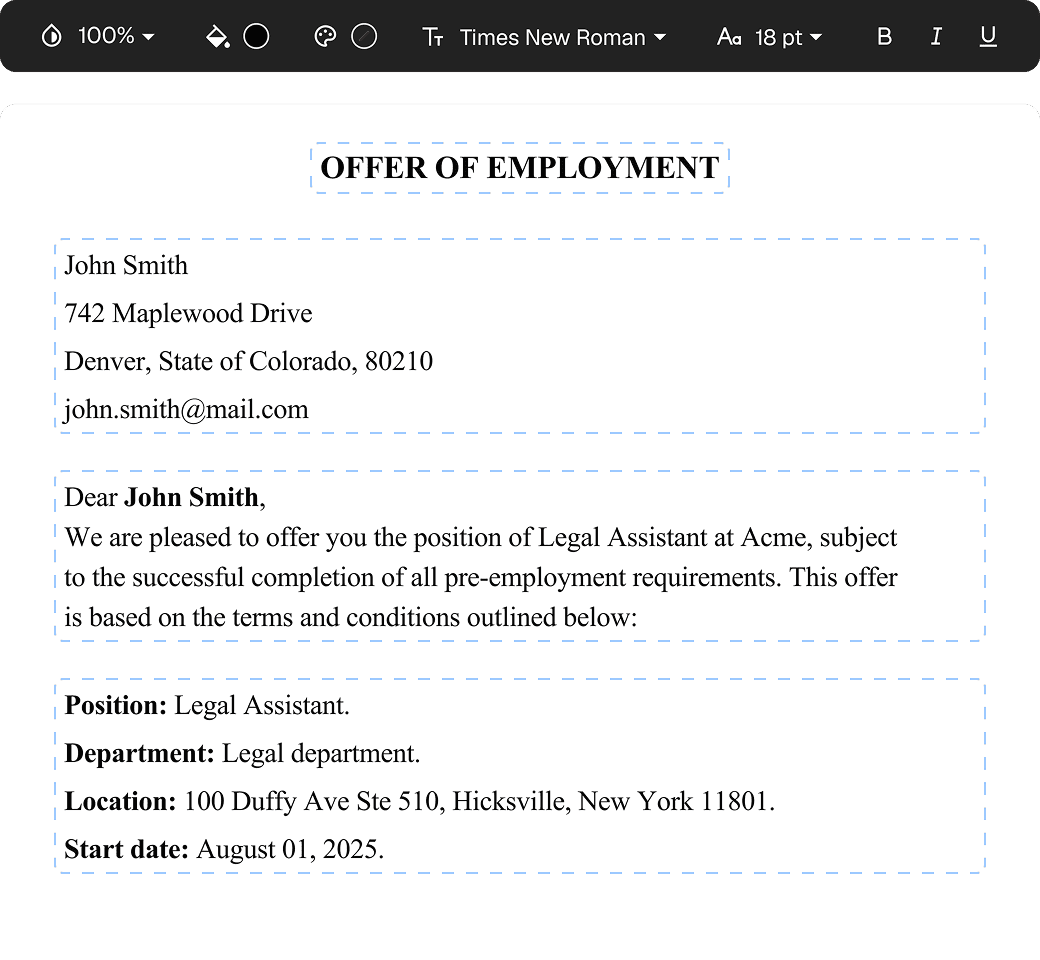
Edit PDFs seamlessly
Tweak agreements before signing or sending for signatures. Update details, add or remove clauses, adjust formatting, and redline changes instantly.
eSign legally and securely
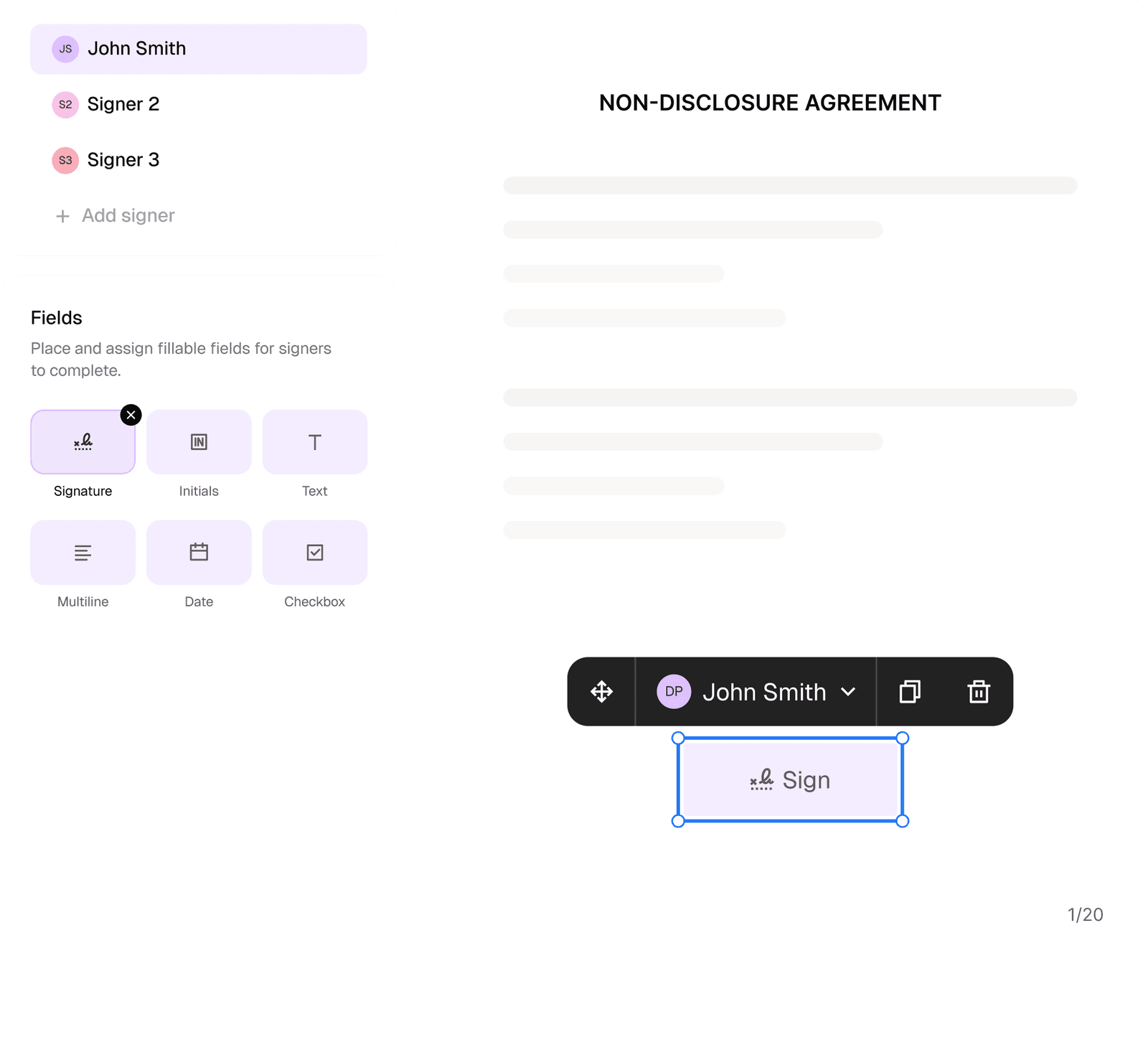
Sign documents and collect legally binding signatures. Invite up to ten people to sign in any order, track the progress, and send reminders.

Request legally binding signatures
Invite up to ten people to sign your document in any order. Get a finalized, audit-ready copy without chasing signatures.
Skip the drafting.
Choose from 2,500+ templates
Browse templatesChoose a template
Fill in details

Sign and download