
Updated July 25, 2026
11 min read
Charitable Donations Tax Deduction: Eligibility, Limits, and Records

Charitable Donations Tax Deduction: Eligibility, Limits, and Records
- Are Donations Tax Deductible In 2026?
- What Qualifies for a Charity Tax Deduction?
- Which Organizations Qualify for a Charity Tax Deduction?
- What Donations Are Not Tax-Deductible?
- How a Charitable Donation Tax Deduction Reduces Taxes
- How Much Can You Write Off for Donations?
- Do You Need to Itemize for a Charitable Donations Tax Deduction?
- What Documentation Do You Need for a Charitable Contributions Tax Deduction?
- How to Claim a Charitable Donations Tax Deduction Step By Step
- Common Charitable Donation Mistakes to Avoid
- Key Takeaways
Content
You donated $2,000 to your favorite charity last year. You assumed it would lower your taxes. But when tax season came, your accountant said, “It doesn’t change your tax bill.” That might be frustrating, but not unusual.
The truth is that you'll only get a tax advantage from a donation if it meets the requirements. The contribution must comply with IRS rules, benefit a qualified organization, have supporting documentation, and align with your tax status. Until 2026, claiming charitable giving deductions meant you had to itemize deductions; most taxpayers couldn't benefit otherwise. Starting in 2026, standard deduction filers can claim a deduction for qualifying cash donations, though with restrictions.
This guide breaks down what makes a donation tax-deductible, deduction thresholds, documentation needs, and whether a charitable donations tax deduction will actually help your bottom line. For additional context, see Loio’s tax guides and financial documents checklist.
Are Donations Tax Deductible In 2026?
Yes, charitable donations are tax-deductible when they meet IRS requirements.
In general, a donation may qualify if:
- 1
You donate to a qualified organization.
- 2
You receive no substantial benefit in return.
- 3
You keep proper documentation.
- 4
You claim the deduction correctly on your tax return.
Your filing method is everything when it comes to charitable giving. If you're like most taxpayers and you claim the standard deduction, donations historically didn't help you at all. You needed to itemize deductions on Schedule A to get a tax benefit, and itemizing only made sense if you had enough other deductions to justify it. IRS data from 2022 shows this in stark terms: 88.6% of returns took the standard deduction. That's the population that got nothing from charitable donations.
Things are shifting though. Starting in 2026, standard deduction filers can claim a deduction for qualifying cash charitable contributions. The limits are $1,000 per person, $2,000 for married couples filing jointly. It's a meaningful change because it finally gives most people a tax reason to keep receipts. The catch is that it only applies to cash. Stock donations, property, and other assets don't qualify under this non-itemizer deduction.
So even with the expansion, whether you actually save money depends on the charity's status, what you've documented, whether it's cash, and how you file.

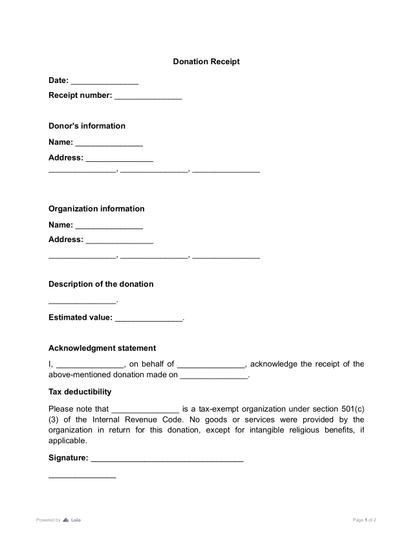
Create a clear donation record from the start. Before you claim a charitable contributions tax deduction, make sure the gift is documented correctly. Loio’s Donation Receipt Template helps record the donation amount, date, organization details, and whether any goods or services were provided in return.
What Qualifies for a Charity Tax Deduction?
The IRS allows a charitable contributions deduction for several types of giving, but each one has its own rules.
Cash donations
Cash donations include money given by:
bank transfer;
credit card;
debit card;
check;
payroll deduction;
electronic payment.
These are usually the simplest donations to document. If you donate $500 to a qualified public charity and keep proof of payment, that donation can generally count toward your charity tax deduction, subject to the filing and limitation rules.
Non-cash donations
You can also donate property, such as:
clothing;
furniture;
books;
household goods;
electronics;
vehicles;
stocks or other appreciated assets.
For most donated property, the deduction is based on the item’s fair market value at the time of the donation, not what you originally paid. IRS Publication 526 explains that property donations may generally be deductible at fair market value, but additional rules apply depending on the property type and claimed amount.
For example, if you donate a used desk that originally cost $600 but is now worth $120, the deduction is based on the $120 fair market value.
Vehicle donations need extra care. If a charity sells a donated car, the deduction is often limited to the gross proceeds from the sale, not simply the vehicle’s estimated fair market value. For qualified vehicles valued over $500, the organization generally files Form 1098-C.
Out-of-pocket volunteer expenses
You cannot deduct the value of your time. However, you may be able to deduct unreimbursed expenses directly connected to volunteer work for a qualified charity.
Examples include:
supplies purchased for a nonprofit event;
required volunteer uniforms that are not suitable for everyday wear;
charity-related mileage.
The charitable mileage rate is 14 cents per mile — set by statute and unchanged for many years. It does not adjust annually like the business mileage rate. At 1,000 miles per year, that equals $140 in deductible volunteer expenses (with proper records).
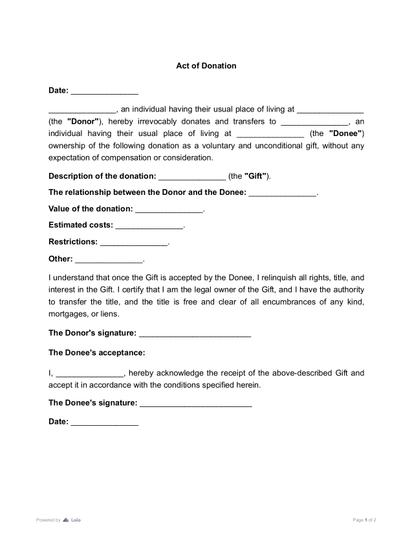
For non-cash donations like property, furniture, or equipment, document the transfer using Loio's Act of Donation Form. It records the item description, confirms voluntary intent, and shows no compensation was received — all details the IRS may expect.
Which Organizations Qualify for a Charity Tax Deduction?
A donation must go to a qualified organization to be deductible. The most common qualifying organizations include:
501(c)(3) public charities;
religious organizations;
educational organizations;
certain hospitals and medical research organizations;
government entities, if the gift is for public purposes.
The IRS explains that gifts to individuals are not deductible, and only qualified organizations can receive tax-deductible contributions.
The rules for what makes a donation deductible actually come from a specific part of the tax law called Section 170(c). It lists the types of groups that "count" in the eyes of the IRS, like churches, certain government branches, and qualified charities. This is why we always emphasize that the charity’s legal status is just as vital as the donation itself — if the group doesn't meet the Section 170(c) criteria, the gift isn't deductible.
How to check whether a charity qualifies
The safest approach is to verify the organization before donating. Use the IRS Tax Exempt Organization Search tool to confirm whether the organization is eligible to receive deductible charitable contributions.
This is a small step, but it prevents a common mistake. A group can be nonprofit, community-based, or mission-driven and still not qualify for deductible donations. Political organizations, social clubs, many crowdfunding campaigns, and gifts to individuals generally do not qualify.
What Donations Are Not Tax-Deductible?
Some gifts feel charitable but do not qualify for a federal tax deduction.
Generally, you cannot deduct:
gifts to individuals;
political campaign contributions;
donations to many personal crowdfunding campaigns;
the value of your volunteer time;
donations to non-qualified organizations;
the full cost of an event ticket when you receive something in return.
For example, if you pay $300 for a charity dinner and the meal’s fair market value is $100, only the amount above the benefit may potentially be deductible. If the organization gives you goods or services in exchange, your deductible amount is reduced.
The key question is: did you make a gift to a qualified organization without receiving equal value back? If not, the deduction may be limited or unavailable.

How a Charitable Donation Tax Deduction Reduces Taxes
A charitable donation tax deduction does not work like a tax credit.
A tax credit directly reduces the amount of tax you owe. A deduction reduces the amount of income subject to tax. That means the actual benefit depends on your tax bracket.
Suppose you donate $1,000 to a qualified charity and you are in the 24% federal tax bracket.
- Donation amount: $1,000
- Tax bracket: 24%
- Approximate federal tax savings: $240
You do not receive a $1,000 refund. Your taxable income is reduced by $1,000, and the tax savings are based on your marginal rate.
This is why people often feel confused after donating. A donation may be deductible, but the deduction is not a dollar-for-dollar refund.
How Much Can You Write Off for Donations?
The amount you can deduct depends on your adjusted gross income, donation type, and the type of organization receiving the donation.
IRS Publication 526 explains that charitable contribution deductions generally cannot exceed 60% of adjusted gross income, but in some cases 20%, 30%, or 50% limits apply.
In simplified terms:
cash gifts to many public charities may qualify up to the 60% of AGI limit;
certain non-cash gifts may be subject to lower limits;
appreciated assets may have different limits;
gifts to some private foundations may have stricter rules.
Starting in 2026, itemizers also face a new charitable deduction floor: only the portion of charitable contributions that exceeds 0.5% of adjusted gross income is deductible. Any amount below that floor cannot be deducted for that year under the 2026 rule.
Higher-income taxpayers should also note an additional change. For taxpayers in the top 37% federal bracket, the tax benefit of itemized charitable deductions is capped at 35% beginning in 2026, which slightly reduces the value of large charitable deductions for top-bracket donors.
If your donation exceeds the allowed limit for the year, you may be able to carry the excess forward, subject to IRS rules. For large gifts, appreciated assets, donor-advised funds, or private foundation gifts, it is safer to consult a qualified tax advisor before filing.
With Loio, you can review donation documents faster. If you receive long acknowledgment letters, donation agreements, or tax-related records, Loio’s AI summarizing tool can help you quickly identify the key details, while the PDF editor helps keep everything organized for filing.
Do You Need to Itemize for a Charitable Donations Tax Deduction?
For tax years before 2026, the answer was almost always yes. You had to itemize deductions on Schedule A to claim charitable contributions.
Beginning with tax year 2026, there is an important change: taxpayers who take the standard deduction may deduct up to $1,000 in qualifying cash charitable contributions, or $2,000 for married couples filing jointly. This deduction is limited to qualifying cash gifts and generally excludes gifts to donor-advised funds and certain private foundations. It also does not replace the broader itemized deduction rules for larger, non-cash, or more complex charitable gifts.
Standard deduction vs. itemized deduction
You take a fixed deduction amount
Starting in 2026, limited qualifying cash donations may still be deductible
You list eligible expenses on Schedule A
Charitable donations may reduce taxable income if they meet IRS rules and exceed applicable limits
For 2026, the standard deduction is $16,100 for single filers, $32,200 for married couples filing jointly, and $24,150 for heads of household.
Example
A married couple filing jointly has:
$8,000 in mortgage interest;
$6,000 in state and local taxes;
$3,000 in charitable donations.
Their itemized deductions total $17,000. Since the 2026 standard deduction for married filing jointly is $32,200, itemizing would not be useful based on these numbers alone. However, starting in 2026, they may still be able to deduct up to $2,000 of qualifying cash charitable contributions while taking the standard deduction.
Previously, if you took the standard deduction, your charitable donations gave you zero additional tax benefit. Starting in 2026, there's a small exception: even while taking the standard deduction, you can also deduct up to $2,000 in cash donations on top of it. For broader tax planning, see Loio’s Internal Revenue Service tax guidelines.
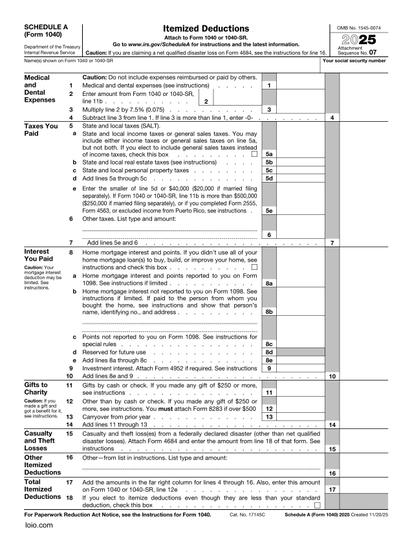
If your charitable donations qualify and itemizing makes sense, use Loio’s Schedule A Template to organize deductible expenses, including charitable contributions, mortgage interest, state and local taxes, and medical costs before filing.
What Documentation Do You Need for a Charitable Contributions Tax Deduction?
Documentation is where many charitable deductions fail. The IRS can disallow a deduction if the taxpayer cannot properly prove it.
Cash donations under $250
For smaller cash donations, you generally need a bank record or written communication from the charity showing:
organization name;
date of donation;
donation amount.
Cash donations of $250 or more
For any single contribution of $250 or more, the donor must obtain a written acknowledgment from the charity. The IRS states that the acknowledgment must be received by the earlier of the date the donor files the original return or the due date, including extensions, for filing that return.
A proper acknowledgment usually includes:
the organization’s name;
donation amount;
date of contribution;
statement about whether goods or services were provided;
description and good-faith estimate of any goods or services received.
Use Loio’s PDF editor to organize donation receipts, written acknowledgments, and tax documents in one place and if any of them are scanned images, make sure they're searchable before you file them away. You can edit, review, and keep your records easier to access when it’s time to file.
Non-cash donations
Non-cash donations require more careful records. IRS Topic 506 notes that Form 8283 is generally required if the amount of the taxpayer’s deduction for all noncash gifts is more than $500. Higher-value property may require additional information or a qualified appraisal.
A simple rule: the more valuable or unusual the donated property is, the more documentation you should keep.
For small businesses or self-employed donors, Loio’s tax return and financial document checklist can help organize tax records before filing.
How to Claim a Charitable Donations Tax Deduction Step By Step
Claiming a charitable deduction is easier when you treat it as a year-round recordkeeping process, not something you reconstruct at tax time.
Step 1: Track donations throughout the year
Keep a simple list with:
donation date;
organization name;
donation amount;
donation type;
receipt status.
Do not wait until filing season to reconstruct your giving history from emails and bank statements.
Step 2: Verify the organization
Before claiming the deduction, confirm that the organization qualifies. This is especially important for lesser-known nonprofits, crowdfunding campaigns, and international causes.
Step 3: Collect receipts and acknowledgments
Make sure every donation has backup documentation. For gifts of $250 or more, request a written acknowledgment from the charity before filing.
Step 4: Check whether the deduction applies to your filing method
If you itemize, charitable deductions are generally claimed on Schedule A. If you take the standard deduction in 2026 or later, check whether your cash donations qualify for the limited non-itemizer deduction.
Step 5: Keep records after filing
Do not throw away receipts once the return is submitted. Keep donation records with your tax files in case questions come up later. If you keep these acknowledgments as scanned paper receipts, make the scanned PDF searchable so you can find a specific donation quickly if the IRS ever asks questions.
For filing risks and IRS consequences, see Loio’s guide to IRS tax filing and penalties.
Prepare your donation paperwork before filing. Before claiming a deduction, make sure your receipts, acknowledgments, and donation forms are complete. Loio’s PDF editor helps you organize tax documents, while e-signature makes it easier to sign donation-related forms digitally.
Common Charitable Donation Mistakes to Avoid
Most deduction problems come from the same few issues: unclear records, incorrect organization status, or misunderstanding how charitable deductions actually work.
Donating to a non-qualified organization
A donation to a person in need, a political campaign, or a non-qualified group may be generous, but it is generally not deductible.
Assuming a deduction equals a refund
A $1,000 deduction does not mean a $1,000 refund. It reduces taxable income, and the actual tax savings depend on the taxpayer’s rate.
Missing the $250 acknowledgment rule
For contributions of $250 or more, a bank record alone may not be enough. You need a written acknowledgment from the charity.
Overvaluing donated property
Non-cash donations should be valued realistically. Used items are normally worth far less than their original purchase price.
Forgetting vehicle donation rules
A vehicle donation over $500 may involve Form 1098-C, and the deduction may depend on how the charity uses or sells the vehicle.
Misapplying the 2026 non-itemizer deduction
Don’t assume every donation is deductible under the 2026 rules for non-itemizers. Although standard deduction filers gain a new cash contribution limit, many popular donations — like donor-advised funds and certain private foundations — are excluded from this benefit. It’s also important to remember that this new rule is strictly for cash; if you’re donating property or equipment, you’ll still need to perform a separate deduction analysis and maintain the traditional paperwork.
Ignoring the 2026 itemizer limits
Itemizers should also account for the new 0.5% AGI floor. Taxpayers in the top 37% bracket should consider the 35% cap on the value of itemized deductions when planning large gifts. These rules can affect whether it makes sense to give annually, bunch donations, or use other charitable planning strategies.
Key Takeaways
A donation is tax-deductible when it is made to a qualified organization, properly documented, and claimed under the right tax rules.
The most important points are:
Charitable donations tax deduction rules depend on the organization, donation type, and filing method.
Gifts to individuals and political campaigns are generally not deductible.
Deductions reduce taxable income, not taxes dollar for dollar.
For 2026, non-itemizers may deduct limited qualifying cash donations.
The 2026 non-itemizer deduction generally excludes donor-advised funds and certain private foundations.
Itemizers can claim broader charitable deductions but must follow AGI limits, the 0.5% AGI floor, and documentation rules.
Top-bracket taxpayers should consider the 35% cap on the value of itemized deductions.
Receipts, written acknowledgments, and fair market value records matter.
Non-cash and vehicle donations require extra care.
To stay organized, use Loio’s forms and templates. You can also explore Loio’s tax deduction guides and guides for business and beyond for broader legal and financial document support.
More guides
September 1
7 min read
How to Provide Proof of Employment: Documents and Steps

September 1
6 min read
Different Types of 1099: Who and When Files Them

July 22
4 min read
Income Statement vs Profit and Loss Statement: Is There a Difference?

August 5
7 min read
How to Accept ACH Payments from Clients

July 24
4 min read
What Is a Fixed-Term Lease, and How Is It Different From an Automatic Renewal Lease?

July 26
12 min read
How to Read a Profit and Loss Statement

One home for your
agreements
Edit PDFs seamlessly
Tweak agreements before signing or sending for signatures. Update details, add or remove clauses, adjust formatting, and redline changes instantly.
eSign legally and securely
Sign documents and collect legally binding signatures. Invite up to ten people to sign in any order, track the progress, and send reminders.

Request legally binding signatures
Invite up to ten people to sign your document in any order. Get a finalized, audit-ready copy without chasing signatures.

Skip the drafting.
Choose from 2,500+ templates
Browse templatesChoose a template
Fill in details

Sign and download