Free template
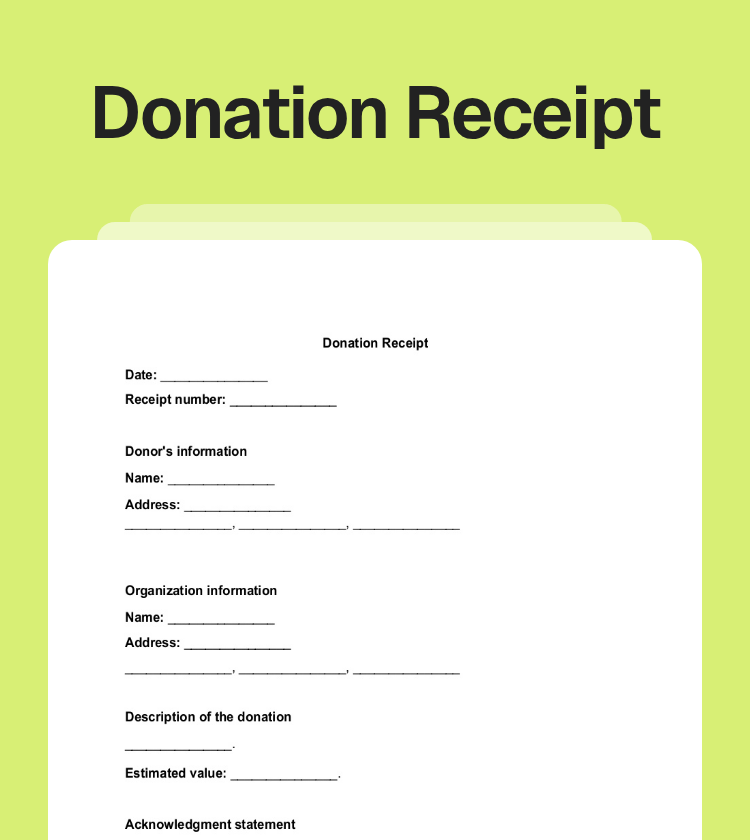
Free Donation Receipt Template

What Is a Donation Receipt?
Copy section linkA donation receipt is an official paper or email that proves one has given money or items to an organization as a charitable contribution. It allows donors to claim tax deductions and nonprofits to maintain clear financial records. Using a standardized donation receipt template helps organizations quickly acknowledge gifts and precisely record the incoming material support.
Donors can significantly reduce their taxable income by claiming deductions for their charitable contributions, as outlined by the Internal Revenue Service (IRS). Having proper documentation ensures the tax benefits are legally valid during the audit.
Nonprofit organizations, particularly those classified as 501(c)(3), do an important job, and tax-deductible gifts help them fund their goals. By applying ready-to-use donation receipt letter templates,charities can immediately send tax proofs. This is a useful step in building trust with donors and keeps the process transparent for everyone.
When to Use a Donation Receipt
Copy section linkYou will need a donation receipt template whenever you donate your money or items to charity. It legally proves a contribution was received and allows the donor to claim tax deduction. Here are a few examples of situations when you would want to get your donation receipt letter:
Cash gifts: gives the donor an immediate proof of payment and keeps money tracking accurate.
Donations over $250: according to the IRS requirements, a donor needs the receipt so they can legally claim their tax deduction.
Fundraiser tickets or charity dinners: shows the total paid sum minus the cost of the food or entry.
Donated items (like equipment or clothes): proves that the charitable organization received certain items for their inventory and tax records.
Parties to the Donation Receipt
Copy section linkEvery donation receipt form includes two parties:
the donor: an individual or business providing money, goods, or services. They need a receipt as an official proof of their contribution.
the donee/receiver: a charity, tax-exempt organization getting the donation. Usually, they issue a donation receipt to confirm the gift and maintain transparent financial records.
Key Components
Copy section link- Donor’s information: the data or the Donor that lets identify their personality; usually includes a full name, address, city, state, and ZIP code.
- Recipient Organization information: the details about a receiving organization that helps to identify it; also includes the name of the organization, its address, city, state, and ZIP code.
- Receipt date: an exact date when the receipt was filed.
- Estimated value: an approximate financial value of the items donated.
- Description of the donated items: a short note on the items that get donated, describing their use.
- Declaration of charitable contribution: same as Donation Receipt—a proof of money, goods, or services donated for charity.
- Tax-exempt status: an official label from the government that lets a charity give the donors tax write-offs for their donations.
- Signature: an official sign-off from a charity leader that proves a donation receipt is real and valid for the taxes.
Key Terms in a Donation Receipt
Copy section linkDonor: a person or business giving the money, goods, or services.
Receiver: the tax-exempt charity or non-profit organization receiving the gift.
Tax-Exempt Status: an official government label showing a charity is recognized as a non-profit whose gifts qualify for tax write-offs.
Tax ID / EIN: a unique identification number assigned by the government to verify a charity's tax status.
Declaration: a mandatory written statement on the receipt confirming whether the donor received any goods or services in return.
How to Write a Donation Receipt
Copy section link- Enter your receipt date.
- Specify the receipt number, if necessary.
- Write in the Donor’s personal information: their full name, address, city, state, and ZIP code.
- Add Donor’s contact details: an email and a phone number.
- Enter the Organization’s (receiver) full info: name, address, city, state, and ZIP code.
- Enter the Organization’s tax ID number.
- Add Organization’s contact details: an email, a phone number, and a website, if they have one.
- Choose a type of donation: a monetary or non-monetary donation.
- Give a short description of the donated items. If the Donor’s providing a vehicle, information on the model, year, VIN number, etc. will be necessary, too.
- Enter the estimated value of the donation.
- Add the donation date.
- Choose if the Organization qualifies as a 503(c)(3) Charity.
- Answer if the Organization operates for religious purposes.
- Enter the Representative’s name and title—this is a signer of the donation receipt.
How do I make a simple receipt?
You can easily create a simple receipt using a pre-made donation receipt form ensuring you fill in the donor's details, date, payment amount, and an authorized signature.
What is the format for a donation receipt?
A compliant receipt includes the charity's name and tax ID (EIN), donor's name, donation date, amount or non-cash description, and the required statement about goods or services provided.
What are the IRS requirements for donations over $250?
The donor must get a written acknowledgment from the charity (a donation receipt) showing the contribution date, the total amount, and a clear description of the donation. Also, there needs to be a a statement whether the donor get anything in return.
How long do charities and donors need to keep receipt records?
Proper recordkeeping requires saving all donation receipts for at least three to seven years in case of a tax audit.
How do quid pro quo donations affect tax write-offs?
For quid-pro-quo donations where a donor gets something back (like a dinner ticket), only the contribution amount minus the item's value is tax-deductible.
Who sets the financial value for non-cash or donated items?
The donor is responsible for determining in-kind valuations for donated items, while the charity only provides a written description of what was received.
This template is intended for general use across all 50 U.S. states+DC. Local procedures — such as notarization, witnessing, or filing requirements — may still apply, so check your state's specific rules before signing.
Statutory references
Related Documents