
Updated September 2, 2026
10 min read
Joint Venture vs. Partnership: Key Differences and How to Choose

Joint Venture vs. Partnership: Key Differences and How to Choose
Content
If you want to grow your business, you can choose between two popular options: a joint venture or a partnership. Both structures let you pool resources, share expertise, and reduce personal risk. However, they are very different in terms of formation, liability, and the prospect offered. So, what are the key differences between a joint venture and a partnership in the U.S, and what will match your business plans better?
What Is a Partnership?
A partnership is a business relationship between two or more individuals or companies who agree to operate a business together for profit as co-owners. Under the Revised Uniform Partnership Act (RUPA), which most states have adopted, a partnership is a separate legal entity, which means it can own assets and property.
In 2023, U.S. partnerships filed over 4.5 million tax returns.
Partnerships are very common in the U.S. as they offer business owners substantial advantages:
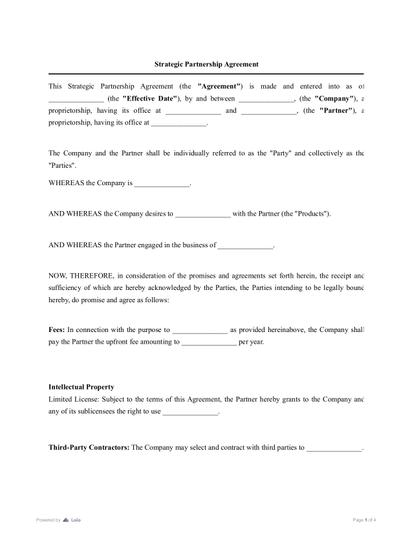
Simple formation. Some partnerships can be started with only a handshake, but a detailed strategic partnership agreement is enough.
Tax efficiency. Pass-through taxation eliminates double taxation. Partners report their share of profits on individual returns.
Flexible profit distribution. Partners can agree to split profits in any ratio, regardless of their capital contributions.
Combined expertise. Each partner brings different skills, networks, and resources to the business, which increases its chances for success.
Shared financial burden. You do not need to invest all your money into your business. Starting a business with a partner allows you to share all the business expenses with other people and, in such a way, minimize your personal risks.
Types of partnerships
There are four common partnership types, each coming with a specific level of liability and management rights:
- 1
General partnership (GP):
- All partners share equal responsibility.
- Each partner can make decisions on behalf of the partnership.
- Each partner is personally liable for business debts.
- No need to file formal documents with the state to form the partnership.
- 2
Limited partnership (LP):
- Has one general partner and one or more limited partners.
- The general partner manages the business and assumes full liability.
- Limited partners contribute capital but do not participate in daily operations. Their liability is limited to their investment.
- To form the partnership, a certificate of limited partnership must be filed with the state.
- 3
Limited liability partnership (LLP):
- All partners are protected from personal liability for the negligence or misconduct of others.
- Most popular among professional service firms such as law practices, accounting firms, and medical groups.
- Must be registered with the Secretary of State and maintain liability insurance.
- 4
Limited liability limited partnership (LLLP):
- It combines the features of an LP and an LLP.
- Requires one or more general partners and one or more limited partners.
- Both general and limited partners receive liability protection.
- Only general partners manage the business.
- Not all states recognize this structure.

What Is a Joint Venture Partnership?
A joint venture is a business arrangement in which two or more parties agree to combine their resources for a specific project while each party keeps its separate legal identity. Unlike a partnership, a joint venture is formed for a specific project or a defined period rather than for a business in general. It presupposes:
An agreement between parties;
A common purpose;
Shared profits and losses;
Each party's right to control the venture.
A joint venture can offer significant strategic advantages for business owners, namely:
Access to new markets. You can enter unfamiliar territories with a local partner who understands the market.
Shared risk. Large projects often require substantial capital. A joint venture lets you divide the financial exposure.
Resource combination. You gain access to your partner's technology, intellectual property, distribution channels, or expertise.
Limited commitment. The arrangement ends when the project concludes. You are not locked into a long-lasting relationship.
Preserved independence. Each party keeps control of its core business operations outside the venture.
Types of joint ventures
Joint ventures can take several forms based on the parties' goals and legal preferences.
- 1
Contractual joint venture:
- The parties electronically sign a contract that outlines their relationship, contributions, and profit allocation.
- No new legal entity is created.
- Each party remains independent and reports its share of income on its own tax return.
- 2
Equity joint venture (incorporated joint venture):
- The parties create a new legal entity — typically a corporation or LLC — to conduct the venture.
- Each party holds equity in the new entity.
- Each party has limited liability protection
- It requires formal registration, corporate filings, and compliance with state business laws.
- 3
Consortium:
- Multiple parties join together for a large-scale project but do not form a separate entity.
- Each member performs a defined portion of the work and assumes responsibility for its own obligations.
- This type is common in construction, infrastructure, and research projects.
Differences Between Partnerships and Joint Ventures
At first glance, joint ventures and partnerships look similar. Both involve collaboration, shared profits, and combined resources. However, when you choose a structure for your business expansion, even tiny differences matter. Let’s compare a joint venture versus a partnership.
Participants
Both structures involve two or more parties, but the nature of their cooperation differs. A partnership typically consists of sole proprietors, though companies can also enter into it. The parties usually share management duties and hold equal responsibility for the business unless their partnership agreement specifies otherwise.
Meanwhile, joint ventures often involve larger entities, such as corporations, LLCs, or other partnerships. Each participant has its own management team, legal counsel, and operational infrastructure, and is responsible only for a certain part of the project. Therefore, the joint venture agreement must clearly define each party's responsibilities, decision-making authority, and scope of involvement to avoid misunderstandings and "I-thought-you-would-do-it" situations.
Purpose
A partnership is formed for an ongoing business enterprise. Partners aim to build and operate a single business together. It can be:
A law firm;
A restaurant owned by two chefs;
A real estate investment company.
A joint venture is formed for a specific project. Once it ends, the venture dissolves. This model is popular among technology firms, construction companies, and pharmaceutical enterprises that work together on projects. In some cases, they can continue their collaboration on future projects, but it is not about long-lasting business relationships or shared growth plans.
Formation
A partnership and a joint venture require different paperwork and legal compliance.
For instance, a GP can form without filing with the state. Two people just decide to run a business together and share profits – and they create a partnership. Actually, they can do it even without a written agreement, but this approach carries certain risks.
No matter how much you trust your potential business partner, it is recommended to sign a strategic partnership agreement that addresses:
Your capital contributions.
How you will share profit and loss.
What management responsibilities each of you has.
How you will resolve disputes.
Under what terms each of you can leave the partnership.
Meanwhile, limited partnerships and LLPs require state registration. You must file a certificate with the Secretary of State and pay the applicable fee. Some states also require annual reports and renewal filings.
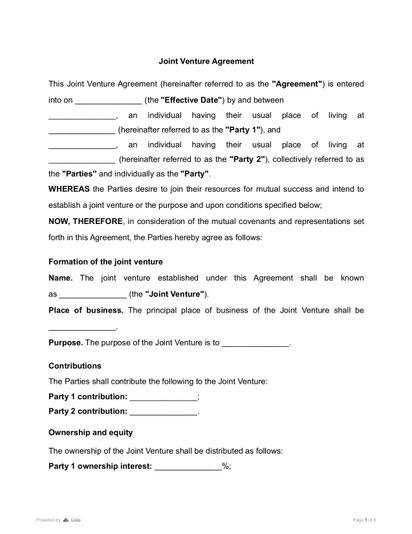
As for a contractual joint venture, it does not require any state filings and is formed when parties sign a joint venture agreement that specifies:
The project's scope and objectives.
Each party's contributions (capital, labor, intellectual property).
The parties' voting rights and management power.
How profit and loss will be divided.
Confidentiality and non-compete provisions.
How the parties can terminate the agreement and exit the joint venture.
An equity joint venture, in its turn, requires the formation of a new entity. You must additionally file:
Articles of Incorporation (for a corporation)/ Articles of Organization (for an LLC).
Shareholder agreements;
Required licenses or permits.
- Corporate Bylaws
 3967 downloads
 - LLC Operating Agreement
 4015 downloads
Duration
A partnership exists indefinitely unless the partnership agreement sets a termination date or the partners decide to stop working together. Under RUPA, certain events can trigger partnership dissolution by default:
A partner says they want to leave.
The agreed time of the partnership ends.
Partners agree to close the business.
An event occurs that triggers dissolution according to the terms of the partnership agreement.
The court dissolves the partnership due to illegal activity, impractical operations, or partner misconduct.
The partnership has fewer than two partners for 90 consecutive days.
However, a partnership agreement may include a continuation clause that will allow the business to survive these events.
A joint venture exists for a limited period, or until the specific project ends. The termination conditions may include:
Completion of the project;
Achievement of certain milestones;
A fixed end date.
When the venture ends, the parties divide the remaining assets and go their separate ways.
Size and scope
Partnerships vary in size. A two-person consulting firm is a partnership. So is a global law firm with thousands of attorneys. No matter how big the business is, a partnership covers all business activities the parties choose to pursue together.
Meanwhile, joint ventures tend to have a narrower scope because they are limited to a single project. What the parties do outside that scope is their own business. So, if they even have different strategic visions but are ready to work together on a product or a service, the venture has a chance to succeed.
Finances
Partners share profits and losses based on their written agreement. If the contract does not specify it, Section 401 of the RUPA provides default rules – typically equal shares regardless of capital contributions. Partners report their share of income on Schedule K-1 and include it on their personal tax returns.
Partners may also receive guaranteed payments for services rendered to the partnership. These payments are deductible by the partnership and taxable to the recipient partner.
In a joint venture, profit and loss distribution depends on the structure.
In a contractual joint venture, each party reports its share of income in accordance with the agreement's terms.
In an equity joint venture organized as an LLC, the operating agreement controls distribution.
If the venture is a corporation, profits are distributed as dividends, which may result in double taxation.
The joint venture agreement should address how the parties will fund the project. It can be:
Equal contributions;
Contributions proportional to ownership;
Contributions based on each party's role.
The document must also specify what happens if one party fails to meet its financial obligations. Use specialized contract reviewing tools to check if the contract contains all the essential clauses and terms.
Liability
Liability should be one of the most important factors in your decision.
In a GP, all partners bear unlimited personal liability for the partnership's debts and obligations. It means that if the partnership cannot pay its creditors, the creditors can pursue each partner's personal assets. This liability is "joint and several," which means a creditor can collect the entire debt from any single partner.
Unlike GPs, LPs and LLPs offer some protection:
Limited partners in an LP risk only their invested capital, as long as they do not participate in management.
LLP partners are fully protected from liability for other partners' negligence or misconduct, though they remain liable for their own actions.
In a joint venture, liability also depends on the entity type:
A contractual joint venture may expose each party to joint and several liability. If we compare a general partnership vs. a joint venture, the level of liability will be approximately the same, especially if they are not registered as separate legal entities. Therefore, a written agreement is so important: it distributes the liability between the parties.
An equity joint venture organized as an LLC or corporation guarantees liability protection. Each party's exposure is limited to its investment in the entity. Therefore, creditors of the venture cannot reach the participants' personal assets.
Partnership vs. Joint Venture: What to Choose
Joint venture and partnership differences define what the better choice for your business is. The second option generally works best in these situations:
- 1
You plan to operate together for a long time. If your goal is to build a business that grows and evolves, a partnership provides the continuity you need. Joint ventures are designed to end.
- 2
You want shared control. Partners typically manage the business together and make decisions as a team. In a joint venture, parties are responsible only for separate operations.
- 3
Your business activities are broad and may expand. A partnership can pursue any lawful business purpose unless the agreement restricts it. A joint venture is limited by its project.
- 4
You accept shared liability. General partnerships require a high level of trust. Each partner's actions bind the partnership. If you are comfortable with this arrangement, a partnership offers simplicity and flexibility.
- 5
You operate a service firm. Law firms, accounting practices, medical groups, and architecture firms often use partnerships or LLPs. These structures allow professionals to collaborate on equal terms.
- 6
You want simple tax treatment. Partnerships avoid double taxation. Income passes through to partners, who report it on their individual returns. This option is perfect for businesses that distribute most of their profits to owners.
Joint ventures and partnerships both offer valuable tools for business expansion, but they serve different purposes. A partnership is ideal for long-term business relationships, while a joint venture is a good choice for those with a shared vision for a product or service rather than the whole business. So, the right choice depends on your goals, risk tolerance, and how long you plan to work with your collaborators.
More guides
September 15
10 min read
Who Can Sign a Contract on Behalf of a Company?

September 15
What Is Contract Redlining?

September 1
7 min read
How to Provide Proof of Employment: Documents and Steps

October 7
How to Start a Staffing Agency: Licensing, Pricing, and Cash Flow

July 20
4 min read
Addendum vs. Amendment: Change Your Purchase Agreement Properly

July 22
Vendor vs Supplier: Key Differences and Which Agreement to Use

One home for your
agreements
Edit PDFs seamlessly
Tweak agreements before signing or sending for signatures. Update details, add or remove clauses, adjust formatting, and redline changes instantly.

eSign legally and securely
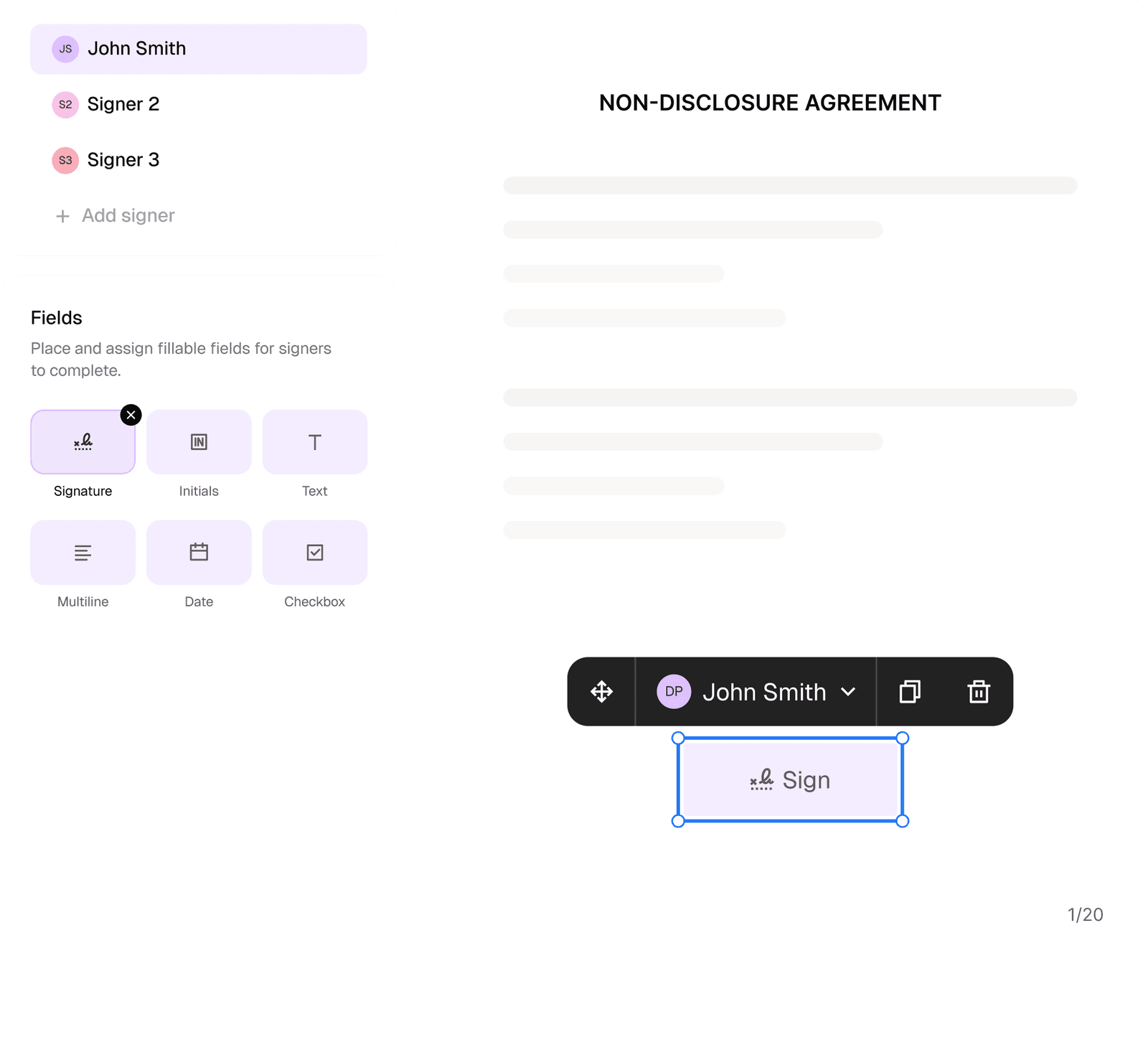
Sign documents and collect legally binding signatures. Invite up to ten people to sign in any order, track the progress, and send reminders.

Request legally binding signatures
Invite up to ten people to sign your document in any order. Get a finalized, audit-ready copy without chasing signatures.
Skip the drafting.
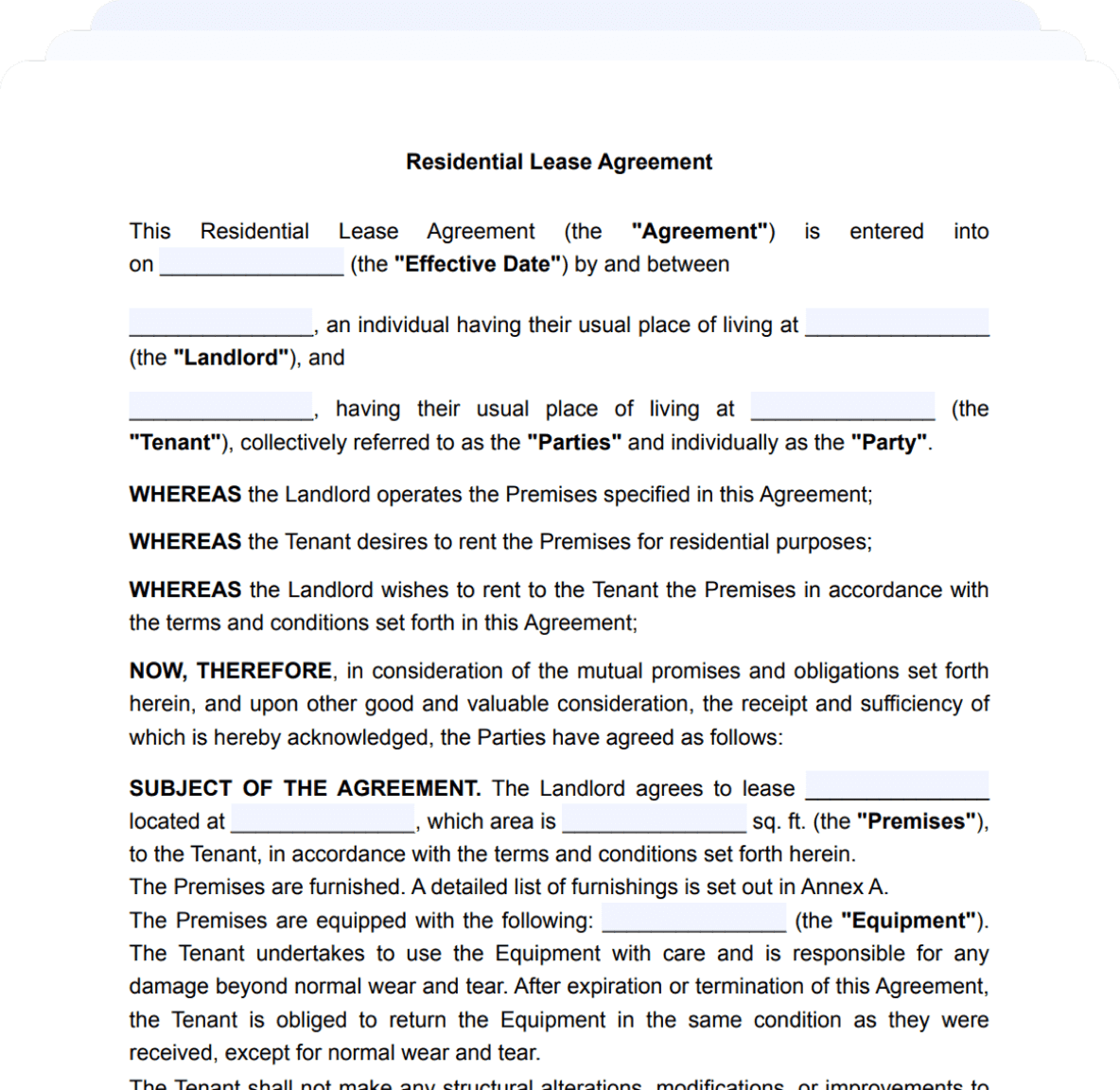
Choose from 2,500+ templates
Browse templatesChoose a template
Fill in details

Sign and download