Updated July 21, 2026
8 min read
Contract Management Statistics and Trends 2026

Contract Management Statistics and Trends 2026
Content
Contracts aren’t just paperwork anymore – they’re mission-critical. Companies are handling more agreements than ever, under stricter rules, with less budget to spare. So, what does contract management really look like in 2026? Let’s break it down.
Key Takeaways
- 11% of businesses rate their contract management as “very effective.”
- Companies lose 8–9% of annual revenue due to poor contracting practices.
- Top firms hold leakage to 3%, compared to 15–20% for low performers.
- Lack of governance can reduce up to 40% of a contract’s value.
- 64% of U.S. civil lawsuits involve contract disputes.
- Automation saves legal teams up to 82% of routine task time.
- AI reviews an NDA in 26 seconds vs. 92 minutes for humans with 94% accuracy.
- 74% of legal departments already use CLM software; 78% invested in the past five years.
- Large firms manage 350+ contracts weekly, consuming 18% of the sales cycle.
- 65% of legal professionals say wasted admin time is their #1 pain point.
Key Contract Management Trends
In 2026, five major trends are shaping contract management, with statistics showing both the challenges organizations face and the opportunities opened by smarter tools and processes. The details might surprise you.
Automation and AI
For years, contract management has been slowed down by much manual work: drafting, reviewing, and tracking obligations. Automation and artificial intelligence can fix these problems.
Research shows that legal teams can save up to 82% of the time spent on routine tasks with automation.
AI can review an NDA in about 26 seconds compared to 92 minutes for a human, reaching 94% accuracy in identifying key terms.
Today, 74% of corporate legal departments use contract management software, and 78% of organizations have invested in CLM technology over the past five years.
The momentum is expected to continue, with the global CLM market projected to reach $12 billion by 2026, growing at an annual rate of 12–15%.
AI-driven redlining can cut review cycles by 45–90%, while reducing costs by one-third.
The AI in contract management systems market is projected to grow from USD 359.6 million in 2023 to USD 3,987.4 million by 2033.
Among legal professionals using AI tools:
- 77% use AI for document review.
- 74% use AI for legal research.
- 59% use it to draft briefs or memos.

In summary: the next stage of development will see deeper integration. Instead of serving only as optional add-ons, AI-driven features are expected to become core components of contract management platforms, helping to drive workflows, monitor compliance, and learn to improve accuracy and efficiency.
Process efficiency
Inefficient processes remain a major challenge in contract management. Many organizations still rely on outdated workflows, lack clear role definitions, or simply move too slowly when handling agreements. This has a direct impact on business outcomes.
Only 11% of companies rate their contract management as “very effective.”
40% of organizations admit they don’t have clear ownership over contract responsibilities.
Between 55–70% of firms lack efficient systems altogether, explaining why top performers can process contracts up to four times faster than peers.
Over half of businesses report losing opportunities due to contracting delays.
In-house legal teams lose $122 for every hour spent working on contracts due to inefficiencies.
CLM platforms can reduce contract review times by up to 50% and cut administrative workload by as much as 82%.
9 in 10 contract professionals say finding specific contracts or clauses is a challenge — many spend up to two hours searching a document.

In summary: Most companies still do not have an effective contract management system.
Manual processes, unclear accountability, and disjointed systems slow down deals and cost companies valuable opportunities.
Cost reduction
Contract management isn’t just a support function – it’s a real driver of financial performance. Poor practices quietly drain money. As a result, every year, businesses lose around 8-9% of revenue because of missed deadlines, overlooked obligations, or inefficient approvals.
The gap between strong and weak performers is striking. Leading firms manage to keep value leakage as low as 3%, while lagging companies lose 15-20%. In the worst cases, the absence of proper governance can result in up to 40% of a contract’s value being wiped out over its lifetime. That’s not just inefficiency – it’s a lost opportunity that directly hits profitability.
However, the problem can be solved ot at least reduced with technology. Automation can reduce administrative contracting costs by 25–30%, cutting out repetitive tasks that weigh teams down. And speed matters: negotiations that move 50% faster lower the risk of incorrect payments by as much as 75-90%. Faster cycles don’t just save time – they protect revenue and ensure that agreed terms actually pay off.

In summary: Effective contract management helps businesses avoid late fees, missed renewals, and penalties by keeping track of key dates and terms. It ensures suppliers follow agreed pricing and service levels, which prevents overcharges and reduces unnecessary spending. Strong oversight also makes it easier to spot duplicate services or contracts that no longer have value.
Risk reduction
The biggest risk isn’t in the contracts themselves, but in how they’re managed – or not managed.
The fact that 64% of civil lawsuits in U.S. courts involve contract disputes shows just how high the stakes really are.
71% of businesses cannot locate at least 10% of their contracts, which means obligations go unfulfilled and important terms are overlooked.
On top of that, 71% of contracts are never monitored for deviations from standard terms, leaving companies vulnerable to unfavorable conditions. Without visibility, leaders are essentially running blind.
Add to this the rigidity executives complain about – 83% say their contracts don’t adapt well to change – and it’s clear why so many organizations find themselves exposed.
The good news is that this risk can be controlled. Digitizing management processes can improve compliance by around 55%, while defined playbooks – which currently exist for only 31% of contracts – bring consistency and reduce the chance of costly mistakes.

In summary: active monitoring then ensures that unfavorable deviations are caught before they escalate. Risk reduction in contract management isn’t just about avoiding lawsuits; it’s about giving organizations the clarity and flexibility to operate with confidence.
Legal workload and contract volume
The rising volume of contracts is stretching legal departments to their limits.
Large firms now handle more than 350 contracts every week, and each one requires drafting, review, negotiation, and approval. It’s no wonder that contracts account for nearly 18% of the entire sales cycle, slowing down business and straining internal resources.
- 29% of legal teams report handling 100–500 contracts annually.
- 84% of solo in-house lawyers manage fewer than 500 contracts per year.
- 79% of large legal teams (50+ members) handle over 5,000 contracts annually.
The real cost is in how lawyers spend their time.
In-house counsel dedicate 25–40% of their working hours to administrative tasks that don’t require legal expertise.
That lost time translates into an estimated $2.7 million in productivity costs each year.
Adding to the pressure, 80% of in-house counsel are still expected to assist with routine drafting and review, leaving less room for high-value legal work.
It’s not just about workload – it’s also about morale. 65% of legal professionals say wasted admin time is their biggest pain point.
51% of legal professionals spend a third of their time on drafting, clause review, and negotiation tasks.
When talented lawyers spend more time formatting contracts than advising on strategy, both efficiency and job satisfaction suffer.

In summary: without better systems, legal teams will continue to drown in routine work. Smarter contract management tools and automation are essential for freeing lawyers to focus on strategic, high-impact matters.
Final Words
Contract management is no longer just an administrative task – the data shows it directly impacts revenue, risk, and team efficiency. Poor practices drain millions, while modern systems, automation, and AI help companies work faster and smarter. Still, technology alone isn’t enough. The real advantage comes when smart tools are combined with human expertise, turning contracts into drivers of value rather than sources of delay and cost.
The future of contracting belongs to organizations that treat it as a strategic priority, not just a legal formality.
More guides
September 15
10 min read
Who Can Sign a Contract on Behalf of a Company?

September 15
What Is Contract Redlining?
September 1
7 min read
How to Provide Proof of Employment: Documents and Steps

October 15
How to Start a Staffing Agency: Licensing, Pricing, and Cash Flow

July 20
4 min read
Addendum vs. Amendment: Change Your Purchase Agreement Properly
July 20
What Is an Assignment of Contract? Rights, Duties, and Consent

One home for your
agreements
Edit PDFs seamlessly
Tweak agreements before signing or sending for signatures. Update details, add or remove clauses, adjust formatting, and redline changes instantly.
eSign legally and securely
Sign documents and collect legally binding signatures. Invite up to ten people to sign in any order, track the progress, and send reminders.
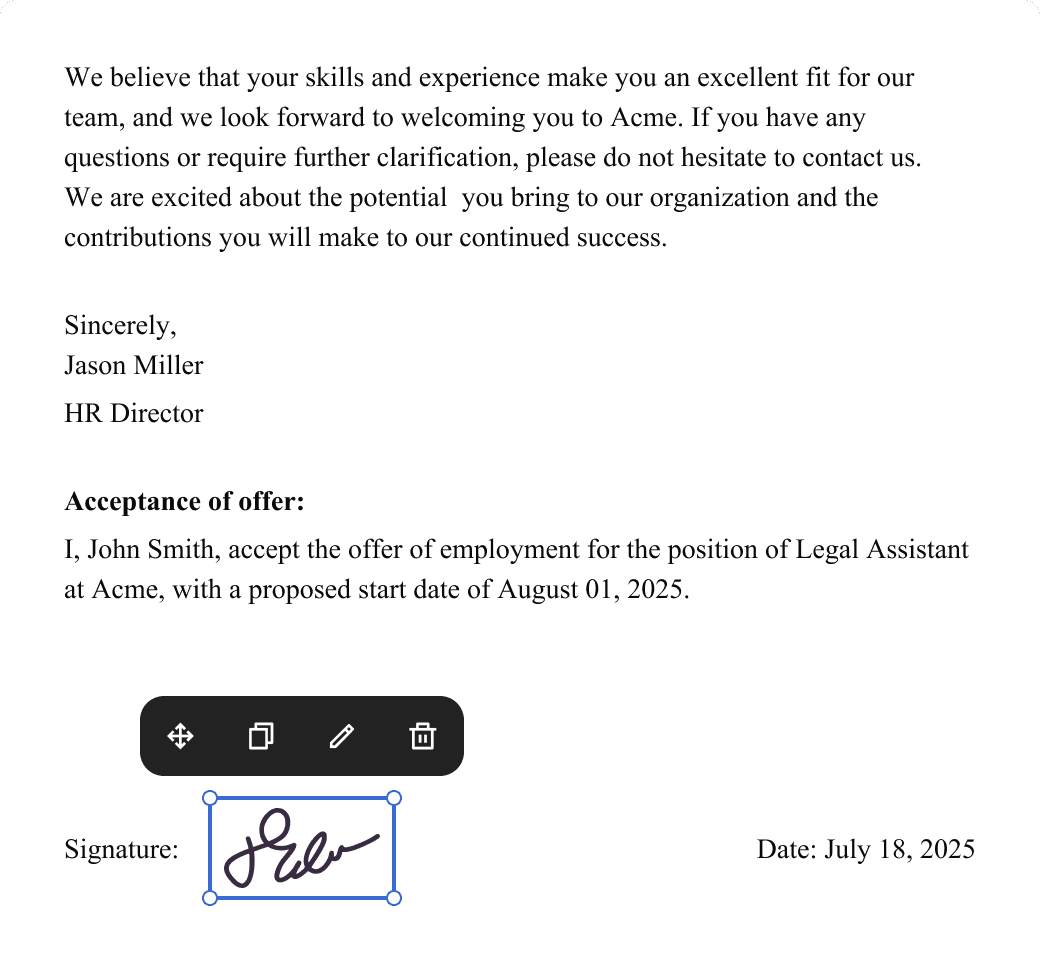
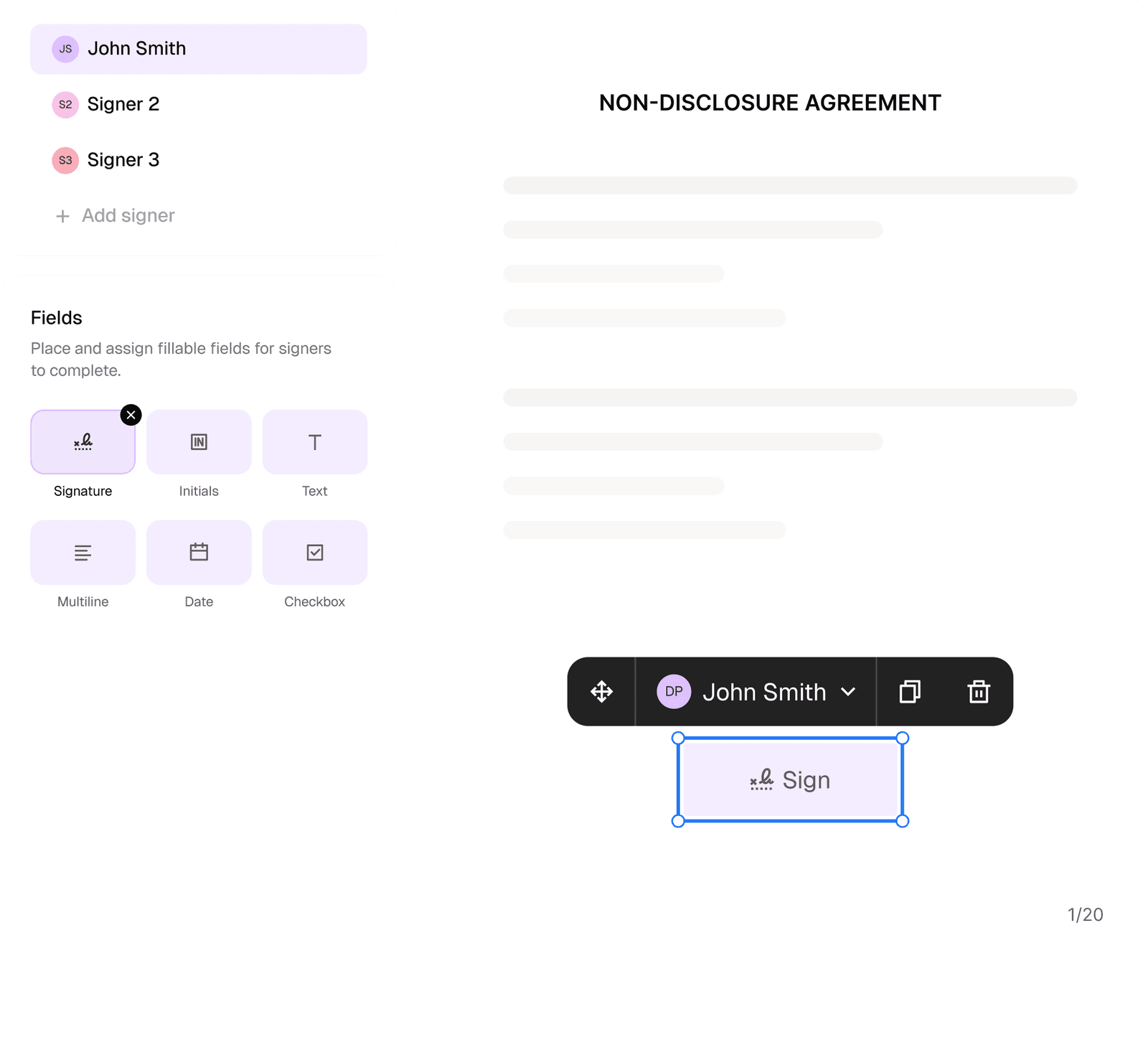
Request legally binding signatures
Invite up to ten people to sign your document in any order. Get a finalized, audit-ready copy without chasing signatures.
Skip the drafting.
Choose from 2,500+ templates
Browse templatesChoose a template
Fill in details
Sign and download