Free template
Free Caregiver Contract Template

What Is a Caregiver Contract?
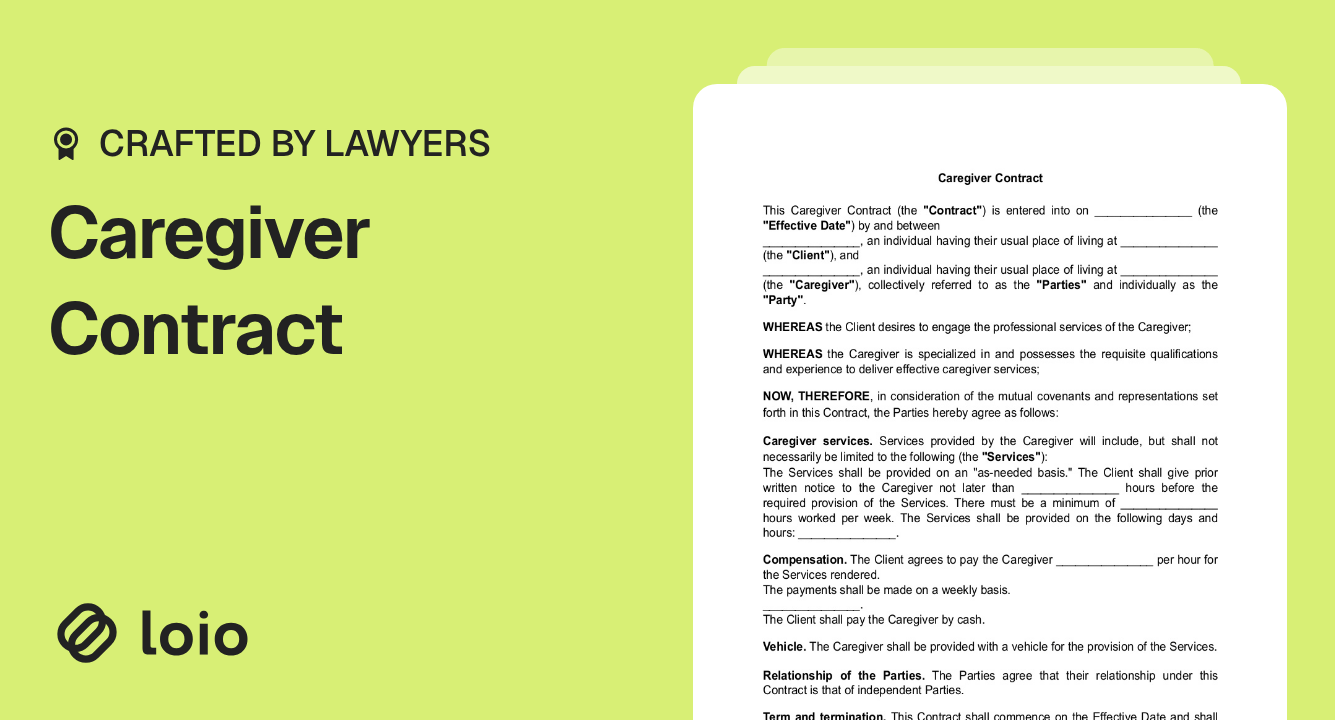
Copy section linkA caregiver contract template is used for a written agreement between someone who needs care and an independent caregiver who will provide those services. The contract specifies the caregiver's duties, compensation, work schedule, and the terms under which either party can end the arrangement. Families hire a caregiver to assist an aging parent, a person with a disability, or anyone who needs help with daily activities like bathing, preparing meals, or managing medications.
A caregiver works as an independent contractor who controls their own work methods and schedule. Such business relationships require a caregiver contract template that provides legal protection for both parties. While independent contractors handle their own tax obligations, they need this documentation to report income to the IRS accurately. Meanwhile, the client gets proof that payments were for actual services, not gifts from the family, which matters during Medicaid's review of financial transactions.
A caregiver contract also clarifies the financial aspects of such cooperation: payment schedules (weekly, bi-weekly, or monthly), hourly rates or flat fees, and the method of payment. This allows the parties to avoid misunderstandings and payment delays.
When to Use a Caregiver Contract?
Copy section linkUse a caregiver contract when:
You hire someone to provide in-home care for an elderly or disabled family member.
A family member will serve as a paid caregiver and needs documentation for Medicaid planning.
You engage an independent caregiver who is not employed by an agency.
An adult child or relative will leave other employment to care for a parent and requires formal compensation.
You plan to apply for Medicaid benefits and need to prove that payments to a caregiver were for legitimate services, not gifts.
When not to use a caregiver contract:
You are employed as a caregiver by a licensed agency (an employment contract should be used instead).
You need someone to make medical decisions for an elderly or disabled person (use a medical power of attorney instead).
The arrangement is purely voluntary with no expectation of payment.
What Are the Parties to the Caregiver Contract?
Copy section linkClient: The person receiving care services, or their legal representative (such as a guardian or agent under a power of attorney) who has authority to hire and pay the caregiver.
Caregiver: The individual who agrees to provide personal care, companionship, household support, or limited medical assistance in exchange for compensation.
What to Include in a Caregiver Contract?
Copy section linkParties’ information: Full legal names, addresses, and contact details of the client (or their representative) and the caregiver to identify who enters into the caregiver contract.
Caregiver services: A detailed description of the services to be provided, such as personal care, companionship, meal preparation, or medication reminders, to define the scope of responsibilities and expectations, ensuring compliance with labor law.
Compensation: The agreed payment structure, including hourly rate or flat fee, overtime (if applicable), payment schedule, and method.
Vehicle: Statement that the client provides the caregiver with a vehicle and the terms of its use.
Term and termination: The start date, duration of the caregiver agreement, and the conditions and notice requirements for ending the caregiver contract template.
Confidentiality: An obligation both parties take to protect each other’s personal, financial, and medical information in accordance with privacy and applicable law.
Force majeure: A clause explaining that neither party will be held liable for failure to perform obligations due to events beyond their control, such as natural disasters or government actions.
Mutual indemnification: A provision stating that each party agrees to compensate the other for certain losses or damages resulting from their own negligence or misconduct.
Notices: Instructions on how official communications related to the caregiver contract must be delivered (e.g., in writing, by mail or email) to be legally effective.
Governing law and dispute resolution: Identification of the state law that applies to caregiver agreement template and the method for resolving disputes, such as mediation, arbitration, or court proceedings.
Waiver: A statement that failure to enforce any part of the caregiver agreement does not mean either party gives up the right to enforce it later.
Signatures and date: The signatures of both parties and the date that make the document legally enforceable.
What Are the Key Terms of a Caregiver Contract?
Copy section linkServices: This term specifies the caregiver's responsibilities, including tasks like grooming, meal preparation, medication management, shopping, etc.
Wages or compensation: Details about payment frequency, rate, and method, helping avoid confusion or potential disputes.
Work schedule: Detailing the caregiver's working hours, including breaks, prevents misunderstandings.
Termination clause: Defines the conditions under which the independent caregiver contract can be terminated by either party.
Confidentiality: Stipulates how personal and private information about the client has to be handled, ensuring their privacy is protected.
How to Fill Out a Caregiver Contract Template
Copy section link- Enter the full legal names and contact information of the client and caregiver.
- List all caregiving duties in detail.
- Specify the work schedule, including days and hours.
- Enter the agreed hourly rate or flat fee.
- Add payment frequency, method, and due dates.
- Mention whether the caregiver will be provided with a vehicle.
- Define the notice period and grounds for termination.
- Add confidentiality and privacy obligations.
- Specify the governing state law.
- Have both parties sign and date the agreement.
Is a caregiver contract legally binding?
Yes, a caregiver contract is legally binding if it meets state contract law requirements. It should be signed and dated by both parties and comply with state elder care or consumer protection laws.
Is a family caregiver considered an employee?
Under IRS rules and the Fair Labor Standards Act (FLSA), a family caregiver may be classified as a household employee if the family controls how and when the work is done. In that case, the employer may be responsible for payroll taxes and minimum wage compliance.
How does a caregiver agreement affect Medicaid eligibility?
Medicaid reviews payments made during the five-year “look-back” period. A written caregiver agreement helps prove that payments were reasonable compensation for services, not gifts, which can prevent penalties or delays in eligibility.
Do live-in caregivers receive overtime pay?
Under the FLSA, live-in domestic workers may be exempt from federal overtime requirements, but they must still receive at least minimum wage. However, some states — such as California and New York — require overtime pay for live-in caregivers, so state law must be checked carefully.
Is caregiver income taxable?
Wages paid to a caregiver are taxable income. Household employers may need to withhold and pay Social Security, Medicare (FICA), and federal unemployment taxes in accordance with IRS Publication 926.
Requirements for this document vary by state. Review your state's laws and procedures — or consult a licensed attorney — before using this template to ensure it's valid and enforceable where you live.
Sources
Related documents
Also read