Free template
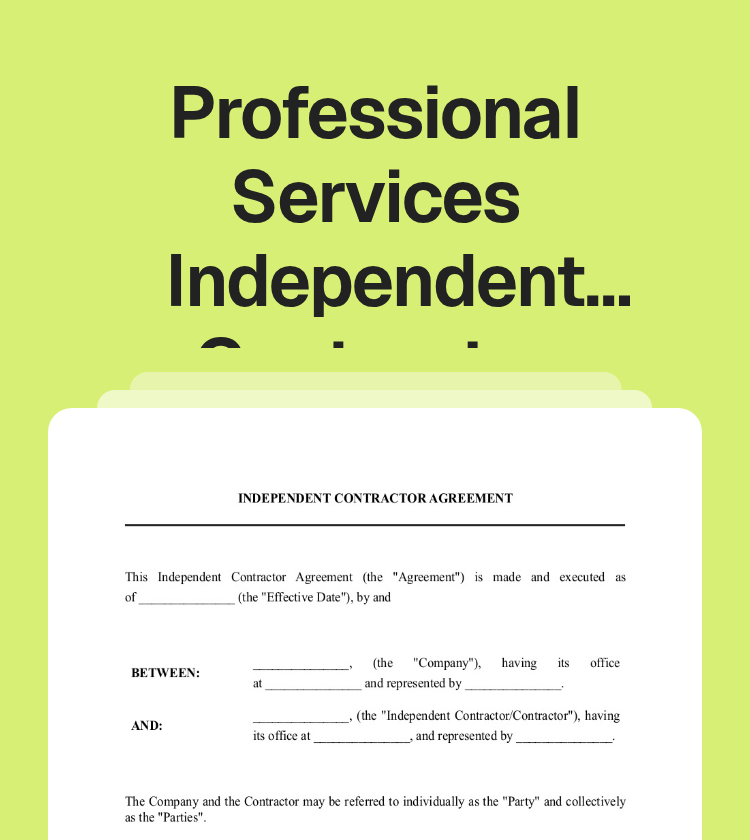
Free Professional Services Agreement Template

What Is a Professional Services Agreement?
Copy section linkA professional services agreement is a legally binding contract between a business or individual who provides specialized services, like legal counsel, accounting, IT consulting, marketing, and a client who needs those services. This document covers the terms of such cooperation: list of services, timelines, fees, and ownership of work product.
A professional services agreement template is applicable only if the service provider operates as an independent contractor, not an employee. This distinction affects tax treatment, benefits, liability, and the level of control the client has over how work is performed.
When to Use a Professional Services Agreement?
Copy section linkIf an individual or an entity hires a consultant, advisor, or specialist for a defined project or ongoing support.
If a consultant provides professional services to a client as an independent contractor.
When not to use a personal service agreement:
If you hire the person as a full-time or part-time employee rather than an independent consultant (an employment contract should be used instead).
If you already have a Master Service Agreement and just need to document a specific project under it (use a statement of work instead).
What Are the Parties to the Professional Services Agreement?
Copy section linkService provider: The individual, firm, or company that delivers professional services. The provider operates as an independent contractor and is responsible for taxes, insurance, and compliance with state and local regulations.
Client: The business or individual that hires the service provider. The client pays for services rendered and may provide access to information, systems, or personnel needed to complete the work.
What to Include in a Professional Services Agreement?
Copy section linkA legally-binding professional services agreement template should contain the following elements:
Engagement: The scope of work the service provider agrees to perform for the client.
Term: The start date, end date, or duration of the agreement.
Independent contractor relationship: Confirmation that the service provider operates as an independent contractor, not an employee, which affects tax obligations, benefits, and legal liability.
Fees for services: The compensation structure (hourly rate, fixed fee, or retainer), payment schedule, invoicing procedures, and any late payment penalties.
Intellectual property ownership: Clarifies who owns the work product, deliverables, and any pre-existing intellectual property used during the engagement.
Supplies and equipment: List of tools, software, materials, or equipment needed to complete the work and who is responsible for providing them
Work made for hire: States that certain deliverables created by the contractor during the engagement belong to the client upon completion and payment. These deliverables must fall into one of the following categories: contribution to a collective work, part of a motion picture or other audiovisual work, translation, supplementary work, compilation, instructional text, test, answer material for a test, or an atlas. Otherwise, an IP assignment agreement should be signed additionally.
Obligations of the independent contractor: The duties, standards, and responsibilities the service provider must fulfill under the agreement.
Communication: The rules for how and when the parties will communicate, including preferred contact methods, response times, and progress updates.
Non-circumvention: Prevents either party from bypassing the other to work directly with introduced contacts, clients, or vendors without the other party's consent.
Taxes: Confirms that the service provider is responsible for their own tax payments, including income tax and self-employment tax, and that the client will not withhold taxes.
Termination: The conditions under which either party may end the agreement, required notice period, and payment obligations for work completed before termination.
Indemnification: Responsibility for claims, damages, or losses that arise from the services or breach of the contract.
Dispute resolution: The method for resolution of disagreements, such as mediation, arbitration, or litigation in a specified jurisdiction.
What Are the Key Terms of a Professional Services Agreement?
Copy section linkServices: The specific professional work the provider agrees to perform for the client, as described in the scope of services section of the agreement.
Intellectual property: Creations produced during the engagement, such as reports, designs, software, or strategies, and the terms determining who owns these deliverables after the work is complete.
Confidentiality: The obligation of both parties to protect sensitive information, trade secrets, and proprietary data shared during the cooperation not to disclose it to unauthorized third parties.
Term/Termination: The duration of the agreement and the conditions under which either party may end the contract.
Compensation: The fees the client agrees to pay for services.
How to Fill Out a Professional Services Contract Template
Copy section link- State the names, business form, and contact information of the service provider and the client.
- Specify the services the provider will perform, including the deliverables, project scope, and any milestones to be achieved.
- Describe payment terms, including the fee structure, invoicing schedule, and any other expenses that must be reimbursed.
- Identify who owns work output, how the client can use it, and under what circumstances the service provider can use it for promotional purposes.
- State the conditions under which the contract can be terminated prematurely and how it can be extended, if necessary.
- Add a confidentiality or non-disclosure clause to protect sensitive business information.
- Define what happens in case of a dispute and whether any insurance is required.
- Specify the starting and ending dates of the service agreement.
- Have both parties sign and date the professional services contract.
What is the difference between a PSA, MSA, and SOW?
A professional services agreement (PSA) governs a single engagement with defined scope and fees. A master service agreement (MSA) sets general terms for an ongoing relationship, while a statement of work (SOW) describes specific projects under that MSA. Use a PSA for one-time engagements and an MSA with SOWs for repeat clients or multiple projects.
Who owns the intellectual property created during the engagement?
It depends on what the contract states. Without a written agreement, ownership rules vary by jurisdiction and type of work. Most PSAs include a clause that transfers IP rights to the client upon payment or specifies that the provider retains ownership and grants a license.
Are there limits on indemnification in a professional services agreement?
Many contracts cap indemnification at a specific dollar amount, often tied to fees paid or the total contract value. Some agreements exclude certain damages (such as consequential or punitive damages) from indemnification obligations.
What insurance should a service provider carry?
Common requirements include professional liability (errors and omissions) insurance, general commercial liability insurance, and, in some cases, cyber liability coverage. The client may specify minimum coverage amounts in the contract.
Does the client have the right to audit the service provider's records?
Only if the contract includes such terms. Under them, the client can review invoices, time entries, or expenses to verify the accuracy of the work being done.
Requirements for this document vary by state. Review your state's laws and procedures — or consult a licensed attorney — before using this template to ensure it's valid and enforceable where you live.
Sources
Related documents
Also read