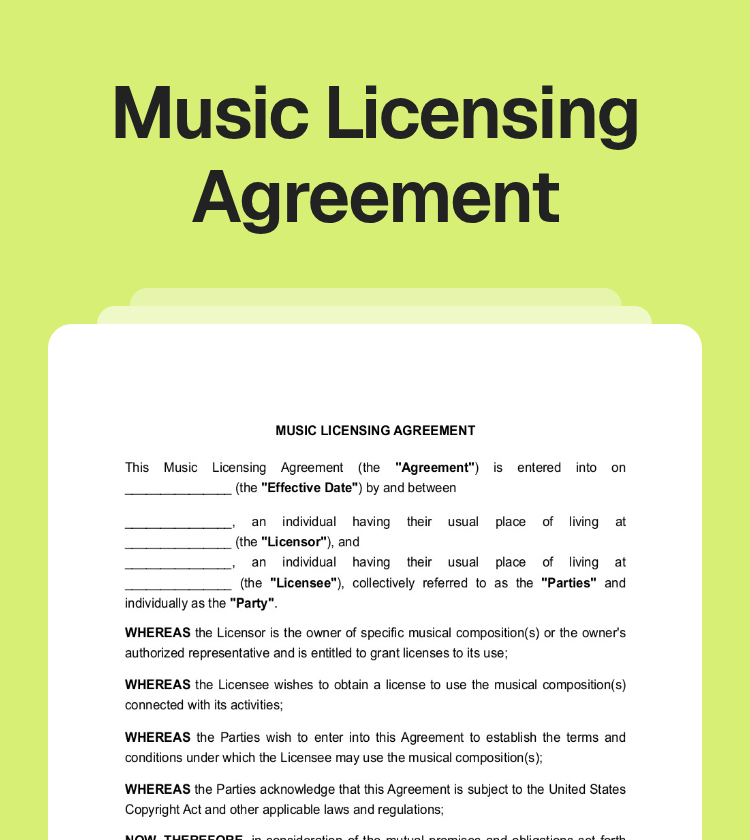
Music Licensing Agreement Template

4.8 (93 reviews)
All states
Updated Jul 4, 2024
~ 8 pages
PDF
4.6K downloads
MUSIC LICENSING AGREEMENT

This Music Licensing Agreement (the "Agreement") is entered into on   (the "Effective Date") by and between 

 , an individual having their usual place of living at   (the "Licensor"), and

 , an individual having their usual place of living at   (the "Licensee"), collectively referred to as the "Parties" and individually as the "Party".

WHEREAS the Licensor is the owner of specific musical composition(s) or the owner's authorized representative and is entitled to grant licenses to its use;

WHEREAS the Licensee wishes to obtain a license to use the musical composition(s) connected with its activities;

WHEREAS the Parties wish to enter into this Agreement to establish the terms and conditions under which the Licensee may use the musical composition(s);

WHEREAS the Parties acknowledge that this Agreement is subject to the United States Copyright Act and other applicable laws and regulations; 

NOW, THEREFORE, in consideration of the mutual promises and obligations set forth herein and upon other good and valuable consideration, the receipt and sufficiency of which is hereby acknowledged, the Parties have agreed as follows:

SUBJECT OF THE AGREEMENT. Under this Agreement, the Licensor grants the Licensee a license subject to the following terms and conditions:

A. Type of license: The Licensor grants the Licensee the non-exclusive, worldwide, perpetual license (the "License") to use the following musical composition(s) (the "Composition(s)") subject to the restrictions set forth in this Agreement:


B. Territory: The License granted hereunder is worldwide, without any territorial limitation to the use of the Composition(s).

C. Term of the License. The License is granted for an unlimited period.

D. Rights granted: The License granted hereunder includes the following rights regarding the Composition(s) subject to the limitations set forth in this Agreement (the "Rights Granted"):

According to this Agreement, the Licensee has no right to issue the sublicense to the third parties regarding the usage of the Composition(s), which are subject to the present Agreement.

PAYMENT TERMS AND PROCEDURE. The Licensee undertakes to pay the Licensor the fee for the use of the Composition(s) in accordance with the terms of this Agreement and the following provisions:

  1. Calculation of compensation: The Licensee agrees to pay the Licensor a royalty (the "Royalty") of   on all net revenues derived from the use of the Composition(s) under this Agreement. 

  2. Payment procedure: The Licensee shall pay to the Licensor the Royalty due under this Agreement within   (the "Due Date") after the end of each month during the term of this Agreement.

The Licensee shall provide the Licensor with a Royalty calculation report payable under this Agreement along with the aforementioned payment. The report shall include a detailed accounting of all net revenues derived from the use of the Composition(s) during the relevant month, as well as any third-party fees, taxes, and actual out-of-pocket expenses incurred by the Licensee in connection with such use.

Late payment: If the Licensee fails to make any fee due under this Agreement within   days after the Due Date, the Licensor shall be entitled to charge interest on the unpaid amount of   per day or at the maximum rate permitted by law, whichever is less.

Payment method: The Licensee shall pay the Licensor by cash

Taxes: The   shall be responsible for all taxes related to the License, including sales tax, use tax, and other applicable taxes.

OBLIGATIONS OF THE PARTIES

  1. Licensee's obligations: The Licensee is solely responsible for obtaining all permissions, consents, and licenses necessary to use the Composition(s) in accordance with the terms of this Agreement. The Licensee shall comply with all applicable laws, regulations, and industry standards connected with the use of the Composition(s). The Licensee shall not infringe third-party rights, including intellectual property rights while using the Composition(s) under this Agreement.

  2. Licensor's obligations: The Licensor represents and warrants that the Composition(s) do not infringe the intellectual property rights of any third party. The Licensor shall provide the Licensee with any information that may be reasonably requested by the Licensee for the use of the Composition(s) under this Agreement.

  3. Joint obligations: The Parties shall cooperate in good faith to promote and market the Composition(s) in such a way as to maximize their commercial potential. The Parties shall consult with each other on all material aspects of the use of the Composition(s), including the use of the Composition(s), along with any advertising, marketing, or promotional campaign.

WARRANTIES AND REPRESENTATIONS. The Licensor represents and warrants being the sole and exclusive owner of the Composition(s) and possessing full right, power, and authority to grant the License to the Licensee.

The Licensor represents and warrants that the Composition(s) is/are free from any claims, liens, encumbrances, and adverse rights or interests.

The Licensor further represents and warrants that all relevant information regarding the Composition(s) has been disclosed to the Licensee.

LIABILITY AND INDEMNIFICATION. The Licensor shall not be liable for any indirect, special, punitive, or consequential damages arising out of or in connection with the use of the Composition(s) by the Licensee under this Agreement.

The Licensor shall indemnify and hold the Licensee harmless from and against any claims, damages, liabilities, costs, and expenses, including reasonable attorneys' fees, arising from or in connection with any breach of the Licensor's warranties or representations. The obligation of the Licensor to indemnify and hold harmless the Licensee shall be limited to the actual damages suffered by the Licensee as a result of any breach of the Licensor's warranties or representations.

The Licensee shall indemnify and hold the Licensor harmless from and against any claims, damages, liabilities, costs, and expenses, including reasonable attorneys' fees, arising out of any breach of the Licensee's obligations hereunder or any claim that the use or exploitation of the Composition(s) by the Licensee infringes the intellectual property rights of any third party. 

Either Party shall promptly notify the other Party of any claim or action asserted against the Licensor in connection with the use of the Composition(s), and the other Party shall have the right to control the defense of any such claim or action.

DEFAULT. Either Party shall be considered in default under this Agreement upon the occurrence of any of the following events:

  1. Failure to perform any of the obligations under this Agreement, continuing for a period of   days after written notice or for such longer period as may be reasonable under the circumstances.

  2. Any voluntary or involuntary proceedings against either Party arising under any bankruptcy or insolvency law.

TERMINATION OF AGREEMENT. This Agreement shall commence on the Effective Date and continue until   unless otherwise agreed by the Parties under the terms of this Agreement.

Either Party may terminate this Agreement at any time by giving the other Party   days prior written notice. 

Upon termination of this Agreement, the Licensee shall immediately cease all use of the Composition(s) and return or destroy all copies of the Composition(s).

NOTICE. Any notice, request, demand, or other communication required or permitted to be given under this Agreement shall be in writing and deemed duly given if delivered personally or sent by registered mail, return receipt requested, postage prepaid, or by a reputable overnight delivery service to the address or email addresses set forth below, or to such other address as either Party may designate by written notice to the other Party:

If to the Licensor:

Attn.  

 , USA


If to the Licensee: 

Attn.  

 , USA


Either Party may change the registered mail or email address for receipt of notices by giving written notice to the other Party.

Notices shall be deemed received on the day of delivery if sent by hand or courier service or on the third business day after the date of posting if sent by registered mail or email.

CONFIDENTIALITY. The Parties agree to keep all information disclosed during this Agreement confidential and not to share such information with any third party unless required by law. The Parties agree not to use the confidential information for any purpose other than what is necessary to fulfill their obligations under this Agreement.

This confidentiality clause shall survive the termination or expiration of this Agreement.

GOVERNING LAW AND DISPUTE RESOLUTION. This Agreement shall be governed by and interpreted in accordance with the laws of the State of  , and any disputes arising out of or in connection with this Agreement shall be exclusively resolved by the courts of the State of  .

FORCE MAJEURE

Neither Party shall be liable for any failure to perform or delay in performing the obligations under this Agreement if such failure or delay is caused by events of force majeure, including but not limited to acts of God, war, terrorism, strikes, lockouts, labor disputes, pandemics, epidemics, governmental regulations, or any other similar cause beyond the reasonable control of the affected Party. 

In the case of force majeure, the affected Party shall immediately notify the other Party in writing and provide the other Party with reasonable evidence of the delay or inability to perform the obligations. The Party affected by force majeure shall endeavor to mitigate the consequences of such circumstances and resume the performance of obligations as soon as possible after the circumstances cease to exist.

If the force majeure circumstances last more than   days, either Party may terminate this Agreement by giving written notice to the other Party. In this case, neither Party shall be liable for any damages arising from the termination of this Agreement.

SEVERABILITY. The invalidity or unenforceability of any provision of this Agreement shall not affect the validity or enforceability of any other provision of this Agreement.

WAIVER. The failure of any Party to enforce a particular provision of this Agreement shall not constitute a waiver of their right to enforce that provision in the future.

ENTIRE AGREEMENT. This Agreement constitutes the entire understanding between the Parties and supersedes all prior or contemporaneous agreements, understandings, negotiations, or discussions, whether oral or written, relating to the subject matter of this Agreement. Any amendments or modifications to this Agreement must be in writing and signed by both Parties. 

BINDING EFFECT. This Agreement shall be binding upon the Parties and their respective successors and assigns. Neither Party may assign this Agreement or any of its rights or obligations hereunder without the prior written consent of the other Party, which consent shall not be unreasonably withheld.

IN WITNESS WHEREOF, the Parties have executed this Agreement as of the Effective Date.

THE LICENSOR

THE LICENSEE


 , USA


 , USA


______________________________

(Place for signature)


______________________________

(Place for signature)


Written by Megan Thompson - Reviewed by Jonathan McGill

Template Description

Copy section link
Paper titled "Music Licensing Agreement"; music playlist; woman singing and playing the guitar; microphone standing in front of the woman

The music industry is tightly connected with media, people, and legal paperwork. Anyone who wants to use music samples in movies, TV, or other visual media must get a license from the music creators. This is where music license agreements come into play to help the parties legalize the deal and ensure the protection of intellectual property rights.

In this template description, we will cover types of music licenses, scenarios of using a music license agreement, and steps on how to create a personal music license agreement according to your needs.

What Is a Music License Agreement?

Copy section link

A music license agreement outlines all the terms and conditions for music use between the copyright owner (licensor) and the party intending to use the copyrighted music (licensee). The licensor is usually a composer, a songwriter, or a record brand –– the sole owner of the music. Licensees can be TV producers, filmmakers, video game developers, and others willing to apply music to their materials.

When to Use a Music License Agreement

Copy section link

The worldwide music industry and related areas offer various scenarios for employing a sample music license agreement. The common cases are the following:

  • Television and film industry, where various musical compositions are must-haves;

  • Advertising campaigns;

  • Live events like concerts and festivals;

  • Streaming services;

  • Other visual media.

Before creating a music license agreement template, it is essential to understand music license types.

Benefits of Music Licensing

Copy section link

1. Shielded intellectual property

A music recording is a product of the mind that should be protected by intellectual property and copyright laws. Without music license agreements, composers, songwriters, and other parties creating music will not be able to prove their authorship rights and will not be paid for their work.

2. Clear payment terms

Music license agreements allow the parties involved to spell out fair compensation rules for the usage of a song or master recording. This section should also explain royalty payments issued every time the music product is used in public. When all payment terms are written in detail in a music license agreement template, the parties will avoid future legal disputes or lawsuits.

How to Write a Music License Agreement

Copy section link

A simple music license agreement template should cover the details of a music sample, the selected type of license, its geographical scope, royalties, termination, indemnification, and warranties. Below are the clauses you should fill out in your future legal contract:

  1. Music sample. This information includes the type of music, its name, and the author’s name. If the owner is a record label or a publisher, mention the company names and the names of its legal representatives.

  2. Grant of rights. This explains the rights the licensee acquires after signing the music license agreement. The rights may allow the licensee to perform, distribute, or reproduce the music during the contract terms. 

  3. Type of music license. The licensor must clarify the purpose of using music and the exact channels through which it can be used. A licensee who fails to follow the defined terms risks breaching the music license contract.

  4. Territory. This clause specifies the geographical area where the licensee can use the music. For example, if the licensee may publish or perform the music only within the U.S., any performance in other regions would cause the contract termination.

  5. License duration. The parties themselves define the validity period of the music license agreement, whether it’s a couple of months or perpetual music licensing.

  6. Royalties and compensation. A royalty fee may depend on the number of times when the music is used and listeners. Other fares, payment methods, and terms of renegotiating fees should also be mentioned in this provision.

  7. Termination and breach. This section describes how the parties can end their music license agreement and the termination conditions. The party willing to end the cooperation must inform the other party of their intentions with a prior written notice. 

  8. Indemnification and liability. The parties to the music license agreement should be aware of all possible legal claims and exclusions.

  9. Governing law. Here, the parties should specify the jurisdiction in which this music license agreement operates. For example, if it abides by California state law, all legal disputes and conflicts must be resolved under California state law respectively.

Other essential details to include in a music license agreement template are force majeure and confidentiality clauses. These standalone sections elaborate on unforeseen circumstances and terms of keeping the contract information confidential.

Creating a DIY music license agreement is no longer a complicated process. Simple template-related questions offered by Loio will help you add correct information and prepare an original legal contract for negotiations. After the paper is revised, design an electronic signature on Loio and put it on your newly created music license agreement to ensure the intellectual property rights are safeguarded, and music licensing is legally enforceable.