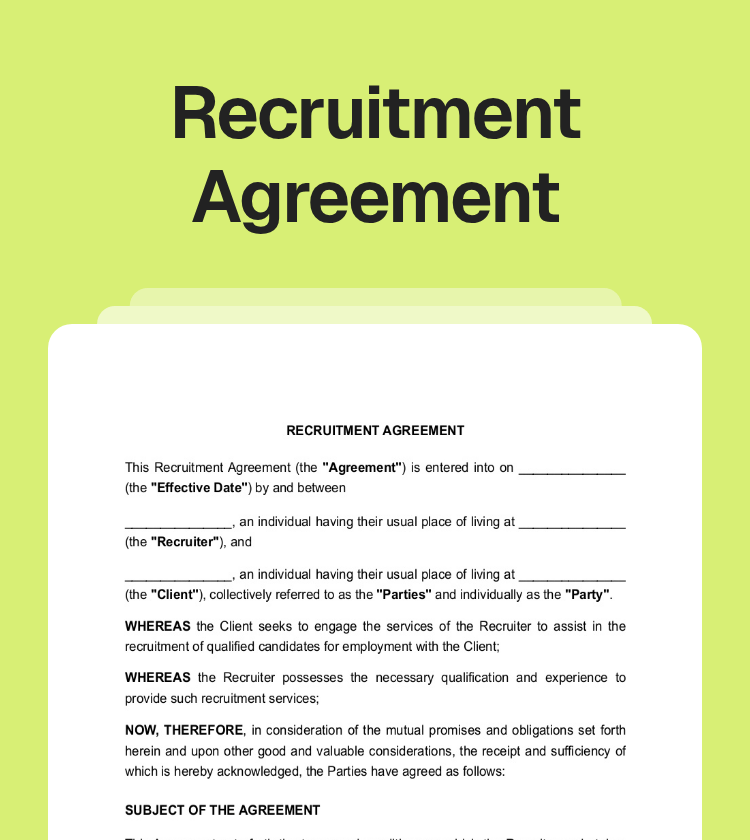
Recruitment Agreement Template

4.6 (140 reviews)
All states
Updated May 7, 2024
~ 7 pages
PDF
4.6K downloads
A Recruitment Agreement is a legal contract between an employer and a recruitment agency outlining terms for sourcing and hiring candidates. It is used to define fees, responsibilities, and hiring expectations between both parties.
RECRUITMENT AGREEMENT

This Recruitment Agreement (the "Agreement") is entered into on   (the "Effective Date") by and between

 , an individual having their usual place of living at   (the "Recruiter"), and

 , an individual having their usual place of living at   (the "Client"), collectively referred to as the "Parties" and individually as the "Party"

WHEREAS the Client seeks to engage the services of the Recruiter to assist in the recruitment of qualified candidates for employment with the Client; 

WHEREAS the Recruiter possesses the necessary qualification and experience to provide such recruitment services;

NOW, THEREFORE, in consideration of the mutual promises and obligations set forth herein and upon other good and valuable considerations, the receipt and sufficiency of which is hereby acknowledged, the Parties have agreed as follows:

SUBJECT OF THE AGREEMENT

This Agreement sets forth the terms and conditions on which the Recruiter undertakes to provide the Client with the recruiting services (the "Services"):

Scope of the Services. The Services shall include the following:

Requested information. The Client undertakes to provide the Recruiter with all the necessary information regarding the opening(s) for which the Services are provided, including job obligations, job level, required qualifications, and other relevant information.

Client's requirements. The Recruiter agrees to make every effort to find and present candidates who align with the requirements provided by the Client.

Evaluation of candidates. The Recruiter shall make every effort to evaluate the qualifications and suitability of each candidate presented to the Client. However, the final decision to hire or not to hire any candidate is the Client's sole responsibility.

No guarantee of employment. The Recruiter does not guarantee that any candidate presented to the Client will be hired by the Client or that any hired candidate shall remain employed by the Client for a particular period.

Non-exclusive agreement. This Agreement is non-exclusive, and the Client may use the Services of other recruiters or recruitment agencies. If multiple recruiters have submitted the same candidate for the Client's consideration, the Client shall notify all relevant recruiters of the situation in a timely manner. If the candidate is hired, the compensation must be equally divided between such recruiters.

The purpose of providing the Services should be acceptance of the Client's job offer by the candidates provided by the Recruiter, who, after such an acceptance, refer to the "Employee". The Client shall not be obligated to pay the Recruiter any remuneration for candidates referred to the Client by any other means than through the Recruiter's efforts under this Agreement.

PAYMENT TERMS

The Client agrees to pay the Recruiter for the Services provided under this Agreement as follows:

Taxes: The Recruiter is responsible for covering all taxes and other fees imposed by federal, state, and local governments on the Recruiter, including but not limited to income taxes on the compensation paid to the Recruiter under this Agreement. The Client is responsible for covering all taxes and other fees imposed by federal, state, and local governments related to the hiring of Employees.

Candidate's early resignation: If the Employee's employment relationship with the Client is terminated for any valid reason during the first   days of employment, the Recruiter shall make every effort to find a replacement candidate at no additional cost to the Client. If the Recruiter is unable to find a replacement candidate, the Client shall be entitled to a pro-rata reimbursement of the fee paid to the Recruiter.

Late payment: If the Client fails to make any payment under this Agreement within   days after the Due Date, the Client shall pay the Recruiter a late fee of   per day.

TERM OF THE AGREEMENT

This Agreement shall commence on the Effective Date and shall continue until  , unless terminated earlier under the terms of this Agreement. Either Party may terminate this Agreement without cause upon   days prior written notice to the other Party. This Agreement may be terminated immediately for cause if either Party fails to perform in accordance with the terms of this Agreement.

In addition, either Party may terminate this Agreement immediately upon written notice to the other Party if the other Party becomes insolvent or files for bankruptcy.

Upon termination of this Agreement, the Recruiter shall immediately return to the Client all property and confidential information in the Recruiter's possession or under the Recruiter's control. The Recruiter shall provide the Client with all results of work and materials received by the Recruiter during the provision of the Services under this Agreement. The Client shall compensate the Recruiter for all the Services satisfactorily completed by the Recruiter through the date of termination.

APPROVAL AND REJECTION OF THE PRESENTED CANDIDATE

The Client shall inform the Recruiter of the decision regarding the candidates, whether they are approved or rejected, within   days after making a decision, in a fair and transparent manner. The Recruiter shall maintain professionalism and cooperation in such situations and respect the Client's decision regarding candidate selection.

If the Client approves a candidate submitted by the Recruiter, the Client shall immediately notify the Recruiter in writing of such an approval and outline the terms and conditions of employment offered to the candidate. If the Client rejects the candidates proposed by the Recruiter, the Recruiter shall make every effort to find and present other qualified candidates to the Client.

NOTICE

Any notice, request, demand, or other communication required or permitted under this Agreement shall be sufficiently given if delivered personally or by certified mail, return receipt requested, to the address set forth in the opening paragraph or to such other address as one Party may have furnished to the other Party in writing.

NON-SOLICITATION

During the term of this Agreement and for a period of   years following the expiration or termination of this Agreement, the Recruiter shall not directly or indirectly solicit, hire, or engage in any recruiting activities targeting the current or prospective Employee of the Client for employment opportunities outside of the Client's organization, whether it be in person, by phone, email, social media, or any other means, without obtaining the prior written consent of the Client. If the Recruiter violates this non-solicitation clause, the Recruiter shall be liable for any damages incurred by the Client as a result of such violation, including but not limited to recruitment costs, loss of productivity, and any legal expenses incurred by the Client in enforcing the rights under this Agreement.

The provisions of this non-solicitation clause shall remain in effect after the expiration or termination of this Agreement and shall continue to be binding upon the Recruiter.

RELATIONSHIP OF THE PARTIES

The Recruiter provides the Services under this Agreement as an independent contractor and has no authority to bind or oblige the Client in any way. This Agreement does not create an employment, agency, partnership, or joint venture relationship between the Parties.

CONFIDENTIALITY

The Parties agree to keep all information, including but not limited to sensitive information, disclosed during this Agreement confidential and not to share such information with any third party unless required by law. The Parties agree not to use the confidential information for any purpose other than what is necessary to fulfill their obligations under this Agreement.
This confidentiality clause shall remain in effect after the termination or expiration of this Agreement.

INDEMNIFICATION

Either Party shall indemnify, defend, and hold harmless the other Party, its affiliates, agents, employees, and officers from any claims, damages, losses, liabilities, costs, and expenses, including reasonable attorneys' fees, resulting from or related to such Party's obligations fulfilling under this Agreement, with the exception of claims, damages, losses, liabilities, costs, or expenses caused by the other Party's negligence or willful misconduct.

FORCE MAJEURE

Neither Party shall be liable for any failure to perform or delay in performing the obligations under this Agreement if such failure or delay is caused by events of force majeure, including but not limited to acts of God, war, terrorism, strikes, lockouts, labor disputes, pandemics, governmental regulations, or any other similar cause beyond the reasonable control of the affected Party.

In the case of force majeure, the affected Party shall immediately notify the other Party in writing and provide reasonable proof of the cause of the delay or inability to perform the obligations. The Party affected by force majeure shall endeavor to mitigate the consequences of such circumstances and resume the performance of obligations as soon as possible after the circumstances cease to exist.

If the force majeure circumstances last more than   days, either Party may terminate this Agreement by giving written notice to the other Party. In this case, neither Party shall be liable to the other Party for any damages arising from the termination of this Agreement.

SEVERABILITY

The invalidity or unenforceability of any provision of this Agreement shall not affect the validity or enforceability of any other provision of this Agreement.

ENTIRE AGREEMENT

This Agreement constitutes the entire understanding between the Parties and supersedes any prior oral or written agreements.

GOVERNING LAW AND DISPUTE RESOLUTION

This Agreement shall be governed by and interpreted under the laws of the State of  , and any disputes arising out of or in connection with this Agreement shall be exclusively resolved by the courts of the State of  .

WAIVER

The failure of any party to enforce a particular provision of this Agreement shall not constitute a waiver of their right to enforce that provision in the future.

BINDING EFFECT

This Agreement shall be binding upon the Parties and their respective successors and assigns. Neither Party may assign this Agreement or any of its rights or obligations hereunder without obtaining prior written consent from the other Party, which consent shall not be unreasonably withheld.

IN WITNESS WHEREOF, the Parties have executed this Agreement as of the Effective Date.

THE RECRUITER

THE CLIENT


Address:  


______________________________

(Place for signature)


Address:  


______________________________

(Place for signature)


Written by Karyna Pukaniuk - Reviewed by Jonathan McGill

Template Description

Copy section link
Paper titled "Recruitment Agreement"; business men talking; screen with candidate profiles

A recruitment agreement is the foundation for a successful hiring process. It is, therefore, important that recruitment contracts are drafted with care. A well-drafted and standardized recruitment agreement template ensures that crucial aspects of the agreement are covered. This will help minimize potential disputes and legal complications in the long run. 

In the following sections, we will explore the mandatory elements of a recruitment agreement template.

What Is a Recruitment Agreement?

Copy section link

A recruitment agreement is a legally binding document signed by a company (the client) and a talent acquisition agency hired to manage recruitment tasks for the company. 

Also known as a recruitment contract, the agreement outlines both parties’ rights, obligations, and expectations throughout the recruitment process. It details clauses on  compensation, contract duration, terms and conditions, and more.

Parties of the Recruitment Agreement

Recruitment agreements are typically signed between a company (client) looking to outsource recruitment tasks and an agency providing recruitment services. Employers engage the services of a recruitment agency when they need suitable candidates to fill open positions within the company. Recruitment agencies act as intermediaries between employers and potential candidates and are responsible for sourcing and screening candidates. They also draw up recruitment agreements to formalize the relationship between both parties.

Key Terms

Every recruitment agreement contains important phrases, and while most are self-explanatory, some key terms are worth looking at:

  • Candidate Sourcing: A recruitment contract must define how candidates will be sourced, either through advertising, online job portals, or other means.

  • Screening and Selection Process: This specifies the criteria and methods for evaluating and selecting candidates, such as interviews, assessments, reference checks, etc.

  • Placement Expenses: The compensation payable to the agency, how it will be paid, and whether it is fixed rate or hourly- project- or target-based pay. Typically placement fees are a percentage of the candidate's annual salary. 

  • Confidentiality: Provisions to protect and maintain the confidentiality of any sensitive information shared for the duration of the agreement to ensure data security and compliance with applicable laws.

  • Term and Termination: Specifies the duration of the agreement and mitigating conditions that allow either party to terminate the contract.

Contract Staffing vs. Employment

Copy section link

Recruitment agreements are commonly associated with permanent employment. However, they are also relevant in contract staffing. Contract staffing is an arrangement wherein individuals are hired to fulfill certain business needs. It is usually a fixed-term or project-based recruitment contract, not a permanent arrangement. 

Permanent employment may be part or full-time employment. Such employees are on the company's payroll and eligible for benefits, including health insurance, paid time off, etc.

Why Is a Recruitment Agreement Important?

Copy section link

A recruitment agreement is of significant importance not just to employers but to recruitment agencies as well. Having a well-thought-out recruitment agreement ensures that the hiring process is streamlined. It also minimizes misunderstandings and protects the interests of the parties involved should any problems arise or if either party fails to fulfill its responsibilities.

Benefits of Hiring a Contract Recruiter

Copy section link

A contract for recruitment is usually a part-time or short-term contract brought on board to solve a specific hiring problem or to devise effective recruiting solutions. It also implies that the recruiter will only work for the client for the length of the contract. Flexibility, cost-effectiveness, and access to specialized expertise are among the benefits of hiring a contract recruiter. Other benefits include:

Hiring Expertise

When you hire a highly skilled recruitment specialist, you have access to the recruiter’s talent acquisition expertise and skills that can supplement your existing human resource team, especially during periods of high demand. Recruitment specialists are adept at identifying quality candidates, skilled at interviews, screening, ascertaining if a candidate is the right fit for the role, and helping with a contract for recruitment. 

Focus on Targeting Talent

A recruitment agreement allows employers to be specific in their requirements for the desired candidates. Since the recruitment agency’s sole priority is to acquire quality candidates, they can focus on targeting and attracting the best talent, leading to successful hires.

Quality Hiring Services

Recruitment agencies aim to provide exceptional hiring services to their clients. And a client or employer can set expectations about performance metrics and service levels through a contract for recruitment agreement. This ensures that the agency delivers high-quality candidates within agreed-upon timelines.

Access to a Wide Network

Recruitment agencies often have  extensive networks of candidates and industry contacts compared to in-house HR teams. A recruitment agreement allows employers access to this network, which increases a company’s chances of finding the right match for their organization.

What Should Be Included in a Recruitment Agreement?

Copy section link

A good recruitment agreement must include aspects like the scope of the services, the fee structure, confidentiality provisions, termination conditions, and any additional recruitment contract terms specific to the agreement. Ensuring the inclusion of these essential components in a contract for recruitment will enable both parties to navigate the hiring process with clarity and transparency. This, in turn, will ensure a smooth recruitment process while protecting the interests of both parties. 

How To Write Recruitment Agreement

Copy section link

Writing an effective contract for recruitment requires careful consideration of the terms and conditions governing the employer-recruitment agency relationship. Read on for practical tips and guidance on drafting a comprehensive recruitment agreement.

Parties

A recruitment agreement must clearly mention the parties involved, including their legal names, addresses, and contact details.

Agreement

It is essential to define the scope and purpose of the recruitment agreement, including the recruitment services to be provided, candidate sourcing, screening, and selection processes.

Fees and Payment Terms

The recruitment agreement must detail the fee structure, including how such fees will be calculated. Typically recruitment agencies are paid either as a fixed percentage of the candidate's annual salary or as a flat fee per successful placement. The contract should also detail any other payment terms mutually agreed upon by both parties.

Confidentiality

Every recruitment agreement must also address the important issue of confidentiality. Confidentiality terms are a must to protect any sensitive information shared during the partnership period. It must also include stipulations to restrict the disclosure of confidential information and detail the consequences of such data breaches.

Term and Termination

Any good recruitment agreement will include the duration of the collaboration and must specify the start and end dates. The agreement should also specify conditions allowing either party to terminate the agreement, like non-performance, breach of contract, etc., without leaving any room for ambiguity.

Other Terms

Include any additional terms and conditions relevant to the specific agreement, like common clauses that may need to be highlighted, for example, non-solicitation agreements or exclusivity clauses.

Execution

To ensure its legal validity, a good recruitment contract should also have guidelines on how the recruitment agreement should be executed. Include details on signatures, date of execution, and any witnessing requirements. Also, ensure the contract establishes a clear record of mutual consent between the parties to enhance the contract's enforceability and minimize the risk of misunderstandings or disputes arising from ambiguous or incomplete execution. 

Why You Need a Recruitment Agreement

Copy section link

Most recruitment agency and client relationships are smooth sailing. However, there are several scenarios where laying down concrete terms and conditions to mitigate risks and manage potential disputes is crucial. Having a recruitment agreement ensures the interests of both employers and recruitment agencies are protected, making it essential in today's competitive job market.

Common Use Cases

Recruitment agreements can help in effectively managing large-scale recruitment projects, streamlining the recruitment process, and ensuring consistency in candidate evaluation and selection. These real-world examples illustrate common scenarios where a recruitment agreement is beneficial:

  • Hiring for Specialized Positions: When looking to fill specialized roles, job agreement templates can help define the qualifications, expectations, and responsibilities associated with these positions. This ensures a clear understanding between the hiring company and the prospective candidate.

  • Managing Large-Scale Recruitment Projects: A recruit template allows for a consistent and efficient hiring process when undertaking extensive recruitment efforts, like hiring for multiple positions quickly or staffing for a large project. The recruiter can establish standardized processes, outline recruitment timelines, and define evaluation criteria. 

  • Outsourcing Recruitment Services: A recruitment contract is essential when a company outsources the hiring process to an agency or a third-party vendor. Outlining everything from the scope of services and the fee structure to confidentiality requirements and responsibilities will ensure a transparent and well-defined working relationship.

When Not To Use the Recruitment Agreement

While a recruitment agreement is always beneficial, alternative options may sometimes be more appropriate. For example, a service agreement or a statement of work listing deliverables and payment terms may be suitable when engaging freelancers or independent contractors for short-term projects. Similarly, internal transfer letters or revised employment contracts addressing changes in responsibilities and compensation are better options for internal promotions or inter-departmental transfers.

Recruitment Agreement Preview