Updated September 11, 2026
6 min read
Service Agreement Red Flags: What to Check Before You Sign
Service Agreement Red Flags: What to Check Before You Sign
- The Contract Has Parts You Haven't Seen
- “Incorporated by Reference”
- When the Work Has No Finish Line
- Payment Clauses That Don't Guarantee Payment
- Who Pays if Something Goes Wrong
- Your Templates Are Not the Deliverable
- Clauses Worth a Second Look, Not a Fight
- How to Send It Back Without Losing the Client
- Run This on Your Own Contract
Content
Sometimes a client sends over a 14-page service agreement on Thursday afternoon and wants it back before Monday so the project can start ASAP. It's their standard paperwork, the email says, and everyone signs it. Some service providers skim the document or sign without resolving every concern, which is understandable.
The bigger trap may come later, because even the people who read all 14 pages can't push back on all of it. If you ask for 11 changes, you risk looking difficult before the work has started. If you ask for nothing, you might have agreed to unlimited liability on a $4,000 job.
Every red flag discussed below comes with what it may realistically cost you and the specific change you can ask for. This guide is for independent service providers and small U.S. service businesses reviewing client-drafted agreements.
The Contract Has Parts You Haven't Seen
Work out what kind of document you're holding before reading it clause by clause, because the type significantly changes what you're agreeing to.
MSA today, SOW later
A master service agreement (MSA) sets the baseline terms that govern projects until the MSA is amended, terminated, or expires. Project-specific details, such as price, scope, and deadlines, usually go into a separate statement of work (SOW) signed later, often once per project.
You may read the MSA carefully in week one, then sign three SOWs over the following year without checking any of them back against it. The MSA usually sets the baseline terms, but if an SOW conflicts with it, check the order-of-precedence clause to see which document controls. That’s why you always need to check every new SOW against the MSA for:
Payment terms that differ from the master document
Deliverables that exceed the scope or risk the original liability cap was priced to cover
Any extension of an exclusivity or non-compete period
References to yet another document
A short service agreement can be a good option for a single project because it keeps the terms and price in one document and ends when the work is complete.
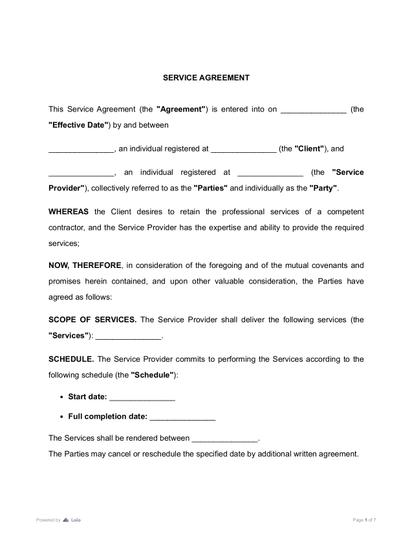
Ask to see a sample SOW before you sign an MSA. The MSA on its own won't tell you how the client defines a finished deliverable.
“Incorporated by Reference”
Near the back of most agreements sits a sentence saying other documents, like a vendor handbook or a security policy, form part of the contract. If they are validly incorporated by reference, those documents may become part of your contractual obligations even if they are not attached.
Obtain every incorporated document before signing and save the version in effect at that time. Ask for wording that identifies that version, push back on any provision allowing unilateral changes, and check which document controls if the documents conflict.
A long MSA and three attached policies make for a lot of reading in one evening. You can review contracts with our AI Contract Review tool to get a plain summary of what each document commits you to. This can reduce the time needed to find the provisions worth negotiating.
When the Work Has No Finish Line
Scope problems never feel like problems at signing. They surface in month two, when you're on revision nine, and the client seems surprised you brought it up.
“To the client's satisfaction”
Deliverables described with adjectives instead of nouns are a warning sign. Watch for phrases like:
Professional quality
Industry standard
Acceptable to the client
To the client's satisfaction
As reasonably required
These phrases leave the acceptance standard uncertain and may give the client substantial discretion over when the work is considered finished.
You can suggest replacing the adjective with something countable, like “Three logo concepts delivered as layered source files, plus one round of revisions on the selected concept.” Something like “A professional logo package" is too vague and leaves the decision entirely with them.
How many revisions are included
The most common way small projects lose money is a revision clause with no number attached. For example, if you quoted $2,800 for a website build and the contract includes revisions until approval, repeated revision rounds can push your effective hourly rate well below what you originally priced.
To protect yourself and your work, always state a number and state what happens after it. For example, the clause might say, “two rounds included, further rounds billed hourly.” Clients usually agree to this because a revision cap protects their timeline as much as your margin.
When approval never comes
Agreements sometimes make payment conditional on client approval and then never say how long the client has to approve. Instead, you can ask for a deemed-acceptance window. This means if the client sends no written comments within five business days, the deliverable counts as accepted and you can bill for it.
Payment Clauses That Don't Guarantee Payment
Pay-when-paid and pay-if-paid
Some contracts tie your payment to money the client receives from somebody else, which is especially common in construction and can also appear in subcontracting arrangements.
A pay-when-paid clause generally addresses the timing of payment. A pay-if-paid clause may go further by making the client's receipt of payment from a third party a condition of your right to be paid. If that upstream payment never arrives, a pay-if-paid clause may leave you unpaid.
How these clauses are treated depends on the contract, governing law, and industry. Construction contracts in particular may be subject to state-specific restrictions, but those protections do not necessarily apply to ordinary service agreements.
Ask for a fixed backstop date, so payment becomes due a set number of days after the invoice, regardless of whether the client has been paid by a third party.
Net 30 From When?
Most terms run from the invoice date, but some run from the date the client approves the work, and pairing that second version with an approval clause that has no deadline turns Net 30 into Net whenever.
Check which of these your terms are tied to:
Invoice date, the best outcome for you
Delivery date, which is fine
Approval date, safe only alongside a deemed-acceptance window
The client's receipt of payment from a third party, which is the pay-if-paid problem above
California's Freelance Worker Protection Act, effective January 1, 2025, generally covers specified professional services worth at least $250 in one contract or in aggregate with the same client over the preceding 120 days. New York's Freelance Isn't Free Act took effect statewide on August 28, 2024, applies at $800 or more, including qualifying contracts aggregated over 120 days, and allows freelance workers to file complaints with the Attorney General or bring a private civil action. Illinois's Freelance Worker Protection Act applies to work worth at least $500 over a 120-day period and has been effective for covered contracts since July 1, 2024. Los Angeles and Seattle also maintain local protections for covered freelance or independent-contractor work.
Canceled halfway, paid for nothing
Almost every service agreement lets the client end the deal early, which is normal and reasonable on its own, but you should read the sentence immediately after it. A termination clause drafted in the client’s favor may leave you disputing payment for partially completed work, reserved capacity, or non-cancelable costs.
Ask for payment covering all work performed, including partially completed work, through the termination date, plus any committed costs you can't recover.
Who Pays if Something Goes Wrong
The terms in this section can cost more than the whole contract is worth. They usually take up less than a page and deserve more attention than everything else combined.
Who covers whom
An indemnity clause can require one party to cover certain losses, claims, or liabilities, including third-party claims and, depending on the wording, direct claims between the parties. Also check separately whether the clause creates a duty to defend and when that duty begins.
Imagine a $4,000 marketing engagement containing a clause that says you must cover the client for any claim arising from your services, with no upper limit. If a customer sues over a campaign the client signed off on, you're funding that defense out of a $4,000 job.
Do not assume an indemnity clause is balanced merely because it applies to both parties. Limit each party’s obligation to risks within its control, such as its own negligence, misconduct, or infringement.
Some states restrict indemnity clauses in specific contexts, especially construction, but these protections do not apply uniformly to ordinary service agreements.
Liability with no ceiling
Look for a limitation of liability clause separately from the indemnity. Common negotiation positions include:
Total fees paid under the agreement, or fees paid in the last 12 months for ongoing work
Explicit exclusions for risks such as lost profits, lost data, or business interruption, rather than assuming all of them qualify as consequential damages
The same ceiling applying to both sides
Also check which claims are carved out of the cap; broad exceptions for indemnity, confidentiality, data security, or IP can substantially reduce its value.
Your Templates Are Not the Deliverable
IP clauses often assign everything you create during the engagement to the client, and "everything" can include the tools you brought with you. These may be your project management templates or your code libraries. If you sign those away once, you will have a problem on the next contract.
One more thing worth knowing about ownership. Work you create as an independent contractor is not automatically a "work made for hire" under US copyright law. That status applies only when the work was specially commissioned, the agreement says "work made for hire" in writing and is signed by both parties, and the work fits one of nine categories listed in the statute. Software and most design work typically fall outside those categories under the U.S. Copyright Office's work-made-for-hire guidance, so copyright stays with you unless the contract separately assigns it.
- Independent Contractor Agreement
 7304 downloads
 - IP Assignment Agreement
 5515 downloads
The clause that ends your niche
Non-compete and non-solicitation terms in service agreements often get written far broader than the client needs. In that regard, the federal picture changed and then changed back. A court blocked the FTC's 2024 rule banning most non-competes, the agency dropped its appeals in September 2025, and the rule came out of federal regulations in February 2026.
At the time of writing, no national ban exists. Enforceability is a state question, and the range is wide, with California, Minnesota, North Dakota, and Oklahoma prohibiting most non-competes outright while other states enforce them within limits.
Here are a few things you can ask for:
A time limit measured in months rather than years
Scope tied to the specific client rather than the whole industry
Non-solicitation of that client's staff and customers in place of a broad non-compete
State rules may also differ for employees and independent contractors, and broad non-solicitation clauses can be restricted in some states as well.
Clauses Worth a Second Look, Not a Fight
Not every unfamiliar clause requires the same level of pushback, but each of these deserves a closer look before you sign.
- 1
Mutual confidentiality. A mutual confidentiality clause is common, but check the details before signing. Ordinary confidential information may have a defined protection period, while trade secrets may remain protected for as long as they qualify as trade secrets. The clause should also exclude information you already knew, developed independently, received lawfully from another source, were required to disclose by law, or that became public through no fault of yours.
- 2
Governing law in the client's state. Governing law can affect how provisions such as non-competes, indemnity clauses, liability caps, and available remedies are interpreted. Review it together with the forum-selection and dispute-resolution clauses, because being required to resolve a dispute in a distant or unfamiliar jurisdiction can make even a relatively small claim harder or more expensive to pursue.
- 3
The independent contractor paragraph. This clause commonly states that you're responsible for your own taxes, insurance, licenses, expenses, equipment, and benefits. Check that those responsibilities match how the engagement will actually work. The contract's label alone does not determine whether you are legally classified as an independent contractor.
- 4
Assignment. A limited right to assign the agreement in connection with a merger, reorganization, or sale of the company is common. Still, consider asking for notice and checking whether the clause could transfer your agreement to a direct competitor or to a party that may be unable to meet the client's payment obligations.
Most terms can be changed later through a written amendment signed by both sides. When the relationship is going well, raising it at renewal usually goes better than raising it mid-project.
How to Send It Back Without Losing the Client
Prioritize the changes that matter most
Prioritize terms that create disproportionate financial or operational exposure, but do not leave a genuinely unacceptable term unaddressed just to keep the list short. Reasonable, well-explained requests are more likely to get a quick positive response.
What the email says
Keep it short and lead with the yes. For example, “Thanks for sending this over; happy to move forward. I've marked three proposed changes. A cap on liability at the fees under this agreement, payment for work completed if the project is canceled early, and a two-round revision limit with further rounds billed hourly. Everything else looks good, so let me know if you'd like to talk any of it through.”
Such a message shows both that you read the document and makes it clear you aren't haggling line by line, and it puts a start date back on the table.
— Can I send my own contract instead of signing theirs?
You can offer, and for smaller engagements, clients often accept. Larger companies usually won't, because their paperwork has already been through their legal team. Marking up their draft is normally the faster route to a start date.
When to walk away
One bad clause is a conversation, but several together can tell you something about how the rest of the relationship will run. These points should be taken especially seriously:
The client refuses to cap your liability at any number
The client refuses to pay for work already performed if the project ends
The client is pressing you to sign quickly
Any one of those on its own is common enough, but all three together mean the terms may not improve after you sign either.
Run This on Your Own Contract
A general list only gets you so far. The indemnity might sit in a section called General Provisions; the revision limit might be missing rather than wrong; and half the terms might live in a policy document attached at the back. Working through all of that in a 14-page agreement is the point where many people give up and sign.
Loio's AI Contract Review can summarize provisions and help surface terms that may deserve closer review. Automated review may still miss incorporated documents, governing-law implications, or issues specific to the transaction.
Once you know what needs changing, you can pull replacement language from a template, mark up the file, and send it back the same afternoon. An eSign tool makes it easier to close the loop when the client accepts, and each party retains an identical copy of the executed agreement.
More guides
September 1
7 min read
How to Provide Proof of Employment: Documents and Steps

July 20
10 min read
How to Start a Landscaping Business: Legal and Business Checklist

September 12
13 min read
Construction Change Order Process: How to Avoid Scope Creep

July 21
8 min read
Statement of Work vs Scope of Work: Differences and How They Work Together

September 10
14 min read
How to Protect Your Small Business from Lawsuits

October 6
14 min read
How to Make a PDF Searchable: 5 Tested OCR Methods in 2026
One home for your
agreements
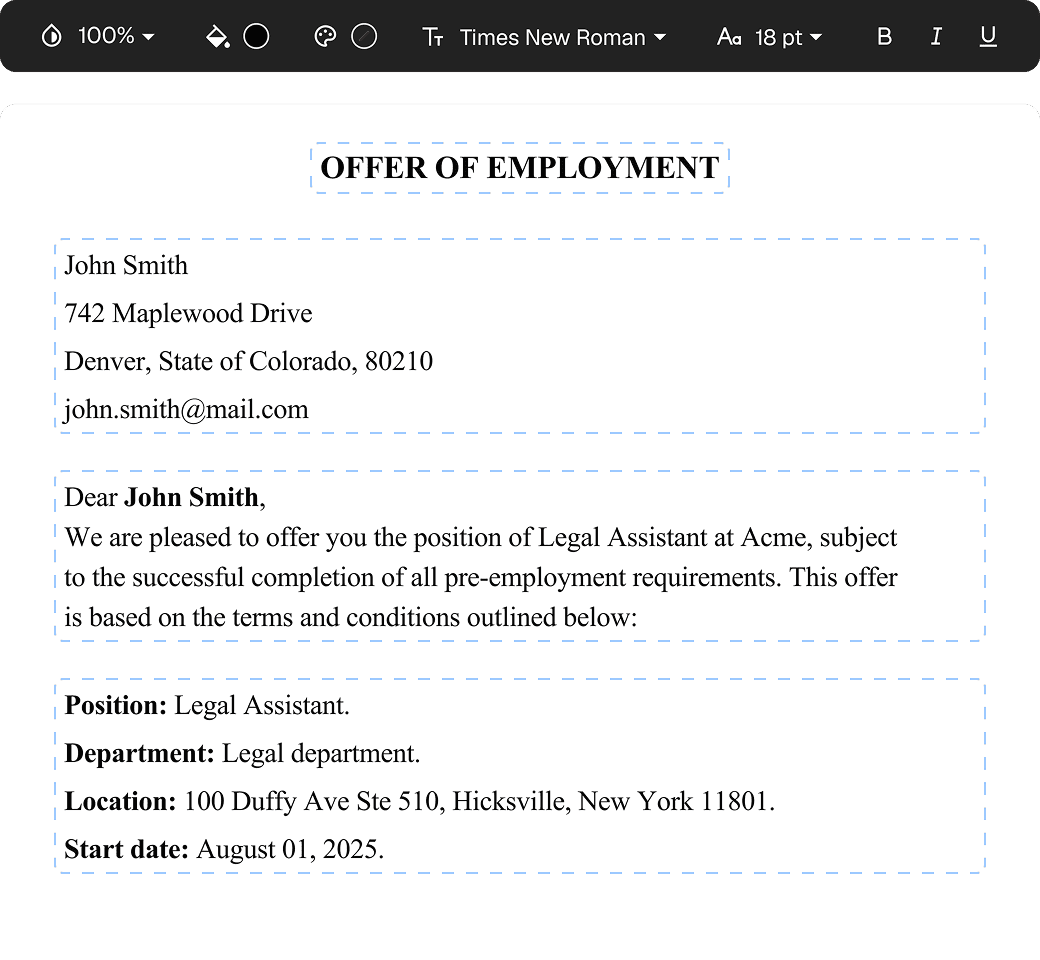
Edit PDFs seamlessly
Tweak agreements before signing or sending for signatures. Update details, add or remove clauses, adjust formatting, and redline changes instantly.
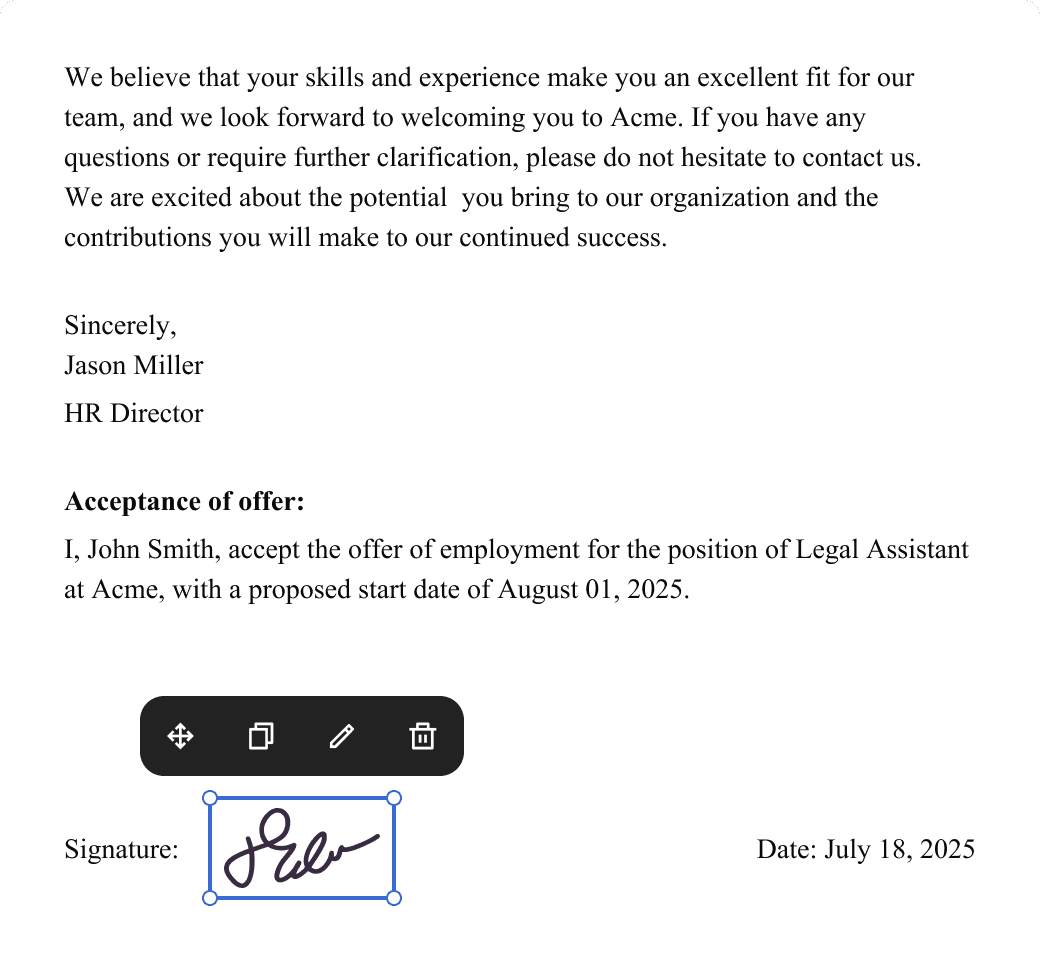
eSign legally and securely
Sign documents and collect legally binding signatures. Invite up to ten people to sign in any order, track the progress, and send reminders.
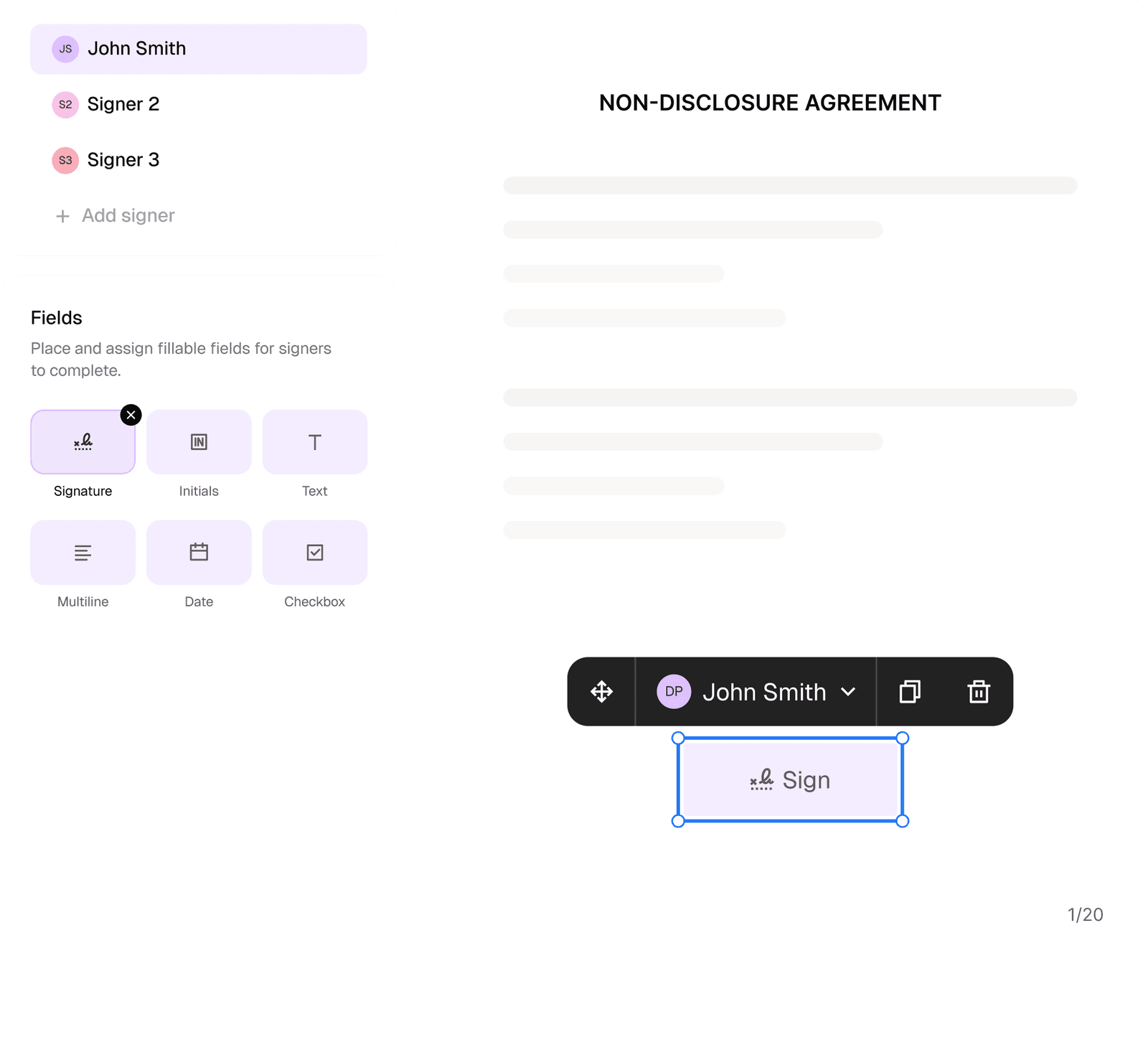
Request legally binding signatures
Invite up to ten people to sign your document in any order. Get a finalized, audit-ready copy without chasing signatures.
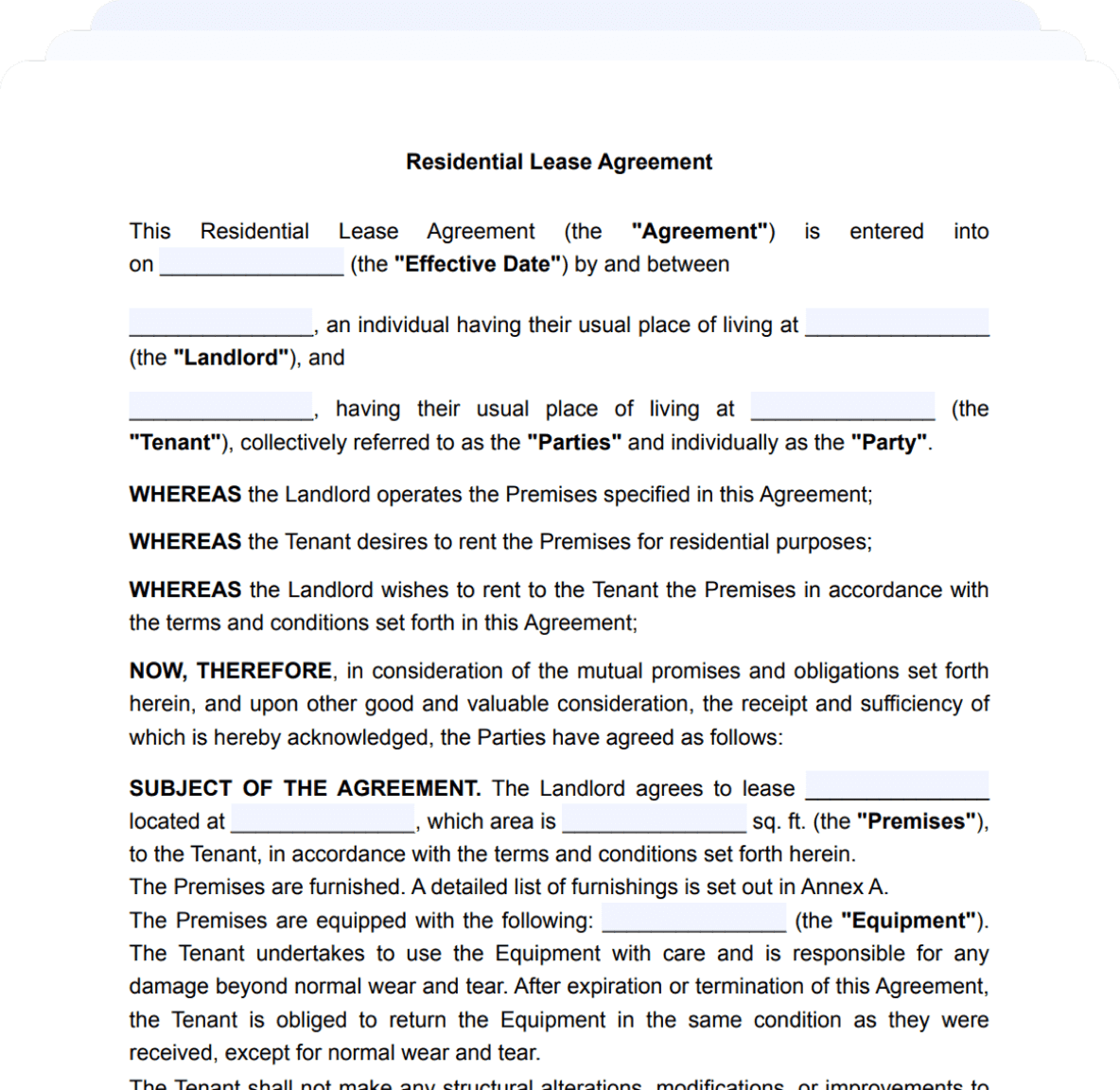
Skip the drafting.
Choose from 2,500+ templates
Browse templatesChoose a template
Fill in details
Sign and download