Free template
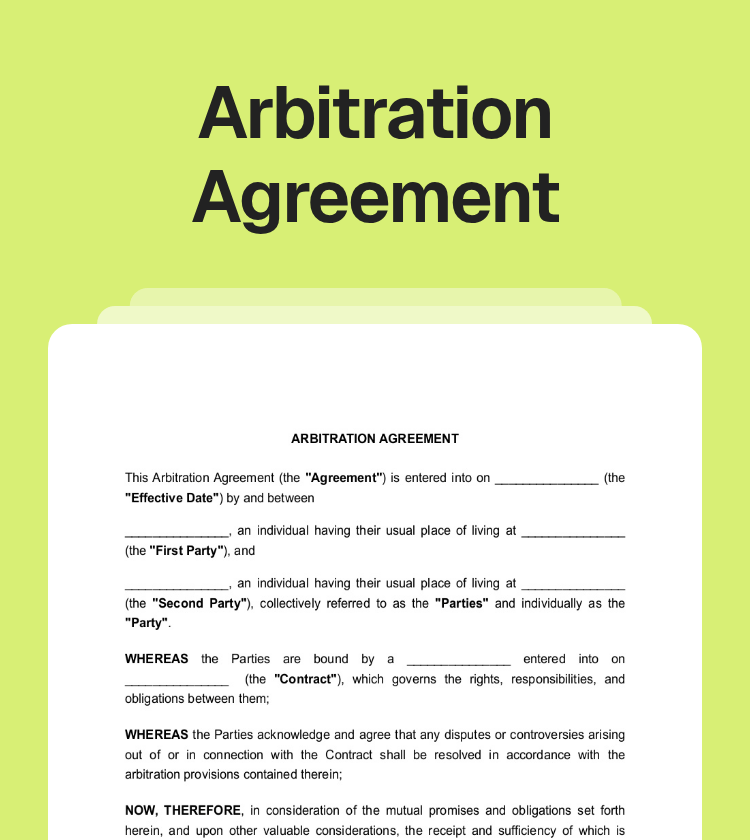
Free Arbitration Agreement Template

What Is an Arbitration Agreement?
Copy section linkAn arbitration agreement is a written contract in which two parties agree that if a dispute comes up, they'll resolve it through arbitration instead of filing a lawsuit in court. Arbitration takes place outside the courtroom: a private, neutral arbitrator hears both sides and issues a decision, called an award, which is usually final and enforceable in court.
Employers commonly use an arbitration agreement template when onboarding new hires, since it lets them resolve wage, benefits, or termination disputes without a jury trial. Businesses also use them in vendor and customer contracts to keep disagreements private and move them along faster than litigation would.
An arbitration agreement can stand on its own, or it can appear as a clause inside a larger contract, like an employment contract or service agreement. Either way, its core function is the same: both parties give up their right to sue in exchange for a faster, more private process.
When to Use an Arbitration Agreement
Copy section linkUse an arbitration agreement form in situations where both sides want a private, faster alternative to court, such as:
New employee onboarding: to route wage, benefits, or wrongful termination disputes to arbitration instead of court.
Consumer or vendor contracts: banks, service providers, and vendors often include one to avoid class-action exposure.
Business-to-business agreements: to keep contract disputes out of public court records.
Independent contractor relationships: to formalize how payment or scope disagreements get resolved.
After a dispute has already started: a stand-alone "submission agreement" version can send an existing disagreement to arbitration even without a prior clause.
When not to use one:
To resolve a sexual harassment or sexual assault claim: under the Ending Forced Arbitration of Sexual Assault and Sexual Harassment Act, these claims can't be forced into arbitration if the person bringing them objects.
If you need the parties to remain able to sue individually or as a group: consider a standard business contract without an arbitration clause instead.
For matters requiring a court order: such as restraining orders or emergency injunctive relief.
The goal is to agree on what to do if things don't go as planned — which helps both sides feel more secure.
Who Are the Parties to an Arbitration Agreement?
Copy section linkEmployer or Business: the party requiring or proposing arbitration, often as part of onboarding or a vendor relationship.
Employee or Consumer: the individual agreeing to resolve disputes through arbitration instead of court.
Arbitrator (named later, not at signing): the neutral third party selected under the agreement's rules to hear and decide the dispute.
Witness (optional): sometimes included to confirm both parties signed voluntarily, which can help defend the agreement against later unconscionability challenges.
What Are the Key Components of an Arbitration Agreement Template?
Copy section link- Parties and their roles: identifies who is bound by the agreement and in what capacity.
- Scope of disputes covered: defines exactly which claims must go to arbitration, so both sides know what's included and what isn't.
- Arbitrator selection: sets out how a neutral arbitrator will be chosen, which protects the agreement from unconscionability challenges.
- Governing rules and organization: names the rules (e.g., AAA or JAMS) that will run the process, so procedure isn't left to guesswork.
- Cost allocation: states who pays arbitrator fees, filing fees, and administrative costs; this matters most in employment agreements, where unfair cost-shifting can make the whole agreement unenforceable.
- Confidentiality: keeps the dispute and its outcome private, one of the main reasons parties choose arbitration over court.
- Class-action waiver: requires each party to bring claims individually rather than as part of a class or group action.
- Severability: keeps the rest of the agreement enforceable even if one clause is struck down.
- Signatures: makes the agreement effective; both parties must sign voluntarily for it to hold up later.
Key Clauses in an Arbitration Agreement
Copy section linkEvery arbitration agreement contains standard sections, but a small set of clauses attracts most of the negotiation, litigation, or state-by-state variation. Sample language for each is included below; customize the bracketed values before signing.
Arbitrator Selection Clause
What it does: Sets out how the parties will choose a neutral arbitrator, including any qualifications the arbitrator must have. Courts look closely at this clause when deciding whether an agreement is fair enough to enforce.
Sample language:
The parties shall select a single arbitrator by mutual agreement within [15] days of a dispute arising. If the parties cannot agree, the arbitrator shall be appointed under the rules of the [American Arbitration Association]. The arbitrator must have at least [5] years of experience in [relevant field].
When to include/omit: Include in nearly every arbitration agreement. An unclear or one-sided selection process is one of the most common reasons courts refuse to enforce arbitration clauses.
State variation: California courts, following Armendariz v. Foundation Health Psychcare Services (2000), require that the arbitrator be genuinely neutral and that selection procedures not favor the employer; agreements that let only the employer pick the arbitrator are routinely struck down as unconscionable.
Class Action Waiver Clause
What it does: Requires each party to bring disputes individually rather than as part of a class, collective, or representative action.
Sample language:
The parties agree that any arbitration will be conducted only on an individual basis and not as a class, collective, or representative action. The arbitrator has no authority to consolidate claims or preside over any form of class or representative proceeding.
When to include/omit: Include when the business wants to limit exposure to group claims; omit or narrow it in contracts covering sexual harassment or sexual assault disputes, where such waivers are unenforceable under federal law.
State variation: In California, a class-action waiver can still push an employee's individual wage claims under the Private Attorneys General Act (PAGA) into arbitration, but under Adolph v. Uber Technologies (2023), the employee keeps standing to pursue the representative PAGA claim in court, so a waiver drafted for other states may not fully apply there.
Cost Allocation Clause
What it does: Specifies who pays the arbitrator's fees, filing fees, and administrative costs of the arbitration.
Sample language:
[Company Name] shall pay all costs unique to arbitration, including arbitrator fees and administrative fees. Each party shall bear its own attorney's fees unless the arbitrator's award provides otherwise.
When to include/omit: Include in every employment arbitration agreement. Leaving cost allocation vague or shifting standard arbitration costs onto the employee is a common ground for unenforceability.
State variation: California, under Armendariz, requires employers to cover any arbitration costs an employee wouldn't have faced in court; agreements that make employees share arbitrator fees in employment disputes are frequently invalidated there.
Confidentiality Clause
What it does: Keeps the existence, content, and outcome of the arbitration private, unless disclosure is required by law.
Sample language:
Except as required by law, the parties, witnesses, and arbitrator shall not disclose the existence, content, or results of the arbitration without the prior written consent of both parties.
When to include/omit: Include when privacy is a priority, such as in employment or business disputes involving sensitive information; consider omitting or narrowing it in consumer agreements, where broad confidentiality clauses sometimes draw added scrutiny for limiting transparency.
State variation: No major state bans confidentiality clauses outright, but courts in several states will refuse to enforce one if it's used to conceal a pattern of unlawful conduct, such as repeated harassment claims against the same employer.
What Are the Key Terms on an Arbitration Agreement
Copy section linkArbitration: A private process where a neutral arbitrator, not a judge or jury, decides a dispute outside of court.
Mediation: A process where a neutral third party helps both sides negotiate a resolution, but doesn't issue a binding decision, unlike arbitration.
Arbitrator: The neutral person selected to hear both sides of a dispute and issue a decision, called an award.
Binding arbitration: Arbitration where the arbitrator's decision is final and can only be challenged in court under narrow, limited circumstances.
Non-binding arbitration: Arbitration where either party can reject the arbitrator's decision and take the dispute to court instead.
Federal Arbitration Act (FAA): The federal law (9 U.S.C. §§ 1–16) that makes arbitration agreements enforceable nationwide and limits states' ability to restrict them.
Class-action waiver: A clause requiring disputes to be brought individually rather than as part of a group or class claim.
AAA (American Arbitration Association): One of the most widely used organizations for administering arbitration proceedings and setting procedural rules.
JAMS: Another major arbitration and mediation provider, often used in commercial and employment disputes.
Award: The arbitrator's final, written decision resolving the dispute.
How to Fill Out an Arbitration Agreement
Copy section link- Enter the full legal names and addresses of both parties.
- Describe the scope of disputes the agreement covers (e.g., all employment-related claims, or disputes arising from a specific contract).
- Select the arbitration rules and organization that will govern the process, such as AAA or JAMS.
- Choose how the arbitrator will be selected, including any required qualifications.
- State the city and state where arbitration hearings will take place.
- Specify how arbitration costs and fees will be divided between the parties.
- Add a confidentiality clause if you want the dispute kept private.
- Add a class-action waiver if you want disputes handled individually.
- Include a severability clause to keep the rest of the agreement valid if one part is struck down.
- Both parties sign (by hand or eSign) and date the agreement, and each keeps a signed copy.
Can you do arbitration without a lawyer?
Yes. Arbitration doesn't require legal representation, and many individuals represent themselves, especially in smaller consumer or employment disputes. That said, because an arbitrator's decision is usually final and very hard to appeal, it's worth at least consulting an attorney before the hearing if the claim involves significant money or complex legal issues.
What are the two types of arbitration agreements?
The two main types are pre-dispute arbitration agreements, signed before any disagreement arises (common in employment and consumer contracts), and submission agreements, signed after a dispute has already started to send that specific disagreement to arbitration. Agreements can also be binding, where the arbitrator's decision is final, or non-binding, where either party can still take the matter to court afterward.
Why should I sign an arbitration agreement?
Signing one can mean a faster, more private, and often less expensive path to resolving a dispute than going through court. It also sets clear rules in advance (who the arbitrator will be, how costs are split, and where the hearing takes place), so there's less confusion if a disagreement actually happens.
Can I sue if I signed an arbitration agreement?
Generally, no. Signing a valid arbitration agreement means you're giving up your right to sue in court over the disputes it covers. There are limited exceptions: if the agreement itself is unclear, if someone signed under pressure or without understanding it, or if the claim involves sexual harassment or sexual assault, which federal law exempts from forced arbitration.
Can I be fired for not signing an arbitration agreement?
In most states, including California, after the Federal Arbitration Act was found to preempt the state's ban on mandatory employment arbitration in Chamber of Commerce v. Bonta, an employer can require arbitration as a condition of employment and can decline to hire, or can terminate, someone who refuses to sign. The one federal exception is claims of sexual harassment or sexual assault: under the Ending Forced Arbitration of Sexual Assault and Sexual Harassment Act, an employee can't be compelled into arbitration for those specific claims, and refusing arbitration on that basis alone can't be held against them.
Is an arbitration agreement legally binding?
Yes, when properly drafted and signed. The Federal Arbitration Act makes arbitration agreements "valid, irrevocable, and enforceable" in both state and federal court, as long as the agreement is in writing and doesn't strip away rights a court would otherwise protect.
Do I need to notarize an arbitration agreement?
No federal law requires notarization for an arbitration agreement to be enforceable. Some parties choose to have signatures witnessed or notarized anyway, since it can help defend the agreement later against a claim that a signature wasn't genuine or voluntary.
State Law
Copy section linkThe Federal Arbitration Act (9 U.S.C. § 1-16 “FAA”) governs arbitration agreements in contracts involving interstate commerce and applies in both federal and state courts. FAA requires that arbitration agreements be in writing to be enforceable.The form can vary; it can be an arbitration clause in a commercial contract, a stand-alone arbitration agreement, or other type of written agreement.
Chapter 1 (9 U.S.C. § 1-16) stipulates general provisions applicable to arbitration agreements involving maritime, interstate, and foreign commerce.
The 1958 Convention on the Recognition and Enforcement of Foreign Arbitral Awards (the "New York Convention") is implemented in Chapter 2 (9 U.S.C. 201-208), which governs any contractual or non-contractual relationship between parties that is deemed to be commercial in nature, unless both parties are citizens of the United States and the relationship involves property located abroad or has some other reasonable connection to one or more foreign states.
Chapter 3 (9 U.S.C. §§ 301-307) implements the 1975 Inter-American Convention on International Arbitration (“Panama Convention”). Where both the New York and Panama Convention could apply to the enforcement of an arbitral award, the NY Convention applies, unless the parties indicate the Panama Convention should apply.
The US has not enacted the United Nations Commission on International Trade Law (“UNCITRAL”) Model Law, however several states have enacted statutes based on Model Law, namely: California, Connecticut, Florida, Georgia, Illinois, Louisiana, Oregon, and Texas.
Other Regulations
- California regulation: California Code of Civil Procedure, Part 3, Title 9 – Arbitration, Chapter 2 – Enforcement of Arbitration Agreements.
- Texas regulation: Texas Statutes/Civil Practice and Remedies Code, Title 7 – Alternative Methods of Dispute Resolution, chapter 171 – General Arbitration, Subchapter C- Arbitration.
Requirements for this document vary by state. Review your state's laws and procedures — or consult a licensed attorney — before using this template to ensure it's valid and enforceable where you live.
Statutory References
Related Documents