Free template
Free Certificate of Incumbency Template

What Is a Certificate of Incumbency?
Copy section linkA certificate of incumbency is a document a company issues to list its current officers, directors, or authorized signers, along with confirmation that these individuals currently hold their stated positions. It's a way for a corporation, LLC, or other business entity to prove exactly who has legal authority to act on its behalf.
An incumbency certificate template is most commonly requested by banks, lawyers, or investors before they'll finalize a transaction, since these third parties need assurance that they're dealing with someone who actually has the authority to sign. Some people also search for this document as a certificate of incumbency form, a letter of incumbency, or misspell it as an incumbancy certificate or certificate of incumbancy. However, the structure and purpose stay the same across each version.
This document works alongside a company's foundational paperwork — its articles of incorporation and corporate bylaws — but serves a different, narrower purpose. Those documents establish how the company is structured; a certificate of incumbency confirms who currently holds the roles created by that structure.
When to Use a Certificate of Incumbency?
Copy section linkUse a certificate of incumbency form, sometimes requested as a letter of incumbency, when:
A bank requires proof of who is authorized to open or manage a company account.
A lender needs to verify the identities of the signers before finalizing a business loan.
The company is entering a new partnership or joint venture and needs to verify its leadership.
A government agency requires proof of company leadership when applying for a license or permit.
An investor or supplier wants assurance about who holds decision-making authority before finalizing a deal.
The company is participating in an international business transaction and needs to verify its officers to a foreign party.
An auditor needs to confirm current company leadership as part of a review.
When not to use a certificate of incumbency:
Use articles of incorporation instead if you're forming the company itself, rather than verifying who currently runs it.
Use corporate bylaws instead if you need to document the internal rules governing how the company operates, rather than confirming who holds a specific role today.
Use a power of attorney instead if you need to grant someone authority to act on your behalf as an individual, rather than verifying an existing corporate officer's role.
Who Are the Parties to a Certificate of Incumbency?
Copy section linkCorporation / issuing company: The business entity certifying the accuracy of the information in the document. The company is responsible for keeping this information current.
Corporate secretary (or authorized officer): The person who typically signs the certificate, confirming that the listed individuals currently hold the stated positions and authority.
Third party/recipient: The bank, lender, investor, government agency, or other party requesting the certificate to confirm who they're dealing with before proceeding with a transaction.
What are the Key Components of a Certificate of Incumbency?
Copy section link- Company information: The company's legal name, registration or business ID number, and the state or jurisdiction where it was formed.
- Officer and director details: Full names and titles of the individuals currently holding authority — directors, officers, or authorized signers.
- Description of authority: A specific statement of what each listed person is authorized to do, such as signing contracts or opening bank accounts.
- Certification statement: A statement confirming that the information provided is accurate as of the date of issue.
- Date of issue: The date the certificate was signed, which matters because these certificates are typically considered current only for a limited period.
- Signature: The signature of the officer or secretary issuing the certificate, confirming its accuracy.
- Corporate seal (conditional): Some companies affix a corporate seal for added formality, though this isn't legally required in most states.
What Are the Key Terms in a Certificate of Incumbency?
Copy section linkOfficer: A person holding a formal leadership position in a company, such as president, secretary, or treasurer, typically with specific decision-making authority.
Director: A member of a company's board responsible for overseeing major decisions and corporate governance, distinct from day-to-day officers.
Authorized signer: A person specifically empowered to sign contracts, checks, or other documents on the company's behalf.
Corporate seal: An official stamp or emblem some companies use to formally authenticate documents, though most states no longer require it for validity.
Secretary's certificate: A closely related document, sometimes used interchangeably with a certificate of incumbency, in which the corporate secretary certifies specific corporate facts or actions.
Apostille: A form of international certification that authenticates a document for use in a foreign country that's part of the Hague Apostille Convention.
How to Fill Out a Certificate of Incumbency Template?
Copy section link- Enter the company's legal name and business registration or ID number.
- Enter the state or jurisdiction where the company was formed.
- Enter the company's registered address.
- List the names and titles of each officer, director, or authorized signer.
- Describe the specific authority each listed person holds, such as the ability to sign contracts or open accounts.
- Add a certification statement confirming the information is accurate as of the date of issue.
- Enter the date of issue.
- Sign the certificate as the corporate secretary or authorized officer. You can sign electronically using eSign or by hand.
- Affix the corporate seal, if your company uses one.
- Provide the signed certificate to the requesting third party and keep a copy for your records.
How Long Is a Certificate of Incumbency Valid?
Copy section linkThere's no official expiration date set by law. Still, in practice, most banks and business partners treat a certificate of incumbency as current for only a short window — typically 6 to 12 months. Some may ask for a freshly dated certificate if the one you provide is more than a few months old, even if nothing about your leadership has changed.
Because of this, it's good practice to reissue the certificate whenever there's a change in company leadership, and to keep a recently dated version on hand if you regularly work with banks or partners who request one.
Certificate of Incumbency vs. Other Documents
Copy section linkA certificate of incumbency is often confused with a few related corporate documents, but each serves a distinct purpose.
Vs. Articles of Incorporation: Articles of incorporation are filed with the state to form the company legally. A certificate of incumbency doesn't create anything — it simply confirms who currently holds authority within a company that already exists.
Vs. Corporate Bylaws: Bylaws are the internal rulebook governing how a company operates — how officers are elected, how meetings are run, and so on. A certificate of incumbency doesn't establish rules; it certifies a snapshot of current leadership.
Vs. Secretary's Certificate: These two documents are similar and sometimes used interchangeably, but a secretary's certificate can also certify specific corporate actions or resolutions. In contrast, a certificate of incumbency focuses specifically on confirming who holds which roles.
This template is intended for general use across all 50 U.S. states+DC. Local procedures — such as notarization, witnessing, or filing requirements — may still apply, so check your state's specific rules before signing.
What does a certificate of incumbency template look like?
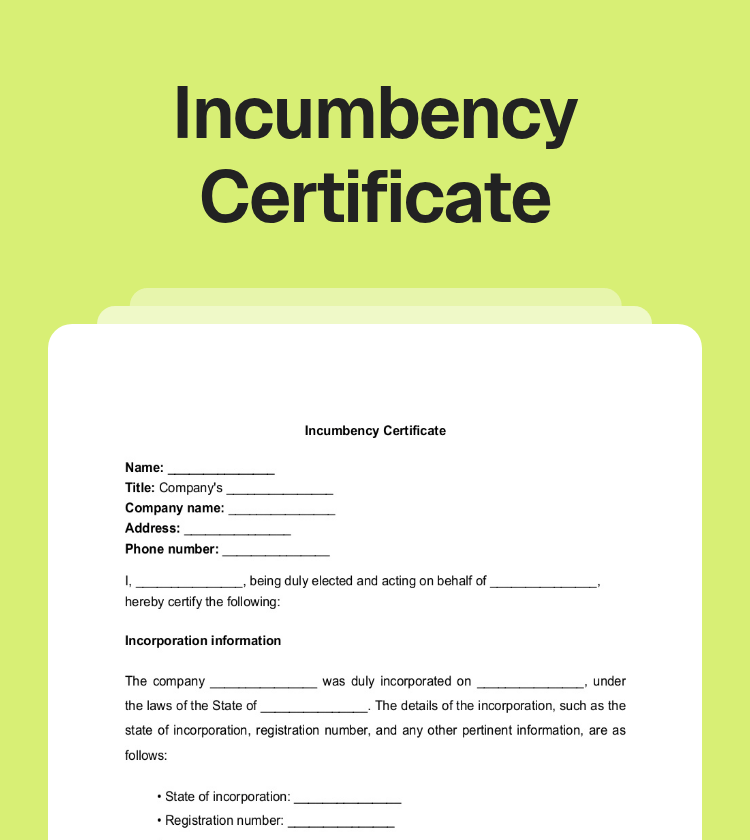
It's typically a one- to two-page formal document on company letterhead, listing the company's identifying information at the top, followed by the names and titles of current officers or directors, a certification statement, and a signature block. It often includes a corporate seal, though this isn't a legal requirement in most states. You may also see this document referred to as an incumbancy certificate or a certificate of incumbancy — common misspellings of the same term.
Who prepares a certificate of incumbency?
The corporate secretary typically prepares and signs it, since this role is traditionally responsible for certifying corporate records. In smaller companies without a formally designated secretary, another authorized officer, such as the president or a managing member, may prepare and sign it instead.
Do I need to have a certificate of incumbency notarized?
Not always, but it depends on who's requesting it. Domestic banks and business partners often accept an unnotarized certificate. If the certificate will be used internationally or needs an apostille, notarization is typically required first, since apostille and authentication processes generally require an underlying notarized signature.
Do I need an apostille for international use?
Often, yes, if you're using the certificate in a country that's part of the Hague Apostille Convention. For a corporate document like this, the apostille or authentication is typically issued by the Secretary of State in the state where the company is registered, not directly by the federal government, and usually requires that the certificate be notarized first.
How often should a certificate of incumbency be reissued?
There's no fixed legal requirement, but many banks and partners expect one dated within the last 6 to 12 months. It's also good practice to reissue the certificate any time there's a change in company officers or directors, even if it hasn't reached that window yet.
Is a certificate of incumbency legally binding?
It's not a contract in the traditional sense, but it is a legal certification — the company and the signing officer are making a formal, factual representation about who holds authority. Providing false information on a certificate of incumbency can expose the signer and the company to liability.
Can a certificate of incumbency be used to verify a company's EIN?
Not directly. A certificate of incumbency confirms leadership and signing authority, not tax identification details. If a bank or partner specifically needs EIN verification, that's typically provided separately through an IRS-issued EIN confirmation or verification letter.
Statutory references
Related Documents
Also Read