Free template
Free Employee Non-Disclosure Agreement (NDA) Template

What Is an Employee NDA?
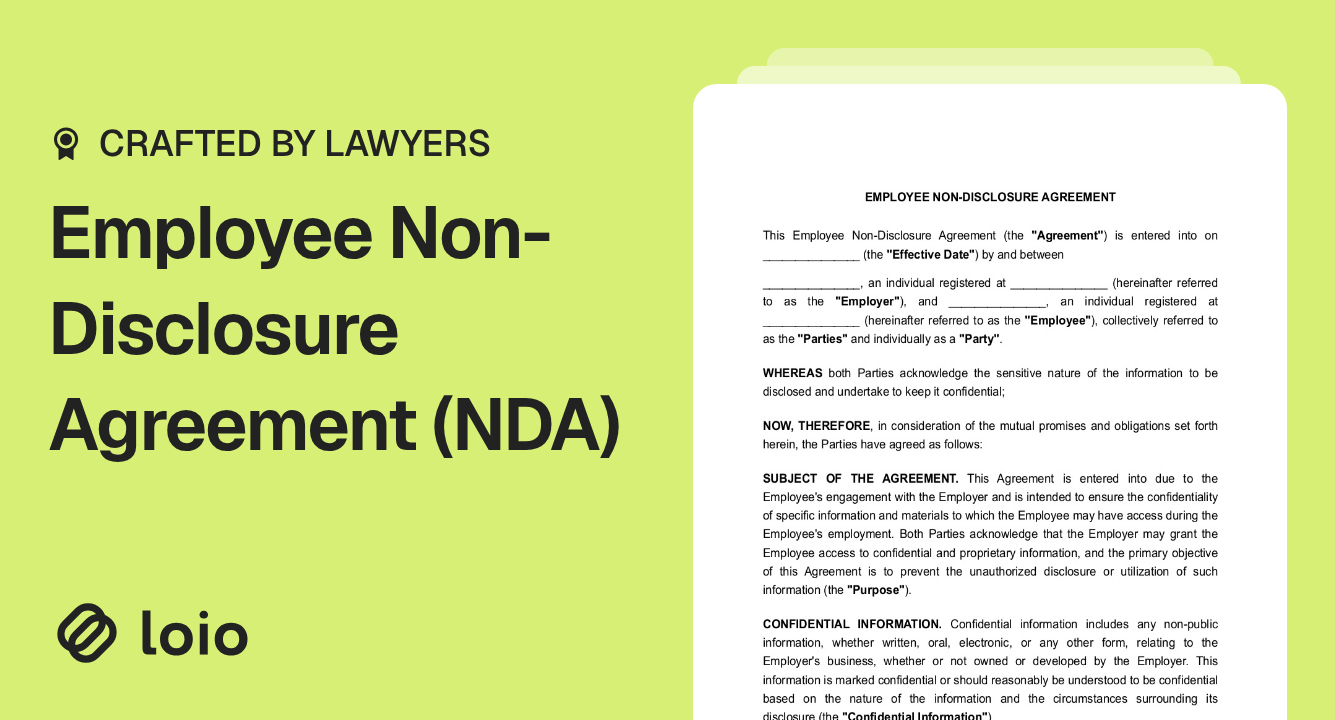
Copy section linkAn employee non-disclosure agreement template is a written contract between an employer and an employee that restricts the employee from sharing the employer's confidential information. It covers trade secrets, client lists, financial data, and other proprietary knowledge the employee learns about while on the job.
This document is a core tool in employment law for protecting a company's competitive edge. Without a signed NDA, a business has a harder time proving that certain information was intended to remain confidential in court. It also becomes harder to show the employee understood their obligation not to share it. A well-drafted employee NDA also often includes a non-compete or non-solicit clause, since confidentiality and competition restrictions frequently go together, though each serves a different legal purpose.
Some people search for this document as a non-disclosure agreement for employees or simply an employee NDA. Whether it's called an employee NDA template or something else, it exists to give both sides a clear understanding. That means knowing what information must stay private and what happens if it doesn't.
When To Use an Employee NDA
Copy section linkUsing an employee non-disclosure agreement template could be beneficial in various work situations due to the following advantages:
Agreement on confidentiality duration
Employer and employee understand their obligations
The consequences of a breach are outlined
Ultimately, if you and the employee decide not to make use of an NDA, you might not experience the same protections for your business secrets.
Parties of the Employee NDA
Copy section linkIn an employee non-disclosure agreement (NDA), two key parties are involved.
- The disclosing party (employer): This entity or individual shares confidential information and holds the rights to it. The disclosing party seeks to safeguard its intellectual property, trade secrets, and proprietary knowledge from unauthorized disclosure or use. They have the right to expect the confidential information to be kept confidential, used only for authorized purposes, and protected from unauthorized disclosure.
- The receiving party (employee): This individual gains access to the confidential information as part of their employment. As the receiving party, they must uphold the terms of the NDA and ensure the confidentiality of the information entrusted to them. This includes refraining from disclosing or misusing confidential information and taking necessary measures to protect it from unauthorized access.
Key Terms
Copy section link- Confidential Information: Defines the type of information the NDA covers, including trade secrets, customer data, marketing strategies, intellectual property, financial information, and other proprietary knowledge.
- Non-Disclosure Obligations: Outlines the employee's responsibilities concerning protecting, non-disclosing, and using confidential information.
- Non-Compete Clause: Specifies whether the employee is restricted from competing with the employer during employment or for a certain period after termination.
- Exceptions: Sets forth situations in which confidential information can be disclosed without violating the NDA, such as when required by law or with prior written consent from the employer.
- Term and Termination: Establishes the duration of the NDA and the conditions under which it may be terminated, ensuring that the obligations persist even after the employment relationship ends.
Key Components
Copy section linkParties: Names the employer, the disclosing party, and the employee, the receiving party. Every employee NDA needs both parties clearly identified, so it's obvious who's bound by the confidentiality obligations.
Definition of confidential information: Spells out exactly what counts as confidential, such as trade secrets, client lists, pricing, and internal processes. This removes any ambiguity about what the employee must protect.
Non-disclosure obligations: A non-disclosure agreement for employees states what the employee must and must not do with confidential information. That includes not sharing it with outside parties or using it for personal benefit.
Exceptions: Lists situations where disclosure is allowed without violating the agreement, such as information that's already public or disclosure required by law.
Non-compete: Restricts the employee from working for a competitor or starting a competing business for a set period and within a specified geographic area, if the agreement includes this clause.
Non-solicit: Restricts the employee from poaching the employer's clients or coworkers for a set period after leaving, if the agreement includes this clause.
Term: States how long the confidentiality obligations last, which is often indefinite for trade secrets even after employment ends.
Remedies: Describes what the employer can do if the employee breaches the agreement, such as seeking an injunction or damages.
How To Write an Employee NDA
Copy section linkWhether you are an employer aiming to protect your business secrets or an employee ensuring to abide by the agreement rules, you can quickly generate a professional employee non-disclosure agreement. Create a PDF file using Loio Templates and deliberate the agreement terms with the counterparty. Once you have procured the fillable NDA for employees template, comply with the steps below to personalize your document:
Ensure clarity on the transaction details by studying any points in a bare employee NDA template drafted during initial conversations with the parties involved.
When composing the non-disclosure agreement for employees, it's important to use the employee agreement example and any available NDAs as a guide. Incorporate the names of all parties in the preamble, along with their contact details. In this non-disclosure form for employees, remember to clearly specify the commencement date of the contract and its end date.
Insert an exhaustive list of crucial terms and definitions throughout the NDA to elucidate unclear terms. For instance, the writer may refer to sensitive information protected through the NDA as "Confidential Information." However, defining what comprises the "Confidential Information clearly is crucial."
Start by outlining the confidential information in the business relationship, then deliberate on each party's role and responsibilities. This consists of any information the employee is required to keep confidential and any obligations the employer will have.
Offer an in-depth description of the remedies in case of breach of the agreement, including potential penalties and restitution. This is also an ideal place to denote any restrictions with non-disclosure and non-compete clauses.
Include the protective measures of the agreement and the consequences if any party breaches it. You can also consider including exceptions to confidential information, term duration, jurisdiction, and dispute resolution.
Ensure all parties understand the contract details along with their respective obligations and expectations. Proceed to revise the NDA as frequently as necessary until an agreement is reached.
For an NDA to have legal force, a lawful representative of each party must sign and date it.
If you want your NDA to hold its ground among potential parties, make sure to learn about writing non-disclosure forms and include all the technicalities in your NDA, then document it in writing. Ensure to employ simple language and transparent terms when learning to draft one.
Statutory references
Related Documents
Copy section linkAlso read