Free template
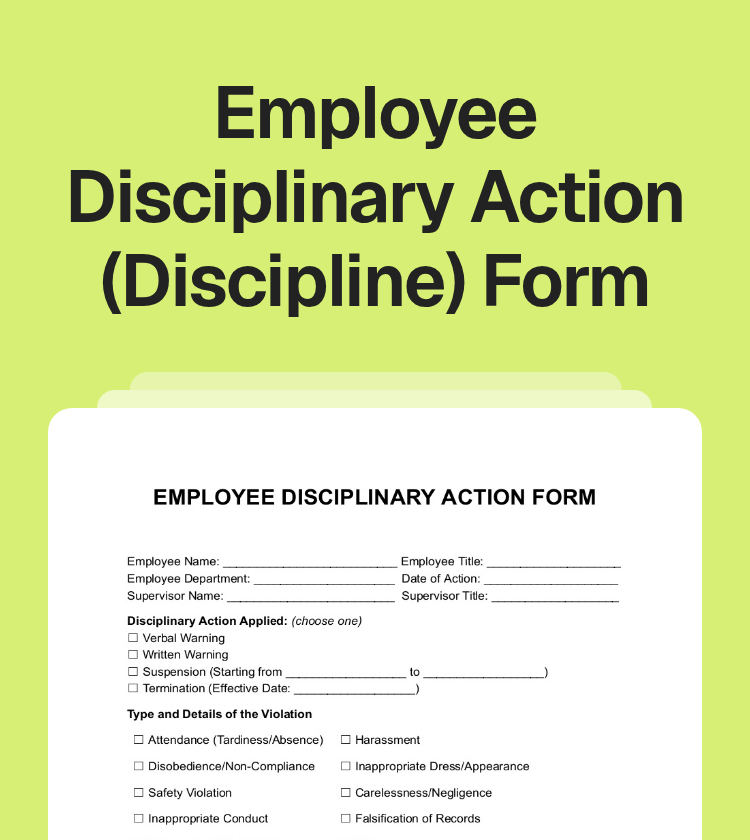
Free Employee Disciplinary Action Form

What Is a Disciplinary Action Form?
Copy section linkA disciplinary action form is a document employers use to formally record a workplace conduct or performance issue, along with the corrective steps expected of the employee going forward. It's typically used after informal coaching hasn't resolved the problem, or immediately following a serious policy violation.
An employee disciplinary action form does more than issue a warning — it creates a timestamped, factual record that the employer addressed the issue consistently and for legitimate business reasons. This matters most in at-will employment, where an employer can generally terminate someone for any lawful reason, but still needs to show that a termination wasn't discriminatory or retaliatory if it's ever challenged.
Employers sometimes refer to this document as an employee discipline form or a disciplinary form template, depending on their internal HR terminology. Still, the structure and purpose remain consistent: document the issue, reference the policy that was violated, and lay out a clear path for the employee to correct the behavior.
When to Use a Disciplinary Action Form?
Copy section linkUse a disciplinary action form when:
An employee repeats a behavior after receiving an informal or verbal warning.
A single incident is serious enough to warrant formal documentation, such as insubordination, a safety violation, or harassment.
An employee's performance hasn't improved despite clear, documented feedback and support.
An employee violates a specific, written company policy from the employee handbook.
You need a documented paper trail before considering suspension or termination.
When not to use a disciplinary action form
Use a structured performance improvement discussion instead if the primary issue is ongoing performance rather than a specific policy violation.
Use a contract termination letter instead if the decision to end the working relationship has already been made — a disciplinary form documents corrective steps, not a final separation.
Don't use a disciplinary action form template for minor, one-off issues that would typically be handled with informal verbal feedback — overusing formal documentation can undermine its seriousness when you actually need it.
Who Are the Parties to a Disciplinary Action Form?
Copy section linkEmployee: The individual whose conduct or performance is being documented. Their signature acknowledges receipt of the form, not necessarily agreement with its contents.
Direct supervisor/manager: The person who identifies the issue, completes the form, and typically delivers it to the employee.
HR representative: Often involved in reviewing the form for consistency with company policy and maintaining it in the employee's personnel file.
Witness (conditional): An additional person present during the disciplinary conversation, particularly useful if the employee refuses to sign the form.
What Are the Key Components of a Disciplinary Action Form?
Copy section linkWhether your HR team uses a disciplinary action template, an employee disciplinary form, or a discipline form template, the same core fields apply:
Employee and manager information: the employee's name, position, and department, along with the supervisor's name and title.
Date of report and incident: The date the form is completed and the specific date and time the violation occurred.
Type of violation: The category of the issue — attendance, safety, conduct, or performance — so the record is easy to reference later.
Description of the incident: A factual, objective account of what happened, without personal opinions or characterizations of the employee. For example, rather than writing "the employee has a bad attitude," a stronger entry reads: "On [date], the employee told a client, 'That's a stupid question,' which violates the company's professional conduct policy." The second version documents a specific, verifiable fact instead of a subjective judgment, which holds up far better if the disciplinary record is ever reviewed or challenged later.
Policies violated: A specific reference to the relevant section of the employee handbook or company policy.
Previous disciplinary actions: A summary of any prior verbal or written warnings related to similar issues, showing a pattern if one exists.
Corrective action plan: Clear, measurable expectations for improvement, along with a timeline for the employee to meet them.
Consequences of failure to improve: A statement of what happens if the behavior or performance issue persists, such as further disciplinary action or termination.
Employee comments: Space for the employee to add their own account or dispute the manager's description of events.
Signatures: Signature lines for the employee, manager, and HR representative or witness.
What Are the Key Terms on a Disciplinary Action Form?
Copy section linkAt-will employment: An employment relationship in which either the employer or the employee may terminate the relationship at any time, for any lawful reason, without notice.
Progressive discipline: A structured approach to workplace discipline that escalates in severity—typically starting with a verbal warning and progressing to written warnings, suspension, and, if the issue isn't resolved, termination.
Performance Improvement Plan (PIP): A formal document outlining specific, measurable goals an employee must meet within a set timeframe to avoid further disciplinary action.
Just cause: A standard, often used in union contracts, requiring an employer to show a fair and legitimate business reason before disciplining or terminating an employee.
Wrongful termination: Ending someone's employment for an illegal reason, such as discrimination or retaliation, even in an at-will employment relationship.
Retaliation: Taking adverse action against an employee for engaging in a legally protected activity, such as reporting harassment or filing a discrimination complaint.
How to Fill Out a Disciplinary Action Form Template?
Copy section linkWhether you're filling out an employee disciplinary action template or a shorter employee discipline form template for a single incident, follow these steps in order:
- Enter the employee's name, position, and department.
- Enter the supervisor's name and title.
- Enter the date the form is completed and the date and time the incident occurred.
- Select or describe the type of violation — attendance, safety, conduct, or performance.
- Write a factual, objective description of the incident, avoiding personal opinions or characterizations.
- Reference the specific company policy or handbook section that was violated.
- Note any witnesses to the incident, if applicable.
- Summarize any previous disciplinary actions related to the same issue.
- Write a corrective action plan with specific, measurable goals and a clear timeline.
- State the consequences if the employee doesn't meet the corrective action plan.
- Leave space for employee comments or a dispute of the account.
- Sign the form. You can use eSign to collect signatures, even if the employee declines to sign — the platform can still document that the form was delivered and viewed.
Why Does Documentation Matter in At-Will Employment?
Copy section linkMost U.S. employees work under at-will employment, meaning an employer can generally end the relationship at any time, for almost any reason, without needing to prove cause. This gives employers wide latitude — but it isn't unlimited.
An employee cannot legally be terminated for an illegal reason, such as discrimination based on a protected characteristic or retaliation for protected activity, such as reporting harassment. This is exactly where a disciplinary action form matters: it creates a timestamped, factual record showing that disciplinary steps were taken for legitimate business reasons, not a prohibited reason.
In some cases, an employee facing formal discipline may choose to resign rather than go through the process, which is a personal decision the documentation itself doesn't need to address. If a former employee later claims wrongful termination or discrimination, consistent documentation is often the strongest evidence an employer has.
What are the four types of disciplinary action?
Most progressive discipline models follow four escalating steps: a verbal warning, a written warning, suspension (paid or unpaid, depending on company policy), and termination. Not every issue needs to start at step one — a serious violation, like a safety incident or harassment, may justify skipping directly to a more severe step.
Does disciplinary action mean an employee will be fired?
Not necessarily. Most disciplinary action is meant to correct behavior, not end employment. A single written warning is usually one step in a progressive process, and many employees successfully improve after receiving one. Termination typically comes after repeated issues or a single serious violation that doesn't allow for a corrective process.
How long does a disciplinary action stay in an employee's file?
This depends on company policy, since there's no universal legal requirement dictating retention length. Many companies keep disciplinary records in an employee's personnel file for the duration of their employment, and some retain them for a period after separation in case of a later legal claim.
Can union employees grieve a disciplinary action?
Often, yes. Many collective bargaining agreements include a "just cause" standard requiring the employer to show a fair, legitimate reason for discipline, along with a grievance process the employee can use to challenge it. Union employees also generally have the right to request union representation during an investigatory interview that could lead to discipline.
Must an employee receive a copy of their disciplinary form?
This depends on company policy and, in some states, specific personnel record laws that grant employees the right to access their own files. Even where it's not strictly required, providing a copy is common practice and reduces disputes over what was actually communicated.
Does an employee have to sign a disciplinary form?
No. If an employee refuses or is unable to sign, the supervisor should note this on the form itself, and a witness signature becomes more important. Using an e-signature platform can also help document that the form was delivered and viewed, even without a signature.
Can a disciplinary action be disputed?
Yes. Most disciplinary forms include a section for employee comments, where they can add their own account or dispute the manager's description of events. Many companies also maintain a formal grievance process for employees to escalate disputes further.
Requirements for this document vary by state. Review your state's laws and procedures — or consult a licensed attorney — before using this template to ensure it's valid and enforceable where you live.
Sources
Related Documents
Also Read