Free template
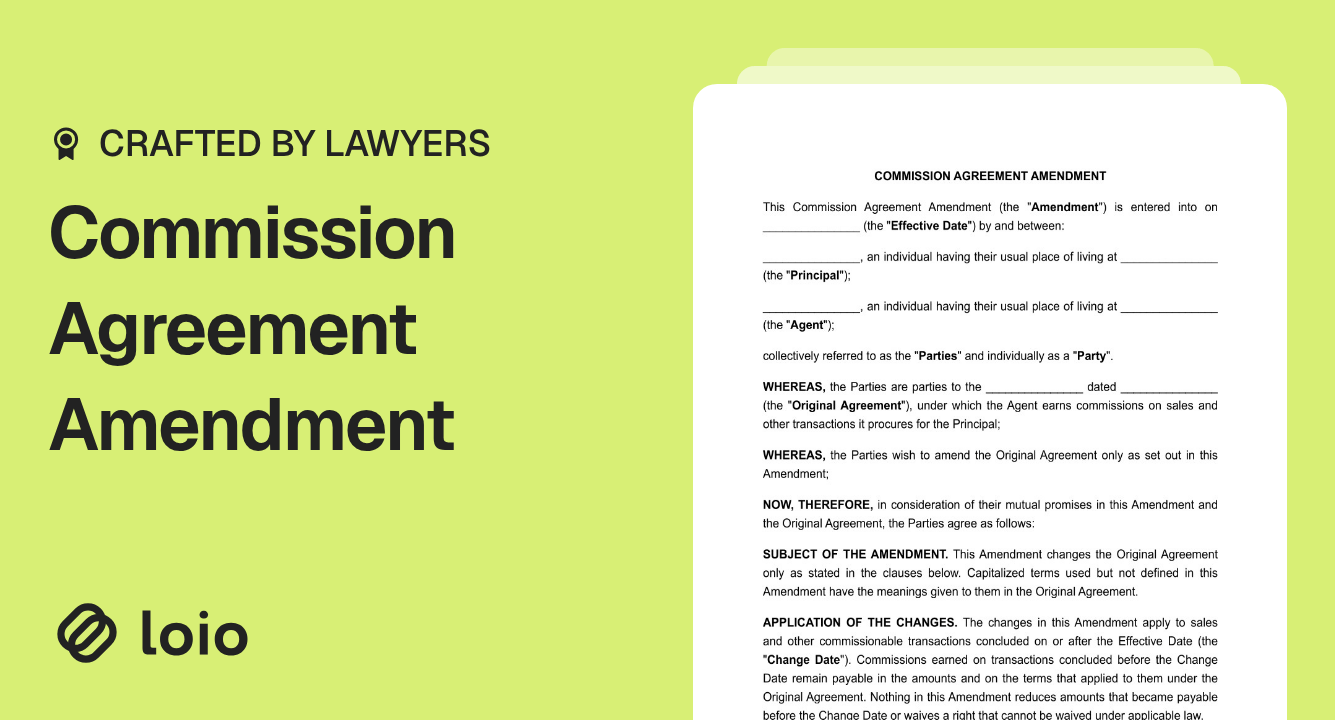
Free Commission Agreement Amendment Template

Need to change an Agent's commission rate without reopening the entire contract? This commission agreement amendment template helps the Principal and Agent document new terms while keeping the rest of their Original Agreement in place. It also protects previously earned commissions and provides a starting point for handling deals still in progress.
What Is a Commission Agreement Amendment?
Copy section linkA commission agreement amendment is a written agreement between the Principal, who pays commissions, and the Agent, who earns them. It changes specific provisions of an existing Original Agreement without replacing the entire contract.
Are commissions legally binding? Generally, yes. Commissions owed under an enforceable agreement create payment obligations. Changing the rate doesn't automatically erase amounts already earned or payable.
When should you use an addendum instead? An addendum usually adds new material without replacing existing terms. For example, adding a separate product line or service may call for an addendum, while replacing an existing commission rate calls for an amendment. What the document actually changes matters more than its title.
When Should You Use a Commission Agreement Amendment?
Copy section linkSuppose margins fall and the Principal wants to reduce commissions next quarter. A rate announcement isn't automatically a contract modification. An amendment to commission agreement records what both parties accept.
Unless the Original Agreement already permits the particular adjustment, the Agent must agree. If the Agent refuses, review the existing renewal and termination options rather than imposing a new rate.
| Situation | Best approach |
|---|---|
| Changing commission rates, calculation methods, payment timing, or territory | Use this amendment between the same Principal and Agent. |
| Replacing a rate table or territory map | Use with additions: expressly incorporate the replacement exhibit and follow the Original Agreement's amendment procedure. |
| Ending the relationship or replacing a party | Use another solution: termination under the Original Agreement or an appropriate novation. |
| Settling disputed commissions or rewriting nearly everything | Consider a settlement agreement or a new Commission Agreement. |
This template assumes an independent Agent. For covered employees, California Labor Code § 2751 requires written commission terms explaining calculation and payment, a signed copy, and a signed receipt. Employee compensation changes belong in employment documentation.
What to Check Before Amending a Commission Agreement
Copy section linkStart with the current arrangement: the Original Agreement, earlier amendments, and applicable schedules. Review:
Commission rates, tiers, and calculation bases.
When commissions are earned and when they're payable.
Payment deadlines, returns, and chargebacks.
Territories, protected customers, and house accounts.
Post-termination commissions and amendment procedures.
What if the parties have followed a different rate agreed by email? Confirm what they actually agreed, which transactions were affected, and what was paid. The new Amendment can document that practice and the period it covered, using an express provision rather than leaving the written contract inconsistent with the records.
An email's legal effect depends on the Original Agreement and applicable law. Also, the template's default APPLICATION OF THE CHANGES clause preserves earlier transactions under the old terms. Any intended historical adjustment must expressly address that rule without unlawfully reducing accrued rights.
Under California Civil Code § 1738.13, covered nonemployee wholesale sales representative agreements must be written and specify calculation, payment timing, territory, exceptions, and chargebacks. Both parties receive signed copies, the Agent signs a receipt, and contractual waivers of statutory rights are void.
How Commission Changes Affect the Agent's Earnings
Copy section linkA sales commission agreement amendment can raise the percentage yet reduce what the Agent receives. Check four things: rate, commission base, earning/payment timing, and chargebacks.
The basic calculation is:
Commission = (Rate × Eligible Base) − Applicable Chargebacks
Timing determines when a commission is earned and paid; it isn't another mathematical multiplier.
Consider this example:
Original Agreement: 8% of $10,000 invoiced sales = $800.
Amended terms: 10% of $6,000 collected sales = $600.
If the customer never pays the remaining $4,000, and no further commission becomes due, the Agent receives $200 less despite the higher rate.
Under SUBJECT OF THE AMENDMENT, only expressly stated provisions change. Everything else remains as written, and capitalized terms retain their meanings from the Original Agreement unless redefined.
Give each material change its own clause: identify the current section, provide its full replacement wording, and specify which calculation or payment elements change or remain unchanged. Define new terms such as “Net Collected Revenue” rather than assuming both parties interpret them alike.
Territory changes matter just as much. Removing a major customer or introducing house accounts can reduce earnings like a rate cut. The parties might negotiate protected accounts, volume-based tiers, or faster payments to make the revision acceptable.
What Happens to Commissions Earned Before the Change Date?
Copy section linkUnder APPLICATION OF THE CHANGES, revised terms apply to transactions concluded on or after the Change Date. Earlier transactions retain their previous commission terms, and amounts already payable are protected.
The Effective Date determines when the Amendment takes effect. The Change Date determines which transactions receive the new terms. They may be the same date or different dates.
Ideally, both parties sign on or before the date the new terms begin. A Change Date earlier than the signing date may apply revised terms to transactions already completed when the parties sign.
But what does concluded mean? It might refer to an accepted order, a signed customer contract, or goods being shipped. Check the Original Agreement instead of assuming that every sale closes at the same stage.
For an amendment to sales commission agreement, consider an Agent who negotiated a deal for six months before the customer signed after the Change Date. Under the default wording, the new terms may apply.
How to protect pipeline deals or document earlier practice: After completing the questionnaire, open the generated document in Loio's PDF editor. Add a separate, clearly labeled clause, such as “Pending Transactions” or “Prior Commission Practice,” identifying the affected transactions, dates, and rates. Then revise APPLICATION OF THE CHANGES to reference that clause and state which rule takes priority.
These additions aren't generated automatically. They modify how the Amendment operates, so they shouldn't be forced into OTHER CHANGES, which is designed to revise sections of the Original Agreement. Check that the complete final wording is incorporated before signing.
Under the Illinois Sales Representative Act, 820 ILCS 120/2, covered commissions due at termination must be paid within 13 days; commissions becoming due afterward must be paid within 13 days of becoming due. Contractual waivers of the Act are void.
How to Fill Out a Commission Agreement Amendment Template
Copy section linkHow do you amend an agreement? Identify the Original Agreement, state the exact changes and their dates, follow its amendment procedure, and obtain both parties' signatures.
Complete Loio's commission agreement amendment form in these steps:
Identify the parties and Effective Date. Enter the Principal's and Agent's legal names and addresses. For a business entity, include its jurisdiction, legal address, and authorized representative.
Identify the Original Agreement. Copy its exact title and date. List earlier amendments so you're changing the current wording.
Choose the Change Date. Use the Effective Date or specify another date. Review pending transactions before deciding.
Set the commission method. Choose percentage, fixed commission per transaction, or another calculation method. Enter the rate and base, fixed amount and unit, or alternative formula. Complex tiers can be described using the other-method wording.
Set payment timing. Choose whether the period begins when the Principal invoices the customer or receives the customer's payment. Enter the number of calendar days.
Update territory or accounts. Describe the covered areas and customers in Territory. If using a separate list or map, expressly reference and incorporate the exhibit into the signed Amendment.
Change the term or other provisions. Enter a new end date if needed. Use OTHER CHANGES to identify and replace sections of the Original Agreement, including chargeback provisions. For separate pipeline or historical-practice provisions, follow the instructions in the Change Date section above.
Review and sign. Open the generated document in Loio's PDF editor to make any additional revisions before signing. Check calculations, dates, clauses, and incorporated exhibits. Both parties must agree on the final version.
Is a Commission Agreement Amendment Legally Binding?
Copy section linkGenerally, yes, if both parties validly agree to clear changes and satisfy applicable contract requirements. These may include consideration or another recognized legal basis, authorized consent, required signatures, and compliance with the Original Agreement's amendment procedure.
Who signs? Both the Principal and Agent should sign. When either is a business, an authorized representative signs on its behalf. A payroll administrator or sales manager doesn't automatically have authority to bind the business.
This template includes separate signature blocks for both parties, including corporate representatives where applicable, but no witness block. Check whether additional approvals or formalities are required.
The Amendment permits counterparts and electronic signatures where allowed. Under the federal ESIGN Act, 15 U.S.C. § 7001, a covered contract generally cannot be denied legal effect solely because electronic signatures were used. Consent and other substantive requirements still apply.
What to Do After Signing the Amendment
Copy section linkThe first commission statement after the Change Date is the practical test. Can the Agent distinguish transactions governed by the old terms from those governed by the new ones?
For relationships covered by California Civil Code § 1738.13, payment must be accompanied by an accounting identifying relevant orders, including customer names, invoice numbers, commission rates, and chargeback information.
Update commission calculations, customer and territory assignments, and payout approvals. Store the Amendment with the Original Agreement, earlier amendments, and incorporated exhibits.
Under EFFECT OF THE AMENDMENT, unchanged provisions remain in force, and the Amendment controls conflicts. The Original Agreement's governing law and dispute procedures continue to apply.
The ENTIRE AGREEMENT clause requires changes to this Amendment to be in writing, signed by both parties. For the next commission rate, territory, or quota revision, prepare another signed amendment rather than relying on an informal email.
Create and Sign a Commission Agreement Amendment in Loio
Copy section linkEmailing successive contract versions creates a familiar problem: someone signs one copy while finance calculates commissions from another.
Start with Loio AI Contract Review. Upload the Original Agreement to summarize its financial terms, dates, and key provisions. Use that summary as a starting checklist for the review described earlier.
Next, complete the questionnaire and revise the generated document using Loio's PDF editing tools, including redline markups where needed. Agree on one final version before sending it for signatures.
With Loio Sign, you can sign your part and send the document by email for the other party's signature. Track its status, send reminders, and retain the completed Amendment with a time-stamped audit trail.
For several Agents, reuse a signature-request setup while preparing a separate amendment for each Agent. That keeps individual commission arrangements and signatures distinct.
Why You Should Trust This Template
Copy section linkCommission disputes often begin when the new rate is clear but the calculation base, effective date, or treatment of earlier sales isn't. This template addresses those risks directly, with defined commission options, a Change Date, protection for earlier transactions, and signatures from both parties.
Loio's templates follow a writing, legal review, and maintenance process explained in its Editorial Policy. Review applicable state-specific sales representative and employment rules before signing.
Related Documents
Also Read