Free template
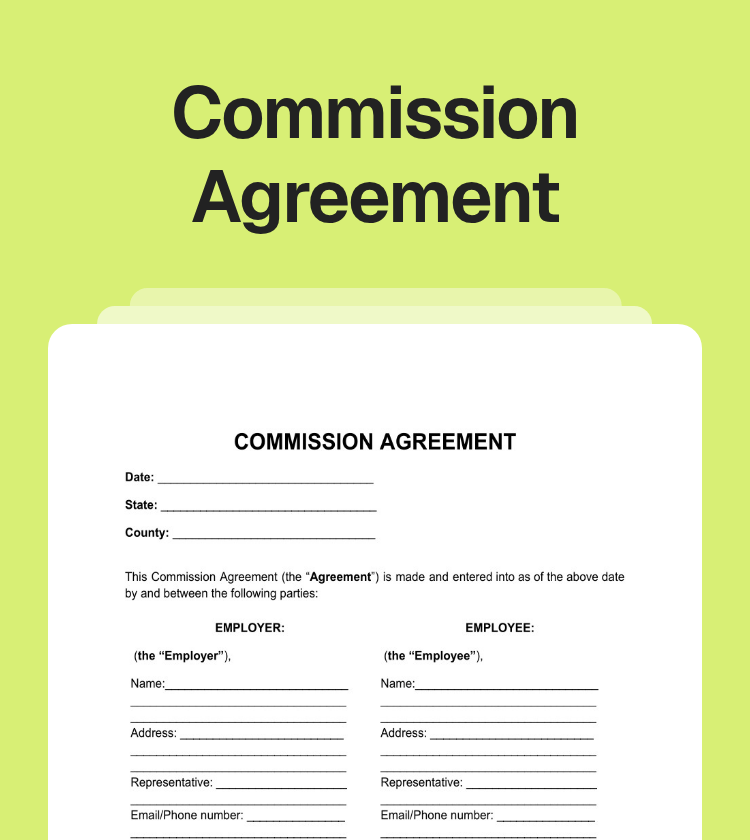
Free Commission Agreement Template
What Is a Commission Agreement?
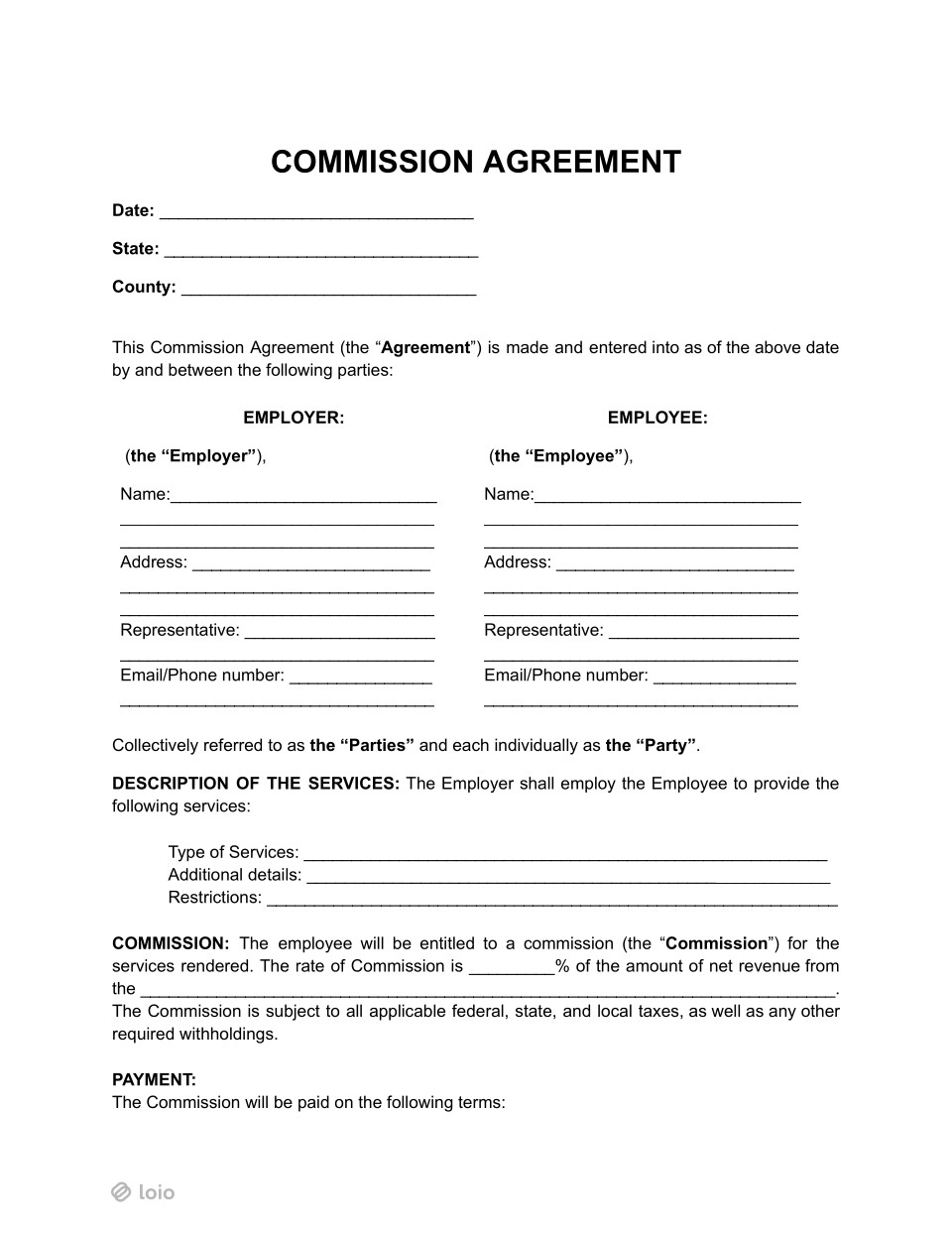
Copy section linkA commission agreement template sets out a written contract between a principal (the business or person selling goods or services) and an agent (the person or company hired to sell on the principal's behalf in exchange for a share of each sale). Instead of a flat salary, the principal pays the agent through commission, so the agent's income depends on sales results rather than hours worked.
This commission contract covers who pays whom, how the commission is calculated, and what the agent is expected to do. It also spells out what happens if a sale falls through or the arrangement ends. A commission contract template also draws the line between a straight commission structure, where the agent earns nothing without a completed sale, and a salary-plus-commission structure. In the second structure, a base wage is guaranteed, and commission is added on top.
Businesses reach for a commission agreement any time pay is tied to performance instead of a fixed rate. That covers outside sales representatives, real estate agents, referral partners, and independent sales contractors. In business law, this document sits alongside employment contracts and independent contractor agreements as one of the main tools for defining how someone gets paid for work. Because commission rules differ depending on whether the agent is an employee or an independent contractor, the agreement should state that classification directly. It affects tax withholding, minimum wage protections, and whether the agent is entitled to unemployment insurance.
When to Use a Commission Agreement
Copy section linkA commission agreement makes sense any time someone's pay depends on the sales or deals they bring in, rather than a fixed hourly or salaried rate.
Hiring an outside sales representative who is paid a percentage of the deals they close, instead of or in addition to a salary
Bringing on a referral partner who earns a fee only when their introductions turn into a sale
Structuring pay for a real estate agent, insurance broker, or manufacturer's representative who works on commission
Formalizing an informal commission arrangement, especially after a disagreement over unpaid commission has already come up
Documenting a switch from salary-only to salary-plus-commission pay for a current employee
A commission agreement contract works the same way whether you call it a commission contract template, a sales commission agreement, or a commission agreement form. The name varies by industry, but the terms it needs to cover don't.
When not to use a Commission Agreement:
If the worker is paid a flat hourly rate or project fee with no performance-based component, a service contract covers that relationship better.
If the person is doing consulting or project-based work rather than sales, an independent contractor agreement is the more accurate fit.
If protecting confidential information is the only goal and no commission is being paid, use a standalone non-disclosure agreement instead of folding confidentiality into a commission contract.
Parties to the Commission Agreement
Copy section linkPrincipal: The business or individual that owns the goods, services, or product being sold, sets the commission rate, and pays the agent once a sale qualifies under the agreement's terms.
Agent: The person or company hired to sell on the principal's behalf. The agent follows the territory, product scope, and reporting terms set out in the agreement and earns commission on qualifying sales.
Witness (conditional): Some companies require a witness signature to strengthen the agreement's enforceability, though most states don't require one for a commission agreement to be valid.
Key Components of the Commission Agreement
Copy section link- Parties and contact information: Identifies exactly who is bound by the agreement and where formal notices should be sent.
- Territory or account scope: Defines the geographic area, client list, or product line the agent is authorized to sell, so two agents don't end up competing for the same accounts.
- Product or service scope: States exactly what the agent is authorized to sell, so commission doesn't apply to unrelated transactions. If the agent is selling a proprietary product, a creative work, or anything involving intellectual property, this is also where the agreement should state who owns that IP, since selling something doesn't automatically transfer ownership.
- Commission structure: Sets the rate or formula, whether that's a flat percentage, a tiered rate, or a fixed amount per sale.
- Payment schedule: States when commission is calculated and paid, such as monthly or after the customer's payment clears.
- Expense reimbursement: Clarifies whether travel, marketing, or other business costs are reimbursed separately from commission.
- Confidentiality: Protects client lists, pricing, and other business information the agent has access to while working under the agreement.
- Term and termination: Sets how long the agreement runs and what happens to pending or already-earned commission if either side ends it early.
Key Clauses in a Commission Agreement
Copy section linkEvery commission agreement contains standard sections, but a small set of clauses attracts most of the negotiation, disputes, or state-by-state variation. Sample language for each is included below; customize the bracketed values before signing.
Exclusivity Clause
What it does: States whether the agent is the only one selling in a given territory or account list, or whether the principal can use multiple agents in the same area. It can also restrict the agent from selling competing products during the term of the agreement.
Sample language:
During the term of this Agreement, Agent shall not sell, market, or promote any product or service that competes with the Principal's [product/service] within the Territory, without Principal's prior written consent.
When to include or omit: Include it when the principal wants to protect market focus or prevent the agent from splitting attention between competitors. Omit it, or narrow it significantly, if the agent is expected to represent multiple non-competing product lines.
State variation: California, Minnesota, North Dakota, and Oklahoma largely refuse to enforce exclusivity language that functions as a non-compete restricting the agent's ability to work elsewhere after the agreement ends.
Post-Termination Commission Clause
What it does: Covers whether the agent still gets paid on deals they started before the agreement ended but that close afterward, sometimes called tail or pipeline commission. Without this clause, it's unclear whether a sale in progress at termination is still owed to the agent.
Sample language:
Agent shall be entitled to commission on any sale for which Agent was the procuring cause before the termination date, provided the sale closes within [90] days of termination.
When to include or omit: Include it any time sales cycles are long enough that a deal could realistically still be open when the relationship ends. It's less necessary for agreements where each sale closes the same day it's initiated.
State variation: Illinois and Minnesota both have sales representative statutes that set strict payment deadlines after termination, in Illinois's case as few as 13 days. Missing that deadline can expose the principal to penalties of up to three times the unpaid commission.
Chargeback Clause
What it does: Lets the principal deduct previously paid commission from future payments if a sale is later canceled, returned, or goes unpaid by the customer. It protects the principal from paying commission on revenue it never actually collected.
Sample language:
If a sale on which commission was paid is subsequently canceled, returned, or unpaid by the customer within [60] days, Principal may deduct the corresponding commission from Agent's next payment.
When to include or omit: Include it whenever the principal's revenue depends on customer follow-through, such as subscriptions, financed purchases, or return-eligible products. It's less necessary for one-time sales with no return window.
State variation: Some states treat earned commission as wages and restrict how far back an employer can claw it back once it's paid. The deduction terms in this clause should be checked against state wage law before they're finalized, especially if the agent is a W-2 employee rather than a contractor.
Key Terms in a Commission Agreement
Copy section linkPrincipal: The party who owns the goods, services, or product being sold and pays commission to the agent.
Agent: The person or business hired to sell on the principal's behalf in exchange for commission.
Commission: A payment calculated as a percentage of a sale, or a set amount per transaction, paid to the agent for completed sales.
Earned commission: Commission that has met every condition set in the agreement, such as full customer payment, and is now owed to the agent.
Draw: An advance payment made to the agent against future commission, later deducted once the agent earns enough commission to cover it.
Chargeback: A deduction from an agent's future commission when a completed sale is later canceled, returned, or left unpaid by the customer.
Territory: The geographic area, client segment, or account list the agent is authorized to sell within.
Clawback: A clause letting the principal reclaim commission already paid if certain conditions, such as fraud or early cancellation, are later triggered.
Term: The period the agreement is in effect, including the start date and any renewal or termination terms.
How to Fill Out a Commission Agreement
Copy section link- Enter the principal's information. Add the legal name, business type, and address of the party paying commission.
- Enter the agent's information. Add the legal name and contact details of the person or business earning commission.
- Define the territory or accounts. State the geographic area, client list, or product category the agent is authorized to sell within.
- Describe the products or services covered. List exactly what the agent is authorized to sell under this agreement.
- Set the commission structure. Enter the commission rate or formula, including any tiers, minimums, or caps.
- Set the payment schedule. State how often commission is calculated and paid, and what triggers payment, such as delivery, invoicing, or full customer payment.
- Add expense terms. State whether the agent will be reimbursed for travel, marketing, or other approved costs.
- Add a confidentiality clause. State what business information the agent must keep private during and after the agreement.
- Set the term and termination conditions. Enter the start date, end date or renewal terms, and what happens to earned or pending commission if the agreement ends early.
- Sign and date. Both parties sign to make the agreement enforceable.
Does a commission agreement have to be in writing?
Not in every state, but several require it. California law requires any commission-based pay arrangement to be set out in a signed written contract that states how commission is calculated and paid. New York has a similar requirement for commission salespersons. Even where it isn't legally required, a written agreement is the clearest way to prove what was promised if a dispute over unpaid commission comes up later.
How do I write a simple commission agreement?
List the parties, describe what's being sold, set the commission rate and payment schedule, add a start and end date, and have both sides sign. A commission agreement template makes sure none of these fields get missed, and you can adjust the commission structure and territory to fit the specific role.
What's the difference between a draw and a commission?
A draw is money paid to the agent up front, before any sale closes, and it's typically deducted from commission once the agent earns enough to cover it. Commission itself is payment tied directly to a completed sale. The agreement should state whether the draw is recoverable, meaning the company can reclaim any unearned portion, or non-recoverable, meaning the agent keeps it regardless of sales performance.
Is commission taxable as 1099 income?
It depends on how the agent is classified. If the agent is an independent contractor, the principal reports commission payments on Form 1099-NEC once the annual total reaches the IRS reporting threshold. If the agent is a W-2 employee, commission is reported on their W-2 and is subject to standard payroll tax withholding instead.
Can an agent still collect commission after the agreement ends?
Only if the agreement says so; many commission agreements include a clause covering pipeline or tail commission, meaning sales the agent initiated before termination but that close after they leave. Without that clause, most agreements treat commission as unearned once the agent's contract ends, even on a deal that was already in progress.
What happens if a sale is charged back or canceled?
If the agreement includes a chargeback clause, the principal can deduct previously paid commission from future payments when a sale is later returned, canceled, or goes unpaid. Without that clause, recovering commission on a failed sale can be difficult, so it's worth spelling out rather than assuming it applies automatically.
Can a commission agreement include an exclusivity clause?
Yes. An exclusivity clause can require the agent to sell only for one principal, or keep the principal from hiring competing agents in the same territory. These terms should state a specific scope and duration, since overly broad exclusivity or non-compete language isn't enforceable in every state.
Is a commission agreement legally binding?
Yes. Once both parties sign it, a commission agreement is a legally binding contract enforceable like any other written agreement. Failing to pay commission that's due under the agreement is a breach of contract, and depending on the state, it may also violate wage payment laws.
Requirements for this document vary by state. Review your state's laws and procedures — or consult a licensed attorney — before using this template to ensure it's valid and enforceable where you live.
Statutory references
Related Documents