Free template
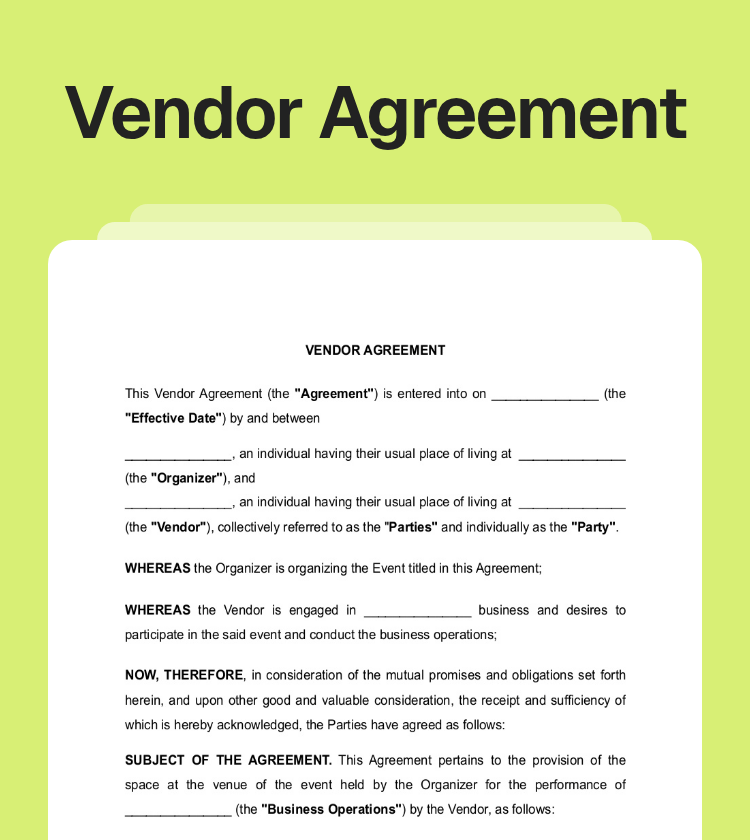
Free Vendor Agreement Template

What Is a Vendor Agreement?
Copy section linkA vendor contract template is a written agreement between an event organizer and a vendor who wants to sell goods or provide services at that event. It covers the practical details of showing up: where the vendor's booth or table will be, what fees are owed, and what hours the vendor operates. It also spells out what happens if either side cancels.
This vendor agreement works for almost any kind of gathering where outside sellers set up shop, including farmers markets, craft fairs, food festivals, and corporate events. The event organizer licenses a defined space to the vendor for the length of the event. This is usually a license, not a lease. The vendor gets temporary permission to use the space, and that permission ends when the event does, without creating any ongoing tenancy rights.
Some people search for this document as a vendor agreement template or a vendor agreement contract. Whatever it's called, its job is the same. It spells out who's responsible for what before the event starts, so a disagreement over fees, cancellation, or damaged goods doesn't turn into a bigger dispute.
When Do I Use a Vendor Contract Template?
You use a vendor agreement form any time you invite a seller or service provider to your event, whether it's a market, fair, festival, or corporate gathering. The Loio’s vendor agreement template ensures that all important details like fees, setup times, and space assignments are clearly defined and agreed upon in writing.
Parties to the Vendor Agreement
Copy section linkEvent organizer (buyer): The individual or business holding the event and licensing space to vendors. The organizer sets the event details, collects fees, and is typically responsible for the venue and overall event insurance.
Vendor (seller): The individual or business selling goods or providing services at the event. The vendor pays the agreed fee, follows the space and conduct rules set out in the agreement, and is usually responsible for their own liability coverage.
Venue owner (conditional): If the event organizer doesn't own the location, the venue owner may be a separate party. They may need to approve the event and any vendor activity taking place on their property.
Key Components
Copy section linkEvent details: States the event's name, date or dates, and general schedule.
Booth or space: Describes the specific space the vendor will use, such as a booth number, table size, or square footage, along with setup and teardown times.
Fees: Sets the payment structure, whether that's a flat fee, a percentage of sales, or a combination, and when payment is due.
Permits: Lists any licenses or permits the vendor is responsible for obtaining, such as a health permit for food or a liquor license for alcohol.
Insurance: States what insurance coverage the vendor must carry, often including a certificate of insurance as proof.
Cancellation: Covers what happens if either the vendor or the organizer cancels, including any refund of fees and how much notice is required.
Indemnification: States that each party covers the other's losses if their own actions cause a claim related to the event.
Signatures: Both parties sign to make the agreement binding.
Key Terms
Copy section linkIndemnification: A commitment by one party to cover the other's losses if a third party brings a claim related to the agreement.
For example, if a customer is injured at a vendor's booth, the vendor's indemnification clause would typically require the vendor to cover the organizer's resulting legal costs.
Hold harmless: A clause closely related to indemnification, where one party agrees not to hold the other legally responsible for certain risks or losses connected to the event.
Force majeure: A clause covering events beyond either party's control, like severe weather or a government order, that may excuse a party from performing or justify canceling the event.
Liquor liability: A type of insurance coverage specific to serving or selling alcohol, which protects against claims arising from an intoxicated guest. Most general liability policies don't cover this.
Certificate of insurance: A document from an insurance company confirming that a policy is active and showing its coverage limits. Organizers commonly require vendors to submit one before the event.
MSA (master service agreement): A broader contract that sets recurring terms between an organizer and a vendor who works multiple events together. Each event then only needs a short order form instead of a full new contract.
How To Write a Vendor Contract Agreement
Copy section linkThe vendor services agreement template lets you create a valid contract for vendors to attend your event. Simply follow our user-friendly questionnaire to download and save a PDF copy of your contract.
- Select the dates and location of the event
Choose whether your event is a single-day or multi-day event to ensure accurate coverage. Then, enter the location so your vendors agreement format PDF complies with your state’s laws. - Describe the event
Add the event’s schedule, expected number of attendees, and venue address. You can also describe the event’s purpose or theme to help vendors better prepare for what’s expected. - Give details of the venue
Explain what space the vendor will use, such as booth or table details. Include key access times, operating hours, the type of goods or services offered, and any rules or permits required. You can also mention in the vendor agreement contract whether utilities or equipment will be provided. - Add both parties’ details
List the full names, addresses, and email contacts of both the event organizer and the vendor. These can be individuals or businesses. - Provide payment information
Specify the payment structure — such as a flat fee, hourly rate, or percentage of sales. You can also include details about deposits, tax, invoicing, and late payment penalties if applicable. - Outline the terms of the vendor license
Clarify important conditions like the cancellation policy, insurance responsibilities, and how legal issues will be handled. You can also include any additional clauses unique to your event in the basic agreement vendor contract template. - Add your signing details to the simple vendor agreement template
Before finalizing the vendor agreement, you can choose whether a witness should be present during signing. This adds an extra layer of verification, though it’s not always required.
Do I need a witness when signing a vendor agreement?
Not in most states. A witness isn't a legal requirement for most vendor agreements, but having one can help if the agreement's validity is ever challenged.
What's a typical cancellation and refund policy for a vendor agreement?
There's no universal standard, so this needs to be spelled out in the agreement itself. A common approach is a sliding scale. Vendors get a full refund of their deposit if they cancel a set number of weeks out, and a partial or no refund closer to the event.
Do I need special terms for alcohol vendors?
Yes. A vendor selling or serving alcohol needs its own state or local liquor permit in addition to the vendor agreement, since the agreement itself doesn't grant permission to sell alcohol. Many events also require proof of liquor liability insurance before an alcohol vendor can set up.
Can a vendor use a subcontractor to help at the event?
It depends on what the agreement says. If subcontracting is allowed, the agreement should still hold the original vendor responsible for the subcontractor's conduct and insurance.
What is an example of a vendor contract?
A common example is a farmers market or craft fair agreement. The organizer licenses a booth space to a vendor for a flat fee and requires proof of insurance before the event.
Can I legally write my own contract?
Yes. There's no requirement that a lawyer draft a vendor agreement. It just needs the basic elements of a valid contract: an offer, an acceptance, and something of value exchanged between the parties.
This template is intended for general use across all 50 U.S. states+DC. Local procedures — such as notarization, witnessing, or filing requirements — may still apply, so check your state's specific rules before signing.
State Law
Copy section linkAccording to contract law, certain types of events must be described using specific language, especially if alcohol is involved or if there will be a large number of people present. The language needs to address vendors, what they are allowed to sell, and what regulations are in place (i.e., health codes related to food vendors). This varies by state so it is important to check the laws of your specific state.
Sources
Related Documents
Also Read