Plus template
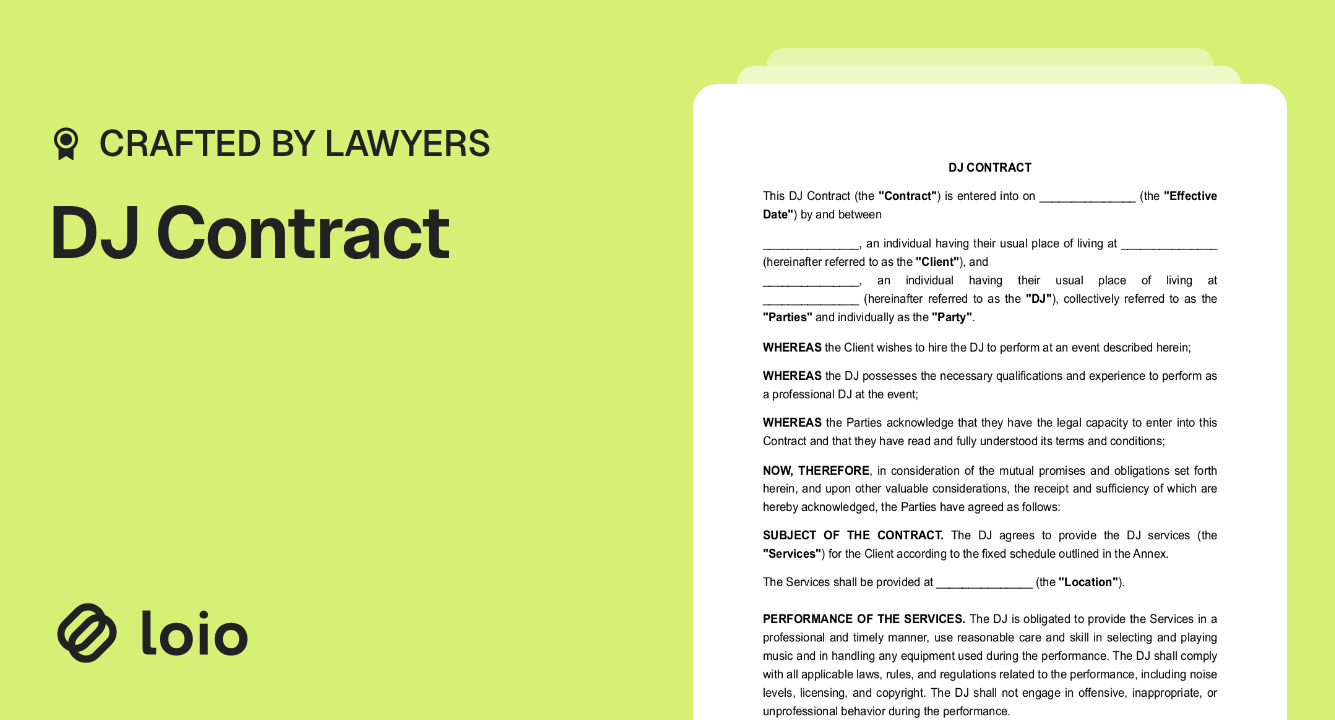
DJ Contract Template

A client cancels three weeks before a wedding. You've already turned down another booking for that date. Do they still owe you the full fee?
A DJ contract template helps you settle questions like this before plans change. It puts the performance schedule, equipment responsibilities, payment terms, and cancellation rules in writing, so you and your Client know exactly what's included in the booking.
Customize the agreement for one wedding, private party, or corporate event, then send it with the DJ's Schedule for signature.
Is This DJ Contract Right for Your Booking?
Copy section linkThis template is designed for one DJ providing services at one event for one Client. It works for weddings, birthday parties, family celebrations, and one-off corporate events.
Even a DJ agreement form for a short performance should establish which date you've reserved, what the Client expects, and how much you'll be paid.
The contract identifies two parties:
- The Client: The person hiring and paying the DJ. For a wedding, this could be one partner, both partners, or another person paying for the celebration.
- The DJ: The individual performing the agreed services and providing the necessary equipment.
The current template identifies both parties as individuals. If the DJ operates through an LLC or another business entity, or a company hires the DJ, adjust the party information and signature blocks to identify the correct legal entity and its authorized representative.
Not every booking calls for the same document:
| Your situation | Document to consider |
|---|---|
| Wedding, birthday, or one-off corporate party | This DJ Contract |
| Recurring club or bar performances by a freelance DJ | Music Performance Contract or a residency agreement |
| DJ working as a venue employee | Employment contract and related paperwork |
| Client rents speakers or lighting without a DJ | Equipment Rental Agreement |
Does the contract make you an independent contractor?
The template's Relationship Between the Parties clause states that the agreement doesn't create an employment, agency, partnership, or joint venture relationship.
But calling someone an independent contractor doesn't automatically make them one.
Under IRS Topic No. 762, worker classification depends on behavioral control, financial control, and the actual relationship between the parties.
For example, a mobile DJ who owns their equipment, sets their rates, and performs for different clients may have a stronger independent-contractor case. A DJ who performs regularly at the same venue may still be an independent contractor. However, if the venue also controls how the DJ performs the work, the relationship may indicate employment rather than independent contracting.
For a longer-term business relationship, an Independent Contractor Agreement may offer a more suitable starting point, provided the actual working relationship supports that classification.
What Should You Confirm With the Client Before the Event?
Copy section linkYou've planned the music, packed the equipment, and checked the venue address. The Client may only know when the performance starts.
A contract for DJ services should help both sides agree on the details before event day. That includes the schedule, equipment setup, venue requirements, and music preferences.
Set the event timeline in the DJ's Schedule
The contract refers to an Annex called DJ's Schedule, which records the agreed performance timetable.
The Annex included with this template does not contain a preformatted schedule. You'll need to add the actual timeline before signing.
Include the following:
- Event date and venue.
- Arrival and equipment unloading time.
- Setup and soundcheck.
- Performance start and end times.
- Agreed breaks and any special timing requirements.
Make sure the schedule matches the venue's access hours and curfew.
Example: Your performance ends at 11 p.m., but the Client requests another 30 minutes. The contract's overtime rate helps determine the additional payment, but it doesn't override an 11 p.m. venue curfew.
The Annex has separate signature lines for the Client and DJ.
Decide who brings what
The contract divides setup responsibilities between the DJ and Client.
| The DJ provides | The Client arranges |
|---|---|
| Sound equipment appropriate for the venue and expected guests | Adequate electrical power and outlets |
| Lighting equipment specified in the agreement | Stage and preparation area |
| Agreed Backline equipment | Necessary extension cords and power strips |
| Professional performance and equipment handling | Agreed catering for the DJ and crew |
Don't assume the Client knows what Backline equipment means. List the specific items you're bringing and check whether you'll need additional equipment from the venue.
You should also obtain the venue's rules before finalizing the agreement. These may include loading restrictions, sound limits, insurance requirements, and access to the performance area.
The contract makes the DJ responsible for complying with applicable performance regulations, including noise, licensing, and copyright requirements. The Client should therefore provide any venue information needed to meet those obligations.
If the Client is renting the event space separately, a Venue Rental Agreement can document the venue's obligations. The DJ's Schedule should be consistent with those arrangements.
If you're renting speakers or lighting from a supplier, sign a separate Equipment Rental Agreement with that supplier before the event. This covers the equipment rental without changing your DJ booking terms.
If the venue requires proof of liability insurance, you may need a certificate of insurance from your insurer. The certificate provides information about existing coverage but doesn't change or extend it. If the venue also requires additional-insured status or advance notice of cancellation, check that the insurance policy or an applicable endorsement provides those protections. See the Oregon Division of Financial Regulation's guidance for details.
Who pays if equipment gets damaged?
The current DJ Contract requires the DJ to provide suitable equipment and use reasonable care when handling it. However, it doesn't clearly allocate responsibility for damage caused by guests, venue staff, or other third parties.
If that risk matters for your event, add a provision addressing equipment damage, loss, and insurance before signing. Specify when compensation is owed and whether any insurance is expected to cover the loss.
Don't assume that the existing indemnification or limitation-of-liability clauses automatically make the Client responsible for damaged equipment.
Agree on the music without planning every song
The DJ contract template includes fields for music genre or style and specific equipment, along with provisions about explicit content and guest requests.
For a wedding, your music arrangements might include:
- Music style: Pop, R&B, and dance music.
- Must-play songs: The first-dance song and selected family favorites.
- Do-not-play songs: Tracks specifically excluded by the couple.
- Content restrictions: No explicit or offensive lyrics.
- Guest requests: Accepted when appropriate for the audience and event.
The template leaves the exact playlist to the DJ's discretion while expecting the DJ to make every effort to accommodate guest requests.
If the Client has a mandatory song list, agree on how it fits with that discretion. You can attach the list to the agreement or incorporate the agreed requirements into the performance terms.
What Should Your DJ Fee Cover, and When Should You Get Paid?
Copy section linkA successful event shouldn't end with a disagreement over the balance.
The DJ service contract covers the fixed fee, Deposit, payment deadlines, overtime, and additional expenses. Read these provisions together before deciding what to charge.
Set the fee, Deposit, and final payment date
Under the DJ service agreement template, the Client pays a fixed amount for the services.
The Deposit is due within a specified number of days after the contract's Effective Date, and the full Compensation is due within a stated number of days after the services are completed.
Check whether payment after the event works for your business. If you prefer to receive the balance before performing or on the event date, change the deadline and have the Client agree to it.
Also, make it clear that the Deposit is credited toward the total Compensation, if that is what you intend. Otherwise, the payment language could leave room for disagreement about how much remains due.
The template describes the Deposit as non-refundable, except in specified termination and force majeure circumstances. Those exceptions should match the cancellation and termination provisions discussed below.
The current payment method is cash. Use a Cash Receipt whenever the Client pays the Deposit, final balance, or agreed overtime charges. The DJ, as the person receiving the cash, signs the receipt, gives the Client a copy, and keeps another for their records.
If the balance is due after the event, you can send an invoice or written payment request when payment becomes due. Issue the receipt once the money has actually been received.
Account for overtime and extra expenses
The Payment Terms include an hourly overtime rate. Fill in that amount and connect it to the performance end time in the signed Annex.
Also decide who pays for:
- Travel to and from the venue.
- Accommodation for overnight events.
- Meals and other agreed expenses.
Pay particular attention to the wording about expenses. The DJ contract template says the fixed Compensation covers all expenses related to the services, but also places responsibility for costs such as travel, accommodation, and meals on the Client unless otherwise agreed.
These statements need clarification so the parties know whether those costs are included in the quoted fee or payable separately. Edit the template if you want to adjust the terms.
For example, if you're traveling for a destination wedding, write down whether the Client will arrange the hotel, reimburse the cost, or pay an additional fixed amount.
Does a business Client need to report DJ payments?
If a venue, event planner, or another business hires an independent DJ, federal tax reporting requirements may apply.
According to the IRS instructions for Forms 1099-MISC and 1099-NEC, the reporting threshold for qualifying nonemployee compensation paid in 2026 is generally $2,000 per payee during the calendar year.
Payments to corporations are generally exempt, subject to exceptions. An LLC's federal tax classification can affect its treatment.
A couple or individual host paying a DJ for a personal celebration generally doesn't have the same business-payment reporting obligation.
If you're hired by a business, the Client may also ask you to complete IRS Form W-9 before payment. The form provides your taxpayer identification information for tax reporting. You complete and certify it yourself; it isn't another contract that both parties sign.
What Happens If the Client Cancels the DJ Booking?
Copy section linkSuppose your Client cancels 20 days before the wedding. You've reserved the date, and it's too late to accept another booking.
Can you charge the full fee?
That depends on the cancellation terms, their consistency with the rest of the agreement, and applicable state law.
Make cancellation and termination terms consistent
The template contains two important provisions:
- Cancellation Policy: Provides for full payment when the Client cancels within a specified period before the event.
- Term and Termination: Allows either party to terminate without cause with advance written notice, with the Client paying for services performed up to termination.
These clauses can produce different results for the same canceled event.
Example: The Cancellation Policy requires full payment for cancellations within 30 days of the event. However, the Termination clause allows termination without cause on 14 days' notice, requiring payment only for services already performed.
A Client canceling 20 days before the event could argue that the second provision applies.
Before signing, coordinate the notice periods and payment consequences. The contract should explain which provision controls if a late event cancellation also qualifies as termination without cause.
The Cancellation Policy's timing language should also be clarified so it's obvious whether the full-fee obligation applies to cancellations within the specified number of days before the event.
Use the contract's Notice provision when communicating cancellation or termination. It provides for written notices through specified delivery methods, including designated email addresses. Don't rely solely on a casual text message without checking the agreed notice requirements.
What if the DJ cancels instead?
Under the template's Cancellation Policy, a DJ who initiates cancellation must refund all payments received, including the Deposit, and pay the Client an additional specified amount.
The DJ service contract template calls that additional amount a penalty. However, labeling a payment a penalty does not make it enforceable.
Restatement (Second) of Contracts § 356 reflects the general common-law principle that agreed damages should be reasonable in light of anticipated or actual loss and the difficulty of proving it. Unreasonably large amounts may be unenforceable.
Consider what the Client might reasonably lose if the DJ backs out, such as the additional expense of arranging a replacement performer on short notice.
The contract also contains a refund deadline. Make sure it specifies when the refund must be completed after cancellation or termination rather than using unclear timing language.
Can you always keep the full cancellation fee?
Not necessarily.
For example, California Civil Code § 1671 applies different rules depending on the contract.
For certain contracts primarily involving personal, family, or household services, an agreed damages provision is generally void unless the statutory conditions are met, including difficulty determining actual damages.
For many business-to-business agreements, the provision is generally valid unless the challenging party establishes that it was unreasonable when the contract was made.
So a cancellation fee for a couple's wedding could face a different legal standard from one agreed between an event company and a DJ.
Before choosing the Deposit amount or a full-fee cancellation charge, consider the potential loss from a canceled booking, how difficult that loss would be to establish, and the law governing your agreement.
What If the Event Is Postponed Instead of Canceled?
Copy section linkA Client moves their wedding to another Saturday. They still want you to perform, but you've already reserved the original date.
A postponement doesn't automatically transfer the contract to a new date. Both parties need to agree on the change.
The template's Amendments clause requires written modifications signed by both parties.
If the Client wants to reschedule, first confirm your availability. Then prepare a written amendment identifying the original contract and stating the new date and any changes to the fee or services. Both the DJ and Client should sign the amendment, as required by the template's Amendments clause.
Update the DJ's Schedule and have both parties sign the revised Annex as well. Keep these documents with the original agreement so it's clear which date and terms now apply.
Decide whether the original Deposit transfers to the new booking, whether additional costs apply, and what happens if you aren't available.
What if bad weather or another emergency prevents the event?
The DJ contract template includes a Force Majeure clause for specified events beyond the affected party's reasonable control. It requires prompt written notice, reasonable proof, and efforts to reduce the consequences.
If the circumstances continue beyond the stated number of days, either party may terminate by written notice. The Deposit provisions also address refunds when the contract ends because of force majeure.
Still, bad weather doesn't automatically excuse performance.
In Kel Kim Corp. v. Central Markets, Inc. (1987), New York's highest court explained that force majeure clauses are generally interpreted narrowly, with attention to the events identified in the agreement.
A rainy outdoor wedding that can move indoors may present a different situation from an event prevented by a government closure order.
Review the clause's covered events, notification requirements, termination period, and Deposit treatment. If both sides prefer a new date, record that agreement in writing rather than assuming the original terms automatically continue.
Can the Client Record the DJ Set or Share Event Videos?
Copy section linkAt most weddings, someone is filming. The videographer records the first dance, guests share clips, and the couple may want a livestream.
But recording permission and ownership rights aren't always as simple as they seem.
Agree on recording and livestream permissions
The template's Intellectual Property section contains a Recordings provision restricting the Client from making unauthorized audio or video recordings of the performance.
It also states that the DJ retains ownership rights in live or video recordings. That contractual statement shouldn't be treated as proof that the DJ automatically owns every recording made by someone else.
Copyright ownership can depend on who created the recording, whether it qualifies as work made for hire, and whether rights have been transferred. See the U.S. Copyright Office's Copyright Basics.
If a wedding videographer will record or publish the DJ's performance, settle the relevant permissions before the event. Specify whether the footage may be used in a wedding film, highlight reel, livestream, or public online post.
The Client may also need a separate Videography Contract with the person filming the event to establish the filming scope, deliverables, and footage rights.
Who handles music licensing?
The DJ Contract requires the DJ to obtain necessary third-party intellectual property permissions and addresses royalties related to the performance.
However, the allocation in the contract doesn't necessarily settle legal responsibility for public performance licenses.
Under 17 U.S.C. § 101, a performance may be public if it occurs in a place open to the public or before a substantial number of people outside the normal circle of family and social acquaintances. Public transmissions are also covered by the statutory definition.
That distinction matters when comparing a private family celebration with a nightclub or public corporate event.
ASCAP's Music Licensing FAQs explain that those involved in public music performances may bear legal responsibility, while a business owner generally obtains the applicable license for music played at the establishment.
Before the event, confirm whether the venue has the appropriate public performance licenses and which additional permissions, if any, are needed.
A venue's public performance license also doesn't automatically authorize copyrighted music to be incorporated into a published video or livestream. Recording and distribution may involve separate rights.
Can the DJ post event clips for promotion?
The contract gives the Client a limited license to use the DJ's name, image, and likeness for promotional materials related to the performance.
That permission runs from the DJ to the Client. It doesn't automatically authorize the DJ to publish photos or videos of the Client's private celebration.
The Confidentiality clause also restricts disclosure and use of information obtained during the contractual relationship.
If you'd like to post event clips on your website or social media, agree on what may be shared before the party. Written consent is especially useful when recognizable guests appear in promotional material.
Depending on the intended use and applicable law, a separate Media Release Form may help establish permission to use a person's image, voice, or likeness. That consent doesn't replace any copyright permissions needed for the recording or music.
How to Fill Out and Sign a DJ Contract in Loio
Copy section linkA booking can quickly become a chain of emails, revised PDFs, and messages about the playlist or schedule. By the time the event arrives, it's easy to lose track of which version everyone approved.
With Loio, you can customize a template, prepare the contract and its Annex together, and arrange electronic signatures without relying on printed copies.
Here's how to complete your basic DJ contract:
- Identify the parties. Enter the Client's and DJ's legal names, addresses, and email contacts. Adjust the individual-party wording if a company is contracting.
- Add the event details. State the venue location, performance date, services, music preferences, and equipment responsibilities.
- Complete the Annex. Add the actual arrival, setup, performance, and end times. Check it against the venue's rules.
- Set the financial terms. Enter the Compensation, Deposit, due dates, overtime rate, and arrangements for expenses.
- Review cancellation and other legal provisions. Make cancellation and termination terms consistent, and resolve any recording, confidentiality, or equipment liability issues.
- Check the final document. Include the completed DJ's Schedule, governing law, notice details, and the signature fields for both parties.
- Send the agreement for signature. Have the Client and DJ sign the main contract and Annex, then retain the completed version.
Who Should Sign the DJ Contract?
Both the DJ and the Client should sign the agreement before the event. Their signatures document acceptance of the performance details, payment obligations, cancellation terms, and other conditions.
The template includes separate signature blocks for the DJ and Client, plus another set in the DJ's Schedule (Annex). Have the same contracting parties sign both documents so the agreed timetable is confirmed along with the main contract.
For a wedding, the person responsible for the booking and payment signs as the Client. If both partners are intended to be parties, name both in the agreement and provide a signature line for each. If an LLC or another company is a party, revise the template's individual-party wording and have an authorized representative sign on its behalf.
The venue manager, wedding planner, and videographer don't need to sign this DJ Contract unless they are themselves contracting parties. They may sign their own separate agreements instead.
The template has no witness or notary signature blocks. Notarization and witnesses are generally unnecessary for an ordinary DJ services contract, although unusual arrangements or applicable law may call for additional formalities.
You can use Loio's PDF editor to update the agreement, add annotations, and mark proposed changes. For a complicated venue setup, a simple image showing the speaker positions, DJ table, and power connections can make the Annex more useful.
With Loio's Request Signatures tool, the parties can sign electronically, track the signing process, and use reminders when a signature is still outstanding.
Electronic signatures are generally recognized under U.S. law. Under the ESIGN Act, 15 U.S.C. § 7001, a contract or signature generally cannot be denied legal effect solely because it is electronic, subject to the Act's scope and requirements.
What makes a DJ contract legally binding? Like other agreements, it must satisfy applicable contract-law requirements, including agreement, consideration, capacity, and lawful terms. An electronic signature can document acceptance, but it doesn't make an otherwise unenforceable clause valid.
For more details, see Are Electronic Signatures Legally Binding?
Make sure the final signed version includes the same schedule both parties approved.
Why You Can Trust This Template
Copy section linkThis DJ service agreement template is designed for use in the United States. It is developed and reviewed by qualified U.S. legal professionals and regularly updated to reflect relevant changes in U.S. law. Our review considers current statutes and regulations, official government guidance, and relevant case law where applicable.
Because legal requirements and individual circumstances vary, you may need to adjust certain provisions to fit your situation. Use Loio's Edit PDF tool to revise or add terms before using the document, and check the laws that apply in your jurisdiction.
Related Documents
Also read