Free template
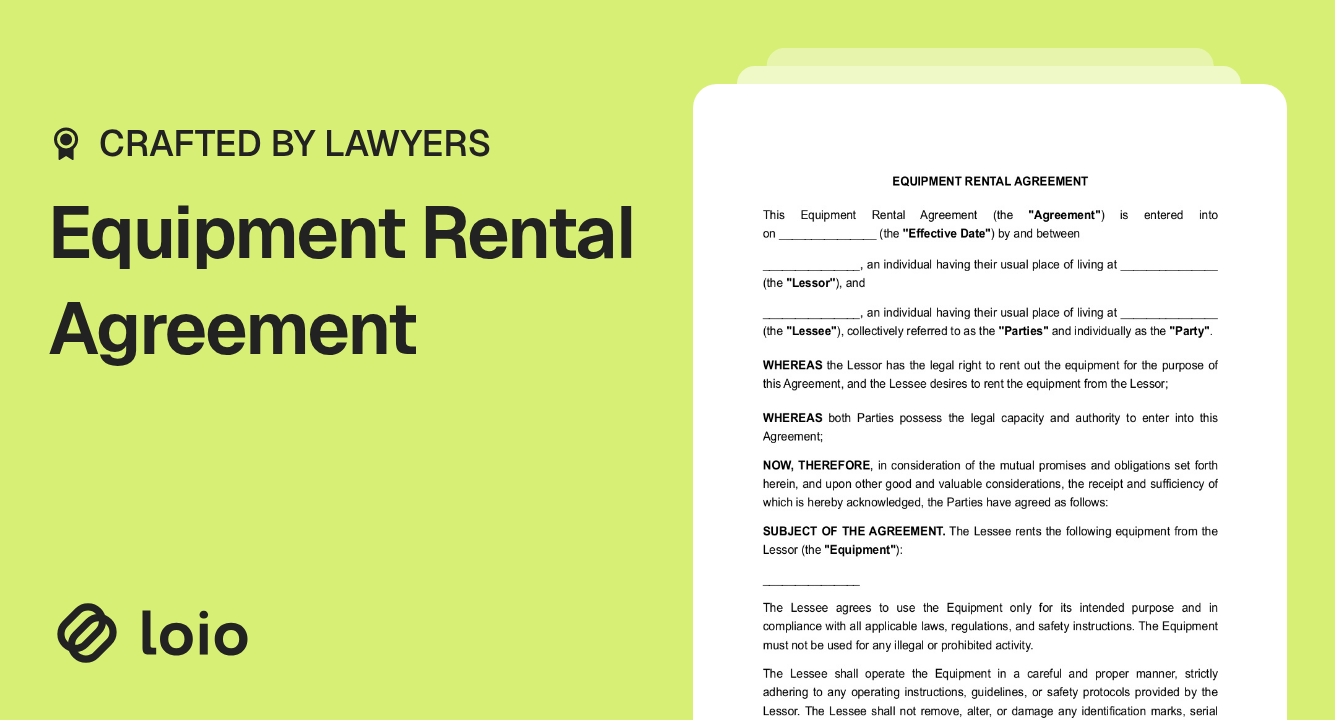
Free Equipment Rental Agreement Template

What Is an Equipment Rental Agreement?
Copy section linkAn equipment rental agreement is a contract in which one party — the owner, or lessor — allows another party — the renter, or lessee — to use specific equipment for a set period in exchange for payment, without transferring ownership. It's the document that governs the relationship for as long as the equipment is out of the owner's hands.
An equipment lease agreement template provides both parties with a consistent structure that covers the details that matter most: what's being rented, for how long, at what cost, and who's responsible if something goes wrong. The same document is sometimes called an equipment rental contract or an equipment lease agreement, depending on the industry and whether the arrangement is short-term or ongoing.
This agreement is used across a wide range of situations — a construction company renting heavy machinery for a project, an event planner renting audio equipment for a single weekend, or a business renting office equipment on a regular basis. Regardless of the equipment or the length of the rental, the agreement exists to make clear who owns what, who's responsible for damage, and what happens when the rental period ends.
When to Use an Equipment Rental Agreement?
Copy section linkUse an equipment rental agreement when:
A business needs to borrow machinery or tools for a specific job or project rather than purchasing them outright.
An individual needs electronic devices — computers, cameras, sound equipment — for a temporary period.
You want a clear fee structure covering the rental rate, security deposit, and any late fees upfront.
The parties need to agree on who's responsible for maintaining the equipment during the rental period.
A construction company needs heavy equipment for the duration of a project without the cost of ownership.
An event organizer needs audio, lighting, or staging equipment for a single event or a short series of events.
When not to use an equipment rental agreement
Use a bill of sale instead if ownership of the equipment is actually being transferred, rather than temporarily loaned out.
Use a lease agreement instead if you're renting real property, such as office space or a storage unit, rather than physical equipment.
Don't use this agreement in place of a manufacturer's warranty — an equipment rental agreement covers the rental relationship, not defects in the equipment itself.
Who are the Parties to an Equipment Rental Agreement?
Copy section linkOwner / Lessor: The individual or business that owns the equipment and is renting it out. Responsible for providing equipment in working condition and disclosing any known issues.
Renter / Lessee: The individual or business borrowing the equipment. Responsible for using it as intended, paying the agreed fees, and returning it in the condition specified by the agreement.
Guarantor (conditional): A third party who agrees to cover the renter's obligations if the renter fails to pay or damages the equipment beyond what a security deposit covers. Not required for most rental agreements, but sometimes requested for high-value equipment or business renters with limited credit history.
What Are the Key Components of an Equipment Rental Agreement?
Copy section linkAn equipment lease agreement template typically comprises these critical sections:
Parties’ information: Full legal names and addresses.
Equipment description: Any identifying information (e.g., make, model, serial number, color, etc.).
Rent term: The dates on which the rent begins and ends.
Payment terms: rent amount, payment frequency, late fee, and security deposit details.
Maintenance and repair requirements: Specifications for the parties responsible for the upkeep of the equipment.
Termination provision: Conditions for terminating the equipment rental contract.
What Are the Key Terms in an Equipment Rental Agreement?
Copy section linkLessor: The party who owns the equipment and grants the right to use it for the rental period — also called the owner.
Lessee: The party renting the equipment and paying for its use — also called the renter.
Fair wear and tear: Normal deterioration from ordinary use, which the renter typically isn't charged for, as opposed to damage caused by misuse or neglect.
Security deposit: An upfront payment held by the owner to cover potential damage or unpaid fees, typically returned at the end of the rental if the equipment is returned in acceptable condition.
Indemnification: A clause where one party agrees to cover losses or claims arising from specific risks, often used to protect the owner from liability if the renter misuses the equipment.
Force majeure: A clause addressing what happens if an unforeseeable event — such as a natural disaster — prevents either party from meeting its obligations under the agreement.
How to Fill Out an Equipment Rental Agreement?
Copy section linkWhether you're using a rental equipment agreement form for a single item or a full equipment rental contract template for ongoing use, follow these steps in order:
- Enter the owner's full legal name and address.
- Enter the renter's full legal name and address.
- Describe the equipment being rented, including make, model, and serial number where applicable.
- Enter the rental start date and end date.
- State the rental fee, payment frequency, and any late fee terms.
- Enter the security deposit amount and the conditions for its return.
- Specify which party is responsible for maintenance and repairs during the rental period.
- Add a termination clause that describes how either party may terminate the agreement early.
- Enter the state whose law will govern the agreement.
- Sign and date the agreement. You can sign electronically using eSign or by hand.
- Keep a signed copy for your records and provide one to the other party.
Is a rental equipment agreement legally binding?
Yes. An equipment rental agreement becomes legally binding once signed by both parties and obligates both parties to follow its terms. Like most contracts, it needs the basic elements of a valid agreement — an offer, acceptance, and consideration (payment for use of the equipment).
Do I need to have an equipment rental agreement notarized?
Generally, no. A written agreement signed by both parties is enough in most cases, and notarization isn't required by law for equipment rentals. Some parties choose to have the agreement notarized anyway for added formality, particularly for high-value equipment, since a notarized document can serve as additional evidence if a dispute arises later.
Where can I get an equipment rental agreement?
You can create one using an equipment rental agreement form or template, such as Loio's, which you can customize, download as a PDF, and sign electronically. If your situation involves unusually high-value equipment or complex liability terms, you may also want an attorney to review or draft the agreement.
Who is responsible if the rented equipment breaks down?
This depends on what the agreement states and why the equipment failed. If a breakdown results from normal wear and tear, the owner typically bears responsibility for repair or replacement. If it results from the renter's misuse or negligence, the renter is typically responsible, which is why the agreement should clearly define fair wear and tear versus renter-caused damage.
Can a security deposit be used to cover late fees?
It depends on the terms of the agreement. Some agreements allow the owner to apply the security deposit toward unpaid late fees, while others require late fees to be paid separately and reserve the deposit strictly for damage. This should be spelled out clearly in the payment terms.
What happens if the renter returns the equipment late?
Most agreements include a late fee structure for equipment returned after the agreed-upon end date. If the agreement doesn't address this, the owner may have limited recourse beyond the contract's general terms, which is why a late fee clause is worth including, even for short-term rentals.
Can an equipment rental agreement be extended?
Yes, if both parties agree. An extension is typically documented as an amendment or addendum to the original agreement, specifying the new end date and any adjusted fees, rather than requiring an entirely new contract.
This template is intended for general use across all 50 U.S. states+DC. Local procedures — such as notarization, witnessing, or filing requirements — may still apply, so check your state's specific rules before signing.
Sources
Related Documents
Also Read