Free template
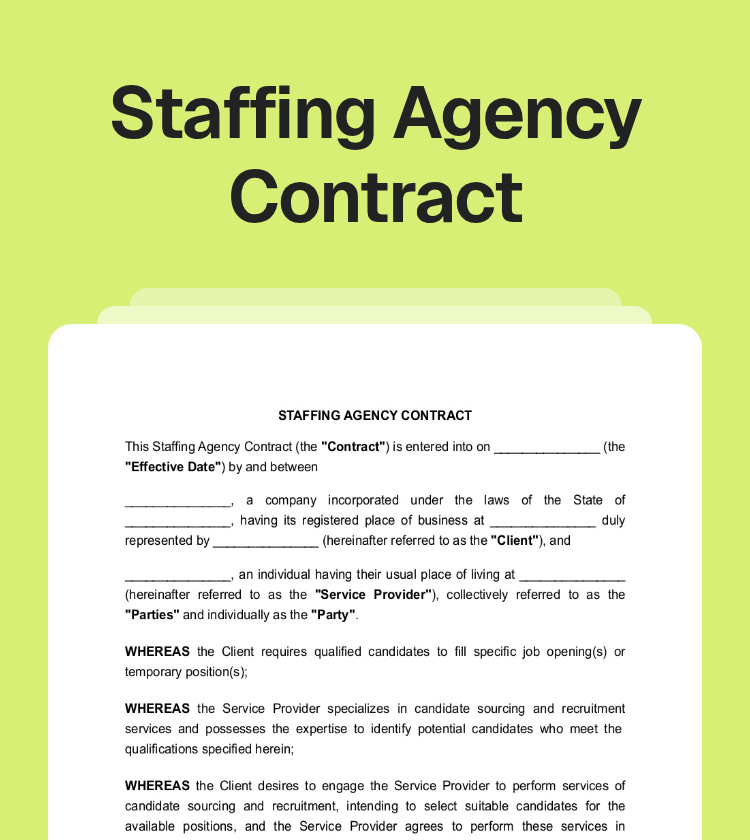
Free Staffing Agency Contract Template

What Is a Staffing Agency Agreement?
Copy section linkA staffing agency agreement is a legally binding contract between a staffing agency and a client company that needs temporary workers. This document is used when the client needs workers for short-term cooperation, like a project, and hires the agency to find and employ them. Meanwhile, the client itself does not serve as an employer.
A standard staffing agency contract template is typically provided by the agency and includes information about the staffing services to be provided. It names the positions to be filled, requirements for workers, payment terms, and liabilities the parties have in terms of the contract.
Things You Should Know Before You Use a Staffing Agency Agreement
Copy section linkUnlike a recruitment agreement designed strictly for hiring permanent, full-time staff, a staffing agency contract is mostly used when a client needs workers for temporary, outsourced, seasonal, or project-based roles. However, the main difference between these two documents is that, according to the staffing agency agreement, the staffing agency is typically the employer of record who hires workers, handles payroll, and pays taxes and benefits.
However, depending on how much control the client exercises over the work, they may be considered a joint employer under certain federal and state laws. In this case, the client also shares the liability with the staffing company. Therefore, it is important to clearly state the responsibilities of both parties in the contract.
If any additional expenses, like a background check or document verification, occur, the contract should specify who covers them: the client or the agency.
Some clauses of the contracts for staffing agencies, like confidentiality, data protection, and non-solicitation, remain valid even after the contract expires. If any party violates its terms, it can be exposed to penalties and lawsuits. Therefore, it is important to discuss the term during which the restrictive terms will be in action and document it in the agreement.
How to Fill Out a Staffing Contract Template
Copy section linkStep 1. Parties identification
Write the date when the staffing agency contract with the client is signed and becomes legally binding.
Add the client and staffing agency’s information: legal company names, corporate addresses, and the governing law under which they operate.
If the client and the agency have authorized representatives, mention their names.
Step 2. Description of the services
Enumerate all the staffing services the agency will perform, such as:
Sourcing applicants;
Reviewing candidate qualifications;
Pre-screening;
Coordinating interviews with candidates;
Managing temporary labor placements.
Clearly frame how many positions are to be filled and name them all. For each position, give a detailed requirements description (hard and soft skills, years of experience, education, etc.). All the requirements should comply with the Fair Labor Standards Act, the Equal Employment Opportunity, and other state and federal laws.
If the client wants to select candidates themselves, mention the number of resumes per position the staffing agency must provide and how much time the client has to review them and give their feedback.
Step 3. Payment terms
Choose the payment option (fixed fee, per candidate, etc.), method (cash, check, or wire transfer), and specify the sum the client should pay to the staffing agency for the services it provides. State whether payment is due before or after services are completed.
Define hourly markup rates, daily bill rates, or overtime multipliers for temporary personnel.
Clarify that the agency handles federal and state income taxes, payroll obligations, and workers' compensation.
Step 4. Background checks
If the client asks for any pre-employment check (background check, drug testing, or academic/credential verification), they will cover all related expenses.
Step 5. Term of the contract
Mention whether the services will be provided until a specific date or until the client selects suitable candidates for the position(s). If the first option applies, set the start date and overall contract expiration date. If the second option applies, mention that the parties must notify each other by written notice and specify the notice period.
Step 6. Insurance requirements
Add information on the type of insurance the service provider should obtain. As it is the staffing agency that hires workers, it should provide workers’ compensation insurance in addition to general and professional liability insurance.
Step 7. Data protection
Add a data protection clause to ensure the parties will not disclose each other’s personal or business data or transfer it to third parties. All the information needed to provide services should be used exclusively to fulfill the terms of the contract.
Step 8. Confidentiality
Add a confidentiality clause that prohibits the parties from disclosing any sensitive information, such as business secrets, agency candidate pools, technical data, or financial terms, to third parties.
Non-disclosure obligations remain valid even after the contract term expires. If any party violates it, it may be penalized.
Step 9. Non-solicitation
Add a non-solicitation clause to ensure the client does not directly hire or poach the agency workers or candidates for a set period (usually 12 months).
Step 10. Force majeure
Explain what the parties should do if catastrophic or unforeseen events (e.g., severe natural disasters, government lockdowns, national emergencies) occur and they cannot fulfill their contractual obligations.
State after how many days of force majeure either party may terminate the agreement without penalties.
Step 11. Governing law
Though the staffing agency and the client may operate in different jurisdictions, they should agree on one jurisdiction where contractual disputes will be settled.
Step 12. Final details
Include the parties’ bank information (bank names, account numbers, and SWIFT/IBAN details for electronic fee settlement), and legal addresses.
Authorized representatives of both parties should add their signatures, handwritten for printed contracts and electronic for digital versions.
Both the agency and the client should sign two copies of the filled-out staffing agency contract template so that every party keeps the original for its protection.
Requirements for this document vary by state. Review your state's laws and procedures — or consult a licensed attorney — before using this template to ensure it's valid and enforceable where you live.
Related documents
Also read