Free template
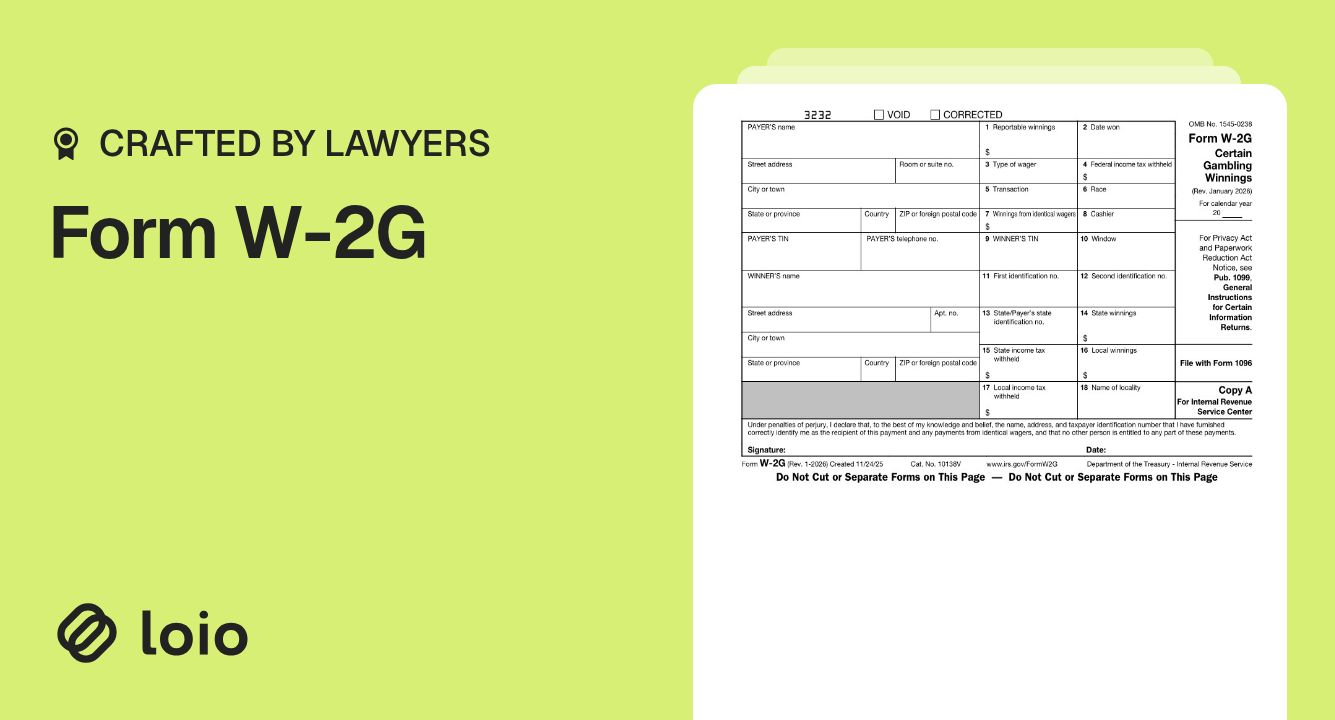
Free Form W-2G
What Is a W-2G Form?
Copy section linkForm W-2G is an official IRS tax document issued by a gambling entity to report certain gambling winnings. If you operate a casino, state lottery, racetrack, or online gambling platform, you are responsible for issuing this form when the winnings (reduced by the wager in certain games) of an individual meet certain reporting thresholds.
Forms W-2G serve two primary purposes:
Create an official record of qualifying gambling income earned by the winner.
Show any federal or state income taxes you withheld from the payout.
What You Should Know Before You Use the W-2G Form
Copy section linkNot every win requires a W-2G. The IRS sets specific dollar thresholds and conditions based on the type of gambling activity. The minimum reporting threshold is $2,000 or more (for the year 2026). This figure is adjusted annually for inflation. To know the actual threshold, check the IRS website.
Depending on the type of gambling, the winnings must meet or exceed these limits:
- Horse racing, dog racing, jai alai: $2,000 and at least 300 times the amount wagered.
- Sweepstakes, wagering pools, lotteries: $2,000 and at least 300 times the amount wagered.
- Bingo & slot machines: $2,000 or more without deducting the wager.
- Keno: $2,000 or more after deducting the price of the winning keno wager on that same keno game.
- Poker tournaments: Net winnings (total winnings minus the wager or buy-in) meeting or exceeding $2,000.
- Sports wagering: $2,000 and at least 300 times the amount wagered.
Payments to nonresident aliens and foreign entities are not reported on Form W-2G. These winnings are generally subject to 30% withholding and are reported on Forms 1042 and 1042-S instead.
Form W-2G reports withholding per winner. The total of gambling withholding and backup withholding should be reported on Form 945.
All winnings, regardless of their size, are taxable. Even if the winner does not receive a copy of Form W-2G, they must still report all gambling income on their tax return (Form 1040).
How to Fill Out a W-2G Form?
Copy section linkThe W-2G Form is filled out and filed by the gambling entity that is referred to as a payer in the document.
A recipient is the individual whose winnings are being reported. They do not fill out the form; they only receive a copy of the completed document.
Step 1: Enter payer & recipient information
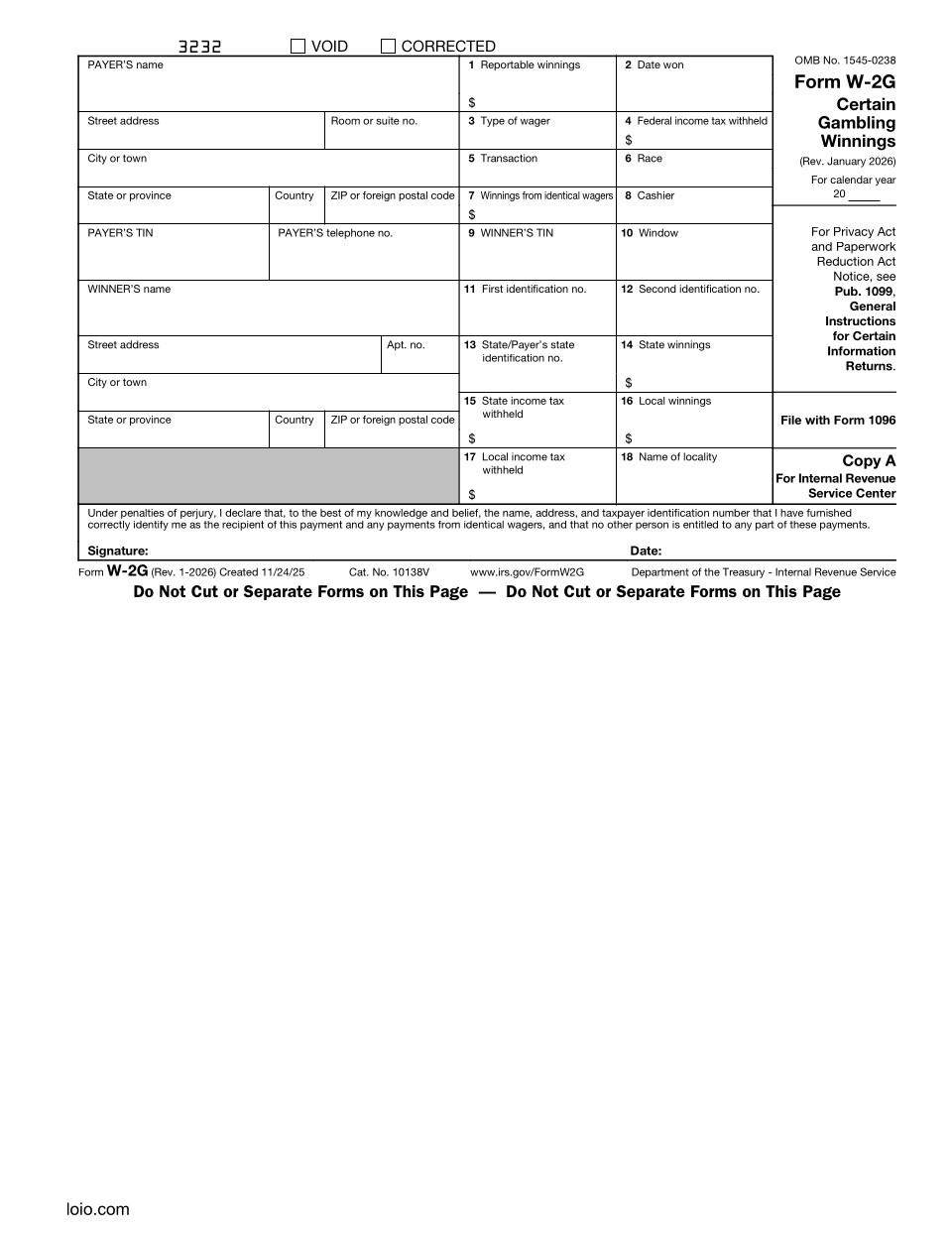
Payer box (top left): Enter the payer’s business name, full address, phone number, and Federal Employer Identification Number (EIN).
Recipient box (bottom left): Add the winner's full name and address.
Box 9 (winner's TIN): Provide the winner's Social Security Number (SSN) or Individual Taxpayer Identification Number (ITIN). If the winner fails or refuses to provide a TIN, apply backup withholding.
If the winner shares the winnings or collects on behalf of others, they must complete and sign Form 5754. The payer uses this document to generate a separate Form W-2G for each individual winner.
Step 2: Enter winnings & transaction details
The IRS gives separate box instructions for each of the five gambling categories:
- Horse racing, dog racing, jai alai, and other wagering transactions;
- Sweepstakes, wagering pools, and lotteries;
- Bingo, keno, and slot machines;
- Poker tournaments;
- Sports wagering.
Before filling in boxes 5–12, identify which category the payout falls under. Several boxes are left blank for some game types.
Box 1 (reportable winnings): Required for all gambling types. Enter the reportable payment amount that meets or exceeds the applicable threshold.
Box 2 (Date won): Required for all gambling types. Add the date of the winning event (e.g., race, drawing, or tournament date). It is not necessarily the payment date if paid later.
Box 3 (Type of wager): Required for all gambling types, but what goes in it differs:
- Racing and jai alai: the wager type, but only if it's not a regular race bet (e.g. "Daily Double" or "Big Triple").
- Sweepstakes, wagering pools, lotteries: the wager type ("raffle", "50-50 drawing") or the lottery name, and the price of the wager.
- Bingo, keno, slots: the game type plus the amount of the wager.
- Poker tournaments: enter "poker tournament".
- Sports wagering: the type of wager or sport bet.
Box 5 (Transaction): Leave blank for categories 1, 5, and 2 (unless it's a state lottery).
- For a state lottery, enter the ticket number or other identifying number.
- For bingo, keno, and slot machines, enter the ticket number, card number (and its color, if applicable), machine serial number, or any other information that helps identify the winning transaction.
- For poker tournaments, enter the name of the tournament and its sponsor.
Box 6 (Race): Used for racing, jai alai, and sports wagering only. Mention the race number or sporting event associated with the winning ticket, where applicable.
Box 7 (Identical wagers): Leave blank for bingo, keno, slots, and poker tournaments. For other categories, enter the amount of additional winnings from identical wagers.
Boxes 8 & 10 (Cashier/Window): For horse/dog racing, jai alai, and other wagering transactions, enter the cashier and/or window number making the winning payment (box 8 or box 10). For bingo, keno, and slot machines, enter the initials of the person paying the winnings in box 8, and the location of that person in box 10, if applicable. Leave both blank for sweepstakes, wagering pools, lotteries, poker tournaments, and sports wagering.
Boxes 11 & 12 (ID verification): You must collect and record information from two forms of ID provided by the winner. For each ID, note the identification number and the state or agency that issued it. Acceptable forms of ID are: a driver's license, passport, Social Security card, military ID card, tribal member ID card from a federally recognized Indian tribe, voter registration card, or a completed unmodified Form W-9. At least one of the two IDs must include a photo of the winner.
- State lotteries: Leave boxes 11 and 12 blank — winners of state-conducted lottery prizes are not required to present identification beyond their TIN.
- Poker tournaments: Two IDs are still recorded, but the accepted forms are limited to a driver's license, Social Security card, or voter registration, and there is no photo requirement.
- Tribal establishments: Gaming establishments owned or licensed by a tribal government may waive the photo requirement for members of that tribe who present a tribal member ID card issued by the same tribal government.
ID verification is not required for every W-2G. It applies to payees who meet the reporting threshold for bingo, keno, and slot machines, and to payees who meet the withholding threshold for horse racing, dog racing, jai alai, sweepstakes, wagering pools, lotteries, sports wagering, and other wagering transactions.
Step 3: Record federal income tax withheld
Copy section linkBox 4 (Federal income tax withheld): Add the total federal income tax withheld:
Regular gambling withholding: 24% of the proceeds (winnings minus the wager), figured on the full proceeds rather than only the amount above $5,000, when the proceeds exceed $5,000 and:
- For sweepstakes, wagering pools, and lotteries — no further condition applies;
- For parimutuel wagers on horse racing, dog racing, and jai alai, for sports wagering, and for other wagering transactions — the winnings are also at least 300 times the amount wagered.
Noncash prizes: Use the fair market value (FMV) of the prize. If FMV minus the wager exceeds $5,000, either the winner pays you the withholding tax (withhold 24% of FMV minus the wager), or you pay it yourself (withhold 31.58% of FMV minus the wager, and enter the sum of the prize and the tax in box 1).
Regular gambling withholding never applies to bingo, keno, slot machines, or poker tournaments. For those games, box 4 holds backup withholding only.
Backup withholding: 24% when the winner does not furnish a correct TIN and regular gambling withholding has not already been applied:
- Horse/dog racing, jai alai, other wagering transactions, sweepstakes, wagering pools, lotteries, sports wagering: applies when the winnings meet or exceed the reporting threshold but are not more than $5,000 and are at least 300 times the wager. Figure it on the winnings, reduced at your option by the amount wagered.
- Bingo, keno, slot machines: applies to winnings meeting or exceeding the reporting threshold, reduced at your option by the amount wagered.
Poker tournaments: If no TIN is furnished, back-withhold 24% of the full amount of the winnings from that tournament. Otherwise, enter $0 if the winner furnishes a TIN and you provide Copies B and C.
Step 4: Complete optional state and local tax information
Boxes 13–18 are filled out for state/local reporting convenience. The IRS does not require them.
Box 13: State abbreviation and payer's state identification number.
Box 14: State winnings.
Box 15: State income tax withheld.
Box 16: Local winnings.
Box 17: Local income tax withheld.
Box 18: Name of the locality.
Step 5: Add the winner’s signature & distribute copies
When regular federal withholding applies to winnings in categories 1 and 5, the winner must sign and date Form W-2G. By signing, they confirm under penalty of perjury that they are the only winner and that all the information on the form is accurate.
Once the document is signed, the copies of the W-2G form are distributed in the following way:
Copy A: Submitted by the payer to the IRS by February 28 for paper forms/ March 31 for online forms.
Copies B & C: Issued by the payer to the winner by January 31 following the calendar year of payment so they can report the income on their federal and state tax returns (Form 1040).
Copy 1: Sent to the state tax department if that department requires a paper copy.
Copy 2: Given to the winner who can use it while filing a state income tax return.
Copy D: Kept by the payer for their own financial and tax records.
This template is intended for general use across all 50 U.S. states+DC. Local procedures — such as notarization, witnessing, or filing requirements — may still apply, so check your state's specific rules before signing.
Related documents
Also read