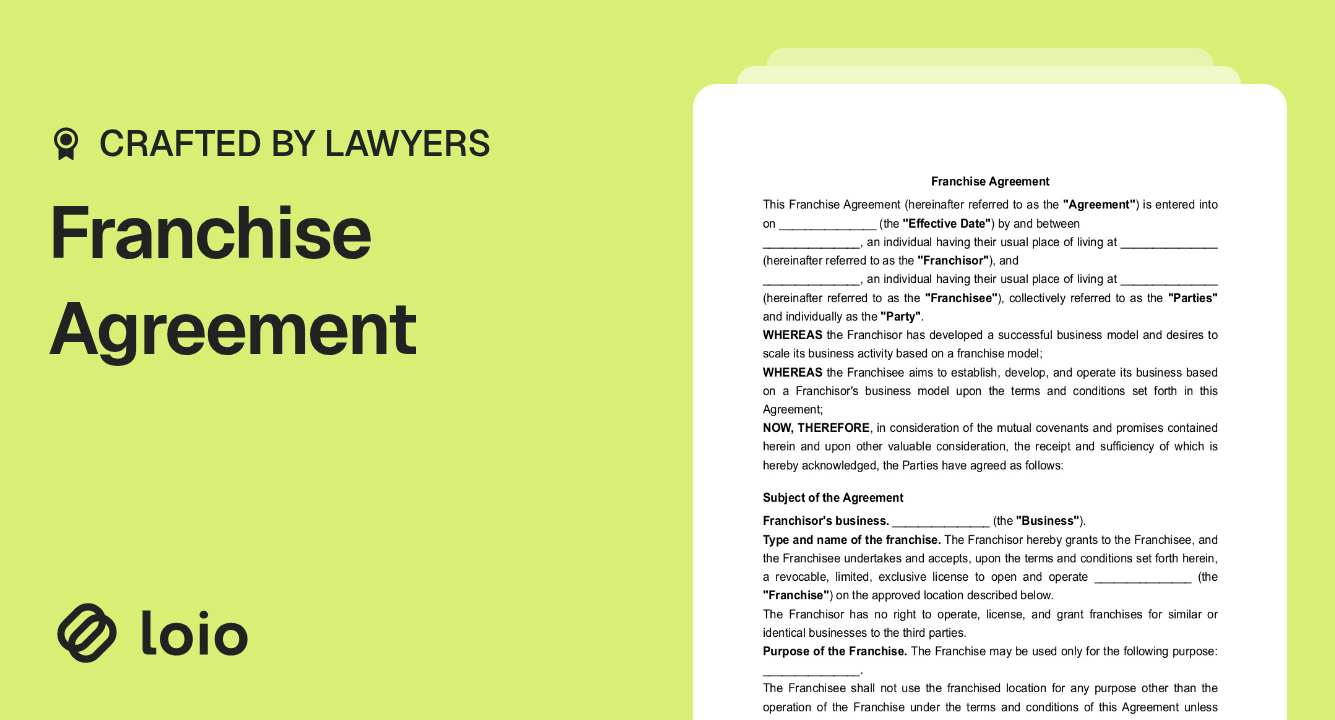
Franchise Agreement Template

4.8 (26 reviews)
All states
Updated Sep 2, 2025
~ 11 pages
PDF
3.9K downloads
A Franchise Agreement is a legal contract between a franchisor and a franchisee that outlines rights to operate a business under an established brand. It is used to define business operations, royalties, and branding terms while protecting both parties.
Franchise Agreement

This Franchise Agreement (hereinafter referred to as the "Agreement") is entered into on   (the "Effective Date") by and between

 , an individual having their usual place of living at   (hereinafter referred to as the "Franchisor"), and

 , an individual having their usual place of living at   (hereinafter referred to as the "Franchisee"), collectively referred to as the "Parties" and individually as the "Party".

WHEREAS the Franchisor has developed a successful business model and desires to scale its business activity based on a franchise model;

WHEREAS the Franchisee aims to establish, develop, and operate its business based on a Franchisor's business model upon the terms and conditions set forth in this Agreement;

NOW, THEREFORE, in consideration of the mutual covenants and promises contained herein and upon other valuable consideration, the receipt and sufficiency of which is hereby acknowledged, the Parties have agreed as follows:

Subject of the Agreement

Franchisor's business.   (the "Business").

Type and name of the franchise. The Franchisor hereby grants to the Franchisee, and the Franchisee undertakes and accepts, upon the terms and conditions set forth herein, a revocable, limited, exclusive license to open and operate   (the "Franchise") on the approved location described below. 

The Franchisor has no right to operate, license, and grant franchises for similar or identical businesses to the third parties.

Purpose of the Franchise. The Franchise may be used only for the following purpose:  

The Franchisee shall not use the franchised location for any purpose other than the operation of the Franchise under the terms and conditions of this Agreement unless otherwise agreed with the Franchisor in writing.

Scope of the Franchise. The Franchisee shall diligently and faithfully operate all aspects of the Franchise, adhering to methods and systems developed and prescribed by the Franchisor. The Franchisee shall make every effort to promote the Franchise.

Franchised location. The Franchisee shall establish and operate as a franchised location (the "Franchised Location") at the following address:  .

Conversion and design. The Franchisee acknowledges that the design, decoration, and color scheme are crucial elements of the Franchise. The Franchisee shall convert, design, and decorate the Franchised Location following the Franchisor's corporate style mentioned in the operational manual, as defined herein.

Operational manual, quality control, and inspections

The Franchisor shall provide the Franchisee with manuals, descriptions, technical guidelines, requirements, standards, specifications, and other materials (the "Operational Manual") that cover all aspects of the Franchise implementation. The Operational Manual shall be provided in the Annex that makes an integral part of the Agreement.

Franchisee's rights and obligations

The Franchisee is entitled to the following rights under this Agreement:

  • Receive all materials, guidelines, instructions, and other information essential for the successful execution of this Agreement;
  • Get the necessary assistance and support from the Franchisor for the successful execution of this Agreement.

The Franchisee has the following obligations, including but not limited to:

  • Operate the Franchise in accordance with the Operational Manual, the terms and conditions of this Agreement, and all applicable laws and regulations;
  • Refrain from advertising or using the logo, name, and trademarks of the Franchisor in advertising or any other form of promotion without the appropriate trademarks and copyright consent or license.


Permits and licenses

Either Party shall obtain and maintain all necessary permits, certifications, and licenses required for the lawful construction and operation of the Franchise. These include but are not limited to health and safety permits, building and other construction permits, business licenses, and sales tax permits.

The Franchisee shall obtain and maintain in full force and effect:

  • Comprehensive general liability insurance with a minimum limit of  .
  • Automobile liability insurance covering all employees of the Franchised Location with authorization to operate a motor vehicle, with a minimum amount of  .
  • Unemployment and worker's compensation insurance.
Intellectual property

The Franchisor owns the following intellectual property:   (the "Intellectual Property Objects").

The Franchisee has the following right(s) related to the Intellectual Property Objects used during the course of carrying on the Franchise: the Intellectual Property Objects solely for the purposes of this Agreement.

The Franchisor retains ownership and reserves all rights, title, interest, and copyright of the Intellectual Property Objects.

The Parties acknowledge that the Franchisor retains all rights not explicitly granted to the Franchisee under this Agreement.

The Franchisee guarantees not to use or register the Intellectual Property Objects and any similar designations or objects alone or as part of the Franchisee's intellectual property anywhere in the world. The Franchisor shall maintain the validity and enforceability of the Intellectual Property Objects, including the timely filing of any necessary renewals. The Franchisee is permitted to use the Intellectual Property Objects only during the valid term of this Franchise.

Franchise registration

The Franchisor shall be responsible for preparing and filing the necessary Franchise disclosure documents in accordance with applicable legal requirements. The Franchisor shall cover all costs related to the preparation, filing, and maintenance of Franchise registration documents and fees unless stated otherwise in this Agreement.

Supply and equipment

The Franchisee shall purchase or otherwise obtain the equipment for use at the Franchised Location and in connection with the Franchise in accordance with the specifications outlined in the Operational Manual. The Franchisor shall provide the Franchisee with an approved suppliers list authorized by the Franchisor for the procurement of ingredients, products, supplies, and materials required to operate the Franchised Location.

Training and assistance

The Franchisor shall perform mandatory and optional training programs to assist the Franchisee in meeting the requirements for recruiting and training the staff as specified in the Operational Manual.

Payment terms

The Franchisee agrees to make payments to Franchisor as outlined in this Agreement. The total amount of all payments shall constitute the price of the Franchise.

Initial fee. The Franchisee agrees to pay the Franchisor an initial fee of   within   days from the Effective Date.

Franchise fee. The Franchisee shall pay the Franchisor the Franchise fee of  . The payment(s) should be made monthly no later than  th day of each month.

Royalties. The Franchisee shall pay the Franchisor  % of the Franchise gross profits (the "Royalties") per year. The payment(s) should be made every year no later than   of each year.

A written report regarding royalty calculation. When the payment of Royalties is due, the Franchisee shall submit to the Franchisor a written statement detailing the calculation of payable and due Royalties. The Franchisee shall keep accurate records and books of account and shall be available at all times for inspection and audit by the Franchisor.

Late payment. If the Franchisee fails to make any payment by the specified due date, the Franchisor shall have the right to charge interest on the overdue amount at a rate of  % per month or the maximum rate allowed by law, whichever is less.

Term and termination

This Agreement shall commence as of the Effective Date and shall be valid for   years. The Agreement may be extended upon prior mutual written consent of the Parties.

Either Party may terminate this Agreement without cause upon providing the other Party with   days prior written notice. This Agreement may be terminated for cause if either Party breaches the terms of this Agreement (the "Default"). In the event of the Default by either Party, the non-breaching Party shall have the right to provide another Party with appropriate written notice (the "Default Notice") with a demand to cure the Default within   days from the date of receiving the notice. If the breaching Party fails to meet the requirements stated in the Default Notice within a specified term, a non-breaching Party shall be entitled to terminate the Agreement unilaterally as of the term specified in the Default Notice.

The Franchisee must cease operating the Franchise, discontinue the use of all Intellectual Property Objects, and return all originals and copies of the Operational Manual.

Upon termination of this Agreement, the Franchisee shall pay the Franchisor all outstanding payments that have become due by the Date of Termination.

The Franchisee shall compensate all fees for the month in which the Agreement has been terminated within   days from the Date of Termination (the "Due Date").

The Royalties should be paid on a pro rata basis as of the Due Date.

Upon the Franchisee's death, incapacity, or bankruptcy, the Agreement shall be automatically terminated within   days from the date of death, incapacity acknowledgment, becoming insolvent or filing for bankruptcy unless otherwise provided by the governing law.

Taxes. Either Party is solely responsible for complying with all applicable tax laws, regulations, and reporting requirements related to the payments under this Agreement.

Assignment of rights. The Franchisee has the right to assign, convey, and transfer all rights, title, interest, and obligations under this Agreement to the third party.

The Franchisee shall not assign or transfer such rights and obligations to any third party without obtaining prior written consent from the Franchisor.

Right to purchase. If the Franchisee proposes to assign the Franchise or any of its assets or ownership interest granted hereunder, the Franchisee shall deliver a written offer or proposal to purchase to the Franchisor (the "Offer") at least   days before the desirable assignment date. The Franchisor shall have the right, exercisable by written notice to the Franchisee, for   days from the date of receiving such document, to purchase the offered assets or interest at the price and under the same terms and conditions outlined in the Offer. If the Franchisor does not exercise this right within   days, the Franchisee shall have the right to complete the transfer to the third parties.

Liability and indemnification

The Franchisee shall be liable for any damages caused to the Franchisor due to negligence or willful misconduct of the Franchisee or any person associated with the Franchisee. The limitation of liability shall apply to the maximum extent permitted by applicable law, covering any damages or liabilities incurred by any cause.

The Franchisee shall indemnify and hold the Franchisor harmless from any demands, claims, damages, or expenses, including reasonable attorney's fees, resulting from the use of the Franchise, except those resulting from the Franchisor's negligence or misconduct. However, if it is found that both the Franchisee and the Franchisor contribute to the claim through fault or negligence, the Franchisor's indemnification obligation shall be reduced by the percentage of fault assigned to the Franchisee.

Notices

All notices required or allowed under this Agreement shall be delivered personally or via certified mail to the address or emails set forth on the signatory page. Either Party may change its registered mail or email address for receipt of notices by giving written notice to the other Party.

Force majeure  

Neither Party shall be liable for any failure to perform or delay in performing the obligations under this Agreement if such failure or delay is caused by events of force majeure, including but not limited to acts of God, war, terrorism, strikes, lockouts, labor disputes, pandemics, epidemics, governmental regulations, or any other similar causes beyond the reasonable control of the affected Party.

In the case of force majeure, the affected Party shall immediately notify the other Party in writing and provide reasonable proof of the cause of the delay or inability to perform the obligations. The Party affected by force majeure shall endeavor to mitigate the consequences of such circumstances and resume the performance of obligations as soon as possible after the circumstances cease to exist.

If the force majeure circumstances last more than   days, either Party may terminate this Agreement by giving written notice to the other Party. In this case, neither Party shall be liable to the other Party for any damages arising from the termination of this Agreement.

Confidentiality

The Parties shall enter into a separate non-disclosing agreement to protect confidential information related to this Agreement.

Governing law and dispute resolution

This Agreement shall be governed by and interpreted in accordance with the laws of the State of  , and any disputes resulting from or related to this Agreement that cannot be resolved by mutual negotiations shall be exclusively resolved by the courts of the State of  .

Miscellaneous 

Severability. If any provision of this Agreement is invalid or unenforceable, the remaining provisions shall still be valid and enforceable.

Entire agreement. This Agreement and Annexes shall make the entire understanding between the Parties concerning the subject matter hereof superseding any prior agreements and communications, both written and oral, regarding such subject matter.

Waiver. The failure of any Party to enforce a particular provision of this Agreement shall not constitute a waiver of their right to enforce that provision in the future.

Amendments. This Agreement may only be modified, or any rights under it waived, by a written document executed by both Parties.

Binding effect. This Agreement shall be binding and inure to the benefit of the Parties and their respective permitted successors and assigns.

Annexes.  All Annexes and exhibits make an integral part of this Agreement.

IN WITNESS WHEREOF, the Parties hereto have executed this Agreement as of the Effective Date.

Details and signatures of the Parties

THE FRANCHISOR

THE FRANCHISEE


 ,  ,  


_____________________

(Place for signature)


 ,  ,  


_____________________

(Place for signature)


Annex A

to the Franchise Agreement signed on  


Operational Manual

Purpose of the Operational Manual. The Operational Manual is designed to standardize and align the operations to the rules of the Franchise, ensuring consistent procedures, maintaining quality standards for products or services, and upholding brand consistency. It outlines the company's policies, procedures, and processes, ensuring safety and efficiency in our daily operations.

Purpose of the Franchise. The Franchise may be used only for the following purpose:  .

The Franchisee shall not use the Franchised Location for any purpose other than the operation of the Franchise under the terms and conditions of this Agreement unless otherwise agreed upon in writing with the Franchisor.

Roles and responsibilities

  • Management and leadership.  .
  • Departmental roles and functions.  .

Operational processes

Legal and compliance

  • Business licenses and permits.  .
  • Regulatory compliance.  .
  • Intellectual property protection.  .

Resources and references

  • Frequently asked questions.  .

List of approved suppliers


This Annex A makes an integral part of the Franchise Agreement executed by the Parties on  .


Details and signatures of the Parties

The Franchisor

The Franchisee

First name and last name:  

Signature: _____________________

First name and last name:  

Signature: _____________________


Written by Karyna Pukaniuk - Reviewed by Kate Adkham

What Is a Franchise Agreement?

Copy section link

A franchise agreement is a legally binding contract between a franchisor (the owner of a brand or business model) and a franchisee (the individual or entity authorized to operate under the franchisor’s brand). It outlines the rights and obligations of each party, including how the franchise operates, what fees are owed, and what standards must be maintained.

This agreement is more than just a formality — it’s the foundation of the franchising relationship. It governs everything from intellectual property use to territorial rights and even how disputes should be resolved.

What are the 4 types of franchise arrangements?

  1. Product Distribution Franchise (e.g., car dealerships).
  2. Business Format Franchise (e.g., fast food chains).
  3. Manufacturing Franchise (e.g., soft drink bottlers).
  4. Management Franchise (e.g., cleaning services or staffing agencies).

When Is a Franchise Agreement Used?

Copy section link

The franchise agreements are used in multiple situations, most commonly when:

  • A new franchisee is opening a location under an existing brand.

  • A current franchisee renews their contract at the end of the original term.

  • Ownership is transferred from one franchisee to another.

  • A franchisee expands into a new territory.

  • There’s a termination or dispute, requiring reference to the original agreement terms.

For example, if someone buys the rights to open a popular fast-food outlet in their city, they'll sign a franchise agreement template that specifies how the restaurant should be operated, how branding is handled, and how royalties are paid.

What Are the Key Elements of a Franchise Agreement?

Copy section link

Every franchise agreement sample includes several essential sections. A solid franchise agreement template should cover:

1. Parties involved

Clearly identifies the franchisor and franchisee, including names, legal business structures, and contact information.

2. Franchise fee & Ongoing payments

This agreement outlines the initial fee, royalty payments, and other potential costs like advertising contributions or software licenses.

Example: A franchisee may pay $30,000 upfront, plus 6% of monthly gross sales as a royalty.

3. Term and renewal

States how long the agreement lasts (typically 5–10 years) and the conditions under which it can be renewed.

4. Territory rights

Defines if the franchisee has exclusive or non-exclusive rights in a specific geographic area.

5. Use of trademarks and intellectual property

Specifies how brand assets (logos, slogans, processes) may be used. These are usually tightly controlled by the franchisor.

6. Training and support

The sample franchise agreement typically outlines the assistance the franchisor will provide, ranging from onboarding to ongoing training and operational support.

7. Operational guidelines

Lays out daily business rules — hours, menu/product standards, software systems, customer service policies, etc.

8. Insurance requirements

Lists the types of insurance the franchisee must carry (e.g., general liability, workers’ comp, property).

9. Termination conditions

Outlines scenarios where the contract may be ended early, such as breach of contract or financial default.

10. Dispute resolution

Details how disagreements will be handled — through mediation, arbitration, or litigation.

How To Fill Out a Franchise Agreement Template

Copy section link

A franchise agreement PDF template can simplify the legal process, especially with a basic step-by-step guide:

  • Start with accurate business info
    Fill in the names, business entities, and contact details of both the franchisor and franchisee.
  • Define the franchise territory
    Be specific about geographic boundaries and exclusivity.
  • Input the financial terms
    Include all fees: initial, royalty, marketing, software, and renewal.
  • Detail operational expectations
    Reference brand manuals or add them as exhibits for clarity.
  • Review renewal and exit clauses
    Ensure the franchisee understands how and when the agreement can be renewed or terminated.
  • Check the legal framework
    Confirm that the agreement complies with state and federal franchise laws.

Use customizable franchise templates that allow you to fill in details, adjust terms, and sign electronically in one place.

What Are the Common Mistakes To Avoid in Franchise Agreements?

Copy section link

Avoiding pitfalls can save thousands of dollars and relationships. Let’s look at some frequent errors:

  1. Overlooking local legal requirements. Franchising laws vary by state.
  2. Failing to define performance benchmarks. Vague standards create room for conflict.
  3. Ignoring intellectual property protections. Weak clauses can damage brand integrity.
  4. Not including a dispute resolution process. When things go wrong, clear steps help resolve issues faster.