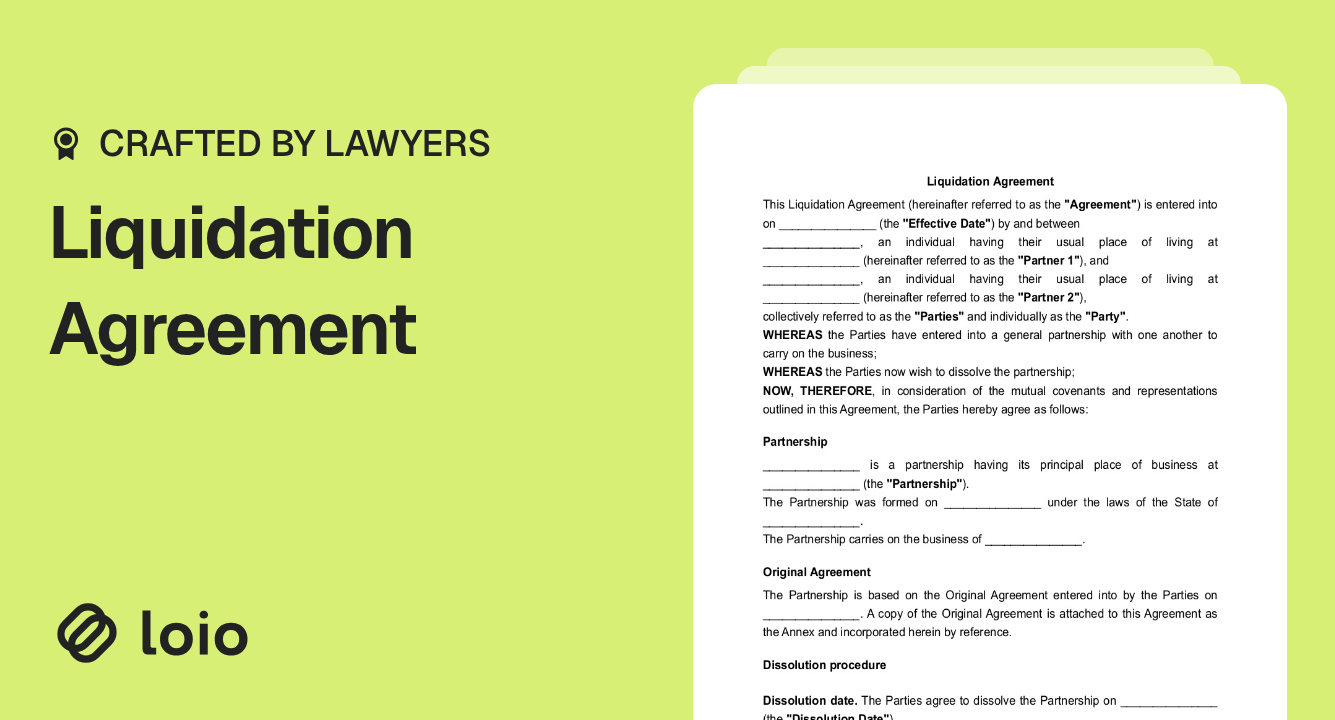
Liquidation Agreement Template

4.7 (42 reviews)
All states
Updated Jan 28, 2025
~ 11 pages
PDF
4.7K downloads
Liquidation Agreement

This Liquidation Agreement (hereinafter referred to as the "Agreement") is entered into on   (the "Effective Date") by and between 

 , an individual having their usual place of living at   (hereinafter referred to as the "Partner 1"), and 

 , an individual having their usual place of living at   (hereinafter referred to as the "Partner 2"), 

collectively referred to as the "Parties" and individually as the "Party"

WHEREAS the Parties have entered into a general partnership with one another to carry on the business;

WHEREAS the Parties now wish to dissolve the partnership;

NOW, THEREFORE, in consideration of the mutual covenants and representations outlined in this Agreement, the Parties hereby agree as follows: 

Partnership 

  is a partnership having its principal place of business at   (the "Partnership"). 

The Partnership was formed on   under the laws of the State of  

The Partnership carries on the business of  

Original Agreement

The Partnership is based on the Original Agreement entered into by the Parties on  . A copy of the Original Agreement is attached to this Agreement as the Annex and incorporated herein by reference. 

Dissolution procedure

Dissolution date. The Parties agree to dissolve the Partnership on   (the "Dissolution Date").

Statement of dissolution. Upon successfully distributing the Partnership assets as provided herein, the partners shall file a statement of dissolution with the responsible authority in the State of   and undertake such other actions that may be necessary to terminate the existence of the Partnership. 

Termination of the Partnership business. After the Dissolution Date, neither Party shall engage in business activities and take any actions on behalf of the Partnership, except actions necessary to conduct the winding-up and liquidation of the Partnership.

Notice of dissolution. The Parties agree to publish notice of such dissolution in a newspaper of general circulation in each place in which the Partnership generally conducts business.  . 

Appointment of the liquidating partner

The Parties appoint   as the liquidating partner. The liquidating partner shall coordinate and be responsible for the procedure of liquidation under the terms and conditions of this Agreement and under State laws and regulations.

Inspection of records

The partners shall have the right, directly or through an authorized representative, at all reasonable times to examine the books and records of the Partnership to establish their rights under this Agreement. 

Liquidation procedure

Assets lists and estimation. The liquidating partner shall compile a comprehensive inventory of all Partnership assets, including but not limited to real estate, personal property, bank accounts, securities, contracts, intellectual property, and any other assets owned or controlled by the Partnership. The Parties with the liquidating partner shall collectively determine the fair market value of each asset listed in the inventory. A final list of assets, including their fair market values and designated owners, shall be prepared and attached as an Annex to this Agreement.

Accounting, settling accounts. The liquidating partner shall provide a statement of account for the Partnership that shall include complete information on inventory, as well as any assets, liabilities, and debts belonging to the Partnership as of the Dissolution Date.

Upon completion of the accounting process, the partners shall pay all of the liabilities of the Partnership, including those owed to the Partners but excluding capital or profits, in accordance with the governing law.

Debt resolution. The Parties shall engage in good-faith negotiations with creditors and other parties to reach mutually acceptable settlements for outstanding debts. Such negotiations may involve payment plans, discounts, or other arrangements.

All outstanding debts of the Partnership shall be resolved following the terms outlined in the Annex to this Agreement. 

The Parties shall use Partnership assets to settle outstanding debts and liabilities. The distribution of assets for debt settlement shall be proportional to each Partner's responsibility for the particular debt. After the agreed-upon settlements are executed and the necessary payments are made, the Parties shall ensure that all obligations associated with the settled debts have been fully discharged.

All amounts remaining after the payment of the specified liabilities shall be distributed between the Parties in accordance with their parts in the Partnership.

Selling of assets. The Parties shall collectively determine whether it is necessary to sell, transfer, or otherwise dispose of any Partnership assets as part of the dissolution process. 

The liquidating partner shall develop a detailed sale plan, including the following information: 

The liquidating partner shall present the proposed sale plan to all partners and request their written consent for the asset sale. The partners shall provide their written consent or objections within   days after receiving the plan. If no consent is received, the Parties shall engage in good-faith negotiations to address objections and reach a mutual agreement. If an agreement cannot be reached, the matter shall be resolved following the conditions outlined in the Dispute resolution clause.

The net proceeds from the sale, transfer, or disposal of assets, after deducting any reasonable expenses incurred in connection with the sale, shall be distributed among the partners according to their ownership interests as outlined in the Original Agreement. 

 .

Closure of offices and notification of employees

Upon dissolution of the Partnership, the Parties shall undertake the orderly closure of any physical office locations associated with the Partnership operations. The planned closure date is as follows: 

Office at   

The closure process shall adhere to all applicable legal requirements, regulatory obligations, and terms outlined in this Agreement.

The Parties shall jointly ensure that all employees affected by the office closures receive written notifications. These notifications shall include information about the Partnership dissolution, the rationale behind the office closures, the anticipated timeline, and any potential implications for employees' positions.

The Parties shall provide affected employees with written notice of the office closures and Partnership dissolution at least   days before the planned closure date. This time frame may be adjusted to comply with legal obligations and practical considerations.

All affected employees shall retain their rights and benefits as defined in employment contracts, agreements, and relevant employment laws. This includes considerations such as severance pay, accrued leave, and the continuation of benefits under applicable regulations.

Warranties

The partners warrant and represent that they have not previously contracted any liability that may be charged to the Partnership or any other partner. The partners also assure that they have not received or discharged any credits, funds, or assets of the Partnership. 

After completion of the liquidation procedure and settlements, the Parties release and discharge each other from any claims, demands, actions, losses, or damages connected to the Partnership. 

Notices 

All notices required under this Agreement shall be sent to the registered mail or email addresses set forth below:

If to Partner 1: Attn.  ,  , email:  , phone number:  

If to Partner 2: Attn.  ,  , email:  , phone number:  

Force majeure

Neither Party shall be liable for any failure to perform or delay in performing the obligations under this Agreement if such failure or delay is caused by events of force majeure, including but not limited to acts of God, war, terrorism, strikes, lockouts, labor disputes, pandemics, epidemics, governmental regulations, or any other similar causes beyond the reasonable control of the affected Party. In the case of force majeure, the affected Party shall immediately notify the other Party in writing and provide reasonable proof of the cause of the delay or inability to perform the obligations. The Party affected by force majeure shall endeavor to mitigate the consequences of such circumstances and resume the performance of obligations as soon as possible after the circumstances cease to exist. 

If the force majeure circumstances last more than   days, either Party may terminate this Agreement by giving written notice to the other Party. In this case, neither Party shall be liable to the other Party for any damages arising from the termination of this Agreement.

Non-competition

Upon the Effective Date, each partner hereby agrees not to directly or indirectly engage in, participate in, or have any interest in any business that is competitive with the business conducted by the dissolved Partnership within the defined territory described below. The non-competition obligations set forth in this clause shall remain in effect for a period of   from the Effective Date. 

During the term of the non-competition obligations, each partner agrees not to:

Confidentiality 

Either Party safeguards and keeps private any exclusive or confidential information shared under this Agreement and during the Parties' cooperation. "Confidential information" means data, shared whether in written, oral, electronic, or other form, related to the Partnership and partners' business, financial affairs, customers, suppliers, products, services, and operations.

Either Party agrees to keep all confidential information received during the course of the liquidation confidential and not to disclose, use, or disseminate such information except as expressly permitted under this Agreement or required by law and authorized official bodies. 

Upon completion of the liquidation, all Parties agree to promptly return or destroy all confidential information, including any copies or reproductions. 

This confidentiality clause remains in effect for   after the termination or expiration of this Agreement.

Indemnification and limitation of liability

Each Partner shall indemnify, defend, and hold harmless the other Partner from any claims, liabilities, losses, damages, costs, and expenses, including reasonable attorneys' fees, resulting from or related to any breach of representations, warranties, or obligations under this Agreement, or any breach of duties associated with the Partnership or its dissolution. 

Notwithstanding any provision to the contrary, neither Party shall be liable to the other Party for any indirect, special, consequential, or punitive damages, whether arising in contract, tort, or otherwise, even if advised of the possibility of such damages. 

The liability of each partner arising out of or in connection with this Liquidation Agreement shall be limited to the amounts received or distributed to each partner in accordance with the terms of this Agreement.

Term and termination

This Agreement shall commence on the Effective Date and shall continue until  , unless terminated earlier under the terms of this Agreement.

Either Party has the right to terminate this Agreement without cause by providing the other Party with   days prior written notice. 


Upon termination of this Agreement, the Parties agree to complete all settlements specified in this Agreement. 

Governing law and dispute resolution

This Agreement will be governed by and construed under the laws of the State of  , except for its conflicts of laws principles. The Parties have the right to engage an independent mediator or arbitration manager for the resolution of disputes resulting from or related to this Agreement. Any disputes that cannot be resolved by negotiations and mutual agreement between the Parties shall be resolved by courts of the State of  .

Miscellaneous 

Severability. The invalidity or unenforceability of any provision of this Agreement shall not affect the validity or enforceability of any other provision of this Agreement.

Entire agreement. This Agreement is the complete and exclusive understanding between the Parties with respect to the subject matter hereof, superseding any prior agreements and communications, both written and oral, regarding such subject matter. Neither Party may assign this Agreement or any of its rights or obligations hereunder without the prior written consent of the other Party, which consent shall not be unreasonably withheld.

Waiver. The failure of any party to enforce a particular provision of this Agreement shall not constitute a waiver of their right to enforce that provision in the future. 

Amendments. This Agreement may only be modified, or any rights under it waived, by a written document signed by both Parties.

Binding effect. This Agreement shall be binding and inure to the benefit of the Parties and their respective successors and assigns. 

Annexes. All Annexes and exhibits are integral parts of this Agreement. 

IN WITNESS WHEREOF, the Parties have signed this Agreement as of the Effective Date.

Details and signatures of the Parties

THE PARTNER 1

THE PARTNER 2


 , USA

Phone number:  

Email:  


_________________________
(Place for signature)


 , USA

Phone number:  

Email:  

 _________________________
(Place for signature)


Annex B 

to the Liquidation Agreement signed on  


List of assets


Number 

Title of asset

Description 

Estimated market value

Comments 

1


2


3


This Annex is an integral part of the Liquidation Agreement signed between the Parties on  

Annex C

to the Liquidation Agreement signed on  

List of creditors and debts

According to the present Agreement, the identified debts of the Partnership include: 

  •  :  .

This Annex is an integral part of the Liquidation Agreement signed between the Parties on  

Written by Megan Thompson - Reviewed by Kate Adkham

Template Description

Copy section link
Paper titled "Liquidation Agreement"; woman bringing folders to the desk

Liquidation examples refer to the process of businesses closing down and converting all remaining assets into cash. Businesses go into liquidation for several reasons, usually when a company is in debt and cannot pay outstanding obligations. This is known as insolvency. Although rare, solvent companies can also enter into liquidation voluntarily.  

Regardless of the reason, organizations must define the liquidation process and appoint a liquidating partner to go through the necessary legal steps. This is done in a liquidation agreement. Here, you will find a downloadable liquidating agreement template and step-by-step instructions for completing the template quickly and easily.

What Is a Liquidation Agreement?

Copy section link

A liquidation agreement, also known as a partnership termination agreement, is a contract negotiated as part of a settlement between two or more business partners, usually when dissolving a business. This document details the liquidation process and what debts the converted assets will cover.

Insight

Liquidating agreement templates may cover three basic elements

  1. The imposition of liability upon the general contractor for the subcontractor’s increased costs, thereby providing the general contractor with a ground for legal action against the owner; 
  2. A liquidation of liability in the amount of the general contractor’s recovery against the owner; and
  3. A provision that provides for the “pass-through” of that recovery to the subcontractor.

Parties of the Liquidation Agreement

A liquidation agreement concerns two or more business partners who have agreed to dissolve their business. As such, the document will be signed by two or more parties, all of which being the business partners.

Key Terms

When two or more business partners want to end their joint venture, they initiate the process by signing a liquidation agreement. An agreement template can be filled out, downloaded as a PDF, and signed as is or modified to add terms that are unique to the business. Though one agreement may differ from the rest, the liquidation form format includes the following key terms:

  • Joint venture or partnership — The joint venture or partnership that is being liquidated needs to be clearly defined in the agreement.
  • Inventory — A major component of the liquidation process is counting all the assets and liabilities of the business. All inventory should be accounted for and included in the liquidation agreement.
  • Liquidation process — The parties will need to agree on the method of liquidation for all remaining assets.
  • Liquidating partner — One partner should be appointed to carry out all the liquidation activities.
  • Prior agreements — Provided that the parties had a liquidation clause in their initial contract, a liquidation agreement will override it. 

What Should Be Included in a Liquidation Agreement?

Copy section link

A comprehensive liquidation agreement sample will include all required sections of the contract, ensuring that it will be legally binding. The information that the parties will need to input before downloading and printing the PDF form includes:

  • Partnership description: The first section of the liquidation form template is for the information about the joint venture. Include the names of both businesses or all partners and define the partnership, which is especially crucial if the parties are involved in several agreements. Also include the end date of the partnership agreement.
  • Statement of dissolution: This section of the liquidating agreement template defines the dissolution process. The standard process requires the parties to file a dissolution with the Department of Treasury and the county clerk’s office for every county in which the business routinely operates. The statement also explains the process for releasing the news to the public.
  • Liquidation information: Include detailed information on the business liquidation, including the process for appointing an accountant and a liquidation partner. This section of the liquidation contract will also describe how the proceeds will be used to pay off any outstanding debt from the partnership.
  • Governing laws: This section on the form outlines under what laws the liquidation agreement shall be governed. This depends on the jurisdiction in which the other legal proceedings for dissolving the partnership are being conducted. Regulations vary by state, but it is important to file documents for all proceedings with the same court.
  • Party information: The final section of the form contains the names, addresses, and contact information for all parties involved in the liquidation agreement. The parties must sign and date the agreement to make it a legally binding contract. The liquidation process will commence after signing.

How To Write a Liquidation Contract

Copy section link

Writing a blank liquidation agreement might seem daunting, especially when dealing with other aspects of dissolving a business. If you’re struggling to know where to start, our liquidation form template can be used to keep things simple. Below is a step-by-step guide for using a printable liquidation agreement sample to create a legal contract.

For Business Partners

  1. Mention all the relevant details. Using a liquidation contract template, mention each party that is entering into the agreement by name. Write all the relevant details of the joint venture or partnership that is ending. That is especially important if there are more partnerships between the parties in existence. Also specify the closing date.

  2. Detail the liquidation process. Begin by choosing the method for taking inventory and selecting a liquidation partner who will be in charge of the process. There should be a specific process for the upcoming liquidation, including how the remaining assets will be liquidated, etc. Similarly, the agreement should specify how the parties will distribute any remaining debt among themselves. 

  3. Check compliance with state law. The laws of your state may differ from those of others. Therefore, research your state laws and make sure that the agreement you have drafted is legally binding.

When Should a Liquidation Contract Be Used?

Copy section link

A liquidation agreement template can be used when dissolving any business. Business partners can voluntarily dissolve a company. Partners may be forced into dissolution due to failure to file or pay annual taxes or other issues. Dissolution of business partnerships can also arise due to bankruptcy.

Regardless of the reason for terminating the business, it is essential to define the terms of liquidation. These dictate who will be appointed as the liquidating partner and outline the entire liquidation process. Any proceeds from liquidated assets are typically used to resolve outstanding business debts.

Insight

Sometimes, the original business partnership contract stipulates liquidation terms. In that case, a liquidation agreement is unnecessary — the rights and responsibilities are already made clear. However, the parties will need to complete a contract liquidation form if these terms were not included in the original contract.

Common Use Cases

A liquidation agreement template may be needed in the following cases:

  • Partners have decided to end a joint venture;
  • One partner has decided to exit a joint venture.
Warning

It is important to note that a liquidation contract doesn’t formally terminate a joint venture or business partnership, nor does it remove the company from the business register. Rather, it is part of the settlement process for the business. It ensures that, after the sale and purchase of remaining assets, things are settled fairly between the parties to help avoid disputes. Debts are then paid off, and the business can officially close its doors.

When Not To Use a Liquidation Contract

A liquidation agreement template is not always appropriate, such as in the following case only:

If a clause about liquidation was included in the original contract and no business partner wants to dispute it.

Check the laws in your state to make sure the contract will be enforceable. As the law may vary from state to state, the language used is a crucial part of the agreement. Consider the following chapters of the 2024 US Code:

  • Title 11 Bankruptcy 

  • Chapter 7 Liquidation

  • Chapter 11 Reorganization

Small business owners prefer Chapter 11 to Chapter 7, specifically to avoid asset liquidation. While Chapter 7 filings normally stipulate a complete shutdown of the business and a selloff of all assets in order to repay the debt, the purpose of Chapter 11 is to maintain business operations and repay the debt over time. 

Liquidation Agreement Preview