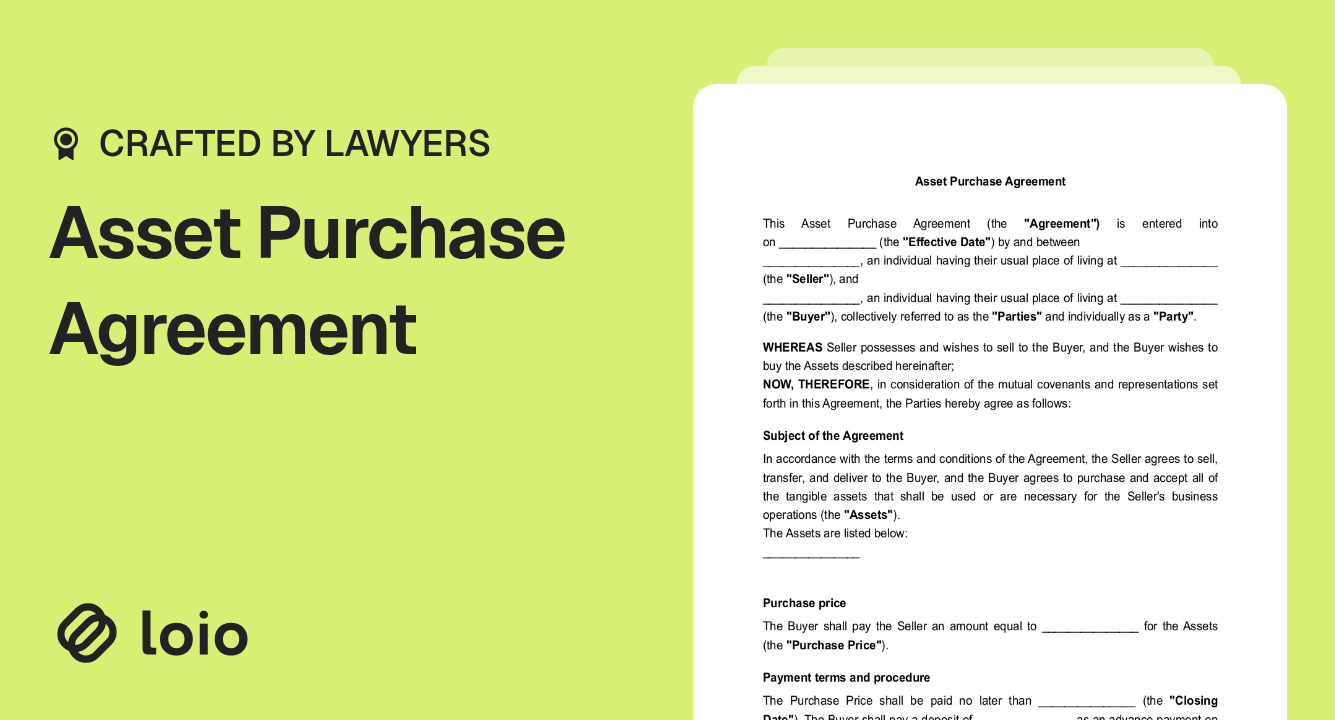
Asset Purchase Agreement Template

4.8 (8 reviews)
All states | 7 types
Updated May 11, 2024
~ 8 pages
PDF
3.9K downloads
An Asset Purchase Agreement is a legal contract between a buyer and a seller detailing the sale of specific business assets. It is used to transfer ownership of selected items rather than the entire business entity.
Asset Purchase Agreement


This Asset Purchase Agreement (the "Agreement") is entered into on   (the "Effective Date") by and between 

 , an individual having their usual place of living at   (the "Seller"), and 

 , an individual having their usual place of living at   (the "Buyer"), collectively referred to as the "Parties" and individually as a "Party"


WHEREAS Seller possesses and wishes to sell to the Buyer, and the Buyer wishes to buy the Assets described hereinafter;

NOW, THEREFORE, in consideration of the mutual covenants and representations set forth in this Agreement, the Parties hereby agree as follows: 

Subject of the Agreement

In accordance with the terms and conditions of the Agreement, the Seller agrees to sell, transfer, and deliver to the Buyer, and the Buyer agrees to purchase and accept all of the tangible assets that shall be used or are necessary for the Seller's business operations (the "Assets").

The Assets are listed below: 


Purchase price

The Buyer shall pay the Seller an amount equal to   for the Assets (the "Purchase Price").

Payment terms and procedure

The Purchase Price shall be paid no later than   (the "Closing Date"). The Buyer shall pay a deposit of   as an advance payment on the future transaction (the "Deposit"). The Deposit should be delivered  no later than  . The Deposit is refundable

The refundable Deposit should be returned to Buyer within   days after the Closing Date.

Payment method

The Parties have agreed that all payments should be made by cash.

Seller's representations

The Seller represents and warrants that: 

• The Seller has full power to enter into this Agreement with all annexes and exhibits, if any, to perform their obligations under this Agreement and carry out the transaction. This Agreement will be legal and binding for the Seller. 

• The Seller is a legal owner of the Assets and has all rights, title, and interest to the Assets. The execution of this Agreement and the consummation of the transaction contemplated herein do not conflict with or violate any provisions or create a breach of any agreement to which the Seller is a party. 

• All Assets are adequately insured, and the Seller will provide the Buyer with a valid insurance policy before the Closing Date.

• The Seller has paid or will pay all necessary taxes before the Closing Date.

• There is no claim, action, suit, proceeding, or investigation pending or, to the knowledge of the Seller, threatened, against, or involving the Seller or one or more of its subsidiaries that questions the validity of this Agreement or seeks to prohibit, enjoin, or otherwise challenge the transactions contemplated. 

• The Seller has disclosed to the Buyer all information concerning the Assets and has not failed to disclose any information known to the Seller regarding the Assets that, if known to a reasonable purchaser, would materially affect or alter the decisions of such purchaser with respect to the transactions contemplated herein. 

Inspection

The Buyer shall have the opportunity to make a satisfactory inspection of the Assets to determine if they are in good condition at the Closing Date. 

Transfer of assets and title (the Seller's covenants to the Buyer)

The Seller promises, covenants, and agrees as follows:

• The Seller shall make all commercially reasonable efforts to complete the transfer as quickly as possible, but not later than  .

• The Seller has and will deliver to the Buyer at the Closing Date good and marketable title to all Assets to be transferred under this Agreement, free and clear of and from any claims, liens, encumbrances, security interest, or liabilities. The Seller shall maintain the Assets in good working condition at the Closing Date.

Indemnification

The Seller shall hold harmless and indemnify the Buyer against any claims, losses, damages, liabilities, and expenses, including, without limitation, settlement, legal, accounting, and other expenses in connection therewith (collectively the "Damages"), incurred by the Buyer in connection with any breach of any representation, warranty, or covenant made by the Seller under this Agreement. 

The Buyer shall hold harmless and indemnify the Seller against any claims, losses, damages, liabilities, and expenses, including, without limitation, settlement, legal, accounting, and other expenses in connection therewith (collectively, the "Damages"), incurred by the Seller in connection with any breach of any representation, warranty, or covenant made by the Buyer under this Agreement

Access to information

The Seller shall, before the Closing Date, disclose to the Buyer all information concerning the Assets and any other data that, if known to a reasonable purchaser, would materially affect or alter the decisions of such purchaser with respect to the transfer of Assets under this Agreement. 

The Seller shall provide the Buyer and the Buyer's representatives access to all books and records related to the Assets, and the Seller shall furnish to the Buyer such financial information and other data as requested for completion of the Buyer's investigation of the Assets. 

The Seller shall provide to the Buyer on or before the Closing Date all of their billing records, the records related to customer accounts, and other records required by the Buyer. 

If the Buyer needs additional administrative, training, or similar support following the Closing Date, the Buyer may engage the Seller for such services under the terms and conditions mutually agreeable to each Party in a separate agreement. 

Additional terms 

For a period of   following the Closing Date, the Seller shall not directly or indirectly induce, or attempt to induce, any customer to cancel, diminish, decrease, or curtail any business relationship, contractual or otherwise, with the Buyer or contact, solicit, induce, or attempt to induce or influence any employee, independent contractor, or agent of the Buyer to terminate their employment, engagement, or contractual relationship with the Buyer. 

Costs and expenses 

Each Party agrees to pay all reasonable costs and expenses connected with the preparation and execution of this Agreement, including but not limited to due diligence, escrow agent and consultant fees, insurance, legal expenses, attorney fees, etc. 

Confidentiality

The "Confidential Information" shall mean any information that is disclosed by one Party (hereinafter the "Discloser") to the other (hereinafter the "Recipient") in connection with the Agreement which is conveyed in written, graphic, machine-readable, or other tangible form and marked "confidential," "proprietary," or in some other manner to indicate its confidential nature. This Confidential Information shall include, without limitation, trade secrets, financial information, sales and marketing plans and business information, know-how, inventions, techniques, processes, algorithms, software programs, semiconductor designs, schematics, designs, contacts, customer lists, etc. 

The Recipient agrees that during the term of this Agreement and   thereafter, not to disclose, use, or disseminate any Confidential Information that the Recipient has received from the Discloser to any person, corporation, association, or other entity for any purpose not expressly permitted (e.g., subcontracting) or required under this Agreement and without obtaining the Discloser's prior written consent on a case-by-case basis. 

Force majeure

Force majeure means earthquake, flood, storm, other acts of God, war, emergency, accident, industrial strike, acts of Government, or other impediment that the affected Party proves was beyond their control and that they could not reasonably be expected to have taken the impediment into account at the time of the conclusion of this Agreement or have avoided or overcome it or its consequences. 

The Party affected by force majeure shall not be deemed to be in breach of this Agreement or otherwise be liable to the other because of any delay in performance or the non-performance of any of the obligations under this Agreement to the extent that the delay or non-performance is due to any force majeure of which they have notified the other Party as agreed hereinafter. The time for the performance of that obligation shall be extended accordingly. If any force majeure occurs with either Party which affects or is likely to affect the performance of any obligations under this Agreement, the affected Party shall notify the other Party within a reasonable time as to the nature and extent of the circumstances in question and their effect on their ability to perform. 

Notices 

All notices to the Parties required or otherwise given under the Agreement shall be delivered to the addresses set forth below:

If to the Seller: 

 ,

 , USA


If to the Buyer: 

 ,

 , USA 


Governing law and dispute resolution

This Agreement will be governed by and construed in accordance with the laws of the State of  , except for its conflict of laws principles.

Any action or proceeding arising out of or relating to this Agreement or its breach shall be brought exclusively in the courts located in the State of  . The Parties hereby submit to the jurisdiction of such courts and waive any objection to venue in such courts.

Miscellaneous

Severability. If and to the extent of any provision of this Agreement is held illegal, invalid, or unenforceable in whole or in part under applicable law, such provision or such portion thereof will be ineffective as to the jurisdiction in which it is illegal, invalid, or unenforceable to the extent of its illegality, invalidity, or unenforceability. The illegality, invalidity, or unenforceability of such a provision in that jurisdiction will not affect the legality, validity, or enforceability of such a provision or any other provision of this Agreement in any other jurisdiction.

Binding character. This Agreement shall be binding and shall inure to the benefit of the Parties and their respective permitted successors and assigns.

Amendments. This Agreement is the complete and exclusive understanding between the Parties with respect to the subject matter hereof, superseding any prior agreements and communications, both written and oral, regarding such subject matter. This Agreement may only be modified, or any rights under it waived, by a written document executed by both Parties.

IN WITNESS WHEREOF, the Parties have executed this Agreement as of the Effective Date.

THE SELLER

THE BUYER

 ,

 , USA


______________________

(Place for signature)


 ,

 , USA 


______________________

(Place for signature)


Written by Karyna Pukaniuk - Reviewed by Kate Adkham

Template Description

Copy section link
Paper titled "Asset Purchase Agreement"; woman and man shaking hands; diagrams, tables, desk

This asset purchase agreement template is meant to serve as a guide through the purchase or sale of an asset. The template will include space to add the parties to the agreement and will use standard key terms. When purchasing or selling an asset, it helps to know when you should use this type of legal document and when it may be better to use something else.

What Is an Asset Purchase Agreement?

Copy section link

An asset purchase agreement is an agreement between two parties that finalizes the sale and purchase of a business or its asset or assets. Some common examples of these assets include machinery, equipment, intellectual property, and licenses. The asset purchase agreement covers all the details of the asset and its sale, including the price, warranties and guarantees, risk assessment, and more. The agreement also serves to transfer the ownership of the asset from one individual or firm to another.

One common misconception is that it is necessary to buy all the assets associated with a business. However, one purchaser is not required to purchase all of a business’s assets or liabilities under an asset purchase agreement. An interested party can select one or more assets to transfer ownership. 

Parties of the Asset Purchase Agreement

The parties of the asset purchase agreement are the buyer and the seller.

  • The seller is usually the individual or company that is selling its assets. The asset can be the business as a whole, or it can be just parts of the business, such as machinery, equipment, or intellectual property. 

  • The buyer is the individual or company that is interested in purchasing the business or its parts, which will be detailed in the asset purchase agreement.

The parties of the asset purchase agreement must come to a consensus regarding its terms and conditions. They will determine a suitable price and a payment schedule, if applicable. It is up to the seller to disclose all relevant information about the asset to allow the buyer to make an informed decision. Either party can seek legal counsel to help find and use the most optimal terms for the contract and to help ensure compliance with state law.

Key Terms

The following are the most common terms included in an asset purchase agreement:

  1. Asset — The document must include a detailed description of the asset that is the subject of the agreement.

  2. Price — The price of the asset is the amount that the buyer has agreed to pay for the purchase.

  3. Warranties — If either the seller or the buyer is making warranties to the other party, the details of the warranties should be included in the contract.

  4. Breach — The document should contain details about what constitutes a breach, as well as any repercussions for breaching the contract.

  5. Party information — The agreement will include relevant information for both parties, such as their names, addresses, and contact details.

What Is Included in an Asset Purchase Agreement?

Copy section link

Though contracts may differ from one individual or business to another, a classic asset purchase agreement template contains many of the same elements. The document should include details about the parties entering into the agreement, such as their full names and contact information. There also needs to be a description of the assets that are being sold, as well as any warranties. After the description should be the agreed price with payment details. Another essential part of the contract is the terms and conditions and an explanation of what would constitute a breach and the related repercussions.

Advantages and Disadvantages of an Asset Purchase Agreement

Copy section link

As with any agreement, an asset purchase agreement serves to protect both parties’ interests and allow the transaction to take place securely. Notably, there are some advantages and disadvantages of using an asset purchase agreement.

Advantages

Some of the advances of using an asset purchase agreement include: 

  • Protection — An asset purchase agreement can protect both parties involved in the transaction. The terms and conditions of the contract help to ensure that the seller can perform the sale at the selected rate and that the buyer will get exactly what is expected for the purchase price.

  • Specific asset acquisition — Instead of purchasing a whole business and/or all of its assets, a buyer can pick and choose which assets to purchase and include in the agreement.

  • Limited liability — Using an asset purchase agreement form, a buyer can decrease the risk associated with certain purchases by only assuming liability over the assets that are part of the agreement.
Disadvantages

An asset purchase agreement does have certain disadvantages, including:

  • Incomplete business acquisition — An asset purchase agreement is most commonly used for the sale and purchase of individual assets related to a business. Purchasers who wish to buy other aspects of the business, such as licenses and contracts, may need to prepare additional agreements.

  • Seller limitations — An asset purchase agreement form may carry some limitations for the seller. If the idea is to sell all of a business’s assets and liabilities, this type of contract might not be sufficient.

  • Liability risks — Even after conducting a thorough risk assessment, some liabilities may not become apparent until after the agreement has been signed.

How To Write an Asset Purchase Agreement

Copy section link

Though each contract will be a little bit different, you can follow an asset purchase agreement template when writing your contract. The steps below can help you to get started.

1. Acquire the Document

Start modifying this asset purchase agreement template on Loio. Our template-oriented questions will help you draft the final version of the document and include all crucial information. 

2. Record the Date of the Agreement

Add the date on which the asset purchase agreement will be signed. That will help to clearly define the timeline.

3. Name the Parties

In the designated space provided in the asset purchase agreement template, add the names and contact information for both parties that are entering into the agreement — the buyer and the seller.

4. Indicate the Assets

Identify the asset or assets that are the subject of the asset purchase agreement. Describe those assets in detail, including quantities, identifying information, and any other relevant information.

5. Establish the Price and the Deposit

Include in the asset purchase agreement the price of the asset or assets being transferred. If there will be a deposit made, state the amount and conditions as well. The more details the parties include in the contract, the better legal protection the contract can offer.

6. Set the Payment Conditions

Describe how the sale will be executed by way of the payment conditions in the asset purchase agreement form. Generally, the buyer and seller can agree to one lump sum payment or multiple installments. Either way, include a calendar with the payment amounts and due dates.

7. Discuss the Financial Status of the Sale

Cover in the contract how any potential expenses will be handled after signing. An asset purchase agreement template will contain a clause relating to the allocation of taxes and liabilities associated with the sale. Be sure to specify which party will be liable.

8. Present the Purchase to All Third Parties for Approval

Include any third parties if the asset purchase agreement template needs their approval to go into effect. Be sure to add a clause specifying which consents are required. Then send the contract to those people for them to review.

9. Document the Costs

Record in the asset purchase agreement all the costs associated with the transaction. Be sure to allocate those costs to either the buyer or the seller.

10. Include Mediation and Arbitration Terms as a Precaution

Add a clause to the asset purchase agreement about dispute resolution. Specify how the parties would solve any potential conflicts that may arise regarding the transaction.

11. Mention the Governing Law of the Agreement

Specify the jurisdiction in which the asset purchase agreement is being made. Should the contract ever need to be viewed in the court of law, knowing the applicable jurisdiction in advance can be very helpful.

12. Review the Content Outlining the Sale

Go through the entire asset purchase agreement document to ensure that the terms and conditions align with the requests and iterations made by both parties. Additionally, be sure to include all relevant terms and warranties in the asset purchase agreement.

13. Provide Evidence of the Buyer’s Approval

Add evidence of the buyer’s approval, which is usually the signature at the bottom of the asset purchase agreement. It is vital for the buyer to acknowledge the asset purchase agreement and sign the document for it to become effective.

When To Use an Asset Purchase Agreement

Copy section link

An asset purchase agreement can be very beneficial in some situations and entirely unnecessary in others. Buyers and sellers often use asset purchase agreement templates to document the acquisition of resources when the parties of the agreement want more control and flexibility. A buyer may only want to purchase certain licenses or machinery, not the whole business with all of its liabilities. A buyer can include the agreement as part of a bigger business deal, or treat it as a standalone document. 

Common Use Cases

Some of the most common uses of an asset purchase agreement include:

  1. Business/asset acquisition — Asset purchase agreements are often used for flexible asset acquisition. When a buyer wants to acquire a company’s asset or assets without its liabilities, the parties generally use this type of agreement.

  2. Asset transfer — An asset purchase agreement form can simply facilitate the transfer of an asset from one entity to another. The document becomes a legal record attached to the sale of an asset.

When Not To Use the Asset Purchase Agreement

An asset purchase agreement isn’t always needed. Specifically, if one party wants to buy the whole business and everything that goes with it, a different type of contract may be required. Additionally, another type of contract may be needed for two companies to merge and/or consolidate their operations.