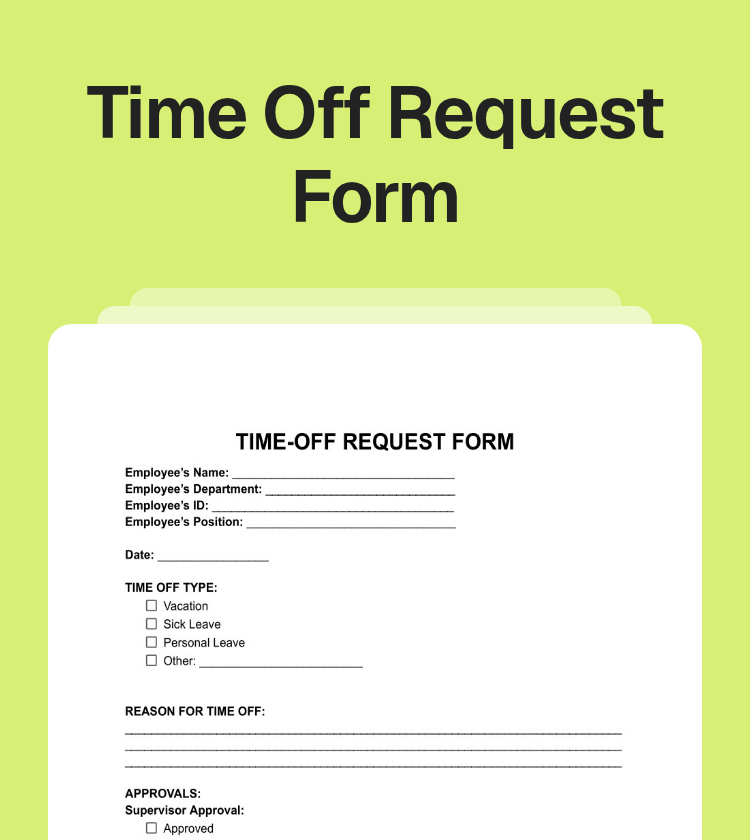
Free Time Off Request Form Template

Free template

4.7 (98 reviews)
All states
Updated Jul 17, 2026
~ 2 pages
PDF
7.5K downloads
A time off request form is a workplace document between an employee and an employer requesting approval for leave dates. It is used to track absences and maintain clear communication about scheduling and workload planning.
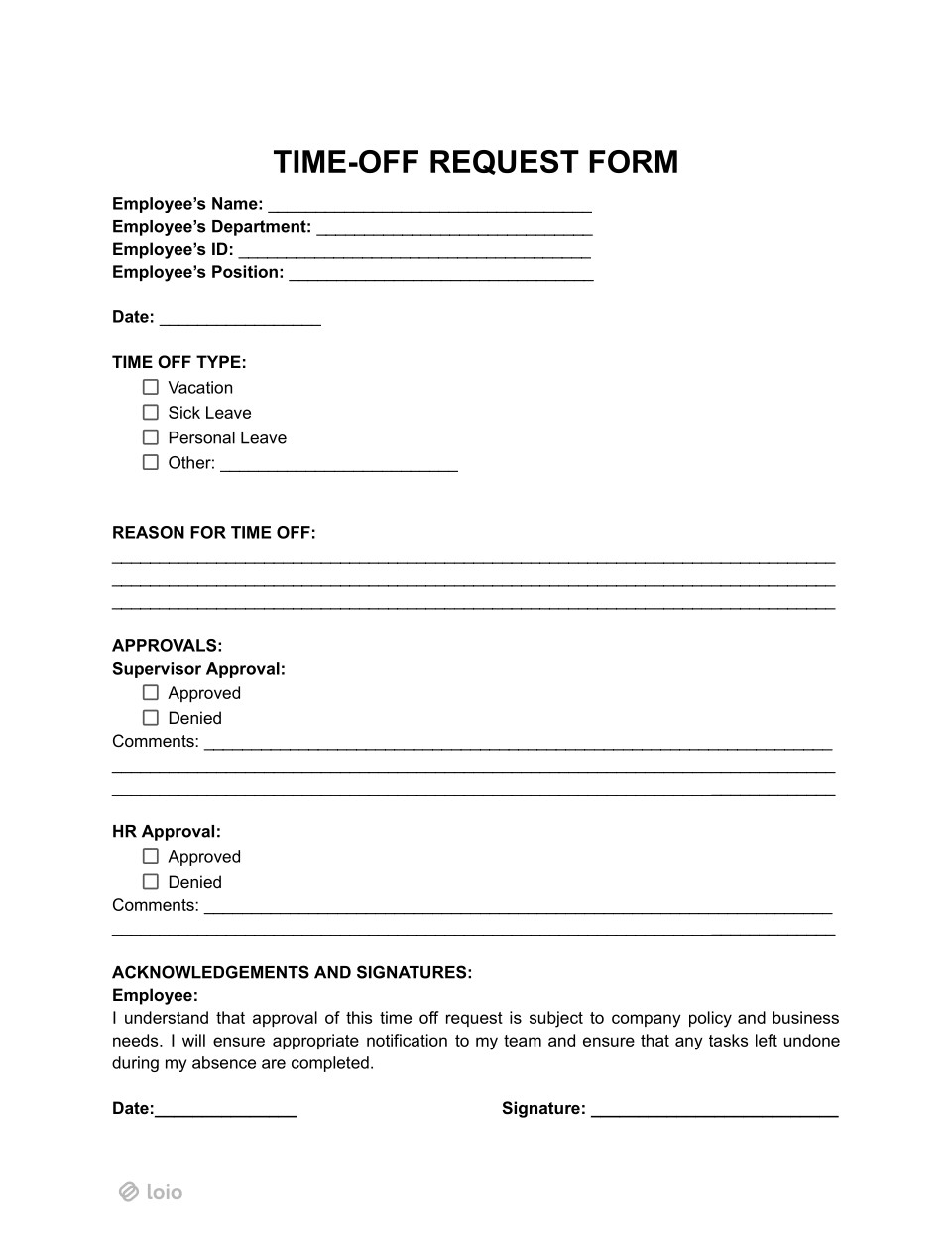
Time Off Request Form Page 1
Preview
Written by Megan Thompson, LLB - Reviewed by Kate Adkham, LLB

What Is a Time Off Request Form?

Copy section link

A time off request form is a short document that an employee submits to ask their employer for approved time away from work. It records the requested dates, the type of leave: vacation, sick leave, unpaid leave, or another category, and the reason, providing the manager and HR with a clear basis for approval.

A time off request form template gives employees and HR teams a consistent format to work from, so every request includes the same essential details. The same document is sometimes called a day off request form, a vacation request form template, or simply a request time off form, depending on the company and the type of leave being requested.

This form does not replace a company's formal leave policy or legal entitlements, such as those under the Family and Medical Leave Act. Instead, it's the practical tool an employee uses to act on those entitlements — requesting and documenting a specific absence so the employer can plan around it and keep an accurate record.

When to Use a Time Off Request Form?

Copy section link

Use a time off request template when:

  • You're planning a vacation and want time approved and scheduled in advance. Many companies use employee vacation request forms specifically for this purpose, separate from sick leave or other categories.

  • You're requesting sick leave for an illness or medical appointment.

  • You need to attend a family event, such as a wedding or graduation.

  • You're handling a personal emergency and need to leave on short notice.

  • You're called for jury duty and need to document the absence for your employer.

  • You're requesting leave under the Family and Medical Leave Act for a qualifying family or medical reason.

  • Your employer requires a written or digital record of every absence for payroll and scheduling purposes.

When not to use a time off request form:

  • Use a leave of absence letter instead if you need a more detailed, formal request for an extended leave, such as parental leave or a multi-month medical leave.

  • Use a resignation letter instead if you are leaving your position permanently rather than requesting temporary time away.

  • Check your employment contract first if you're unsure how much paid time off or sick leave you're entitled to before submitting a request.

Who Are the Parties to a Time Off Request Form?

Copy section link
  • Employee: The person requesting time away from work. Responsible for providing accurate dates, leave type, and reason for the request.

  • Supervisor / manager: The person responsible for reviewing the request, checking it against staffing and scheduling needs, and approving or denying it.

  • HR representative (conditional): Some companies route time off requests through HR for final approval, recordkeeping, or to confirm the employee has sufficient leave balance available.

What Are the Key Components of a Time Off Request Form?

Copy section link

The same essential fields are used whether you're completing a printed time off request sheet or a digital form:

  • Employee information: Full name, job title, and department, so the request is clearly tied to the right employee record.
  • Leave dates: The specific start and end dates of the requested time off, including partial-day requests if applicable.
  • Leave type: The category of leave being requested — PTO, vacation, sick leave, unpaid leave, jury duty, bereavement, or another type recognized by company policy.
  • Reason for leave: A brief explanation of why the time off is needed. Some leave types, such as sick leave or FMLA leave, may require more detail than a routine vacation request.
  • Employee signature and date: Confirms the employee submitted the request and the information is accurate.
  • Supervisor approval section: A space for the manager to approve or deny the request, with a signature and date.
  • HR approval section (conditional): A space for HR to confirm the request was reviewed and recorded, where company policy requires HR sign-off.

What Are the Key Terms on a Time Off Request Template?

Copy section link
  • PTO (paid time off): A general leave category that combines vacation and personal days into a single bank of paid days an employee can use at their discretion.

  • FMLA (Family and Medical Leave Act): A federal law that allows eligible employees to take up to 12 weeks of unpaid, job-protected leave per year for specific family or medical reasons.

  • Accrual: The process by which an employee earns paid time off gradually over time, typically based on hours worked or length of employment, rather than receiving a full allotment upfront.

  • Intermittent leave: Instead of a single continuous period, as is typical under the FMLA for ongoing medical treatment, leave is taken in discrete blocks of time for a single qualifying reason. 

  • Blackout dates: Specific periods during which an employer restricts time off requests, usually due to high business demand, such as retail during the holiday season.

  • Jury duty leave: Leave taken to fulfill a jury summons. Most states require employers to allow this leave and prohibit retaliation against employees who serve.

How to Fill Out a Time Off Request Form?

Copy section link
  1. Enter your full name, job title, and department.
  2. Enter the start date and end date of the leave you're requesting.
  3. Select or write in the type of leave — PTO, sick leave, unpaid leave, jury duty, or another category your employer recognizes.
  4. Write a brief reason for the request.
  5. Confirm you have enough available PTO or leave balance to cover the request, if your company tracks this.
  6. Sign by hand or with eSign and date the form.
  7. Submit the completed request for time off form to your supervisor or HR, ideally with enough advance notice for non-emergency requests.
  8. Leave the supervisor and HR approval sections blank for them to complete during review.

Requirements for this document vary by state. Review your state's laws and procedures — or consult a licensed attorney — before using this template to ensure it's valid and enforceable where you live.

Sources

Also read

Time Off Request Form Preview