Trademark License Agreement Template

4.7 (82 reviews)
All states
Updated Jul 4, 2024
~ 7 pages
PDF
4.2K downloads
A Trademark License Agreement is a legal contract between a trademark owner and a licensee allowing use of the mark under specific conditions. It is used to protect intellectual property while enabling brand expansion through licensing.
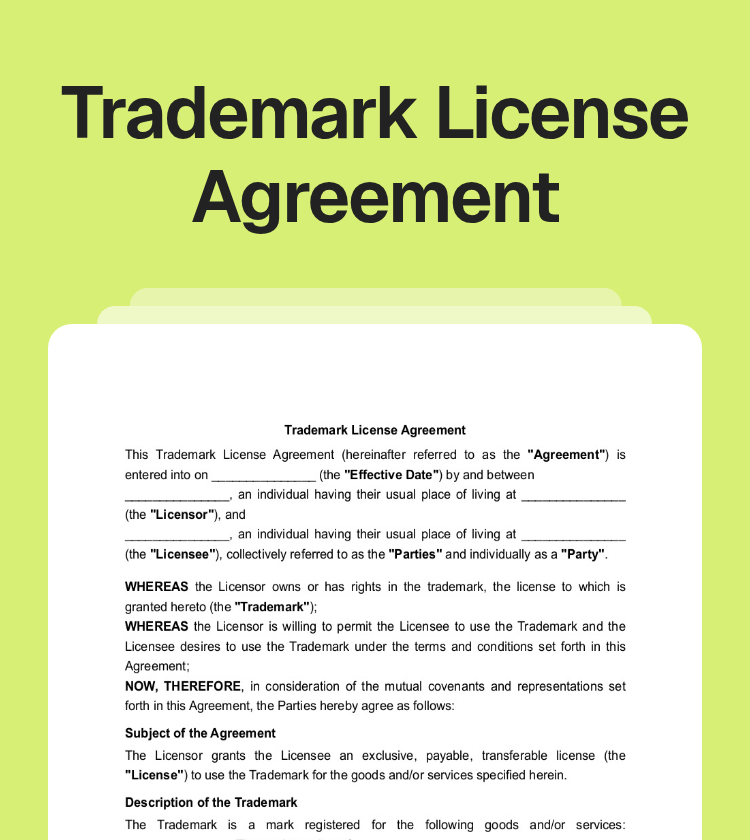
Trademark License Agreement

This Trademark License Agreement (hereinafter referred to as the "Agreement") is entered into on   (the "Effective Date") by and between 

 , an individual having their usual place of living at   (the "Licensor"), and

 , an individual having their usual place of living at   (the "Licensee"), collectively referred to as the "Parties" and individually as a "Party".


WHEREAS the Licensor owns or has rights in the trademark, the license to which is granted hereto (the "Trademark");

WHEREAS the Licensor is willing to permit the Licensee to use the Trademark and the Licensee desires to use the Trademark under the terms and conditions set forth in this Agreement;

NOW, THEREFORE, in consideration of the mutual covenants and representations set forth in this Agreement, the Parties hereby agree as follows:

Subject of the Agreement

The Licensor grants the Licensee an exclusive, payable, transferable license (the "License") to use the Trademark for the goods and/or services specified herein.

Description of the Trademark

The Trademark is a mark registered for the following goods and/or services:  . The mark consists of  . 

The Trademark certificate No.  , registered on  .

Goods and services

The Trademark will be used in association with the following goods and/or services:

  (the "Goods" or the "Services").

Territory

The Trademark shall be used throughout  .

Authorized channels

The Trademark should be used for promoting and selling the Goods or Services through the following authorized channels:  .

Quality control and approval

To protect the Licensor's good standing, the Licensee agrees to maintain the quality standards in all Goods/Services established by the Licensor.

The Licensor reserves the right to inspect and audit the Licensee's use of the Trademark, including the quality of used Goods or Services  .

The Licensee shall not establish or offer the Goods or Services at a price lower than the minimum resale price set forth by the Licensor.

Assignment

This License can be assigned by the Licensee to any third person without prior written consent of another Party.

Sublicense

The Licensee shall have the right to sublicense the use of the Trademark with the Licensor's prior written consent.

Granted rights

The Licensee has an exclusive right to use the Trademark in connection with the of the Goods and/or Services.

The Licensor is obliged not to grant the License to use the Trademark to any other person during the term of this Agreement.

Term of the License

The License is valid as long as the Trademark, specifically until  . The Licensor shall maintain the validity and enforceability of the Trademark, including the timely filing of any necessary Trademark renewals. The Licensee may only use the Trademark during the term of this License while it remains valid and in force.

Registration

The Parties agree to record this Agreement with the United States Patent and Trademark Office (the "USPTO") for purposes of establishing a public record of the License and the rights granted herein. The Licensee shall provide and execute any necessary documents to effectuate such recordation with the USPTO.

Payment terms

The Licensee shall pay the Licensor a one-time licensing fee of   (the "Payment").

The Payment should be made on or before  .

Default

If one Party fails to perform the obligations under the Agreement or violates the provisions of this Agreement (the "Default"), another Party has the right to send an appropriate written notice (the "Default Notice") with a demand to cure the Default within   days. If the defaulting Party fails to meet the non-defaulting Party's requirements stated in the Default Notice within a specified term, the non-defaulting Party shall be entitled to take any actions to protect its interests, including but not limited to declare all payments immediately due and payable, to terminate the Agreement unilaterally as of the term specified in the Default Notice.

The remedies provided in this Agreement shall not be exclusive but cumulative and shall be in addition to all other remedies at law or in equity.

Parties' warranties and representations

The Licensor hereby guarantees to be the sole legal and beneficial owner of the Trademark. The Trademark is provided by the Licensor "as-is." The Licensor hereby guarantees that there are no pending or threatened legal proceedings, oppositions, disputes, or arrests involving the Trademark before any court or administrative body that may affect its validity, enforceability, or ownership.

The Parties hereby represent and warrant to each other that each Party has the full power, capacity, and right to enter into this Agreement. 

Liability and indemnification

The Licensee will indemnify and hold the Licensor harmless from any demands, claims, damages, expenses, including attorney's fees, costs, and liability resulting from the use of the Trademark, except resulting from gross negligence or misconduct of the Licensor. 

In case of any breach of this Agreement or any unauthorized use of the Trademark by the Licensee, the Licensee shall be liable to the Licensor for direct damages, i.e., actual financial losses, resulting from such a breach or unauthorized use.

In case of any breach of this Agreement by the Licensor, the Licensor shall be liable to the Licensee for direct damages, i.e., actual financial losses, resulting from such a breach.

Cooperation between the Parties and protection of trademark rights

The Parties acknowledge that the Licensor remains the owner and reserves all rights, title, interest, and copyright to the Trademark.

The Parties acknowledge that the Licensor retains all rights not explicitly granted to the Licensee under this Agreement. 

The Licensee guarantees not to register the Trademark alone or as part of its trademark anywhere in the world and not to seek registration of any misleadingly similar trademarks, i.e., the ones that could be mistaken for the licensed Trademark with the USPTO or other relevant trademark authorities.

The Licensee shall not use the Trademark as part of any composite trademark in close proximity to or combination with any trademark(s) held by the Licensee or any third party. The Licensee should avoid using any marks that closely resemble the licensed Trademark in a way that might confuse consumers about the source of the Goods or Services (misleadingly similar trademarks).
The Licensee shall support the Licensor's Trademark rights protection and shall cooperate with the Licensor to protect the Trademark.

 .

Term and termination of the Agreement

This Agreement shall commence on the Effective Date and shall be valid for  .

This Agreement shall be effective only if the Trademark is valid and in force. If the Trademark is not valid for any reason, the Agreement shall terminate automatically.

Either Party may terminate this Agreement for any reason upon  -day written notice to the other Party.


In addition, either Party may terminate this Agreement immediately upon written notice to the other Party if the other Party becomes insolvent or files for bankruptcy.
Upon termination of this Agreement, the Licensee shall pay the Licensor all fees that have become due through the date of termination.

Confidentiality

During the term of this Agreement and   thereafter, either Party shall in no way disclose, use, or disseminate any confidential information received from another Party during cooperation under the Agreement, except as required by law. The "confidential information" means any information that is disclosed by one Party (the "Disclosing Party") to the other (the "Recipient") in connection with the Agreement, including but not limited to trade secrets, proprietary information, financial information, sales and marketing plans, and business information.

Force majeure

Neither Party shall be liable for any failure to perform or delay in performing the obligations under this Agreement if such failure or delay is caused by events of force majeure, including but not limited to acts of God, war, terrorism, strikes, lockouts, labor disputes, pandemics, epidemics, governmental regulations, or any other similar cause beyond the reasonable control of the affected Party.
In the force majeure case, the affected Party shall immediately notify the other Party in writing and provide the other Party with reasonable evidence of the delay or inability to perform the obligations. The Party affected by force majeure shall endeavor to mitigate the consequences of such circumstances and resume the performance of obligations as soon as possible after the circumstances cease to exist.
If the force majeure circumstances last more than   days, either Party may terminate this Agreement by giving written notice to the other Party. In this case, neither Party shall be liable to the other Party for any damages arising from the termination of this Agreement.

Notices 

All notices to the Parties required or otherwise given pursuant to the Agreement shall be given to the addresses set forth below: 

If to the Licensor:

Attn.  

 .

If to the Licensee:

Attn.  

 .

A notice shall be considered received if sent by registered or certified mail on the   day after posting, if delivered by a courier service on the date of delivery as indicated in the delivery receipt, or if sent by email on the date of the email.

Either Party may change its address or email address for receipt of notices by giving written notice to the other Party.

Governing law and dispute resolution

This Agreement shall be governed by and interpreted in accordance with the laws of the State of  , and any disputes arising out of or in connection with this Agreement shall be exclusively resolved by the courts of the State of  .

Severability

The invalidity, illegality, or unenforceability of any provision of this Agreement shall not affect or impair the validity, legality, or enforceability of any other provision of this Agreement. 

Binding character

This Agreement shall be legally binding and shall inure to the benefit of the Parties and their respective permitted successors and assigns.

Entire agreement

This written Agreement represents the entire understanding between the Parties and supersedes any prior oral or written agreements. 

Amendments

This Agreement may only be modified, or any rights under it waived, by a written document executed by both Parties.

IN WITNESS WHEREOF, the Parties have signed this Agreement.

Details and signatures of the Parties

THE LICENSOR

THE LICENSEE


 ,  ,  


Other details:  

__________________________________

(Place for signature)


 ,  ,  


Other details:  

__________________________________

(Place for signature)


Written by Karyna Pukaniuk - Reviewed by Kate Adkham

Template Description

Copy section link
Paper titled "Trademark License Agreement"; the copyright sign and a magnifier; men discussing a paper

A trademark license agreement is a legal document in which a trademark owner (licensor) permits the other party (licensee) to use the licensor’s trademark under specific terms. Trademark license agreements help the parties legally authorize the trademark use in a specific region and reduce the chances of legal disputes and violation of contract terms.

In this article, we will discuss all aspects of a trademark licensing agreement, including its types and differences with a trademark assignment agreement. You will also find the steps on how to draft a professional trademark licensing agreement template for your legal needs. Dive in!

When to Use Trademark License Agreements

Copy section link

Trademark licensing is especially popular in such industries as sports, beauty, fashion, food and beverages, transport, etc. Defining a trademark license should go before signing all legal documentation.

A trademark license agreement is necessary for all businesses and types of license transfers to ensure the trademark is used, promoted, or presented on new platforms and territories lawfully. The key parties to trademark licensing agreements are brand producers, franchisors and franchisees, merchandise companies, and business partners. 

Below are the situations when the licensor and licensee can employ a trademark license agreement sample:

  • Brand creators give their permission to operate and grow their trademark in a new geographic territory

  • Franchisors develop and promote trademarks along with their business model and reputation

  • Independent companies start their collaboration to create a new brand that merges the advantages of the two initial brands and more

Without trademark license agreements, licensing may carry deal complications, legal disputes, and unforeseen force majeure circumstances. The rights of the parties are not legally protected, and the cooperation may not happen as lawfully as it should. 

Our trademark license agreement template complies with recent U.S. law regulations, and it is easy to customize to your needs on Loio in no time.

Difference Between Trademark License & Trademark Assignment

Copy section link

Trademark assignment implies the full transfer of trademark rights to the other party and further registration. The new trademark owner can legally establish the new brand growth strategy, geography, business model, royalty policy, etc. This information should be outlined in trademark assignment agreements.

Under trademark licenses and settled quality standards, the brand producer remains the sole owner of the trademark and only grants the right to operate specific products or services in the agreed-upon area.

How to Write a Trademark License Agreement

Copy section link

Here’s the list of the main elements a sample trademark license agreement should include:

1. Recitals

First, specify the full names of the licensor and licensee and their addresses. 

If the parties are business entities, write their legal names, addresses, registration numbers, and the full names of the legal representatives of these businesses. Legal representatives act on behalf of their companies and are responsible for signing the trademark licensing agreement. Then, state the intention to license rights of the trademark to the licensee.

2. Grant of License

In this section of your trademark licensing agreement, add the trademark number and mention the institution of its registration. Mention the field in which the licensed trademark will be used. Such details are extremely important for well-known brands with multiple registered trademarks and legal names.

The grant of the license clause must also include the license exclusivity and the list of products and services covered.

3. Term and territory

The term simply means the duration of the license. Geography should specify territories and regions where the trademark is allowed to be used. Both these sections can be standalone or merged in trademark license agreements.

4. Consideration

This is a monetary section in which the parties should outline all payments for the trademark use: license issue, royalty, payment frequency (full sum or installment payments), etc.

5. Termination

This section explains the conditions of terminating the trademark license agreement before its official date of expiry. A notice period must be mentioned, which is the term for parties to inform one another of the end of the business relationship. If none is provided, it will be subject to breaching the agreement, and the trademark usage must be stopped immediately.

6. Confidentiality

For license authorization deals, this section specifies that all information like trade secrets, financial plans, and other business information must remain confidential between the parties.

7. Governing law

This provision should articulate which U.S. state law will help the parties resolve legal issues that happened during the agreement, if any. 

Additional provisions for trademark license agreements like indemnification, warranties, or force majeure may be added if agreed upon between the parties.

Trademark license agreements are impeccable for safe trademark usage across the world. 
When the details of this deal are properly written and negotiated, the parties can ensure the requirements for trademark license are met, and they can benefit from long-term cooperation.

The most up-to-date trademark license agreement template is available on Loio. Enjoy the stress-free creation of a professional, legally binding document and seamless electronic signing!