Updated September 7, 2026
9 min read
MSA vs SOW: Key Differences and Why You May Need Both
MSA vs SOW: Key Differences and Why You May Need Both
Content
A master service agreement vs statement of work comparison comes down to scope. A master service agreement (MSA) establishes the legal and commercial rules for an ongoing service relationship, while a statement of work (SOW) defines the deliverables, timeline, pricing, and other details of a specific project.
Businesses that expect multiple projects often use an MSA and SOW together: one MSA for the overall relationship and a separate SOW for each engagement.
MSA vs SOW: Key Differences
The main difference between MSA and SOW is what each document governs.
Purpose: Establishes the overall service relationship
Scope: Broad, relationship-level terms
Duration: Often covers multiple projects over time
Typical terms: Payment framework, confidentiality, warranties, liability, intellectual property, dispute resolution, governing law
Use: Usually signed once for an ongoing relationship
Purpose: Defines a specific project or engagement
Scope: Project-specific terms
Duration: Usually applies to one project or phase
Typical terms: Scope of work, deliverables, milestones, deadlines, fees, responsibilities, and acceptance criteria
Use: New SOWs can be created as new projects arise
An SOW should make the work sufficiently specific for both sides to understand what must be delivered and when. As one useful benchmark, the Federal Acquisition Regulation, FAR 8.405-2 requires certain federal Statements of Work to include a description of the work, location, period of performance, deliverable schedule, applicable performance standards, and special requirements. These federal rules do not govern every private commercial SOW, but they illustrate the type of project detail an effective statement of work may need.
The master service agreement vs contract comparison is slightly different because an MSA is itself a type of contract. Likewise, SOW vs contract is not necessarily an either-or distinction: an SOW may form part of a binding contractual arrangement or operate under a separate MSA or service agreement. The key distinction is that an MSA generally deals with relationship-level terms, while an SOW focuses on project-specific obligations.
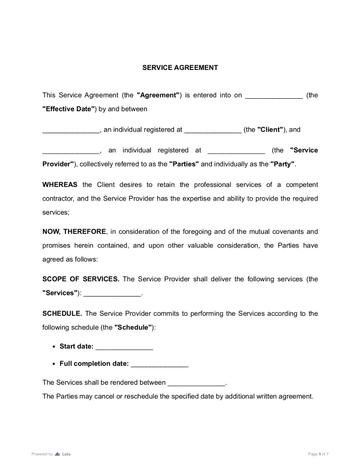
- Service Contract
 4327 downloads
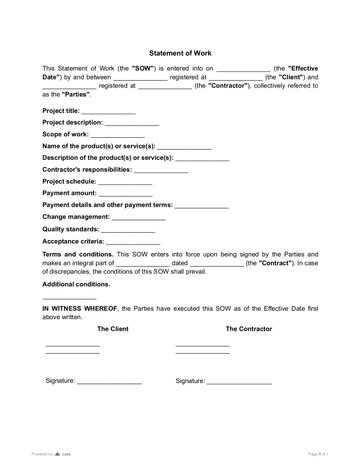
 - Statement of Work (SOW)
 4178 downloads
How MSA and SOW Work Together
In a typical SOW and MSA structure, the parties negotiate the general legal terms once in the MSA and then create SOWs as specific projects arise.
For example, the MSA might establish rules for confidentiality, liability, dispute resolution, payment, and intellectual property. A later SOW can then identify the particular services, deliverables, deadlines, project fee, and acceptance requirements without renegotiating the entire relationship.
The SOW should clearly identify the MSA it operates under rather than assuming the MSA terms apply automatically.
What if the MSA and SOW conflict?
The documents should specify their order of precedence — in other words, which terms control if the MSA and SOW are inconsistent. There is no universal rule that an SOW always overrides an MSA, or vice versa; the documents themselves should address the hierarchy.
For comparison, the federal government uses express order-of-precedence provisions to resolve inconsistencies among contract documents. In a private MSA/SOW relationship, the parties can similarly state that the MSA controls unless an SOW expressly overrides a specified provision, or establish another hierarchy.
Who owns the work created under an MSA and SOW?
The MSA often sets the baseline rules for intellectual property, while the SOW identifies the specific deliverables covered by those rules. The parties can also use an SOW to address project-specific IP terms or exceptions.
The contract language matters. Under U.S. copyright law, copyright initially belongs to the author unless an exception applies, including qualifying works made for hire. A transfer of copyright ownership generally must also be in writing and signed by the owner of the rights conveyed.
For that reason, an MSA or SOW should not merely identify who receives the finished deliverable. It should clearly state whether relevant intellectual property is assigned, licensed, retained by the service provider, or treated as qualifying work made for hire where legally applicable.
Do You Need an MSA, an SOW, or Both?
The right structure depends mainly on the relationship and the work involved.
An MSA plus separate SOWs usually makes sense when:
- The client and service provider expect an ongoing relationship;
- Multiple projects or phases are likely;
- The same legal and commercial terms should apply across those projects; or
- Project scope, deliverables, pricing, or timelines will change from one engagement to another.
For a single, straightforward project, the parties may instead use one standalone service agreement or another contract that includes both the necessary legal terms and a detailed scope of work. An SOW should not be treated as a substitute for missing contractual protections simply because the engagement is short.
If an MSA is already in place, a new SOW can define the next project while preserving the agreed relationship-level terms.
The practical SOW vs MSA distinction is therefore simple: the MSA establishes the long-term service relationship, while the SOW defines the work for a specific project. When businesses expect repeated engagements, the two documents are often most useful when designed to work together.
More guides
September 1
7 min read
How to Provide Proof of Employment: Documents and Steps

October 15
How to Start a Staffing Agency: Licensing, Pricing, and Cash Flow

July 21
8 min read
Statement of Work vs Scope of Work: Differences and How They Work Together

September 10
14 min read
How to Protect Your Small Business from Lawsuits

July 24
10 min read
Construction Documents: Must-Haves for Commercial Projects

October 15
15 min read
Independent Contractor Management: Compliance and Risk Guide

One home for your
agreements
Edit PDFs seamlessly
Tweak agreements before signing or sending for signatures. Update details, add or remove clauses, adjust formatting, and redline changes instantly.
eSign legally and securely
Sign documents and collect legally binding signatures. Invite up to ten people to sign in any order, track the progress, and send reminders.
Request legally binding signatures
Invite up to ten people to sign your document in any order. Get a finalized, audit-ready copy without chasing signatures.
Skip the drafting.
Choose from 2,500+ templates
Browse templatesChoose a template
Fill in details
Sign and download