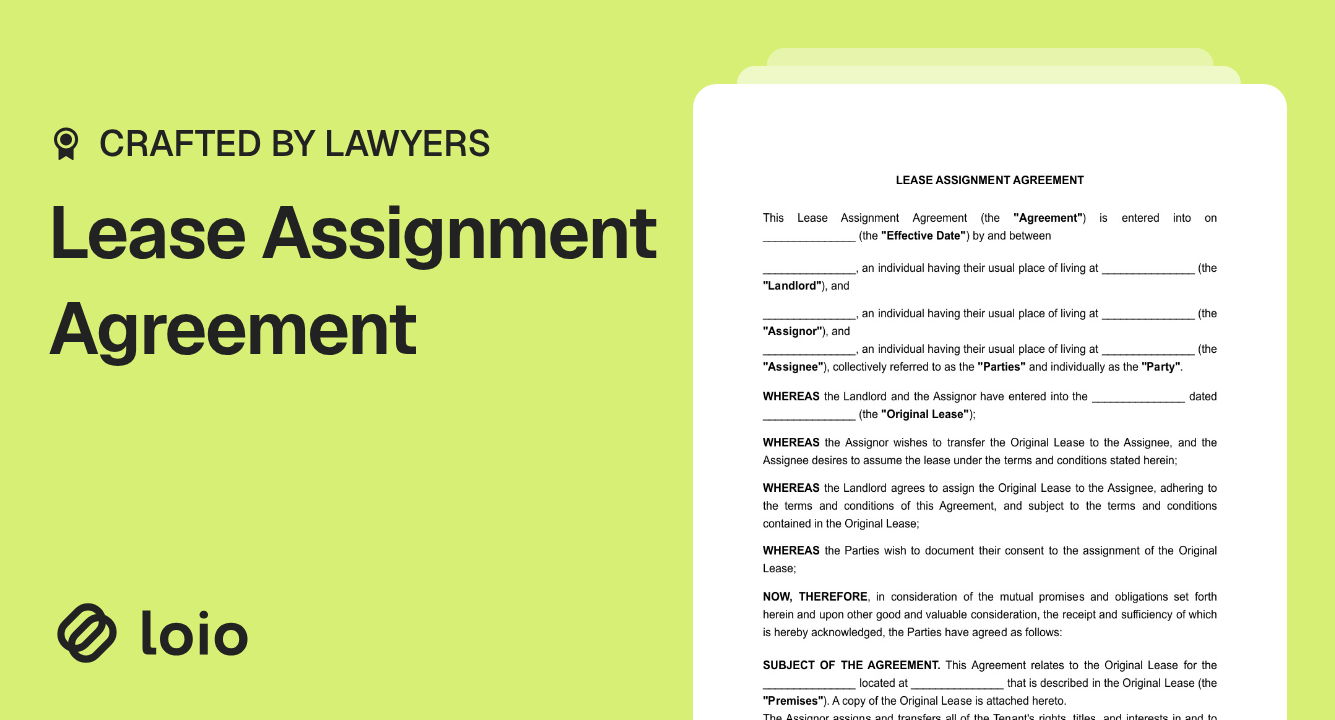
Assignment of Lease Agreement Template

4.9 (14 reviews)
All states | 5 types
Updated Apr 24, 2024
~ 7 pages
PDF
4.2K downloads
A Lease Assignment Agreement is a legal document between a current tenant and a new tenant that transfers the rights and obligations of a lease. It is used by renters who wish to move before the lease ends while ensuring the landlord’s consent and a smooth handover.
LEASE ASSIGNMENT AGREEMENT

This Lease Assignment Agreement (the "Agreement") is entered into on   (the "Effective Date") by and between

 , an individual having their usual place of living at   (the "Landlord"), and 

 , an individual having their usual place of living at   (the "Assignor"), and

 , an individual having their usual place of living at   (the "Assignee"), collectively referred to as the "Parties" and individually as the "Party"


WHEREAS the Landlord and the Assignor have entered into the   dated   (the "Original Lease");

WHEREAS the Assignor wishes to transfer the Original Lease to the Assignee, and the Assignee desires to assume the lease under the terms and conditions stated herein;

WHEREAS the Landlord agrees to assign the Original Lease to the Assignee, adhering to the terms and conditions of this Agreement, and subject to the terms and conditions contained in the Original Lease;

WHEREAS the Parties wish to document their consent to the assignment of the Original Lease;

NOW, THEREFORE, in consideration of the mutual promises and obligations set forth herein and upon other good and valuable consideration, the receipt and sufficiency of which is hereby acknowledged, the Parties have agreed as follows:

SUBJECT OF THE AGREEMENT. This Agreement relates to the Original Lease for the   located at   that is described in the Original Lease (the "Premises"). A copy of the Original Lease is attached hereto.

The Assignor assigns and transfers all of the Tenant's rights, titles, and interests in and to the Original Lease and the Premises to the Assignee. The Assignee assumes and agrees to perform all of the Tenant's obligations under the Original Lease, starting from the date of this Agreement.

All terms and provisions of the Original Lease shall remain in full force and effect, except as modified herein.

CONSENT OF THE LANDLORD TO THE ASSIGNMENT OF THE LEASE. The Landlord hereby consents to the assignment of the Original Lease from the Assignor to the Assignee.

The Assignee consents to accept and be bound by all of the terms and conditions of the Original Lease, including all lease payments.

The Assignee shall provide the Landlord with written notice about any changes to the contact information or address for lease payments or other correspondence.

The Landlord shall have the right to request financial and credit information from the Assignee to verify the Assignee's ability to fulfill the obligations under the Original Lease.

In the event that the Assignee breaches the terms and conditions of the Original Lease, the Landlord shall have the right to terminate the Original Lease.

In the event of any default by the Assignee, the Landlord shall be entitled to all remedies provided under the Original Lease or applicable law.

This Consent of the Landlord to the Assignment of the Lease shall not be deemed a waiver of any rights or remedies available to the Landlord under the Original Lease or applicable law.


ASSIGNEE'S OBLIGATIONS AND WARRANTIES. The Assignee represents and warrants to adhere to all applicable laws, regulations, and ordinances governing the utilization and occupancy of the Premises.

The Assignee assures that the Premises shall only be used for the purposes permitted by the Original Lease and applicable law, and the Assignee shall not use the Premises for any unlawful purpose.

The Assignee acknowledges that the Landlord shall be entitled to all remedies available under the Original Lease or applicable law in case of any default by the Assignee, including the right to terminate the Original Lease.

The Assignee agrees to maintain and repair the Premises following the terms and conditions of the Original Lease. Additionally, the Assignee agrees to promptly inform the Landlord of any necessary repairs or maintenance.

The Assignee undertakes not to engage in any illegal activities on the Premises.

The Assignee acknowledges that the Landlord has the right to terminate the Original Lease in the event of any default or breach by the Assignee and that the Assignee shall be responsible for any resulting damages.

The Assignee represents and warrants that the Assignee is not currently in default under any other lease or agreement and shall not violate the terms of the Original Lease.

The Assignee agrees to indemnify and hold the Landlord harmless from any claims or liabilities arising from the Assignee's use of the Premises. This includes any claims resulting from the Assignee's violation of the terms and conditions of the Original Lease or applicable law.

In line with the terms of the Original Lease, the Assignee agrees to obtain and maintain insurance coverage for the Premises. Upon the Landlord's request, the Assignee should provide proof of insurance.

The Assignee agrees not to make any modifications to the Premises without obtaining prior written consent from the Landlord.

The Assignee agrees not to sublet the Premises without obtaining prior written consent from the Landlord.

 .


LEASE TERM AND TERMINATION OF THE AGREEMENTThis Agreement shall commence on the Effective Date and shall remain in effect until the Lease End Date, unless terminated earlier under the terms of this Agreement or the Original Lease.

The Assignee shall have full possession of the Premises from   (the "Lease Start Date") and shall continue until the date specified in the Original Lease (the "Lease End Date"). The Lease Term is a period from the Lease Start Date to the Lease End Date or the Lease Termination Date.

This Agreement may be terminated by either Party, without cause, upon   days prior written notice. 

This Agreement may be terminated immediately for cause if either Party fails to perform in accordance with the terms of this Agreement. In addition, either Party may terminate this Agreement immediately upon written notice to the other Party if the other Party becomes insolvent or files for bankruptcy.

If the Landlord fails to provide the Assignee with full possession of the Premises on the Lease Start Date, the Assignee may terminate this Agreement immediately upon written notice to the Landlord, and all the amounts paid by the Assignee under this Agreement must be returned to the Assignee. Such payments should be made within   days following the lease termination date using the payment method specified above. 

 .

Upon termination of this Agreement, the Assignee shall pay the Landlord for all days of actual use of the Premises.


LEASE FEE AND PAYMENT PROCEDURE. The lease fee shall remain unchanged as stated in the Original Lease.

The Assignee shall reimburse the Assignor for the security deposit paid by the Assignor to the Landlord under the Original Lease within   days from the Effective Date.

All payments will be made using the payment method specified in the Original Lease.


FORCE MAJEURE. Neither Party shall be liable for any failure to perform or delay in performing the obligations under this Agreement if such failure or delay is caused by events of force majeure, including but not limited to acts of God, war, terrorism, strikes, lockouts, labor disputes, pandemics, governmental regulations, or any other similar causes beyond the reasonable control of the affected Party.

In the case of force majeure, the affected Party shall immediately notify the other Party in writing and provide reasonable proof of the cause of the delay or inability to perform the obligations. The Party affected by force majeure shall endeavor to mitigate the consequences of such circumstances and resume the performance of obligations as soon as possible after the circumstances cease to exist.

If the force majeure circumstances last more than   days, either Party may terminate this Agreement by giving written notice to the other Party. In this case, neither Party shall be liable to the other Party for any damages arising from the termination of this Agreement.


GOVERNING LAW AND DISPUTE RESOLUTION. This Agreement shall be governed by and interpreted in accordance with the laws of the State of  . Any disputes arising out of or in connection with this Agreement shall be exclusively resolved by the courts of the State of  .


CONFIDENTIALITY. The Parties agree to keep all information disclosed during this Agreement confidential and not to share such information with any third party unless required by law. In order to fulfill the Parties' obligations under this Agreement, they consent not to use the confidential information for any purpose unrelated to this Agreement. This confidentiality clause shall remain in effect after the termination or expiration of this Agreement.


WAIVER. The failure of any Party to enforce a particular provision of this Agreement shall not constitute a waiver of the Party's right to enforce that provision in the future.


SEVERABILITY. If any provision of this Agreement is found to be invalid or unenforceable, the remaining provisions shall still be valid and enforceable.


AMENDMENTS. This Agreement may be amended or modified only by a written agreement signed by both Parties. 


BINDING EFFECT. This Agreement shall be binding for the Parties and their respective successors and assigns. 


ANNEX. The Original Lease.


IN WITNESS WHEREOF, the Parties have executed this Agreement as of the Effective Date.

THE LANDLORD

THE ASSIGNOR

THE ASSIGNEE


 , USA

Phone number:  

Email:  


_____________________
(Place for signature)


 , USA

Phone number:  

Email:  


_____________________
(Place for signature)


 , USA

Phone number:  

Email:  


____________________
(Place for signature)


ANNEX

to the Lease Assignment Agreement dated  

The   dated   made by and between  , an individual having their usual place of living at   (the "Landlord"), and  , an individual having their usual place of living at  , (the "Assignor"), is an integral part of Lease Assignment Agreement dated  

Written by Karyna Pukaniuk - Reviewed by Jonathan McGill

Template Description

Copy section link
Paper titled "Lease Assignment Agreement"; women talking near a house

A lease assignment agreement is a legal document that can help you transfer property rights from yourself to a new tenant when you are under a lease. For example, you may transfer the lease to another person when leasing property. You can do this using an assignment of a lease agreement.

However, you must ensure that it is a document you can enforce in a court of law. When coming up with it, there are many considerations. Find a reliable lease assignment agreement template on Loio to create a legally binding and enforceable agreement.

What Is a Lease Assignment Agreement?

Copy section link

A lease assignment agreement is a contract you can enter into to transfer your lease obligations and rights to another person. You can do this to avoid continuing lease obligations. The transfer of these rights is what legal experts call assignment. It is common when a tenant intends to relocate or faces financial difficulties.

A lease assignment agreement helps formalize this process. 

Parties of the Lease Assignment Agreement

Copy section link

Three parties play a crucial role in the lease assignment agreement. They are:

  • Assignor: The original tenant transfers their rights to a new tenant. For example, if you are leasing and transferring your rights to a new tenant, you are the assignor.

  • Assignee: The term denotes the new person receiving the rights from the old tenant. In the example above, the person you transfer the rights to is the assignee.
  • Landlord: The landlord is the property owner (can also be a company). In some instances, you may require the owner's consent before you transfer your rights as a tenant.

The article has already detailed two essential terms in a legal assignment agreement (assignor and assignment). Other terms vital for this agreement are:

  • Effective Date: The date on which the lease assignment becomes legally effective.

  • Assignee’s Acceptance: The confirmation that the assignee agrees to abide by all the rights and responsibilities of the lease.

  • Release of Assignor: A clause outlining whether the assignor will be released from all lease obligations after the assignment. This is subject to the assignee’s compliance with the lease terms.

  • Jurisdiction: The jurisdiction whose laws govern the interpretation and enforcement of the lease assignment agreement.

  • Continuation of Lease Terms: It stipulates that all other terms and agreements, not explicitly altered by the assignment agreement, remain in effect.

What Is Included In a Lease Assignment Agreement?

Copy section link

In a typical lease assignment agreement, you will find the following:

  1. Parties: The contract should identify the assignor, the assignee, and the landlord. It should include their names and other key indicators such as social security numbers.

  2. Property Details: It should specify the property’s address and describe the leased premises.

  3. Original Lease Terms: The agreement should detail specifics about the original lease, including the lease start and end dates, security deposit, rent amount, and other specific lease provisions. The contract should be unambiguous.

  • Assignment Terms: This section details the terms and conditions of the lease assignment. These details can include the effective date of the assignment and landlord requirements, if there are any.

  • Consent of the Landlord: In the agreement, you must stipulate whether the landlord has consented. Do this to avoid trouble down the road.

  • Indemnification: The agreement may include a section whereby the old tenant (assignor) agrees to indemnify the landlord if the new tenant fails to meet the lease obligations. A landlord may insist on this because it is a safety net for them.

  • Signature: It is necessary for all parties involved to sign and date the document.

Advantages of Lease Assignment Agreements

Copy section link

A lease assignment agreement is an essential agreement, and it offers various advantages such as:

  • Maintaining Control: Allows tenants to be in control of where they rent. You don’t need to be tied down by lease obligations when you can assign such obligations to another new tenant through a lease assignment agreement. An example is when you want to relocate to another city or change where you live; you can use this agreement to transfer responsibilities and rights and move to your desired location.

  • Financial Relief: Sometimes, you can be strained financially and unable to fulfill your lease financial obligations. The lease assignment agreement can offer you financial relief by helping you assign those lease obligations to a new tenant.

  • Streamlined Process: A lease assignment agreement involves less paperwork. It is a very straightforward process. Also, it is easy to draft, as you can see from the lease assignment agreement template. 

How to Create a Lease Assignment Agreement

Copy section link

Creating a lease assignment agreement requires attention to detail and clarity. Here are the steps you can follow when drafting one:

1. Begin With Some Clarity Over the Assigned Date

Specify the effective date of the assignment. This date marks when the assignee assumes responsibility for the lease.

2. Come to Terms With the Master Lease’s Basic Terms

The lease assignment agreement should clearly outline the terms and conditions of the original lease, including rent amount, security deposit, and any specific provisions. Including these terms in the lease agreement assignment ensures clarity of the new tenant's responsibilities. It helps avoid confusion or conflict between the landlord and the new tenant.

3. Clarify Any Covenants Regarding the Master Lease

Highlight any obligations, restrictions, or covenants from the original lease the assignee must uphold. One example of a covenant is that the lease requires you to keep the garden in good shape. Remember to inform new tenants of these covenants, if they exist.

4. State The Default And Nonpayment Recourse

Detail the consequences of lease violations, including defaults and nonpayment of rent, to protect both parties' interests. Some agreements may include alternative dispute settlement clauses. The new tenant should be aware of what to expect.

5. Proofread the Document

Ensure the lease assignment agreement is error-free and inconsistencies-free to prevent future disputes. It is advisable to seek a second set of eyes to help proofread the document because sometimes you may need help spot the errors. It would help if you got a lawyer as they can inform you of whether the document complies with relevant laws and regulations.

6. Gain the Consent of the Stakeholders

If the original lease requires the landlord’s consent for assignment, obtain it in writing before proceeding. The landlord's consent is vital in such instances. If it lacks, the legal assignment agreement may be considered invalid and not recognized by the law.

When to Use a Lease Assignment Agreement

Copy section link

A lease assignment agreement is typically used in the following scenarios:

Common Use Cases

  • When a tenant wishes to transfer their lease to another party permanently, a tenant may enter into a lease assignment agreement when relocating permanently. Doing this helps the tenants alleviate the burden of paying for a space they are not using.

  • When the tenant needs to exit the lease before its expiration.

  • In business settings, when a company wants to assign a lease to another entity due to mergers or relocations.

When Not to Use a Lease Assignment Agreement

Avoid using a lease assignment agreement when:

  • The lease explicitly prohibits assignment.
  • The landlord does not consent to the assignment (if required).
  • The tenant wants to retain control over the leased space.
Lease Assignment Agreement Preview