Free template
Free I-9 Form
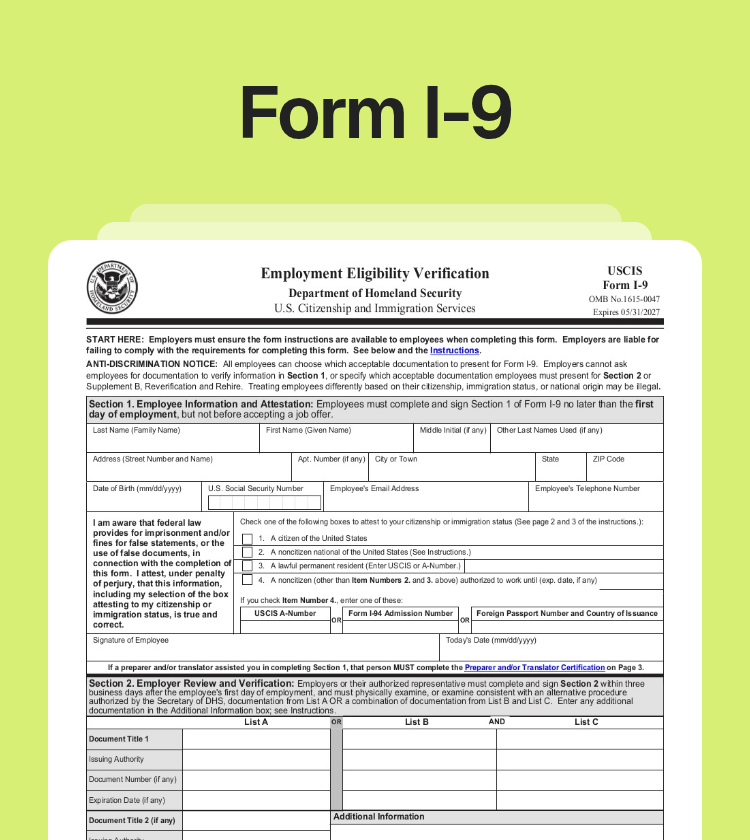
What Is Form I-9?
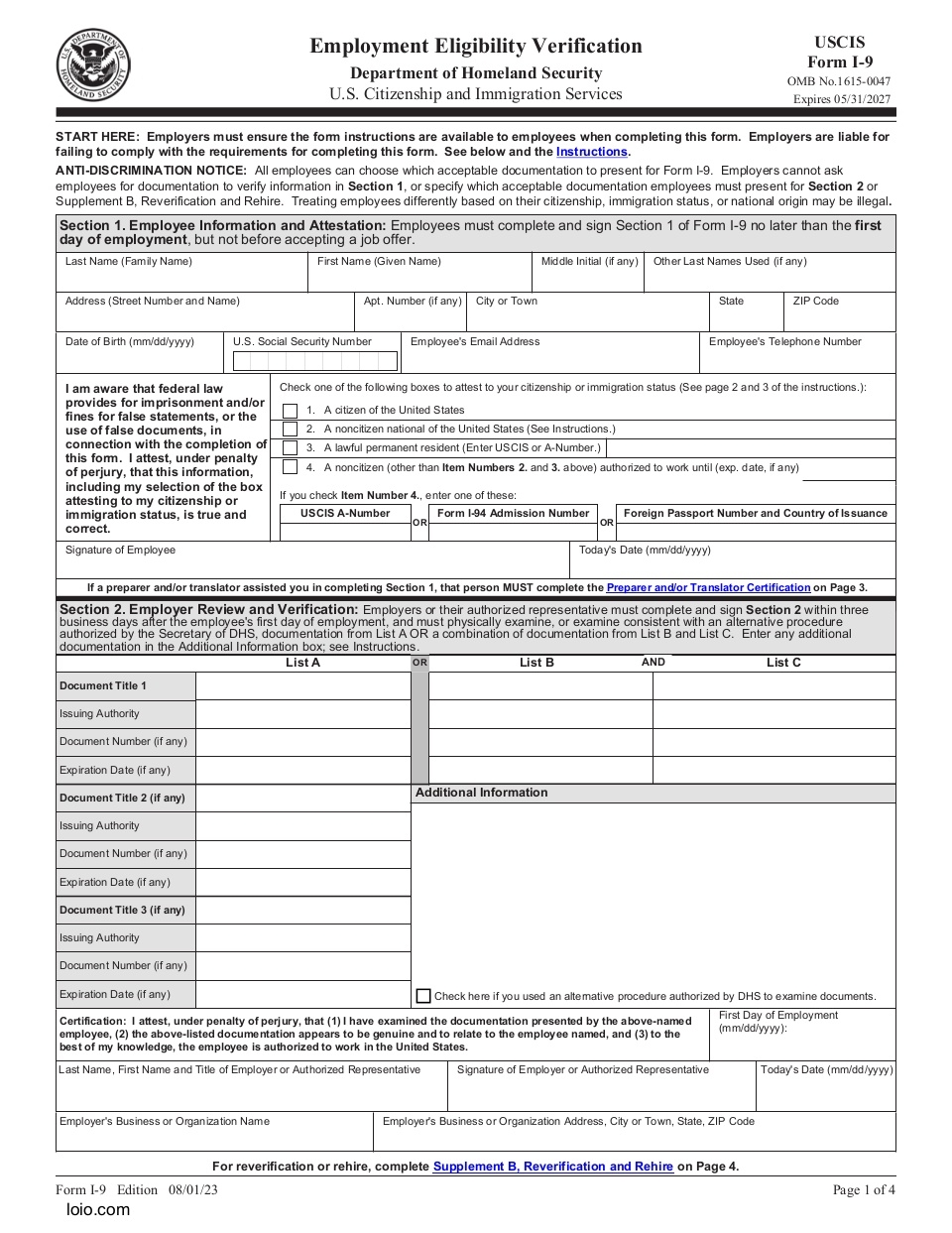
Copy section linkForm I-9, Employment Eligibility Verification, is a federal form U.S. employers use to verify the identity and employment authorization of employees hired to perform work for pay in the United States.
The form is completed by both the employee and the employer. The employee completes and signs Section 1, while the employer or an authorized representative completes Section 2 after examining acceptable identity and employment-authorization documents.
Employers must complete Form I-9 for employees regardless of citizenship or immigration status, including U.S. citizens. The completed form is not normally filed with USCIS, ICE, or another government agency. Instead, the employer retains it and must make it available for an authorized government inspection.
Important: Form I-9 is a federal employment-verification form, not a customizable employment agreement. Use the current USCIS form without altering its required language or fields. Employment terms can be documented separately using an employment contract, such as Loio's Employment Contract Template.
Which Form I-9 Edition Should You Use?
Copy section linkThe current Form I-9 published by USCIS is edition 01/20/25, with an expiration date of 05/31/2027.
USCIS also permits employers to use the 08/01/23 edition displaying an expiration date of 05/31/2027. However, the 08/01/23 version displaying an expiration date of 07/31/2026 has expired and should no longer be used.
Do not confuse the two dates:
the edition date appears at the bottom of the form and identifies the version; and
the expiration date appears near the top and relates to the form's current approval.
For new hires, downloading the current 01/20/25 edition directly from USCIS helps avoid accidentally using an expired copy stored in an older onboarding packet or HR system.
Who Needs Form I-9?
Copy section linkEmployers generally must complete Form I-9 for every person hired to perform labor or services in the United States in return for wages or other remuneration after November 6, 1986.
This requirement applies regardless of whether the employee is:
a U.S. citizen;
a noncitizen national;
a lawful permanent resident; or
another individual authorized to work in the United States.
Form I-9 verifies identity and employment authorization. Employers should not use the process to favor one citizenship or immigration category over another.
Who Does Not Normally Need an I-9?
An employer generally does not complete Form I-9 for a properly classified independent contractor because the person is not the employer's employee.
Employees hired on or before November 6, 1986, who have continued in their employment are also generally outside the original I-9 requirement. Other exclusions may apply in specific circumstances.
Whether someone is an employee or independent contractor depends on the actual working relationship, not simply the title of an agreement. A document such as Loio's Independent Contractor Agreement can define the parties' service terms, but it does not determine worker classification by itself.
When Must Form I-9 Be Completed?
Copy section linkForm I-9 has two main completion deadlines.
Who Completes It?
Employee
Deadline
No later than the employee's first day of work for pay
Who Completes It?
Employer or authorized representative
Deadline
Within three business days after the employee's first day of work for pay
An employee may complete Section 1 before starting work once the employer has made a job offer and the employee has accepted it. An employer should not require Form I-9 completion before an employment offer has been accepted.
For example, if an employee's first day of work for pay is Monday, Section 2 generally must be completed no later than Thursday.
If the employee is hired for fewer than three business days, Section 2 must be completed no later than the employee's first day of work for pay.
Missing the deadline does not justify changing the completion date later. Complete the missing Form I-9 as soon as possible and record the actual dates.
What Documents Are Required for Form I-9?
Copy section linkEmployees must be allowed to choose which acceptable documents they present. They may provide either:
one document from List A, establishing both identity and employment authorization; or
one document from List B plus one document from List C, with List B establishing identity and List C establishing employment authorization.
The current Form I-9 contains the official Lists of Acceptable Documents. Because document rules and automatic extensions can change, employers should use current USCIS guidance rather than create their own shortened list.
The employer or authorized representative generally examines acceptable original documents and determines whether they reasonably appear genuine and relate to the person presenting them.
One recognized List C document is an original or certified copy of a birth certificate issued by a state, county, municipal authority, or U.S. territory and bearing an official seal.
Let the Employee Choose the Documents
Employers should provide the official Lists of Acceptable Documents rather than require a specific document. For example, avoid instructions such as:
“Bring your passport.”
“Show me your green card.”
“Give me your work permit as well.”
If an employee presents sufficient acceptable documentation, the employer generally should not demand additional or different documents.
The Department of Justice's Immigrant and Employee Rights Section enforces the Immigration and Nationality Act's anti-discrimination provisions. Requesting specific, more, or different documents, or rejecting reasonably genuine-looking documents, may constitute an unfair documentary practice when the conduct is based on citizenship status or national origin.
Employers can therefore create compliance problems through discriminatory over-verification as well as by failing to complete employment verification properly.
How to Fill Out Form I-9 for a Remote Employee
Copy section linkHiring an employee remotely does not eliminate the employer's I-9 obligations.
Employers generally have two options:
designate an authorized representative to examine the employee's documents; or
use the DHS-authorized alternative remote document-examination procedure if the employer qualifies.
Using an Authorized Representative
An employer may designate another person to complete Section 2 on its behalf. Federal I-9 rules do not generally require the representative to hold a particular professional license.
The authorized representative examines the employee's documents and completes and signs Section 2 for the employer.
This may be an HR professional, another company representative, or another individual selected by the employer. However, the employer remains responsible for violations connected with the representative's actions.
Give the representative clear instructions about document examination and Form I-9 completion rather than simply asking the person to “verify the employee.”
Alternative Remote Document Examination
The DHS-authorized alternative procedure is available to qualifying employers that participate in E-Verify in good standing and satisfy the E-Verify requirements for the hiring sites where the procedure is used.
To use the procedure for a new hire, the employer generally must:
Have the employee transmit copies of the Form I-9 documents, including the front and back of two-sided documents.
Examine those copies to determine whether the documents reasonably appear genuine.
Conduct a live video interaction in which the employee presents the same documents.
Indicate on Form I-9 that the DHS-authorized alternative procedure was used.
Retain clear and legible copies of the documents examined.
Create an E-Verify case for the new employee as required under E-Verify procedures.
The employer must also make the retained document copies available during an authorized government inspection.
An ordinary video call or an emailed copy of an ID, by itself, does not satisfy the alternative procedure. Employers must meet all applicable eligibility, examination, documentation, retention, and E-Verify requirements.
Does Form I-9 Need to Be Notarized?
Copy section linkNo. Form I-9 does not require notarization.
An authorized representative completing Section 2 signs as the employer's representative, not as a notary performing a notarial act.
The issue can become more complicated when an employer asks a local notary to serve as its authorized representative because state law may restrict what that notary may do.
California Restrictions for Notaries
California treats Form I-9 as an immigration document for purposes of its restrictions on immigration-consultant services.
A California notary who is not otherwise legally qualified to provide the relevant immigration-document services generally may not complete Form I-9 for another person merely by acting in a non-notarial capacity.
California recognizes other legally authorized providers, including attorneys, federally authorized or accredited representatives, and registered and bonded immigration consultants, as applicable. A notary who separately holds a qualifying legal authorization should be evaluated under that authorization rather than solely under the person's status as a notary.
Employers using an authorized representative in California should therefore verify that the person is legally permitted to perform the service rather than assuming any notary may complete Section 2.
What Are Supplements A and B?
Copy section linkThe current Form I-9 uses two supplements.
- Supplement A — Preparer and/or Translator Certification
Use Supplement A when one or more preparers or translators assist an employee in completing Section 1. Each applicable preparer or translator must complete the required certification information.
- Supplement B — Reverification and Rehire
Use Supplement B for applicable reverification and rehire situations.
The 08/01/23 edition changed the former Section 3 into Supplement B. Employers rehiring an employee within three years of the date the original Form I-9 was completed may, when the applicable requirements are satisfied, use Supplement B instead of completing a new Form I-9.
If the previously completed Form I-9 is a different edition from the current form and Supplement B is required, use the current Supplement B and attach it to the previously completed Form I-9.
When Is Reverification Required?
Copy section linkReverification focuses on continuing employment authorization, not simply on documents reaching their expiration dates.
Employers generally must reverify when the employment authorization recorded on Form I-9 expires, unless an exception applies.
However:
do not reverify a U.S. citizen because a document later expires;
do not reverify a lawful permanent resident merely because a Permanent Resident Card expires; and
do not reverify an employee merely because a List B identity document, such as a driver's license, expires.
Reverification may still be required for a lawful permanent resident who originally presented temporary evidence of permanent-resident status with a limited validity period, rather than a Permanent Resident Card or another document not subject to reverification.
Employers should avoid unnecessary reverification because treating workers differently based on citizenship or immigration status can raise discrimination concerns.
How Long Should Employers Keep Form I-9?
Copy section linkKeep each completed Form I-9 for:
three years after the employee's date of hire or one year after employment ends, whichever date is later.
For a current employee, the employer generally retains Form I-9 throughout employment.
Employers may retain Forms I-9 on paper or in qualifying electronic systems. Paper forms may also be scanned and stored electronically, and the original paper form may generally be destroyed after it is securely stored in a compliant electronic system.
Electronic storage systems must satisfy applicable requirements concerning integrity, accuracy, security, indexing, retrieval, reproduction, and audit trails.
Scanning itself is therefore permitted. The important point is that simply placing scans in a general cloud folder does not, by itself, establish that the electronic storage system satisfies all DHS requirements.
How to Correct a Form I-9 Mistake
Copy section linkThe person responsible for a section should generally correct errors in that section.
Section 1: The employee should make the correction. A preparer or translator may assist where appropriate. The employer should not independently change information the employee entered in Section 1.
Section 2 or Supplement B: The employer or its authorized representative should make the correction.
For a paper Form I-9, corrections generally should be made by:
drawing a line through the incorrect information;
entering the correct or missing information; and
initialing and dating the correction.
Do not erase the original information, use correction fluid, conceal the original entry, or backdate a correction.
For multiple or substantial errors, the appropriate section or a new Form I-9 may be completed and attached to the original, together with an explanation of why the correction was made.
What If There Is No I-9 at All?
Complete the current acceptable Form I-9 as soon as the missing record is discovered.
Do not backdate the form. Record the employee's actual first day of work for pay where required, but use the actual date on which the form and certifications are completed.
Employers should document the corrective action. Accurately recording what occurred is important; changing dates to make a late Form I-9 appear timely creates a false record rather than correcting the compliance problem.
What Changed in I-9 Enforcement in 2026?
Copy section linkICE updated its Form I-9 Inspection guidance in March 2026. The updated fact sheet identifies a broader range of defects as substantive violations, while other defects remain classified as technical or procedural.
Employment-law analyses comparing the March 2026 fact sheet with earlier ICE guidance have identified changes involving issues such as:
- missing required Section 1 information;
- incomplete required document information in Section 2;
- missing first-day-of-work information;
- incomplete Supplement A preparer or translator information;
- failure to indicate use of the alternative remote procedure;
- use of that procedure without qualifying E-Verify participation; and
- deficiencies involving electronic I-9 audit trails, signatures, security, or required system documentation.
These comparisons are analyses of the old and new guidance; ICE itself did not publish the list as a formal side-by-side comparison of newly reclassified violations.
Where ICE identifies a technical or procedural failure, federal law generally provides the employer at least 10 business days after notice to correct it. Substantive violations do not receive that same statutory correction period.
The distinction is therefore important: the issue is not simply whether an omission appears minor, but how the applicable enforcement guidance classifies it.
Current federal regulations provide civil penalties of $288 to $2,861 for I-9 paperwork violations for each individual with respect to whom a qualifying violation occurred. The applicable amount depends on the enforcement calculation and factors such as the employer's size, good faith, seriousness of the violation, whether the individual was unauthorized to work, and the employer's history of violations.
Multiple defects on a single employee's Form I-9 do not automatically mean that each individual field error produces a separate maximum statutory paperwork penalty.
Employers should therefore review Forms I-9 for completeness when they are created rather than assuming apparently minor omissions can always be corrected during an inspection.
Can I complete Form I-9 before the employee starts work?
Yes, but only after the employer has offered the job and the employee has accepted it. Section 1 must be completed no later than the employee's first day of work for pay.
Does an independent contractor need Form I-9?
Generally, no. Form I-9 is completed for employees, not properly classified independent contractors. The actual working relationship determines classification, not simply the name of the contract.
Must employers copy the documents employees present?
Generally, copying documents is optional, but special rules apply to certain E-Verify documents and to the DHS alternative remote-examination procedure. Employers that choose to copy documents should follow applicable retention and anti-discrimination requirements consistently.
Does an employee need a Social Security number to complete Form I-9?
Generally, the Social Security number field is voluntary unless the employer participates in E-Verify for that employee. A worker who has applied for but not yet received an SSN may generally continue working if all other Form I-9 requirements are satisfied.
Sources
Related Documents
Also Read