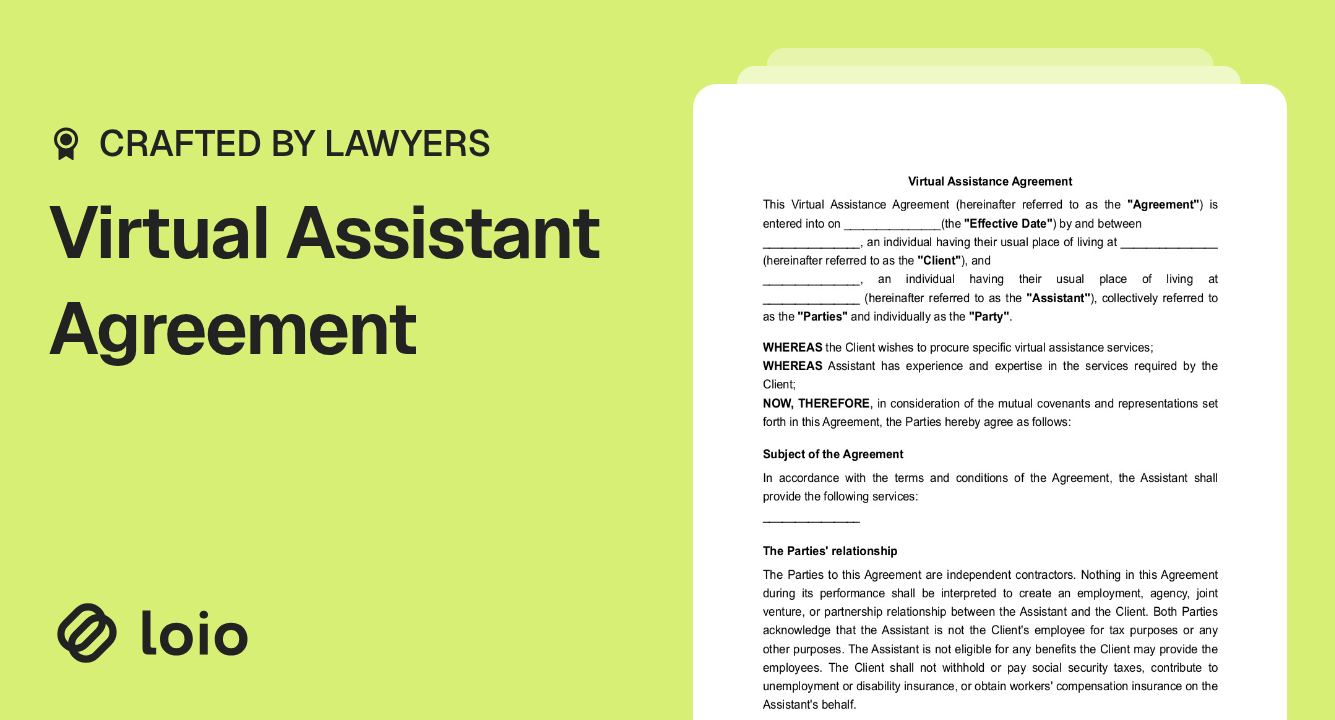
Virtual Assistant Contract Template

4.6 (58 reviews)
All states | 18 types
Updated May 4, 2024
~ 7 pages
PDF
4K downloads
A Virtual Assistant Independent Contractor Agreement is a contract between a business and a remote assistant specifying duties, hourly rate, and confidentiality rules. It is used to formalize remote work arrangements and protect business information.
Virtual Assistance Agreement

This Virtual Assistance Agreement (hereinafter referred to as the "Agreement") is entered into on  (the "Effective Date") by and between 

 , an individual having their usual place of living at   (hereinafter referred to as the "Client"), and 

 , an individual having their usual place of living at   (hereinafter referred to as the "Assistant"), collectively referred to as the "Parties" and individually as the "Party".


WHEREAS the Client wishes to procure specific virtual assistance services;

WHEREAS Assistant has experience and expertise in the services required by the Client;

NOW, THEREFORE, in consideration of the mutual covenants and representations set forth in this Agreement, the Parties hereby agree as follows:

Subject of the Agreement 

In accordance with the terms and conditions of the Agreement, the Assistant shall provide the following services:


The Parties' relationship

The Parties to this Agreement are independent contractors. Nothing in this Agreement during its performance shall be interpreted to create an employment, agency, joint venture, or partnership relationship between the Assistant and the Client. Both Parties acknowledge that the Assistant is not the Client's employee for tax purposes or any other purposes. The Assistant is not eligible for any benefits the Client may provide the employees. The Client shall not withhold or pay social security taxes, contribute to unemployment or disability insurance, or obtain workers' compensation insurance on the Assistant's behalf.

Materials and information

The services shall be performed virtually via email, phone, or other digital platforms.

All materials required for the service delivery, except supplies, tools, and equipment owned by the Assistant, shall be the Client's property. 

The Client shall provide all content, outlines, photos, and product images required for particular projects. The source material must be clear and legible. The Client is responsible for providing accurate, truthful, and complete information for the Assistant to perform the services. The Client confirms that the necessary permissions to use the provided materials have been obtained.

Warranties and representations

Either Party represents and warrants to the other Party that:

  • The Parties have the full right, power, and authority to enter into this Agreement, grant rights, and perform the obligations;
  • This Agreement shall be a legally valid and binding obligation for the Party involved and can be enforced according to its terms.

Additionally, the Assistant guarantees the ability, experience, and resources to fulfill the responsibilities outlined in this Agreement. The Assistant commits to professionally performing all services, adhering to business customs, and complying with laws and regulations applicable to this Agreement. 

Exclusivity

The Assistant may participate in other business, company, or activities without requiring additional consent from the Client, as long as these activities do not create a conflict of interest with the Client. 

Availability of the Assistant

The Assistant shall be available for the performance of the services under this Agreement according to the following schedule:

 .

All correspondence received outside regular business hours shall be responded to the next business day. 

The Assistant shall be unavailable on all public holidays. 

If an emergency or unpredictable circumstances arise, the Assistant should notify the Client as soon as possible.

Fees and expenses, payment terms 

The Client shall pay the Assistant an hourly fee of   for the services provided under this Agreement. All overtime hours should be mutually agreed upon in writing by the Parties and shall be compensated at a   hourly rate.

The payments shall be made weekly for the services performed during the previous period.

The Assistant shall submit an invoice for the services performed during the previous period. 

The Client shall pay the Assistant by cash.

Taxes

The Assistant is solely responsible for filing all tax returns and submitting all payments to federal, state, or local tax authorities and agrees to do so in a timely manner.

Deliverables and milestones

The Assistant shall provide the following deliverables upon completion of the services:  .

The Parties agree that the services shall be rendered by milestones:  .

Term and termination

This Agreement shall start on the Effective Date and shall remain in effect until  

Either Party may terminate this Agreement for any reason within   days by providing written notice to the other Party. 

If either Party commits a significant breach of this Agreement, the other Party may immediately terminate this Agreement by delivering written notice to the breaching Party. 

Intellectual property rights

The Client shall remain the sole and exclusive owner of the intellectual property rights, including all ideas, inventions, improvements, processes, works of authorship, and other forms of intellectual property such as data, software codes, tools, and interfaces, as well as any intellectual property rights of any kind therein (the "Work Product") developed by the Assistant during the Agreement term. The Assistant irrevocably assigns to the Client all rights, titles, and interests related to the Work Product and all associated intellectual property rights.

Confidentiality clause

"Confidential information" is any information that is disclosed by one Party (hereinafter the "Discloser") to the other (hereinafter the "Recipient") in connection with the Agreement, which is conveyed in written, graphic, machine-readable, or other tangible form and marked "confidential," "proprietary," or in some other way to indicate its confidential nature. Without limitation, this confidential information shall include trade secrets, inventions, techniques, processes, algorithms, software programs, schematics, designs, contacts, customer lists, financial information, sales and marketing plans, and business information. 

The Recipient agrees that during the term of this Agreement and   thereafter, the Recipient shall not disclose, use, or disseminate any confidential information received from the Discloser to any person, corporation, association, or other entity for any purpose not expressly permitted or required under this Agreement and without obtaining the Discloser's prior written consent on a case-by-case basis.

Force majeure 

"Force majeure" means an earthquake, flood, storm, other acts of God, war, emergency, accident, industrial strike, acts of Government, or other impediment that the affected Party proves was beyond the Party's control and that it could not reasonably be expected to have taken into account at the time of the conclusion of this Agreement or to have avoided or overcome it or its consequences. 

The Party impacted by force majeure shall not be deemed in violation of this Agreement or held accountable to the other Party for any delays or failures to fulfill obligations under this Agreement, provided that the delay or failure results from force majeure events of which the Party has notified the other Party. The time for the performance of that obligation shall be extended accordingly. In the case of force majeure, the affected Party shall immediately notify the other Party about the nature and extent of the circumstances and their effect on the Party's ability to perform.

Liability and indemnification 

Each Party agrees to indemnify and hold harmless the other Party against any damage, liability, and loss, as well as legal fees and costs incurred that may relate to this Agreement. This clause shall not be interpreted to provide indemnification for any Party if a competent court of law, rendering a final judgment, finds that the Party's bad faith, gross negligence, or willful misconduct caused the damage, liability, or loss.

Governing law and dispute settlement

This Agreement shall be governed by and construed under the laws of the State of  , except for its conflict of laws principles. 

The Parties agree on exclusive jurisdiction in the court of the State of  .

Miscellaneous

Severability. If and to the extent that any provision of this Agreement is held illegal, invalid, or unenforceable in whole or in part under applicable law, such provision or that portion thereof shall be ineffective as to the jurisdiction in which it is illegal, invalid, or unenforceable to the extent of its illegality, invalidity, or unenforceability. The illegality, invalidity, or unenforceability of such a provision in that jurisdiction shall not affect the legality, validity, or enforceability of this Agreement in any other jurisdiction. 

Entire Agreement. This Agreement is the complete understanding between the Parties with respect to the subject matter hereof, superseding any prior agreements and communications, both written and oral, regarding such subject matter. 

Amendments. This Agreement may only be modified, or any rights under it waived, by a written document executed by both Parties. 

Binding effect. This Agreement shall be binding for the Parties and their respective permitted successors and assigns. 

IN WITNESS WHEREOF, the Parties have signed this Agreement.

Details and signatures of the Parties


The Client

Name:  

Address:  


Banking Details

Bank name:  

Account number:  

Signature: ______________________


The Assistant

Name:  

Address:  


Banking Details

Bank name:  

Account number:  

Signature: ______________________

Written by Megan Thompson - Reviewed by Kate Adkham

Template Description

Copy section link
Paper titled "Virtual Assistant Agreement", woman in headphones talking out of a laptop to a man

A virtual assistant agreement enables the parties (client and virtual assistant) to define expectations for increased accountability and legal protection. Ideally, hiring virtual assistants (VAs) facilitates improved productivity without incurring the high costs associated with in-house employees. As the U.S. Small Business Administration writes, VAs enable you to put processes in place and complete tedious daily tasks so you can focus on your main duties.

Virtual assistants also benefit from working remotely due to the increased flexibility and convenience. They can work from anywhere they want, have a more flexible schedule, and set their rates, among other perks. However, an effective client-virtual assistant relationship requires an agreement to spell out the terms and ensure they agree. If you are an employer seeking to hire a virtual assistant or a freelancer contracting your services, continue reading for more information on virtual assistant agreements, why you need them, and how to create one.

A virtual assistant agreement template provides clients (hiring parties) and virtual assistants (contractors) with a quick means of creating a contract to clarify their expectations and institute the necessary legal protections. You can download this virtual assistant contract template free, available in PDF and Word formats. The virtual assistant agreement template covers the scope of work, description of services, fees and expenses, deliverables and milestones, confidentiality, and several other essential terms of service.

What Is a Virtual Assistant Agreement?

Copy section link

A virtual assistant agreement is a document that defines the contractual relationship between a client (hiring party) and a virtual assistant (contractor). It’s usually signed at the beginning of the engagement and helps set out the expectations of each party. 

For instance, using our sample virtual assistant contract, you can provide a detailed description of the services and capture the essential terms needed to clarify expectations. This helps minimize disputes that would strain your relationship and derail productivity.

Parties of the Virtual Assistant Agreement

A virtual assistant contract exists between the client contracting the services and the service provider, who, in this case, is a virtual assistant. Any parties can initiate the virtual assistant agreement, but they must all agree to the terms by appending their signatures before commencing the relationship.

  • Client – In a virtual assistant agreement, the client refers to the hiring party. They could be in any industry, including law firms, real estate, eCommerce, marketing agencies, solopreneurs, healthcare, and small business owners. Anyone seeking specialized skills, help with time-consuming tasks or wants to scale gradually without hiring full-time employees can benefit immensely by contracting a virtual assistant.

  • Virtual Assistant – Mostly, a virtual assistant is an independent contractor. They offer administrative services to firms and businesses remotely. Their services can vary depending on the nature of the client's business and their skills. For instance, Loio's virtual assistant contract template highlights common administrative tasks a law firm would seek help for, such as document production, exhibits, e-filing, and client deposition preparation. Other general tasks in a virtual assistant contract example may include managing schedules, customer service, organizing files, making travel arrangements, and managing social media and email accounts.

Key Terms

General terminologies you might come across in a virtual assistant agreement may include:

  • Agreement – A legally binding arrangement reached by more than one party;
  • Confidential information – Sensitive information shared between a few people and whose disclosure to unauthorized third parties can damage the owner;
  • Deliverable – A quantifiable output expected to be delivered as part of the process;
  • Independent contractor – A self-employed individual (in this case, virtual assistant) hired to perform services for another person or organization;
  • Scope creep – Assigning more tasks or deliverables outside the initial scope without prior consultation;
  • Services – Tasks the virtual assistant will perform on behalf of the client;
  • Third-party – Any person other than the main parties involved in the agreement; and
  • Virtual assistant contract template – A pre-written contract format containing the basic terms, which users can customize to suit their needs.

Do I Have To Make a Virtual Assistant Contract Myself?

You do not necessarily have to make a virtual assistant agreement yourself. However, if you're conversant with the details you must include, you could draft it. You can create it from scratch or use a sample virtual assistant contract for inspiration. But a legal professional should check the final draft to ensure it covers all the basics needed to protect yourself and complies with the applicable laws. 

Alternatively, you can use Loio's virtual assistant contract template, which captures all the basic terms an agreement requires. You only need to make a few edits to customize your virtual assistant agreement form for your services. 

How To Create a Virtual Assistant Contract Template

Copy section link

A virtual assistant contract template can be of any length, depending on the nature of services and specific task requirements. However, below are five crucial components every template must capture.

1. Work Description

The virtual assistant contract should clearly outline the services the virtual assistant should perform for the client. This ensures they know their expectations and that the assigned tasks match their skills.

A detailed work description also eliminates the risk of scope creep. Usually, this refers to a situation whereby the client assigns the virtual assistant additional tasks outside the initially agreed scope without consulting. With the roles and expectations agreed on beforehand, it's much easier for the virtual assistant to request compensation for additional tasks.

2. Deliverables

The virtual assistant agreement should outline specific deliverables, as vague expectations can lead to misunderstandings. Each deliverable or task should have clear schedules and deadlines, e.g., 10 hours per week or three projects per week.

3. Non-Disclosure

The virtual assistant contract should include a non-disclosure clause. This requires the virtual assistant to commit not to disclose the client's confidential information to third parties. Usually, items that must be kept private, such as client lists and business processes, are listed.

4. Expected Working Hours

Virtual assistant contracts should also outline the expected working hours. As much as virtual assistants work under more flexible schedules than full-time workers, a client expects them to commit to a certain amount of time per week or month. 

Depending on the services provided, the client might also require the virtual assistant to be available during specific business hours. This should be indicated to ensure they’re available when clients need their services. It also enables them to manage expectations and avoid conflict.

5. Payment

A virtual assistant agreement should indicate the terms of payment, such as:

  • Rate;

  • Payment schedule;

  • Reimbursement for expenses incurred while performing duties;

  • Overtime and bonuses; and

  • Payment method.

As an independent contractor, a virtual assistant does not enjoy the same Fair Labor Standards Act (FLSA) protection as an employee, such as minimum wage and overtime; hence, the contract must capture clear payment terms.

Why Do You Need a Virtual Assistant Agreement?

Copy section link

Virtual assistant contracts define expectations for a smooth working relationship between clients and contractors. Clients have confidence their work will be performed as expected, while virtual assistants are assured of payment for services rendered.

A virtual assistant agreement also provides legal protection in case of a dispute. For instance, termination provisions protect a client should they decide to end the engagement for non-performance. In the same way, if the virtual assistant agreement requires the client to pay penalties for delayed payment, the assistant can take action if they breach the terms.

Other benefits of virtual assistant contracts to individual parties include:

Benefits to Client
  • Create professional boundaries;
  • Protect confidentiality of private information.
Benefits to Virtual Assistant
  • Prevent scope creep;
  • Guarantee payment for services rendered.

Whether you're a client seeking to hire a virtual assistant or a freelancer contracting your services, having a virtual assistant agreement is immensely beneficial. You can create the document conveniently by downloading our free virtual assistant contract in Word format and customizing it to suit your specific services.

Common Use Cases

Agreements are vital legal documents where business relationships are involved. Whether you’re a hiring party or a contractor, a virtual assistant contract is a must-have document in most cases. However, not every engagement requires signing the contract. Here is a highlight of some of the common use cases:

  • Engagement requires sharing sensitive information with the VA that must be kept confidential;
  • Client needs help with high-priority services; hence necessary for the virtual assistant to express their commitment in writing;
  • VA wants an assurance that work will be available and paid for a pre-agreed minimum number of hours per week; and
  • There is a potential risk of scope creep.

When Not To Use the Virtual Assistance Agreement

Similarly, there are instances where a virtual assistant agreement might not be necessary. These include:

  • One-off projects with no sensitive client information shared;
  • The terms of engagement qualify the assistant as an employee and not an independent contractor; and
  • General occasional services such as blogging, conducting research, or making travel arrangements.

In addition to the task deliverables, you will want to add a section to the agreement that explains exactly when or how often you expect your virtual assistant to work for you. In this section, you may want to clarify that they are responsible for managing the entire office and therefore must work five days per week, eight hours per day from 9 a.m. until 5 p.m. on Eastern Standard Time. Or, if it is a remote or part-time position, the agreement might instead stipulate that they have to work 10 hours per week, but there are no set days of the week during which time those 10 hours must be accumulated.