Free template
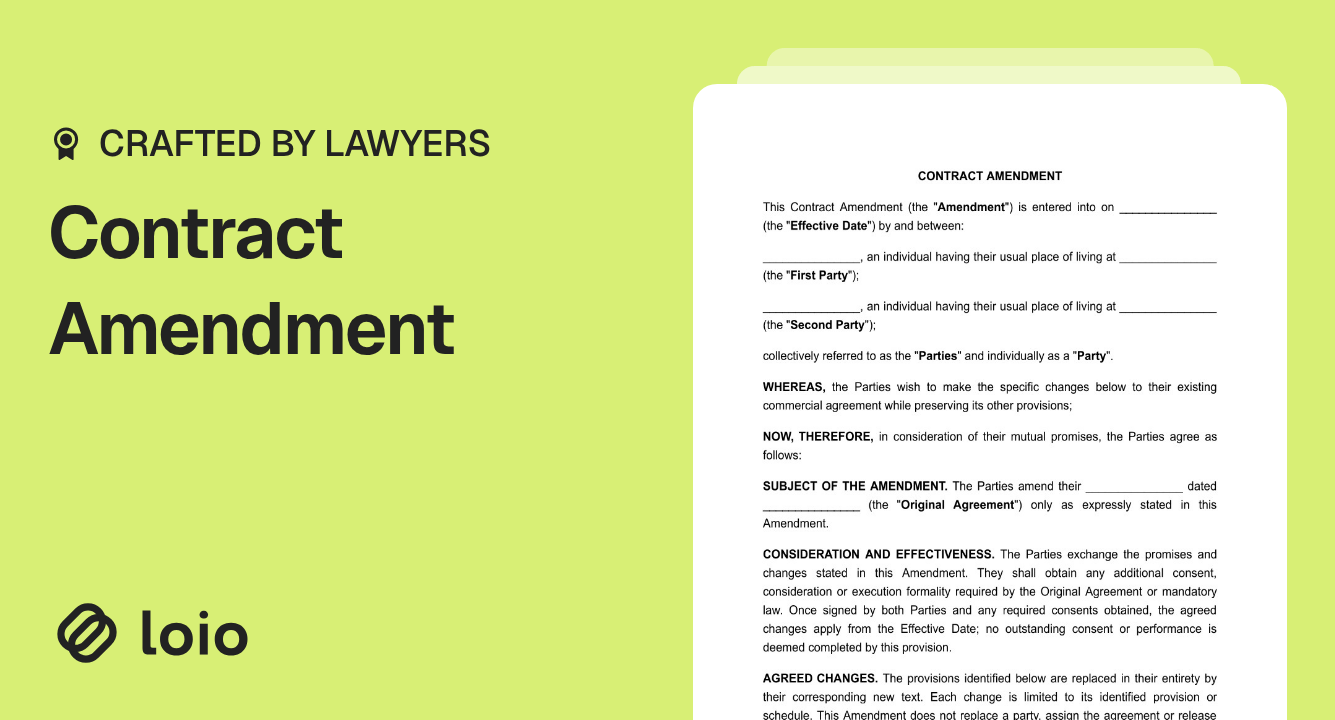
Free Contract Amendment Template
Your client wants 45 days to pay invoices instead of 30. You've agreed — but does the change affect late fees? What about invoices already overdue?
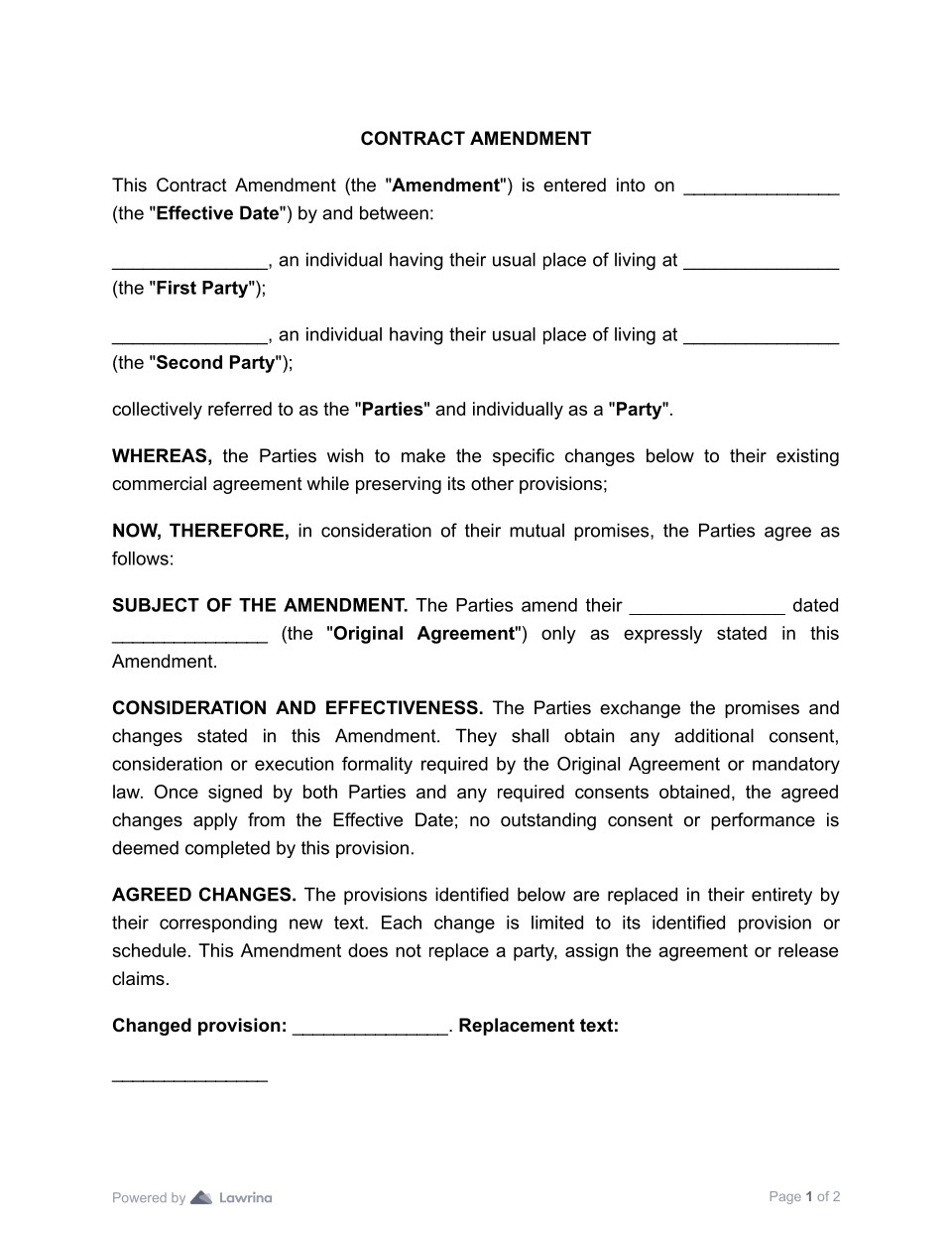
A contract amendment template lets you update specific provisions of a signed Original Agreement without renegotiating everything else. Identify each provision, write its complete replacement text, and get both parties to agree on one version.
What Is a Contract Amendment?
Copy section linkA contract amendment is a written agreement that changes identified provisions of an existing agreement while leaving the rest in force. The process is called amending or modifying a contract; the document is an amendment or contract modification.
An amendment typically revises existing wording, while an addendum generally adds new material. The labels can overlap: what matters is specifying exactly which terms change.
When does this template fit?
Use this amendment to contract template when the same two parties want to revise a price, deadline, service obligation, notice address, or contract term. It also works for extending the relationship; if the end date is the only change, a Contract Extension Agreement may be simpler.
If a guarantor, lender, or landlord must consent, obtain that approval separately. An amendment intended for public recording may also require acknowledgment, notarization, or recording formalities.
Choose another solution if you're replacing a party (novation), transferring contract rights (an Assignment Agreement), or settling existing claims (a settlement and release). When most provisions need rewriting, an amended and restated agreement combines the remaining terms and changes in one complete document rather than piling up patches.
What to Check Before Amending an Agreement
Copy section linkRead the Original Agreement's amendment clause
Don't start from an old Word draft. Gather the signed Original Agreement and every earlier amendment, then check:
Form: Must changes be written, signed, witnessed, or notarized?
Authority: Who can sign for each party?
Process: Is advance notice, board approval, or another consent required?
Existing wording: Has an earlier amendment already changed the provision you're replacing?
The form's Consideration and Effectiveness clause requires any extra consent or execution formality imposed by the Original Agreement or mandatory law. Its Entire Amendment and Further Changes clause sends future modifications through those requirements again. For startups, an investor or financing agreement may require approval from specified directors or holders, not just a founder's signature.
We already agreed by email. Isn't that enough?
Not necessarily. Whether emails or conduct establish a binding modification depends on the Original Agreement and applicable law.
New York General Obligations Law § 15-301 generally restricts unperformed oral changes where a signed-writing clause applies, subject to recognized exceptions. California Civil Code § 1698 recognizes certain oral changes carried out by the parties and leaves room for waiver or estoppel.
A signed amendment gives both sides a clear record of the final wording instead of asking them to reconstruct it from emails and invoices. If negotiations involve sensitive pricing or customer data, consider a Mutual Non-Disclosure Agreement before sharing it.
Who else might need to approve the change?
In Arlona Ltd. Partnership v. 8th of January Corp., a New York court applied that rule to a lease modification increasing rent, while leaving the guarantor's actual consent unresolved.
First, check whether the guaranty already authorizes future changes. Also review lender, landlord, or insurance consent provisions. The template has signature blocks for the First Party and Second Party, but no separate guarantor-consent block. Obtain additional written approvals separately.
What if only one side benefits?
The change can still be enforceable, but it depends on the law and circumstances. Under traditional contract principles, a one-sided promise may raise a consideration problem. Consideration is something of legal value exchanged.
New York General Obligations Law § 5-1103 allows certain written, signed modifications without new consideration. For sales of goods, UCC § 2-209 generally removes the consideration requirement, though other rules still apply.
Where consideration is required, state what the other party receives — perhaps a longer commitment, guaranteed volume, or added service — in the relevant Replacement text. Don't assume signatures alone solve every enforceability issue.
How to Fill Out a Contract Amendment Template
Copy section linkThe interview identifies the parties, the Original Agreement, and up to ten changes, each with a Changed provision and Replacement text field.
Step 1. Choose the Effective Date
Enter the Effective Date, ideally the day both parties sign. It appears in the opening line and beneath both signature blocks. Once both parties sign and required consents are obtained, the changes apply from that date, not earlier.
Ideally, sign on the same day. If the parties sign on different days, use the date of the last signature as the Effective Date and retain an accurate record of when each person signed. The template has no separate signing-date fields. Don't backdate signatures: an inaccurate date could mislead an auditor, lender, or court.
Step 2. Identify the First Party and Second Party
Enter each individual's legal name and address, or each company's legal name, jurisdiction of incorporation, business address, and authorized representative. Use the same contracting parties as in the Original Agreement; this form doesn't replace either party.
Step 3. Identify the Original Agreement and earlier amendments
When using an amendment to agreement template, start with the Original Agreement's exact title and date, then list any earlier amendments in the interview.
For example, if Amendment No. 1 already revised Section 4 (Payment), make sure you're working from that updated version. Your replacement text must reflect the current wording, not a superseded version.
Step 4. Identify each changed provision
In the amendment agreement template, give the section number and heading or the schedule name for each change, such as Section 4 (Payment) or Schedule A (Fees). The interview permits up to ten specified replacements.
Step 5. Write the complete replacement clause
Suppose the Original Agreement currently says:
Section 4 (Payment). Client shall pay invoices within 30 days of receipt. Late invoices are subject to the late-payment terms in Schedule B. Invoices must be sent to accounts@example.com.
The parties agree on Net 45. Enter the following complete Replacement text:
Section 4 (Payment). Client shall pay invoices within 45 days of receipt. Late invoices are subject to the late-payment terms in Schedule B. Invoices must be sent to accounts@example.com.
Entering only “Payment is due within 45 days” would also remove its reference to late-payment rules and invoicing address. Copy the current provision first, then change only what the parties intend.
To delete an entire provision without renumbering, you can use “[Reserved]” or “Intentionally omitted” as replacement text where appropriate.
Step 6. Check connected terms and schedules
Does a new price conflict with an unchanged rate sheet? Does moving a delivery date affect an acceptance milestone? Review definitions, cross-references, exhibits, and related notices before signing.
For substantial changes to services, an updated Statement of Work can explain deliverables and timelines alongside the amendment.
Step 7. Obtain signatures and required consents
Both contracting parties must sign under this template's terms. For a business, an authorized representative signs on its behalf. Any required guarantor or third-party consent must also be obtained, even though that person has no signature block in the form.
The Counterparts and Execution clause allows separate signed copies and electronic exchange where permitted by law and the Original Agreement. Check whether a special execution form, acknowledgment, or other requirement still applies.
What Happens After Signing?
Copy section linkAn amendment changes only the provisions the parties expressly identify. The Limited Precedence and Continuing Effect clause gives the amendment priority only where its changes expressly conflict with the Original Agreement. Otherwise, governing law, confidentiality, dispute resolution, liability, and notice provisions remain in force.
Already-accrued payments, claims, breaches, obligations, and remedies aren't automatically waived. For example, a new Net 45 clause doesn't erase invoices already overdue; documenting a credit for earlier periods requires an express, appropriate arrangement.
If you agree to an amendment to contract payment terms, update your invoicing process when it takes effect. Tell the relevant teams, update schedules and reminders, and keep the signed amendment with the Original Agreement. For supply purchases, a revised Purchase Order may be useful; in construction, a Change Order may document project-specific revisions.
Keep the contract history together: the Original Agreement, numbered amendments, and relevant approvals. Another change must follow the Original Agreement's amendment rules again.
Create and Sign Your Amendment With Loio
Copy section linkEmailing Word attachments back and forth makes it easy to sign the wrong version and difficult to find the amendment that changed your price a year later.
With Loio, complete the contract amendment template and invite the other party into a shared document to suggest edits. Their proposed wording appears as redlines or suggestions in the same draft, so you can check whether a late fee, address, or liability cap was accidentally removed before accepting the final text.
Once the wording is settled, sign and use Request eSignatures to send it to the other party. You can set signing order, track status, and send reminders. First, check that the Original Agreement and applicable law permit electronic signing.
The completed amendment remains accessible through Signatures in Loio, with a time-stamped audit trail. Keep the Original Agreement in your workspace too, so you can retrieve the documents together when needed.
Why You Should Trust This Template
Copy section linkA poorly drafted amendment can create more problems than it solves: accidentally removing important terms, overlooking required approvals, or leaving both parties uncertain about what still applies.
This template is designed to reduce those risks. It requires precise identification of each changed provision and its complete replacement text. Its built-in clauses also preserve unchanged terms and previously accrued obligations, helping protect what the parties have already agreed upon.
The accompanying guidance addresses practical legal concerns, including signing authority, guarantor consent, and enforceability, with references to US statutes and court decisions. Loio's Editorial Policy also explains how its legal templates are drafted and reviewed by legal professionals.
Disclaimer: This template is a general starting point for US commercial agreements, not a guarantee of compliance with every state's laws. Check the Original Agreement and applicable legal requirements, and consult an attorney for complex or high-value changes.
Related Documents
Also Read